PUBLISHER: Mordor Intelligence | PRODUCT CODE: 2097366

PUBLISHER: Mordor Intelligence | PRODUCT CODE: 2097366
United Kingdom Student Accommodation - Market Share Analysis, Industry Trends & Statistics, Growth Forecasts (2026 - 2031)
According to Mordor Intelligence, the United Kingdom student accommodation market size is expected to grow from USD 0.56 billion in 2025 to USD 0.63 billion in 2026 and is forecast to reach USD 1.10 billion by 2031 at 11.79% CAGR over 2026-2031.
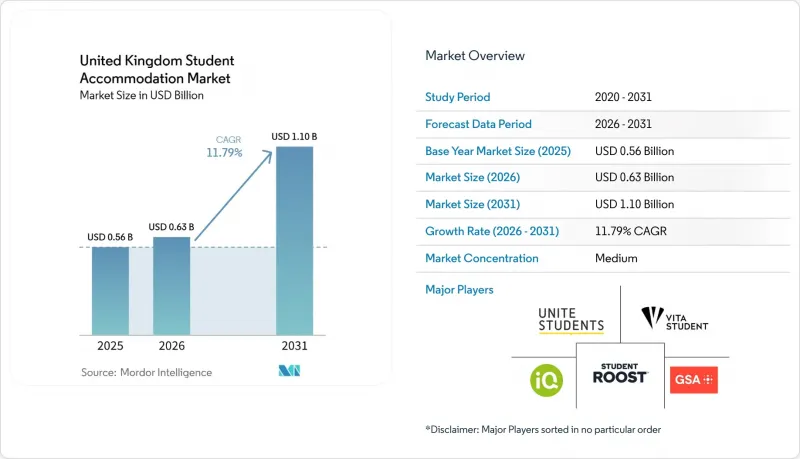
This report is Segmented by Room Type (Entire Place / Studio, Private Room, and Shared Room), Type of Institution (K-12, Higher Education, and Others), Type of Accommodation (On-Campus / University-Owned Accommodation and More), Student (Domestic and International), and Geography (England, Scotland, Wales, and Northern Ireland). The Market Forecasts are Provided in Terms of Value (USD).
United Kingdom Student Accommodation Market Trends and Insights
Structural Shortage of Quality Beds in Prime University Cities
The United Kingdom student accommodation market continues to be shaped by a supply base that has not kept pace with student demand in prime university cities. This matters because constrained delivery keeps occupancy firm at existing schemes and supports rental resilience even when demand softens in isolated local markets. The shortage is not uniform, and it is more pronounced in cities that attract large student populations, have stronger graduate retention, and face international demand. It also favors established operators with assets already in place, because they can capture demand without carrying the same development timing risk as new entrants. As a result, the United Kingdom student accommodation market still offers its clearest long-run opportunity in well-located stock where supply remains hard to replace.
Strong Demand from International and Postgraduate Students
International and postgraduate demand remains one of the clearest growth supports for the United Kingdom student accommodation market. International students accounted for 25% of total higher education enrolments in the United Kingdom in 2023/24 and 71% of all full-time postgraduate study in the same year. HESA (Higher Education Statistics Agency) recorded 685,565 international students at United Kingdom universities in 2024/25, even after a 6.1% year-on-year decline, with the decline concentrated among postgraduate taught entrants. Demand quality is still strong because international students tend to favor private rooms or studios, longer leases, and more predictable booking arrangements, which lifts revenue per bed for operators. The United Kingdom student accommodation market, therefore, remains closely linked to the resilience of global student mobility demand, even when visa policy creates short-term noise.
Policy Risk Around International Student Flows
Policy uncertainty surrounding international student flows remains a significant restraint on the United Kingdom student accommodation market, as overseas students contribute substantially to occupancy levels, premium room demand, and longer tenancy durations across many major university cities. United Kingdom-sponsored study visa grants totaled 410,000 in the year ending March 2026, down 3% from the previous year and 37% below the 2023 peak, indicating that tighter immigration policies are already affecting the student intake pipeline. The impact intensified from April 2026, when the main student visa fee increased to GBP 558 (USD 720) and the Graduate visa fee rose to GBP 937 (USD 1,209), while the Graduate Route is scheduled to shorten to 18 months from 2027. These policy changes are expected to weigh most heavily on cities with large postgraduate student populations, as recent declines in international enrolments have been concentrated among postgraduate taught students rather than across the broader student base. However, the impact is expected to remain uneven. Undergraduate acceptances increased by 2.8% in the 2025/26 cycle, while non-European Union Universities and Colleges Admissions Service (UCAS) acceptances rose by 6.9% in 2025, indicating that core undergraduate demand remains relatively resilient. Consequently, the restraint is more likely to moderate leasing activity in premium postgraduate-focused markets than to materially weaken the broader demand outlook for the United Kingdom student accommodation market.
Other drivers and restraints analyzed in the detailed report include:
- Rising Preference for Purpose-Built Student Accommodation
- University Nomination Agreements Supporting Occupancy Visibility
- Planning Delays in Core University Markets
For complete list of drivers and restraints, kindly check the Table Of Contents.
Segment Analysis
Entire place/studio formats held a 52% share of the United Kingdom student accommodation market in 2025, making them the leading room type. Their position reflects a clear shift in student preference toward privacy, independent living, and a housing format that fits both study and year-round use. This pattern is strongest among international students and postgraduate cohorts, who often value self-contained space and are more willing to pay for it. The British Council's guidance for international students also points toward longer-stay arrangements and room types that reduce disruption across academic breaks.
The United Kingdom student accommodation market size for studio / entire-place formats is projected to expand at a 13.2% CAGR through 2031, keeping this room type ahead in growth and share. Operators are responding by shifting refurbishments and product design toward studio-heavy layouts that better meet postgraduate and returner demand. This is evident in Empiric Student Property's earlier focus on postgraduate studio conversions before its acquisition, which demonstrated that its product strategy had already moved toward premium, self-contained formats. Private rooms still play an important role for students who want a lower price point with shared social space, while shared rooms continue to lose relevance as expectations rise. The United Kingdom student accommodation industry is therefore becoming more selective in room design, with operators placing more value on formats that support longer stays, higher net operating income, and better demand visibility.
Higher education held an 88% share of the United Kingdom student accommodation market in 2025 and is forecast to expand at a 12.4% CAGR from 2026 to 2031, making it the core demand engine of the market. This reflects the scale and standing of the country's university system, which continues to draw domestic students as well as internationally mobile cohorts. It also reflects the fact that university cities remain the main centers where private operators can build scale, form partnerships, and sustain occupancy over multiple leasing cycles. The United Kingdom student accommodation market remains closely tied to the health of colleges and universities, as they drive both the largest enrollment base and the strongest bed demand.
Higher education also carries stronger institutional credibility than smaller education formats when operators structure nomination agreements or joint ventures with campus partners. International students accounted for 25% of total higher education enrolments in the United Kingdom in 2023/24, reinforcing the sector's importance to accommodation demand. K-12 boarding demand remains smaller and more specialized, while further education, language schools, and other institutions stay on the edge of large-scale purpose-built activity. As universities seek to preserve capacity without bearing all development risk, private partners with strong operating records are likely to remain in a favorable position. The United Kingdom student accommodation industry is therefore most firmly anchored in higher education, where demand depth and potential for institutional partnerships are both strongest.
Complete Report Scope:
- By Room Type
- Entire Place / Studio
- Private Room
- Shared Room
- By Type of Institution
- K-12 (School Education)
- Higher Education (Colleges & Universities)
- Others
- By Type of Accommodation
- On-Campus / University-Owned Accommodation
- Off-Campus / Purpose-Built Student Accommodation (PBSA)
- By Student
- Domestic
- International
- By Geography
- England
- Scotland
- Wales
- Northern Ireland
List of Companies Covered in this Report:
- Unite Students
- iQ Student Accommodation
- Student Roost
- Vita Student
- Global Student Accommodation (GSA)
- Scape UK
- Campus Living Villages UK
- Empiric Student Property
- Collegiate AC
- CRM Students
- Downing Students
- Fresh Student Living
- Host Student Housing
- A2Dominion Student
- Nido Student
- Prime Student Living
- Derwent Students
- Urbanest
- Dwell Student Living
- Mansion Student
Additional Benefits:
- The market estimate (ME) sheet in Excel format
- 3 months of analyst support
TABLE OF CONTENTS
1 Introduction
- 1.1 Study Assumptions & Market Definition
- 1.2 Scope of the Study
2 Research Methodology
3 Executive Summary
4 Market Landscape
- 4.1 Market Overview
- 4.2 Market Drivers
- 4.2.1 Structural Shortage of Quality Beds in Prime University Cities
- 4.2.2 Strong Demand from International and Postgraduate Students
- 4.2.3 Rising Preference for Purpose-Built Student Accommodation
- 4.2.4 University Nomination Agreements Supporting Occupancy Visibility
- 4.2.5 Flight to Quality and Amenity-Rich Living Expectations
- 4.2.6 Institutional Capital Rotation Into Operational PBSA Assets
- 4.3 Market Restraints
- 4.3.1 Policy Risk Around International Student Flows
- 4.3.2 Planning Delays in Core University Markets
- 4.3.3 Higher Build Costs and Debt Servicing Pressure
- 4.3.4 Community Pushback Against Dense PBSA Schemes
- 4.4 Value / Supply-Chain Analysis
- 4.5 Regulatory Landscape
- 4.6 Technological Outlook
- 4.7 Porter's Five Forces
- 4.7.1 Bargaining Power of Suppliers
- 4.7.2 Bargaining Power of Consumers
- 4.7.3 Threat of New Entrants
- 4.7.4 Threat of Substitutes
- 4.7.5 Intensity of Competitive Rivalry
5 Market Size & Growth Forecasts (Value, USD)
- 5.1 By Room Type
- 5.1.1 Entire Place / Studio
- 5.1.2 Private Room
- 5.1.3 Shared Room
- 5.2 By Type of Institution
- 5.2.1 K-12 (School Education)
- 5.2.2 Higher Education (Colleges & Universities)
- 5.2.3 Others
- 5.3 By Type of Accommodation
- 5.3.1 On-Campus / University-Owned Accommodation
- 5.3.2 Off-Campus / Purpose-Built Student Accommodation (PBSA)
- 5.4 By Student
- 5.4.1 Domestic
- 5.4.2 International
- 5.5 By Geography
- 5.5.1 England
- 5.5.2 Scotland
- 5.5.3 Wales
- 5.5.4 Northern Ireland
6 Competitive Landscape
- 6.1 Market Concentration
- 6.2 Strategic Moves
- 6.3 Market Share Analysis
- 6.4 Company Profiles (Includes Global Level Overview, Market Level Overview, Core Segments, Financials as Available, Strategic Information, Products & Services, and Recent Developments)
- 6.4.1 Unite Students
- 6.4.2 iQ Student Accommodation
- 6.4.3 Student Roost
- 6.4.4 Vita Student
- 6.4.5 Global Student Accommodation (GSA)
- 6.4.6 Scape UK
- 6.4.7 Campus Living Villages UK
- 6.4.8 Empiric Student Property
- 6.4.9 Collegiate AC
- 6.4.10 CRM Students
- 6.4.11 Downing Students
- 6.4.12 Fresh Student Living
- 6.4.13 Host Student Housing
- 6.4.14 A2Dominion Student
- 6.4.15 Nido Student
- 6.4.16 Prime Student Living
- 6.4.17 Derwent Students
- 6.4.18 Urbanest
- 6.4.19 Dwell Student Living
- 6.4.20 Mansion Student
7 Market Opportunities & Future Outlook
- 7.1 White-Space & Unmet-Need Assessment

