PUBLISHER: Mordor Intelligence | PRODUCT CODE: 2125712

PUBLISHER: Mordor Intelligence | PRODUCT CODE: 2125712
US Student Accommodation - Market Share Analysis, Industry Trends & Statistics, Growth Forecasts (2026 - 2031)
According to Mordor Intelligence, the US student accommodation market size is expected to grow from USD 22.80 billion in 2025 to USD 24.56 billion in 2026 and is forecast to reach USD 35.65 billion by 2031 at 7.74% CAGR over 2026-2031.
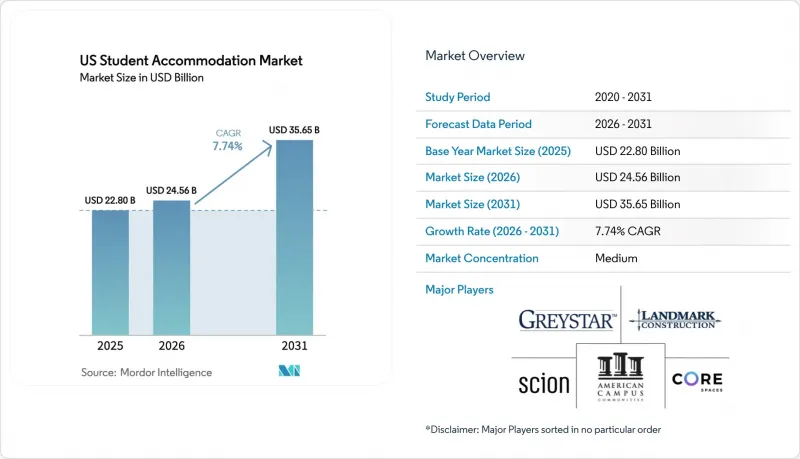
This report is Segmented by Room Type (Entire Place/Studio, Private Room, Shared Room), by Student (Domestic, International), by Institution Type (Universities, Others), and by Geography (Texas, California, Florida, New York, Illinois, Rest of US). The Market Forecasts are Provided in Terms of Value (USD).
US Student Accommodation Market Trends and Insights
Surge in International Student Numbers
The international student market in the United States continues to show robust growth, driven by increasing enrollments and evolving student preferences. In 2023, international student headcounts surpassed 1.057 million, with analysts projecting Indian enrollments to exceed 500,000 by 2030. While California and New York account for a quarter of all foreign students, states like Texas, Illinois, and Florida are witnessing the most significant growth. In response, service providers are introducing gender-inclusive rooms, culturally tailored amenities, and flexible lease terms that sync with visa cycles. Notably, 73% of US campuses now offer gender-inclusive housing, and 83% allow emotional support animals. This steady demand, particularly from STEM-focused institutions, ensures stable revenue streams and boosts occupancy in secondary markets with strong academic reputations.
Rising Institutional and Private Capital Inflows
The US student housing market is witnessing significant investment activity, driven by strong yields and evolving market dynamics. In early 2024, KKR invested USD 1.64 billion to acquire a portfolio from Blackstone, while Greystar committed USD 600 million to three mixed-use campus projects. Global investors, such as CapitaLand Ascott Trust, are attracted by cash yields often exceeding 7% EBITDA. CapitaLand Ascott Trust reported a 99% pre-leasing rate at Standard at Columbia, as noted by hospitalitynet.org. Walker & Dunlop projects USD 8-10 billion in refinancings by 2025, creating opportunities for new entrants to scale. Liquidity is compressing cap rates and encouraging portfolio aggregation, pushing the market closer to institutional standards. These trends underscore the growing maturity and appeal of the US student housing sector.
Affordability Crisis & Persistent Supply Gap
The US student housing market is grappling with significant challenges in 2024. Over 40% of four-year students reported housing insecurity, as supply trails new enrollments by tens of thousands of beds. High land prices in coastal metros impede affordable development, forcing students to opt for distant or substandard housing options. Universities are revising zoning codes to allow taller buildings, but entitlement cycle delays slow progress. This shortfall has driven an 11.40% CAGR in shared rooms, with price-sensitive students prioritizing affordability over privacy. Without accelerated construction, rent increases are expected to outpace inflation, further straining the market.
Other drivers and restraints analyzed in the detailed report include:
- Continued Expansion of Higher-Education Enrollment
- Expansion of Public-Private Partnership Models
- Escalating Construction and Finance Costs
For complete list of drivers and restraints, kindly check the Table Of Contents.
Segment Analysis
Private rooms held 59.12% of revenue within the US student housing market in 2025, underscoring continued willingness among students to pay for privacy and personal study space. Developers enhance this format with bed-bath parity, built-in desks, and smart-lock access, enabling premium rates that cushion operating margins. Shared rooms, though currently smaller, post the fastest 11.18% CAGR to 2031, propelled by affordability concerns among international and first-generation students. Operators leverage technology to refine roommate matching, which trimmed room-change requests by 35% in recent rollouts, making shared layouts more acceptable.
The US student housing market size for shared rooms is projected to expand sharply as universities encourage density to relieve waitlists. Forward-looking owners design convertible units that switch between double and triple occupancy to capture seasonal surges. Entire place/studio products cater to graduate learners and older undergraduates who prize independence; their demand clusters in large urban metros where off-campus apartments compete directly. Notably, NAA surveys indicate that bed-bath parity is now standard in more than 70% of deliveries post-2023, signalling the rising bar for private-room amenities.
Complete Report Scope:
- By Room Type
- Entire Place/Studio
- Private Room
- Shared Room
- By Student
- Domestic
- International
- By Institution type
- Universities
- Others
- By Region
- Texas
- California
- Florida
- New York
- Illinois
- Rest of US
List of Companies Covered in this Report:
- American Campus Communities
- Greystar Student Housing
- The Scion Group
- Landmark Properties
- Core Spaces
- Aspen Heights Partners
- Campus Advantage
- Harrison Street Real Estate
- Blackstone (BREIT Student Housing)
- Asset Living
- PeakMade Real Estate
- Balfour Beatty Campus Solutions
- Capstone Development Partners
- CA Ventures
- GMH Communities
- EdR (Greystar subsidiary)
- University Student Living (Michaels Org.)
- Coastal Ridge (COAST)
- Campus Apartments
- Vie Management
Additional Benefits:
- The market estimate (ME) sheet in Excel format
- 3 months of analyst support
TABLE OF CONTENTS
1 Introduction
- 1.1 Study Assumptions & Market Definition
- 1.2 Scope of the Study
2 Research Methodology
3 Executive Summary
4 Market Landscape
- 4.1 Market Overview
- 4.2 Market Drivers
- 4.2.1 Continued expansion of higher-education enrollment
- 4.2.2 Surge in international student numbers
- 4.2.3 Rising institutional and private capital inflows
- 4.2.4 Expansion of public-private partnership (P3) models
- 4.2.5 State decarbonization mandates spurring green retrofits
- 4.2.6 Growth of short-cycle credential programs needing flexible stays
- 4.3 Market Restraints
- 4.3.1 Affordability crisis & persistent supply gap
- 4.3.2 High cost burden for international students
- 4.3.3 Escalating construction and finance costs
- 4.3.4 Climate-risk-driven insurance premium spikes (Sun Belt)
- 4.4 Value / Supply-Chain Analysis
- 4.5 Regulatory Landscape
- 4.6 Technological Outlook
- 4.7 Impact of Geopolitics & Public-Health Events
- 4.8 Industry Attractiveness - Porter's Five Forces
- 4.8.1 Bargaining Power of Suppliers
- 4.8.2 Bargaining Power of Buyers
- 4.8.3 Threat of New Entrants
- 4.8.4 Threat of Substitutes
- 4.8.5 Intensity of Competitive Rivalry
5 Market Size & Growth Forecasts (Value, In USD Billion)
- 5.1 By Room Type
- 5.1.1 Entire Place/Studio
- 5.1.2 Private Room
- 5.1.3 Shared Room
- 5.2 By Student
- 5.2.1 Domestic
- 5.2.2 International
- 5.3 By Institution type
- 5.3.1 Universities
- 5.3.2 Others
- 5.4 By Region
- 5.4.1 Texas
- 5.4.2 California
- 5.4.3 Florida
- 5.4.4 New York
- 5.4.5 Illinois
- 5.4.6 Rest of US
6 Competitive Landscape
- 6.1 Market Concentration
- 6.2 Strategic Moves
- 6.3 Market Share Analysis
- 6.4 Company Profiles (includes Global level Overview, Market level overview, Core Segments, Financials as available, Strategic Information, Products & Services, Recent Developments)
- 6.4.1 American Campus Communities
- 6.4.2 Greystar Student Housing
- 6.4.3 The Scion Group
- 6.4.4 Landmark Properties
- 6.4.5 Core Spaces
- 6.4.6 Aspen Heights Partners
- 6.4.7 Campus Advantage
- 6.4.8 Harrison Street Real Estate
- 6.4.9 Blackstone (BREIT Student Housing)
- 6.4.10 Asset Living
- 6.4.11 PeakMade Real Estate
- 6.4.12 Balfour Beatty Campus Solutions
- 6.4.13 Capstone Development Partners
- 6.4.14 CA Ventures
- 6.4.15 GMH Communities
- 6.4.16 EdR (Greystar subsidiary)
- 6.4.17 University Student Living (Michaels Org.)
- 6.4.18 Coastal Ridge (COAST)
- 6.4.19 Campus Apartments
- 6.4.20 Vie Management
7 Market Opportunities & Future Outlook
- 7.1 White-Space & Unmet-Need Assessment

