
PUBLISHER: Mordor Intelligence | PRODUCT CODE: 2043926

PUBLISHER: Mordor Intelligence | PRODUCT CODE: 2043926
Clean Beauty - Market Share Analysis, Industry Trends & Statistics, Growth Forecasts (2026 - 2031)
The clean beauty market size was valued at USD 163.35 billion in 2025 and estimated to grow from USD 179.65 billion in 2026 to reach USD 288.99 billion by 2031, at a CAGR of 9.98% during the forecast period (2026-2031).
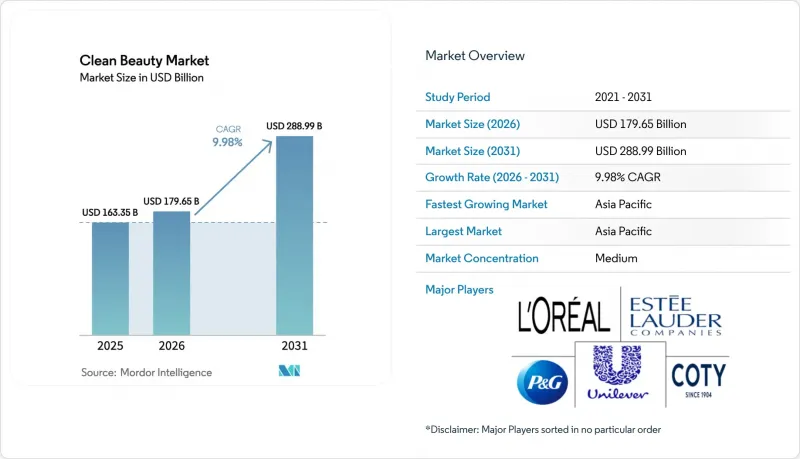
The clean beauty market is transforming, driven by consumer demand for transparency, ingredient safety, and sustainability. Stricter global regulations, like the FDA's MoCRA, favor brands with strong compliance. Asia-Pacific leads growth, with rising demand in India and premiumization in China, while the market's moderate concentration allows room for new players. Skincare dominates, but color cosmetics are growing rapidly due to biotech innovations and social media influence, especially among Gen Z. Digital-first purchasing is reshaping beauty commerce, with platforms like TikTok Shop and Amazon gaining prominence. Despite inflation and rising compliance costs, brands are absorbing expenses to stay accessible, focusing on biotech, ethical sourcing, and consumer trust in clean formulations for long-term clean beauty market growth.
Global Clean Beauty Market Trends and Insights
Health and Safety Concerns
Consumers are increasingly demanding rigorous ingredient safety substantiation, creating a competitive edge for brands with strong clinical validation. The FDA's MoCRA implementation requires cosmetic manufacturers to report serious adverse events within 15 days, favoring companies with established pharmacovigilance systems. With a major portion of consumers viewing toxic chemicals as a major threat, demand for third-party certifications and transparent sourcing is rising. Regulatory pressures and consumer awareness are driving brands to invest in safety infrastructure for sustainable advantages. Post-COVID, consumers are linking topical product safety to overall wellness. State-level regulations, like California and Colorado's PFAS bans, create compliance challenges that benefit larger players with advanced regulatory capabilities.
Environmental Sustainability
Sustainability has shifted from greenwashing concerns to an operational priority, with the EU's Green Claims Directive requiring scientific proof for environmental claims by 2026 . L'Oreal missed its 2025 packaging targets, achieving only 49% recyclable, reusable, or compostable packaging, highlighting the challenges of sustainability transitions. These challenges, however, create opportunities for agile brands delivering genuine outcomes. Unilever's refill solutions and its pledge to cut virgin plastic use by 50% by 2025 show how sustainability drives cost savings and consumer loyalty. The circular economy is advancing through innovations like Evonik's biosurfactants facility in Slovakia, which uses renewable feedstocks for glycolipid surfactants. Rising consumer willingness to pay premiums for sustainable products, reflected in the growing clean beauty market share of sustainability-marketed items, validates the business case for environmental investments.
High Product Costs
Rising costs from premium ingredient sourcing and stricter regulations are increasing entry barriers in the clean beauty market, especially for budget-conscious consumers. The U.S. Bureau of Labor Statistics reported a 0.5% rise in personal care prices in May 2025, reflecting ongoing inflation in this sector . While seemingly minor, these increases affect affordability and buying habits over time. Brands are adopting "upflation" strategies, positioning products as premium to justify higher prices. Supply chain disruptions and elevated raw material costs are pressuring margins, leaving smaller clean beauty brands vulnerable. Although many consumers are willing to pay more for sustainable formulations, persistent cost inflation limits broader market access and adoption.
Other drivers and restraints analyzed in the detailed report include:
- Ingredient Transparency
- Biotech-fermented actives enabling high-performance clean labels
- Lack of harmonised global "clean" definition causing confusion
For complete list of drivers and restraints, kindly check the Table Of Contents.
Segment Analysis
In 2025, skincare commands a dominant 34.02% of the clean beauty market, evolving from basic cleansing to advanced treatments with biotech actives and personalized formulations. This leadership is driven by consumers prioritizing skin health over mere cosmetic enhancement. Major companies, like L'Oreal, report a 16.4% growth in their dermatological beauty divisions in the first half of 2024. While make-up and color cosmetics hold a smaller clean beauty market share, they're set to grow at a 12.19% CAGR through 2031, spurred by social media and hybrid products merging color with skincare benefits. The fragrance segment is seeing a push towards premiumization, and categories like bath, shower, and haircare are embracing clean principles, focusing on wellness, scalp solutions, and sustainable sourcing.
The lines between skincare and color cosmetics are blurring, highlighted by the "skincare as makeup" trend that favors non-toxic, skin-friendly ingredients over mere aesthetics. Innovations in clean beauty are driven by advancements in green chemistry and fermentation, allowing brands to swap synthetic ingredients for bio-based ones without losing effectiveness. Even categories like deodorants and oral care are embracing clean beauty, with new brands emphasizing natural actives and clear labeling. This fragmentation across product types offers niche specialists a chance to excel in specific segments, while larger players anchor their growth in skincare and color cosmetics.
In 2025, mass market products held 61.55% of the clean beauty market, reflecting strong demand for affordable formulations. However, the premium segment, growing at a 11.74% CAGR, highlights consumers' willingness to invest in clean products with proven efficacy and sustainable ingredients. This "premiumization" trend shows consumers trading up for higher-quality formulations, even in mass retail. The line between mass and prestige is blurring as mass brands introduce elevated, cleaner product lines.
Premium segment consumers prioritize ingredient transparency, safety, and brand authenticity over luxury branding, creating opportunities for emerging brands to highlight efficacy and sustainability. The mass segment remains resilient by offering clean alternatives at accessible prices without compromising performance. Private equity investments in brands like Beautycounter and bareMinerals reflect confidence in premium segment growth. The convergence of pricing strategies between mass and premium players signals a shift toward value-based pricing, where consumers focus on formulation quality and ethical sourcing over brand tiering.
The Clean Beauty Market Report is Segmented by Product Type (Skincare, Haircare, Make-Up and Colour Cosmetics, Fragrances, and More), Price Tier (Mass, Premium), End User (Kids, Adults), Distribution Channel (Supermarkets/Hypermarkets, Health and Beauty Stores, and More), and Geography (North America, Europe, Asia-Pacific, South America, Middle East and Africa). The Market Forecasts are Provided in Terms of Value (USD).
Geography Analysis
In 2025, Asia-Pacific commands a 31.00% share of the global clean beauty market and stands out as the region with the fastest growth rate, anticipated to surge at a 12.11% CAGR through 2031. Diverse factors drive this leadership position: In India, a youthful demographic coupled with a heightened focus on ingredient safety propels market growth. Meanwhile, in the more established markets of Japan and South Korea, there's a pronounced emphasis on premium clean formulations and cutting-edge delivery systems. Furthermore, regulatory harmonization efforts, notably the 2024-2 updates to the ASEAN Cosmetic Directive, are streamlining market access. By standardizing ingredient restrictions, these regulations bolster the expansion of clean brands throughout Southeast Asia.
North America is witnessing a pivotal regulatory transformation, spurred by the Modernization of Cosmetics Regulation Act (MoCRA) and escalating state-level restrictions on PFAS in cosmetics. These developments are tightening compliance standards, benefitting clean beauty brands that champion transparency and stringent safety measures. Even amidst economic headwinds and supply chain disruptions, consumers remain steadfast in their commitment to health, sustainability, and ethical sourcing, propelling innovation in the clean beauty arena.
Europe continues to set the regulatory benchmark. Here, heightened consumer awareness, combined with the EU Green Claims Directive, which demands scientific validation for environmental assertions, are propelling the clean beauty movement. This regulatory transparency not only bolsters the competitive stance of European brands but also shapes global benchmarks. Meanwhile, emerging markets in South America, the Middle East, and Africa are witnessing a surge in demand for safer, ethically-produced beauty products, driven by a burgeoning middle class. However, to navigate the distinct regional landscapes, brands must adopt tailored formulation and distribution strategies.
- L'Oreal S.A.
- Unilever PLC
- The Estee Lauder Companies Inc.
- The Procter & Gamble Company
- Coty Inc.
- L'Occitane International SA
- Shiseido Company, Limited
- Natura & co Holding SA.
- Beiersdorf AG
- Honest Company Inc.
- Kose Corporation
- Aramara Beauty LLC
- Beautycounter
- Amorepacific Corporation
- Weleda Group
- Honasa Consumer Ltd.
- Famille C Participations
- Pacifica Beauty LLC
- Herbivore Botanicals, LLC.
- Dr. Hauschka Skin Care Inc.
Additional Benefits:
- The market estimate (ME) sheet in Excel format
- 3 months of analyst support
TABLE OF CONTENTS
1 INTRODUCTION
- 1.1 Study Assumptions and Market Definition
- 1.2 Scope of the Study
2 RESEARCH METHODOLOGY
3 EXECUTIVE SUMMARY
4 MARKET LANDSCAPE
- 4.1 Market Overview
- 4.2 Market Drivers
- 4.2.1 Health and Safety Concerns
- 4.2.2 Environmental Sustainability
- 4.2.3 Ingredient Transparency
- 4.2.4 Ethical Sourcing and Cruelty-Free Practices
- 4.2.5 Biotech-fermented actives enabling high-performance clean labels
- 4.2.6 Influence of Social Media and Digital Platforms
- 4.3 Market Restraints
- 4.3.1 High Product Costs
- 4.3.2 Lack of harmonised global "clean" definition causing confusion
- 4.3.3 Ingredient Sourcing and Supply Chain Complexity
- 4.3.4 Retailer clamp-down on greenwashing and delisting risk
- 4.4 Value/Supply-Chain Analysis
- 4.5 Regulatory Landscape
- 4.6 Technological Outlook
- 4.7 Porter's Five Forces
- 4.7.1 Bargaining Power of Suppliers
- 4.7.2 Bargaining Power of Buyers
- 4.7.3 Threat of New Entrants
- 4.7.4 Threat of Substitutes
- 4.7.5 Competitive Rivalry
5 MARKET SIZE AND GROWTH FORECASTS (VALUE)
- 5.1 By Product Type
- 5.1.1 Skincare
- 5.1.2 Haircare
- 5.1.3 Make-up and Colour Cosmetics
- 5.1.4 Fragrances
- 5.1.5 Bath and Shower
- 5.1.6 Other Products Types
- 5.2 By Price Tier
- 5.2.1 Mass
- 5.2.2 Premium
- 5.3 By End User
- 5.3.1 Kids
- 5.3.2 Adults
- 5.4 By Distribution Channel
- 5.4.1 Supermarkets/Hypermarkets
- 5.4.2 Health and Beauty Stores
- 5.4.3 Online Retail Stores
- 5.4.4 Other Distribution Channels
- 5.5 By Geography
- 5.5.1 North America
- 5.5.1.1 United States
- 5.5.1.2 Canada
- 5.5.1.3 Mexico
- 5.5.1.4 Rest of North America
- 5.5.2 Europe
- 5.5.2.1 Germany
- 5.5.2.2 United Kingdom
- 5.5.2.3 Italy
- 5.5.2.4 France
- 5.5.2.5 Spain
- 5.5.2.6 Netherlands
- 5.5.2.7 Poland
- 5.5.2.8 Belgium
- 5.5.2.9 Sweden
- 5.5.2.10 Rest of Europe
- 5.5.3 Asia-Pacific
- 5.5.3.1 China
- 5.5.3.2 India
- 5.5.3.3 Japan
- 5.5.3.4 Australia
- 5.5.3.5 Indonesia
- 5.5.3.6 South Korea
- 5.5.3.7 Thailand
- 5.5.3.8 Singapore
- 5.5.3.9 Rest of Asia-Pacific
- 5.5.4 South America
- 5.5.4.1 Brazil
- 5.5.4.2 Argentina
- 5.5.4.3 Colombia
- 5.5.4.4 Chile
- 5.5.4.5 Peru
- 5.5.4.6 Rest of South America
- 5.5.5 Middle East and Africa
- 5.5.5.1 South Africa
- 5.5.5.2 Saudi Arabia
- 5.5.5.3 United Arab Emirates
- 5.5.5.4 Nigeria
- 5.5.5.5 Egypt
- 5.5.5.6 Morocco
- 5.5.5.7 Turkey
- 5.5.5.8 Rest of Middle East and Africa
- 5.5.1 North America
6 COMPETITIVE LANDSCAPE
- 6.1 Market Concentration
- 6.2 Strategic Moves
- 6.3 Market Share Analysis
- 6.4 Company Profiles (includes Global level Overview, Market level overview, Core Segments, Financials as available, Strategic Information, Market Rank/Share for key companies, Products and Services, and Recent Developments)
- 6.4.1 L'Oreal S.A.
- 6.4.2 Unilever PLC
- 6.4.3 The Estee Lauder Companies Inc.
- 6.4.4 The Procter & Gamble Company
- 6.4.5 Coty Inc.
- 6.4.6 L'Occitane International SA
- 6.4.7 Shiseido Company, Limited
- 6.4.8 Natura & co Holding SA.
- 6.4.9 Beiersdorf AG
- 6.4.10 Honest Company Inc.
- 6.4.11 Kose Corporation
- 6.4.12 Aramara Beauty LLC
- 6.4.13 Beautycounter
- 6.4.14 Amorepacific Corporation
- 6.4.15 Weleda Group
- 6.4.16 Honasa Consumer Ltd.
- 6.4.17 Famille C Participations
- 6.4.18 Pacifica Beauty LLC
- 6.4.19 Herbivore Botanicals, LLC.
- 6.4.20 Dr. Hauschka Skin Care Inc.
7 MARKET OPPORTUNITIES AND FUTURE OUTLOOK

