PUBLISHER: Mordor Intelligence | PRODUCT CODE: 2043933

PUBLISHER: Mordor Intelligence | PRODUCT CODE: 2043933
Gummy - Market Share Analysis, Industry Trends & Statistics, Growth Forecasts (2026 - 2031)
The Gummy Market size is expected to increase from USD 36.35 billion in 2025 to USD 39.40 billion in 2026 and reach USD 58.78 billion by 2031, growing at a CAGR of 8.33% over 2026-2031.
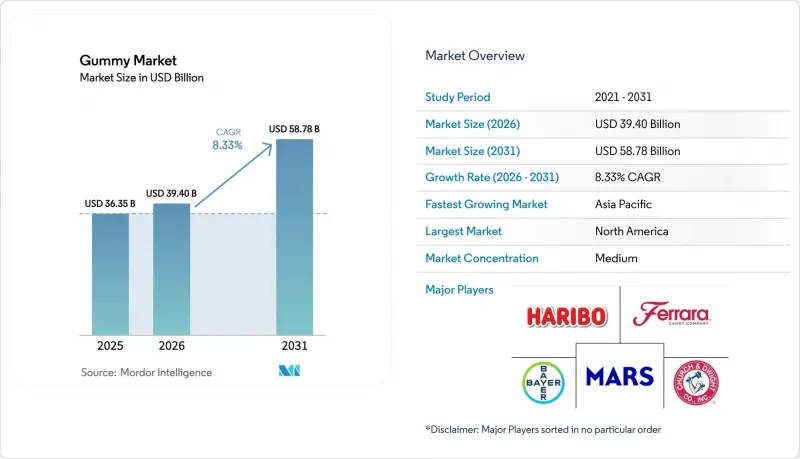
Initially limited to traditional confections, the gummy market has transformed to meet the needs of health-conscious consumers who prefer supplements in more convenient and palatable formats. This shift highlights a growing preference for gummies over conventional pills and capsules due to their taste and ease of consumption. Manufacturers have responded by creating innovative formulations that combine nutritional benefits with appealing flavors. As a result, gummies have become the dominant format in the vitamin and supplement market. Additionally, cannabis and hemp-infused gummies are anticipated to grow at an annual rate of 8.96%, supported by federal clarifications in November 2026 that limit THC content to 0.4 milligrams per container. Regulatory advancements, such as Sweegen's 2025 GRAS approval for brazzein and California's AB 899 transparency law, are further driving the development of clean-label, sugar-reduced products.
Global Gummy Market Trends and Insights
Rising consumer appetite for functional supplement gummies
The combination of confectionery appeal and nutritional benefits has transformed supplement consumption patterns. Consumers are increasingly avoiding traditional pills due to difficulty in swallowing and daily consumption fatigue, instead preferring gummy formats that make their health routines more enjoyable and sustainable. The U.S. Food and Drug Administration's March 2024 update to New Dietary Ingredient Notification Procedures has simplified the approval process for new gummy formulations, reducing regulatory timelines and enabling manufacturers to bring functional ingredients to market more quickly. Manufacturing innovations, particularly starch-free production methods, have enhanced operational efficiency, improved hygiene standards, and reduced production cycles for custom formulations. The market has evolved significantly beyond children's vitamins to encompass adult wellness products, with older adults emerging as a key consumer segment due to their preference for easier-to-consume supplement formats and increasing focus on preventive health measures.
Growing demand for sugar-reduced and sugar-free confectionery gummies
Regulatory pressure and health consciousness have catalyzed the development of sugar-reduced gummy formulations that maintain taste appeal while addressing nutritional concerns. The European Commission's updated specifications for food additives, including sorbic acid and potassium sorbate, reflect the regulatory environment's evolution toward healthier formulations. Research demonstrates that fruit juice concentrates can successfully substitute glucose syrup in gummy formulations, achieving pH values between 2.22-3.08 and water activity levels of 0.46-0.52, while enhancing nutritional profiles. The challenge lies in maintaining texture and stability characteristics that consumers expect from traditional gummies. Stevia and natural antioxidants have emerged as preferred alternatives, though formulation complexity increases with sugar reduction levels. The trend extends beyond health-conscious consumers to include parents seeking better-for-you options for children, driving innovation in natural sweetening systems.
Tightening global regulations on sugar and health-claims
Regulatory frameworks worldwide are imposing stricter controls on sugar content and health claim substantiation, creating compliance challenges for gummy manufacturers. The FDA and FTC's joint enforcement actions against delta-8 THC gummy products in July 2024 demonstrate regulatory agencies' heightened scrutiny of the sector, with over 300 adverse event reports received between January 2021 and December 2023. European Union regulations on food additives and contaminants continue to evolve, with Commission Regulation 2023/915 establishing maximum contaminant levels that particularly affect products targeting children. The challenge extends beyond formulation to marketing claims, where substantiation requirements for functional benefits have become increasingly stringent. Companies must navigate complex approval processes for new ingredients while maintaining product efficacy and consumer appeal. The regulatory landscape's fragmentation across jurisdictions creates additional complexity for global manufacturers seeking standardized formulations.
Other drivers and restraints analyzed in the detailed report include:
- Product innovation and flavor variety
- Shift toward vegan and plant-based formulations
- Raw-material supply volatility for gelatin and pectin
For complete list of drivers and restraints, kindly check the Table Of Contents.
Segment Analysis
In 2025, candy gummies dominated the market with a 58.63% share, bolstered by Haribo's expansive global presence and Ferrara's diverse portfolio, which includes Brach's, Jelly Belly, and Trolli. However, this segment's growth has lagged behind the more rapidly expanding nutraceutical and cannabis categories, signaling its maturity. Functional and nutraceutical gummies, holding the second-largest market share, are reaping benefits from the U.S. supplement market's increasing gummy adoption. This momentum was further amplified by Charlotte's Web's December 2025 introduction of a Medicare-Medicaid pilot, which allows CBD product reimbursements, broadening the potential market to 67 million beneficiaries. While still in their infancy, pharmaceutical gummies are drawing significant investment. A case in point is TopGum's February 2026 purchase of a U.S. pharma-grade facility for USD 25 million, underscoring its ambition to cater to clinical trials and prescriptions, areas where compliance with cGMP and accurate dosing are paramount. In the realm of pet supplement gummies, though they command a smaller market share, their presence is rapidly growing. Noteworthy launches include GumPaws' March 2025 debut as the "world's first" dog gummy touting dental plaque removal, DotDotPet's June 2024 Multifit Gummies aimed at joint and gut health, and NaturVet's May 2025 All-In-One Daily Care line, catering to puppies, adults, and seniors, and featuring PlaqueOff for oral care.
Among various product types, cannabis and hemp-infused gummies are leading the pack, expanding at a robust 8.96% CAGR through 2031. This growth is fueled by clearer regulations, such as the November 2026 federal cap of 0.4 milligrams THC per container and the March 2026 CMS guidance. The latter defines eligible hemp products for Beneficiary Engagement Incentive programs as those containing up to 3 milligrams THC per serving. Highlighting the segment's shift from mere recreational edibles to precise wellness solutions, Charlotte's Web rolled out its Brightside line in May 2025, boasting formulations like Rest & Relax and Focus & Flow, and featuring its proprietary TiME INFUSION for a swift 5-to-15-minute onset. Additionally, their October 2025 introduction of the Knockout sleep gummy, infused with hemp THC and CBN, underscores this evolution. Yet, challenges loom: the FDA's drug-exclusion rule still bars CBD from foods and supplements, posing enforcement risks. This limitation curtails mainstream retail distribution, nudging brands towards specialty channels and direct-to-consumer avenues. In a bid to innovate, confectionery candy gummies are experimenting with textures. Sweet Venture Group's March 2026 Gummi Popz, retailing at USD 2.49, melds chewy gummies with popping candy, while Ferrara's May 2025 SweeTARTS Gummy Halos, featuring airy-fluffy bases, seek to captivate the teen and tween demographic through novel experiences. Meanwhile, functional gummies are broadening their horizons. No longer limited to multivitamins, they're venturing into specific areas like sleep, immunity, and cognitive focus. This evolution not only masks the bitterness of active ingredients but also enhances user adherence, solidifying the gummy format's role as a bridge between traditional supplements and pharmaceuticals.
In 2025, gelatin-based gummies led the market with a 60.38% share. Gelatin's benefits in texture, clarity, and cost significantly contributed to this dominance. Being 20 to 40% cheaper than pectin per kilogram and offering superior elasticity, gelatin remains a preferred choice for confectionery applications. However, regulatory concerns over bovine sourcing in Europe and the Asia-Pacific, due to sporadic disease outbreaks, and religious dietary restrictions in the Middle East and halal markets, are tightening supply. This has driven manufacturers to explore porcine gelatin and plant-based alternatives. Agar and other hydrocolloids, such as tapioca and modified potato starches, cater to niche applications, particularly in the Asia-Pacific, where seaweed cultivation supports agar production. However, these alternatives require precise temperature control and longer setting times, which reduce throughput and limit their use to premium or specialty SKUs.
Pectin-based gummies are experiencing rapid growth, with a 9.15% CAGR projected through 2031, the highest among ingredient types. This growth is driven by European vegan mandates, Asia-Pacific dietary preferences, and North American clean-label trends. Reflecting these trends, Charlotte's Web launched its Brightside and Knockout gummies in May and October 2025, respectively. These products, marketed as vegan and gluten-free, align with the company's Certified B Corporation values and target health-conscious consumers. However, the pectin supply chain remains volatile. Spot prices dropped in June 2025 due to an oversupply from citrus peel processors but rebounded in October 2025 as pharmaceutical and nutraceutical buyers tightened availability. This fluctuation created margin pressures for smaller manufacturers without long-term contracts. Additionally, specialty starches, particularly Thai tapioca, saw an 18% year-over-year price increase in 2025. This was caused by drought-reduced cassava yields and rising demand from the biodegradable packaging sector, which increased formulation costs for vegan gummies. As pectin-based formulations gain market share, procurement risks are shifting from a tactical issue to a strategic bottleneck. This could hinder capacity expansions and raise entry barriers, especially for mid-tier brands lacking vertical integration or hedging capabilities.
The Gummy Market Report is Segmented by Product Type (Candy, Functional/Nutraceutical, and More), Ingredient (Gelatin, Pectin, Agar/Other Hydrocolloids), Consumer Group (Children, Adults), Distribution Channel (Supermarkets/Hypermarkets, and More), and Geography (North America, Europe, Asia-Pacific, South America, Middle East and Africa). Market Forecasts are in Value (USD).
Geography Analysis
By 2025, North America's gummy market experienced significant growth, reaching nearly USD 12 billion and securing a notable 29.64% share of the global market. This growth was largely driven by the U.S.'s mature and well-established supplement industry, coupled with Canada's strong consumer preference for confectionery products. The introduction of federal THC caps in the U.S. in 2026 played a pivotal role in reducing compliance uncertainties, which encouraged mainstream retailers to reconsider the inclusion of hemp gummies in their product portfolios. While Mexico's gummy market remains in its nascent stages, it benefits from cross-border brand recognition, which has helped to establish a foothold in the market. However, Mexico's per-capita gummy consumption continues to trail significantly behind that of its northern counterparts, highlighting room for growth.
In Europe, the growing consumer inclination to pay a premium for vegan and clean-label products has driven annual gummy sales growth of over 10% within the region's EUR 20 billion supplement market. Germany remains the market leader, supported by the extensive presence of drugstore chains such as dm and Rossmann, which cater to a wide consumer base. Meanwhile, the U.K. and France are prioritizing sugar reduction in gummy products to align with public health mandates and address rising health concerns. Eastern Europe presents a promising growth opportunity, driven by increasing disposable incomes and evolving consumer preferences. However, the fragmented nature of retail distribution in the region continues to pose challenges, limiting the potential for immediate large-scale expansion.
The Asia-Pacific region is witnessing rapid growth, with a compound annual growth rate (CAGR) of 9.68%, driven by strong performances in key markets such as China, Japan, South Korea, and India. India's gummy market is forecast to reach USD 1.59 billion by 2033, fueled by a growing preference for vegan products and the rapid expansion of the e-pharmacy sector, which has made gummies more accessible to consumers. Singapore has emerged as a premium market within the region, supported by its high per-capita income levels and demand for high-quality products. In contrast, South America and the Middle East & Africa collectively account for a smaller share of the global gummy market. However, these regions are increasingly attracting multinational companies due to the expanding middle-class population and the growing penetration of modern retail formats, which are creating new opportunities for market players.
- Haribo GmbH & Co. KG
- Mars, Incorporated
- Ferrara Candy Company (Ferrero)
- Perfetti Van Melle Group
- Neste S.A.
- Jelly Belly Candy Company
- Makers Nutrition, LLC,
- Albanese Confectionery Group
- Amway Corp
- Lotte Confectionery Co., Ltd.
- Bayer AG (One A Day, Flintstones)
- Church & Dwight Co., Inc. (Vitafusion)
- Pharmavite LLC (Nature Made)
- The Nature's Bounty Co.
- SmartyPants Vitamins
- Vitabiotics Ltd.
- Hero Nutritionals, Inc.
- Nutraceutical Corporation (Zhou Nutrition)
- Charlotte's Web Inc,
- Handian Nutrition
Additional Benefits:
- The market estimate (ME) sheet in Excel format
- 3 months of analyst support
TABLE OF CONTENTS
1 INTRODUCTION
- 1.1 Study Assumptions and Market Definition
- 1.2 Scope of the Study
2 RESEARCH METHODOLOGY
3 EXECUTIVE SUMMARY
4 MARKET LANDSCAPE
- 4.1 Market Overview
- 4.2 Market Drivers
- 4.2.1 Rising consumer appetite for functional supplement gummies
- 4.2.2 Growing demand for sugar-reduced and sugar-free confectionery gummies
- 4.2.3 Product innovation and flavor variety
- 4.2.4 Shift toward vegan and plant-based formulations
- 4.2.5 Clean label and natural ingredients
- 4.2.6 Technological advancements in manufacturing
- 4.3 Market Restraints
- 4.3.1 Tightening global regulations on sugar and health-claims
- 4.3.2 Raw-material supply volatility for gelatin and pectin
- 4.3.3 High Cost of Premium Ingredients and Manufacturing
- 4.3.4 Product Shelf Life and Stability
- 4.4 Consumer Behavior Analysis
- 4.5 Regulatory Landscape
- 4.6 Technological Outlook
- 4.7 Porter's Five Forces
- 4.7.1 Threat of New Entrants
- 4.7.2 Bargaining Power of Suppliers
- 4.7.3 Bargaining Power of Buyers
- 4.7.4 Threat of Substitutes
- 4.7.5 Competitive Rivalry
5 MARKET SIZE AND GROWTH FORECASTS (VALUE)
- 5.1 By Product Type
- 5.1.1 Candy Gummies
- 5.1.2 Functional/Nutraceutical Gummies
- 5.1.3 Cannabis and Hemp-Infused Gummies
- 5.1.4 Pharmaceutical Gummies
- 5.1.5 Pet Supplement Gummies
- 5.2 By Ingredient
- 5.2.1 Gelatin-Based
- 5.2.2 Pectin-Based
- 5.2.3 Agar and Other Hydrocolloids
- 5.3 By Consumer Group
- 5.3.1 Children
- 5.3.2 Adults
- 5.3.3 Seniors
- 5.4 By Distribution Channel
- 5.4.1 Supermarkets/Hypermarkets
- 5.4.2 Convenience Stores
- 5.4.3 Specialty Stores
- 5.4.4 Pharmacy/Drug Stores
- 5.4.5 Online Retail Stores
- 5.4.6 Others
- 5.5 By Geography
- 5.5.1 North America
- 5.5.1.1 United States
- 5.5.1.2 Canada
- 5.5.1.3 Mexico
- 5.5.1.4 Rest of North America
- 5.5.2 Europe
- 5.5.2.1 Germany
- 5.5.2.2 United Kingdom
- 5.5.2.3 Italy
- 5.5.2.4 France
- 5.5.2.5 Spain
- 5.5.2.6 Netherlands
- 5.5.2.7 Poland
- 5.5.2.8 Belgium
- 5.5.2.9 Sweden
- 5.5.2.10 Rest of Europe
- 5.5.3 Asia-Pacific
- 5.5.3.1 China
- 5.5.3.2 India
- 5.5.3.3 Japan
- 5.5.3.4 Australia
- 5.5.3.5 Indonesia
- 5.5.3.6 South Korea
- 5.5.3.7 Thailand
- 5.5.3.8 Singapore
- 5.5.3.9 Rest of Asia-Pacific
- 5.5.4 South America
- 5.5.4.1 Brazil
- 5.5.4.2 Argentina
- 5.5.4.3 Colombia
- 5.5.4.4 Chile
- 5.5.4.5 Peru
- 5.5.4.6 Rest of South America
- 5.5.5 Middle East and Africa
- 5.5.5.1 South Africa
- 5.5.5.2 Saudi Arabia
- 5.5.5.3 United Arab Emirates
- 5.5.5.4 Nigeria
- 5.5.5.5 Egypt
- 5.5.5.6 Morocco
- 5.5.5.7 Turkey
- 5.5.5.8 Rest of Middle East and Africa
- 5.5.1 North America
6 COMPETITIVE LANDSCAPE
- 6.1 Market Concentration
- 6.2 Strategic Moves
- 6.3 Market Share Analysis
- 6.4 Company Profiles (includes Global level Overview, Market level overview, Core Segments, Financials (if available), Strategic Information, Market Rank/Share for key companies, Products, and Recent Developments)
- 6.4.1 Haribo GmbH & Co. KG
- 6.4.2 Mars, Incorporated
- 6.4.3 Ferrara Candy Company (Ferrero)
- 6.4.4 Perfetti Van Melle Group
- 6.4.5 Neste S.A.
- 6.4.6 Jelly Belly Candy Company
- 6.4.7 Makers Nutrition, LLC,
- 6.4.8 Albanese Confectionery Group
- 6.4.9 Amway Corp
- 6.4.10 Lotte Confectionery Co., Ltd.
- 6.4.11 Bayer AG (One A Day, Flintstones)
- 6.4.12 Church & Dwight Co., Inc. (Vitafusion)
- 6.4.13 Pharmavite LLC (Nature Made)
- 6.4.14 The Nature's Bounty Co.
- 6.4.15 SmartyPants Vitamins
- 6.4.16 Vitabiotics Ltd.
- 6.4.17 Hero Nutritionals, Inc.
- 6.4.18 Nutraceutical Corporation (Zhou Nutrition)
- 6.4.19 Charlotte's Web Inc,
- 6.4.20 Handian Nutrition
7 MARKET OPPORTUNITIES AND FUTURE OUTLOOK

