PUBLISHER: Mordor Intelligence | PRODUCT CODE: 2061849

PUBLISHER: Mordor Intelligence | PRODUCT CODE: 2061849
Multivitamin Gummies - Market Share Analysis, Industry Trends & Statistics, Growth Forecasts (2026 - 2031)
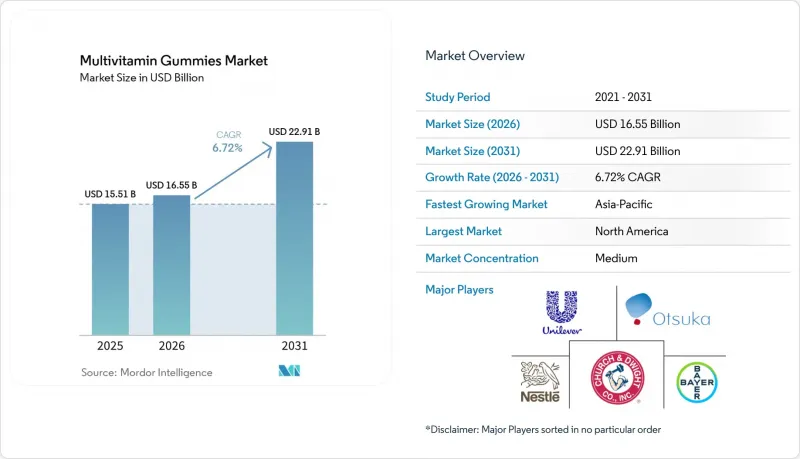
According to Mordor Intelligence, the multivitamin gummies market is expected to grow significantly, increasing from USD 15.51 billion in 2025 and USD 16.55 billion in 2026 to USD 22.91 billion by 2031. This report is Segmented by Flavor Type (Flavored and Unflavored), End User (Children, Men, and Women), Health Application (General Health and Wellness, Digestive Health, and More), Distribution Channel (Supermarkets/Hypermarkets, Drug Stores and Pharmacies, and More), and Geography (North America, Europe, Asia-Pacific, South America, and More). The Market Forecasts are Provided in Terms of Value (USD).
Global Multivitamin Gummies Market Trends and Insights
Rising consumer focus on preventive healthcare and daily wellness
Consumers are increasingly focusing on preventive healthcare and daily wellness, driving growth in the global multivitamin gummies market. People are now prioritizing a regular intake of nutrients to stay healthy rather than waiting to treat illnesses. The Global Wellness Institute reported that the U.S. wellness economy reached approximately USD 2.1 trillion as of April 2026, underscoring the trend's significance. Multivitamin gummies fit well with this shift because they offer a simple, tasty alternative to traditional pills, making it easier for people to stick to their daily health routines. For example, Bayer AG launched a children's gummy containing added iron to help address nutritional deficiencies often caused by picky eating. This trend is especially strong in developed countries, where rising healthcare costs and aging populations are pushing people to invest more in self-care and long-term health solutions.
Growing prevalence of vitamin deficiencies due to poor dietary habits and sedentary lifestyles
More people are experiencing vitamin deficiencies due to unhealthy eating habits and less active lifestyles, which is driving the growth of the global multivitamin gummies market. Although programs like food fortification aim to address this issue, many individuals still lack essential nutrients. For instance, the Centers for Disease Control and Prevention (CDC) has identified certain groups at higher risk of vitamin D deficiency. Similarly, the World Health Organization (WHO) has reported widespread deficiencies in key nutrients, such as iron, iodine, and vitamin A, particularly in developing countries. A 2025 study published in ScienceDirect found that up to 84.1% of people in Northern India suffer from vitamin D deficiency, highlighting the severity of the problem in rapidly urbanizing areas[2]. This issue is worsened by factors such as increased consumption of processed foods, changing dietary patterns, and reduced exposure to sunlight.
High sugar content in many gummy formulations
One of the major challenges in the global multivitamin gummies market is the high sugar content found in many products, especially those targeted at children. Parents are becoming more cautious about the sugar levels in these supplements due to concerns about their impact on dental health, obesity, and long-term metabolic issues when consumed daily. Traditional gummy formulations often include significant amounts of added sugars, which have drawn attention from regulatory bodies like the U.S. Food and Drug Administration (FDA) and the European Food Safety Authority (EFSA). These organizations are working on stricter guidelines for sugar labeling and are considering more rigorous standards for supplements aimed at children. To address these concerns, manufacturers are increasingly developing sugar-free alternatives by using sweeteners such as stevia and erythritol. However, creating sugar-free gummies comes with its own set of challenges, including maintaining the desired taste, texture, and cost-effectiveness. Companies like Tate & Lyle are exploring innovative solutions, such as pectin-based formulations, to overcome these issues.
Other drivers and restraints analyzed in the detailed report include:
- Strong influence of social media and wellness trends
- Continuous product innovation, including functional benefits such as immunity, beauty, and sleep support
- Presence of artificial additives, colors, and flavors
For complete list of drivers and restraints, kindly check the Table Of Contents.
Segment Analysis
The flavored segment was the largest in the global multivitamin gummies market in 2025, accounting for 82.87% of market share. Flavored gummies are widely preferred because they are enjoyable to eat and easy to include in daily routines, especially for children and young adults. These gummies make taking vitamins more appealing by masking the unpleasant taste of certain nutrients. The availability of a variety of flavors and innovative combinations further attracts consumers, making flavored gummies the top choice in the market. Their convenience and taste continue to drive their popularity.
The unflavored segment, while smaller, is expected to grow at a steady CAGR of 8.25% through 2031. This growth is fueled by increasing demand for products with simple, clean ingredients that avoid artificial flavors, colors, or sweeteners. Many health-conscious adults prefer unflavored gummies because they value transparency and minimal ingredient lists. Concerns about sugar intake and dietary restrictions are pushing more consumers toward unflavored options. Although this segment has a smaller share, its growth reflects a shift toward healthier and more natural choices in the market.
The women's segment held a notable 37.22% share of the multivitamin gummies market in 2025, driven by growing health awareness and the need for targeted nutrition. Women are turning to multivitamin gummies for benefits like improved immunity, better skin health, stronger bones, and hormonal balance. The availability of products designed specifically for women, along with attractive flavors, has further boosted their popularity. Additionally, as more women join the workforce and focus on preventive healthcare, demand for convenient, effective supplements like gummies continues to rise, making this segment a key contributor to market revenue.
The children's segment is expected to grow at a CAGR of 7.27% through 2031, driven by increasing parental concern about child nutrition and immunity. Multivitamin gummies are a popular choice for children because they are easy to consume and taste better than traditional tablets or syrups. Parents are also turning to these products to address issues such as nutritional deficiencies and picky eating. Companies are continuously innovating with new shapes, flavors, and added nutrients to make these gummies more appealing to kids. As a result, this segment is expected to grow steadily over the forecast period.
Geography Analysis
North America was the largest market for multivitamin gummies in 2025, accounting for about 45.63% of the total revenue. This strong position is due to the availability of a wide network of retail stores and pharmacies, along with consumers' preference for high-quality, premium products. The region is also known for leading in the development of innovative products, such as clean-label and functional options. While the market continues to grow, the pace has slowed as it matures. In the coming years, growth in North America is expected to come from unique and premium products that address specific consumer needs, such as targeted health benefits.
The Asia-Pacific region is expected to grow the fastest, with a CAGR of 7.23% through 2031. This growth is mainly driven by rising incomes and an increasing focus on preventive healthcare among consumers. Urbanization and the expansion of online shopping platforms are making these products more accessible in key markets like China and India. Companies are also introducing products that cater to local tastes and are adapting to changing regulations, which is helping them grow in the region. As a result, Asia-Pacific is expected to gain a larger share of the global market in the years ahead, supported by growing consumer awareness and demand.
Europe is a stable and steadily growing market for multivitamin gummies, supported by strict regulations that ensure high product quality and build trust among consumers. Major markets in the region include Germany, France, the United Kingdom, and Italy, which contribute significantly to the overall market performance. Growth in Europe is expected to remain moderate, driven by demand for scientifically backed and premium products that meet consumer expectations. Meanwhile, South America and the Middle East & Africa currently hold smaller shares of the market but are expected to grow faster due to improving healthcare systems, rising disposable incomes, and increasing awareness about the benefits of multivitamin gummies.
- Bayer AG
- Church & Dwight Co. Inc.
- Otsuka Pharmaceutical Co., Ltd.
- Goli Nutrition Inc.
- Unilever PLC
- Nestle S.A.
- Haleon plc
- Solistaa Pharmaceuticals Pvt Ltd
- Biovencer Healthcare Pvt. Ltd.
- United Laboratories
- Jamieson Wellness Inc.
- THG Nutrition Ltd.
- Natrol LLC
- XXL Nutrition
- Amway Corp.
- SevenQ Nutrition
- Zhou Nutrition
- Funtrition
- Leo Nutriscience LLP
- Chewwies (AHN Enterprise Ltd)
Additional Benefits:
- The market estimate (ME) sheet in Excel format
- 3 months of analyst support
TABLE OF CONTENTS
1 INTRODUCTION
- 1.1 Study Assumptions and Market Definition
- 1.2 Scope of the Study
2 RESEARCH METHODOLOGY
3 EXECUTIVE SUMMARY
4 MARKET LANDSCAPE
- 4.1 Market Overview
- 4.2 Market Drivers
- 4.2.1 Rising consumer focus on preventive healthcare and daily wellness
- 4.2.2 Growing prevalence of vitamin deficiencies due to poor dietary habits and sedentary lifestyles
- 4.2.3 Continuous product innovation, including functional benefits such as immunity, beauty, and sleep support
- 4.2.4 Increasing preference for convenient, easy-to-consume formats
- 4.2.5 Enhanced taste and sensory appeal of gummies is improving consumer compliance
- 4.2.6 Strong influence of social media and wellness trends
- 4.3 Market Restraints
- 4.3.1 High sugar content in many gummy formulations
- 4.3.2 Presence of artificial additives, colors, and flavors
- 4.3.3 Increasing competition from alternative supplement formats such as powders, effervescent tablets, and functional foods
- 4.3.4 Consumer skepticism around actual health benefits and efficacy of gummies
- 4.4 Consumer Behavior Analysis
- 4.5 Regulatory Outlook
- 4.6 Porter's Five Forces
- 4.6.1 Threat of New Entrants
- 4.6.2 Bargaining Power of Buyers
- 4.6.3 Bargaining Power of Suppliers
- 4.6.4 Threat of Substitute Products
- 4.6.5 Intensity of Competitive Rivalry
5 MARKET SIZE AND GROWTH FORECASTS (VALUE)
- 5.1 By Flavor Type
- 5.1.1 Flavored
- 5.1.2 Unflavored
- 5.2 By End User
- 5.2.1 Men
- 5.2.2 Women
- 5.2.3 Children
- 5.3 By Health Application
- 5.3.1 General Health and Wellness
- 5.3.2 Bone and Joint Health
- 5.3.3 Immunity Boosting
- 5.3.4 Digestive Health
- 5.3.5 Energy and Metabolism
- 5.3.6 Hair, Skin, and Nail Health
- 5.3.7 Others
- 5.4 By Distribution Channel
- 5.4.1 Supermarkets/Hypermarkets
- 5.4.2 Drug Stores and Pharmacies
- 5.4.3 Online Retail Stores
- 5.4.4 Other Channels
- 5.5 By Geography
- 5.5.1 North America
- 5.5.1.1 United States
- 5.5.1.2 Canada
- 5.5.1.3 Mexico
- 5.5.1.4 Rest of North America
- 5.5.2 Europe
- 5.5.2.1 Germany
- 5.5.2.2 United Kingdom
- 5.5.2.3 Italy
- 5.5.2.4 France
- 5.5.2.5 Spain
- 5.5.2.6 Poland
- 5.5.2.7 Belgium
- 5.5.2.8 Sweden
- 5.5.2.9 Rest of Europe
- 5.5.3 Asia-Pacific
- 5.5.3.1 China
- 5.5.3.2 Japan
- 5.5.3.3 India
- 5.5.3.4 Australia
- 5.5.3.5 Indonesia
- 5.5.3.6 South Korea
- 5.5.3.7 Thailand
- 5.5.3.8 Singapore
- 5.5.3.9 Rest of Asia-Pacific
- 5.5.4 South America
- 5.5.4.1 Brazil
- 5.5.4.2 Argentina
- 5.5.4.3 Colombia
- 5.5.4.4 Chile
- 5.5.4.5 Peru
- 5.5.4.6 Rest of South America
- 5.5.5 Middle East and Africa
- 5.5.5.1 South Africa
- 5.5.5.2 Saudi Arabia
- 5.5.5.3 United Arab Emirates
- 5.5.5.4 Nigeria
- 5.5.5.5 Egypt
- 5.5.5.6 Morocco
- 5.5.5.7 Turkey
- 5.5.5.8 Rest of Middle East and Africa
- 5.5.1 North America
6 COMPETITIVE LANDSCAPE
- 6.1 Market Concentration
- 6.2 Strategic Moves
- 6.3 Market Share Analysis
- 6.4 Company Profiles (includes Global-level Overview, Market-level Overview, Core Segments, Financials (if available), Strategic Information, Market Rank/Share, Products and Services, Recent Developments)
- 6.4.1 Bayer AG
- 6.4.2 Church & Dwight Co. Inc.
- 6.4.3 Otsuka Pharmaceutical Co., Ltd.
- 6.4.4 Goli Nutrition Inc.
- 6.4.5 Unilever PLC
- 6.4.6 Nestle S.A.
- 6.4.7 Haleon plc
- 6.4.8 Solistaa Pharmaceuticals Pvt Ltd
- 6.4.9 Biovencer Healthcare Pvt. Ltd.
- 6.4.10 United Laboratories
- 6.4.11 Jamieson Wellness Inc.
- 6.4.12 THG Nutrition Ltd.
- 6.4.13 Natrol LLC
- 6.4.14 XXL Nutrition
- 6.4.15 Amway Corp.
- 6.4.16 SevenQ Nutrition
- 6.4.17 Zhou Nutrition
- 6.4.18 Funtrition
- 6.4.19 Leo Nutriscience LLP
- 6.4.20 Chewwies (AHN Enterprise Ltd)
7 MARKET OPPORTUNITIES AND FUTURE OUTLOOK

