PUBLISHER: Mordor Intelligence | PRODUCT CODE: 2044028

PUBLISHER: Mordor Intelligence | PRODUCT CODE: 2044028
Telecom Network Sustainability - Market Share Analysis, Industry Trends & Statistics, Growth Forecasts (2026 - 2031)
The Telecom Network Sustainability Market size is expected to grow from USD 5.21 billion in 2025 to USD 5.79 billion in 2026 and is forecast to reach USD 8.59 billion by 2031 at 8.21% CAGR over 2026-2031.
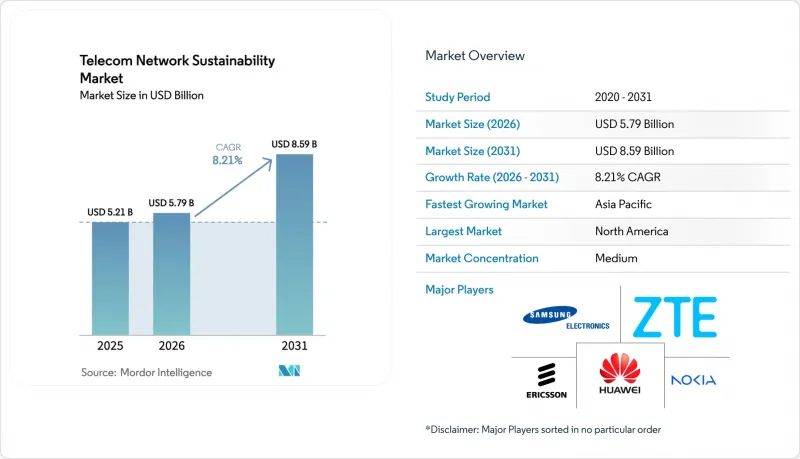
Escalating electricity bills from 5G densification, binding carbon-neutrality mandates, and the availability of ESG-linked financing are together raising sustainability to a board-level priority. Operators are directing capital toward AI-driven radio access network (RAN) sleep-mode software, modular Open RAN hardware, and on-site renewable microgrids to curb Scope 1 and 2 emissions and secure preferential lending rates. Market momentum is reinforced by hyperscale cloud providers that insist colocation partners match their 24/7 carbon-free energy timelines, while tower companies monetize green infrastructure across multiple tenants through premium leases.
Global Telecom Network Sustainability Market Trends and Insights
Net-Zero Commitments and ESG Regulation
Investors no longer reward telecom operators that treat carbon reporting as a footnote. When the European Union's Corporate Sustainability Reporting Directive took effect, procurement teams at Vodafone and Telefonica began scoring bids partly on life-cycle emissions, and vendors that lacked verified data suddenly fell off short lists. China's Ministry of Industry and Information Technology set a matching 2030 ceiling, prompting China Mobile to wire 1.2 million base stations with AI energy software in a single year. This pivot forces every participant in the telecom network sustainability market to publish auditable carbon numbers to access the USD 500 billion ESG-bond pool priced in 2025.
Escalating Energy Costs From 5G Densification
Moving from wide-area 4G sites to dense 5G clusters doubled, and sometimes tripled, monthly electricity bills, especially in markets where utilities raise tariffs with little notice. Ericsson recorded 4-5 kW draws for a typical 5G macro site, compared with 2-3 kW for 4G hardware, pushing many rural markets into negative-margin territory when grid prices spike. Tower operators answered by rolling out hybrid solar-battery kits; American Tower's 3,000-site program in Africa and Latin America cut diesel burn by 60% and saved roughly 50,000 t of CO2 each year. Cost relief of that scale is nudging smaller carriers toward shared off-grid power, expanding the addressable slice of the telecom network sustainability market.
High Capex to Retrofit Legacy Infrastructure
Upgrading brownfield networks for sustainability requires significant capital, often at odds with short-term ROI goals. For a tier-1 operator managing 50,000 sites, this equates to USD 750 million-1.25 billion, or 15-25% of annual capex in stagnant revenue markets. In Europe, operators like Orange and Deutsche Telekom still rely on outdated 3G base stations incapable of AI-driven energy optimization, forcing a two-tiered upgrade cycle. Urban sites are prioritized, widening the energy-efficiency gap with rural areas. Leasing models from tower companies, which finance upgrades and recover costs via higher rents, shift rather than eliminate the capex burden.
Other drivers and restraints analyzed in the detailed report include:
- AI-Driven RAN Sleep-Mode Optimization
- Vendor Eco-Design and Life-Cycle Standards
- Absence of Unified Sustainability KPIs
For complete list of drivers and restraints, kindly check the Table Of Contents.
Segment Analysis
Solutions comprised 68.45% of market share in 2025, driven by investments in energy-efficient radios, AI-powered network platforms, and renewable microgrids. Services, growing at 8.98% through 2031. Operators poured almost 70% of their 2025 budgets into hardware but quickly discovered that buying an efficient radio is the easy part. Calculating Scope 3 footprints across thousands of suppliers, containers, and disposal streams is tougher, so carriers now hire consulting arms at Accenture, Capgemini, and Ericsson to crunch that data. Services revenue inside the telecom network sustainability market therefore rises nearly 9% a year, faster than any boxed product, because regulators refresh disclosure rules annually, keeping advisory contracts alive. Energy-monitoring dashboards illustrate the appeal: Nokia's NetGuard platform paid for itself in 18 months after highlighting over-provisioned cell sites that could safely cycle down at night.
Just as important, services let operators move sustainability spending from capex to opex. Instead of buying their own carbon-accounting tools, many carriers prefer paying a monthly fee that scales with network size, smoothing cash flow and aligning costs with usage. This shift attracts smaller mobile virtual network operators that could never justify a seven-figure software license. As more countries mandate audited Scope 3 data, the service slice of the telecom network sustainability market should harden into a subscription model that delivers predictable, high-margin revenue to vendors and consultants alike.
The access network held 37.89% of the studied market in 2025, driven by the sheer volume of radio units deployed in 5G densification campaigns. Yet data center and edge facilities are growing at 9.12% through 2031, the fastest rate among network layers. RAN still commands the biggest dollar share because every 5G upgrade needs new radios, yet edge and data-center nodes are the real head-turners. Google Cloud matched 24/7 carbon-free energy for five regions in 2025, and Microsoft reserved USD 10 billion to hit the same goal by 2030. Those promises ripple outward when hyperscalers insist that a colocation hall run on green power, and the local telecom operator hosting multi-access edge compute must follow suit or lose the contract. That pressure fuels a 9% growth rate for edge facilities, easily outpacing core and transport upgrades inside the telecom network sustainability market.
Beyond raw power sourcing, edge nodes open new levers for heat reuse and demand-response revenue. Operators in Northern Europe now pipe waste heat from micro-data centers into district-heating grids, earning credits that shorten the payback period. In the United States, Verizon installs batteries at cell sites not only for backup but also to bid for frequency-regulation capacity in regional power markets, further monetizing sustainability installations. These tweaks elevate the edge layer from a cost center to a diversified earnings engine, strengthening its pull on future capex.
The Telecom Network Sustainability Market Report is Segmented by Component (Solutions and Services), Network Layer (Access Network, Transport/Backhaul, Core Network, and More), Deployment Model (On-Premise and Cloud/SaaS), Network Technology (5G, 4G/LTE, and More), Operator Type (Mobile Network Operators (MNOs), Fixed-Line and ISPs, and More), and Geography. The Market Forecasts are Provided in Terms of Value (USD).
Geography Analysis
North America continues to spend the most per site because power purchase agreements with large wind farms remain the cheapest path to carbon cuts. Verizon and AT&T use those contracts to shield themselves from utility volatility and to show Wall Street credible net-zero roadmaps by 2035. State-level incentives, especially in Texas and the Mid-Atlantic, make large wind or solar blocks even more attractive, reinforcing the region's 26.78% share of the telecom network sustainability market.
However, Asia-Pacific is expanding at 10.19% through 2031, the fastest regional growth rate, propelled by government mandates and the sheer scale of 5G deployments. India's Department of Telecommunications mandated renewable-ready 5G base stations by 2027, prompting Reliance Jio and Bharti Airtel to line cell-site rooftops with solar film and battery packs. China Mobile, under Beijing's 2030 carbon-peaking directive, wired 1.2 million radios with AI sleep controllers in 2025, saving a double-digit slice of total network power in a single budget cycle. Because APAC networks are still expanding, new sites ship with green kit baked in, so capex falls into growth budgets rather than retrofit buckets, a structural tailwind for the regional telecom network sustainability market.
In the European region, networks are mature, and swapping old gear is expensive, yet the European Green Deal still pressures carriers to move. Operators from Orange to Vodafone tap ESG-linked loans that shave interest rates if energy KPIs improve, creating financial carrots to balance the retrofit stick. Smaller markets, Nordics, Benelux, experiment with heat-reuse schemes, feeding waste warmth from edge servers into municipal district-heating pipes, an innovation that may spread once energy utilities verify long-term contracts. South America and the Middle East and Africa together account for a mid-teens share of spending, but their growth curves hinge on tower-company solar projects that replace diesel in off-grid towers. Financing models that bundle power services into long leases help overcome high sovereign borrowing costs and accelerate adoption in these regions.
- Telefonaktiebolaget LM Ericsson
- Nokia Corporation
- Huawei Technologies Co., Ltd.
- ZTE Corporation
- Cisco Systems, Inc.
- Samsung Electronics Co., Ltd.
- NEC Corporation
- Fujitsu Limited
- Dell Technologies Inc.
- International Business Machines Corporation (IBM)
- Juniper Networks, Inc.
- Mavenir Systems, Inc.
- Parallel Wireless, Inc.
- Capgemini Engineering (Capgemini SE)
- Accenture plc
- Orange S.A.
- Vodafone Group Plc
- American Tower Corporation
- Crown Castle Inc.
- Digital Realty Trust, Inc.
Additional Benefits:
- The market estimate (ME) sheet in Excel format
- 3 months of analyst support
TABLE OF CONTENTS
1 INTRODUCTION
- 1.1 Study Assumptions and Market Definition
- 1.2 Scope of the Study
2 RESEARCH METHODOLOGY
3 EXECUTIVE SUMMARY
4 MARKET LANDSCAPE
- 4.1 Market Overview
- 4.2 Market Drivers
- 4.2.1 Net-Zero Commitments and ESG Regulation
- 4.2.2 Escalating Energy Costs From 5G Densification
- 4.2.3 Availability of Green Financing and ESG-Linked Bonds
- 4.2.4 Vendor Eco-Design and Lifecycle-Assessment Standards
- 4.2.5 AI-Driven RAN Sleep-Mode Optimization
- 4.2.6 Metal Recovery Revenue From Decommissioned Gear
- 4.3 Market Restraints
- 4.3.1 High Capex to Retrofit Legacy Infrastructure
- 4.3.2 Absence of Unified Sustainability KPIs
- 4.3.3 Site Delays for Renewable Micro-Grids
- 4.3.4 Scarcity of Low-Carbon Steel and Recycled Plastics
- 4.4 Industry Value Chain Analysis
- 4.5 Regulatory Landscape
- 4.6 Technological Outlook
- 4.7 Porter's Five Forces Analysis
- 4.7.1 Threat of New Entrants
- 4.7.2 Bargaining Power of Suppliers
- 4.7.3 Bargaining Power of Buyers
- 4.7.4 Threat of Substitutes
- 4.7.5 Competitive Rivalry
- 4.8 Sustainability Focus Area Analysis
- 4.8.1 Energy Efficiency and Carbon Reduction
- 4.8.2 Circular Economy and E-waste Management
- 4.8.3 Renewable Energy Integration
- 4.8.4 Water Stewardship
5 MARKET SIZE AND GROWTH FORECASTS (VALUE)
- 5.1 By Component
- 5.1.1 Solutions
- 5.1.2 Services
- 5.2 By Network Layer
- 5.2.1 Access Network
- 5.2.2 Transport/Backhaul
- 5.2.3 Core Network
- 5.2.4 Data Center and Edge Facilities
- 5.3 By Deployment Model
- 5.3.1 On-premise
- 5.3.2 Cloud/SaaS
- 5.4 By Network Technology
- 5.4.1 5G
- 5.4.2 4G/LTE
- 5.4.3 Fiber (FTTx)
- 5.4.4 Edge Computing/MEC
- 5.4.5 Open RAN
- 5.4.6 Satellite (LEO)
- 5.5 By Operator Type
- 5.5.1 Mobile Network Operators (MNOs)
- 5.5.2 Fixed-line and ISPs
- 5.5.3 Hyperscale Cloud and Content Providers
- 5.5.4 Neutral Hosts and TowerCos
- 5.5.5 Private-Network Enterprises
- 5.6 By Geography
- 5.6.1 North America
- 5.6.1.1 United States
- 5.6.1.2 Canada
- 5.6.1.3 Mexico
- 5.6.2 South America
- 5.6.2.1 Brazil
- 5.6.2.2 Argentina
- 5.6.2.3 Rest of South America
- 5.6.3 Europe
- 5.6.3.1 Germany
- 5.6.3.2 United Kingdom
- 5.6.3.3 France
- 5.6.3.4 Italy
- 5.6.3.5 Spain
- 5.6.3.6 Rest of Europe
- 5.6.4 Asia-Pacific
- 5.6.4.1 China
- 5.6.4.2 Japan
- 5.6.4.3 India
- 5.6.4.4 South Korea
- 5.6.4.5 Rest of Asia-Pacific
- 5.6.5 Middle East and Africa
- 5.6.5.1 Middle East
- 5.6.5.1.1 GCC Countries
- 5.6.5.1.2 Turkey
- 5.6.5.1.3 Rest of Middle East
- 5.6.5.2 Africa
- 5.6.5.2.1 South Africa
- 5.6.5.2.2 Nigeria
- 5.6.5.2.3 Rest of Africa
- 5.6.5.1 Middle East
- 5.6.1 North America
6 COMPETITIVE LANDSCAPE
- 6.1 Market Concentration
- 6.2 Strategic Moves
- 6.3 Market Share Analysis
- 6.4 Company Profiles (includes Global level Overview, Market level overview, Core Segments, Financials as available, Strategic Information, Market Rank/Share for key companies, Products and Services, and Recent Developments)
- 6.4.1 Telefonaktiebolaget LM Ericsson
- 6.4.2 Nokia Corporation
- 6.4.3 Huawei Technologies Co., Ltd.
- 6.4.4 ZTE Corporation
- 6.4.5 Cisco Systems, Inc.
- 6.4.6 Samsung Electronics Co., Ltd.
- 6.4.7 NEC Corporation
- 6.4.8 Fujitsu Limited
- 6.4.9 Dell Technologies Inc.
- 6.4.10 International Business Machines Corporation (IBM)
- 6.4.11 Juniper Networks, Inc.
- 6.4.12 Mavenir Systems, Inc.
- 6.4.13 Parallel Wireless, Inc.
- 6.4.14 Capgemini Engineering (Capgemini SE)
- 6.4.15 Accenture plc
- 6.4.16 Orange S.A.
- 6.4.17 Vodafone Group Plc
- 6.4.18 American Tower Corporation
- 6.4.19 Crown Castle Inc.
- 6.4.20 Digital Realty Trust, Inc.
7 MARKET OPPORTUNITIES AND FUTURE OUTLOOK
- 7.1 White-Space and Unmet-Need Assessment
- 7.2 Analyst Recommendations and Suggestions

