
PUBLISHER: Mordor Intelligence | PRODUCT CODE: 2044064

PUBLISHER: Mordor Intelligence | PRODUCT CODE: 2044064
China Data Center Rack - Market Share Analysis, Industry Trends & Statistics, Growth Forecasts (2026 - 2031)
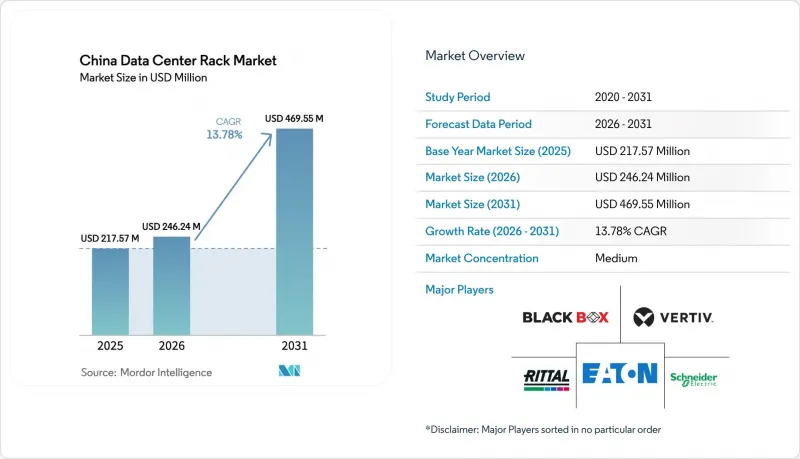
The China data center rack market size is expected to grow from USD 217.57 million in 2025 to USD 246.24 million in 2026 and is forecast to reach USD 469.55 million by 2031 at a 13.78% CAGR over 2026-2031.
Demand is accelerating as the Eastern Data, Western Computing policy moves hyperscale workloads toward inland hubs that offer inexpensive renewable energy and free-cooling climates. Liquid-cooling cabinets, once niche, now command mainstream adoption because rack power densities have climbed past 30 kilowatts in artificial-intelligence clusters. State-owned carriers are standardizing on full-height cabinets with busway distribution and factory-installed containment, thereby reducing installation time and improving consistency across regions. Mid-sized enterprises and 5G operators, meanwhile, favor compact half-height formats for edge nodes where floor space is constrained. Against this backdrop, vendors able to ship pre-commissioned rows with integrated power, telemetry, and coolant loops capture growing preference from both hyperscalers and colocation providers.
China Data Center Rack Market Trends and Insights
Surge in Cloud and AI Workloads Driving High-Density Rack Demand
Artificial-intelligence clusters now exceed 30 kilowatts per rack, forcing operators to retrofit old cabinets with liquid manifolds designed for only 8-12 kilowatts. Huawei's CloudMatrix 384 testbed showed that power delivery must scale to 50 kilowatts to host eight H100-class accelerators per server. Domestic AI revenues surpassed USD 41 billion in 2025 and could top USD 96 billion by 2028. Sensitive sectors such as finance and healthcare account for only 5% of server demand but insist on on-prem cabinets with tamper detection, nudging racks toward active cooling and security functions. Dell'Oro Group reported that direct liquid-cooling revenue more than doubled in Q1 2026, mirroring a 40% surge in busway power rails needed for 600-kilowatt rows. Together, these forces propel the China data center rack market toward higher wattages, richer telemetry, and factory-integrated coolant loops.
Increasing Deployment of Hyperscale and Colocation Facilities
GDS Holdings committed 88,000 square meters of new white space in Q3 2024, while BroadNet operated 72,000 cabinets by mid-2025 with another 230,000 in pipeline. Colocation leaders standardize on Scorpio frames that arrive with busbars, PDUs, and containment, cutting on-site labor by 60%. Gansu State Grid's cloud node invested USD 137 million for 3,000 racks, underscoring the capital intensity of turnkey rows. Hyperscalers now bypass distributors, locking multi-year rack contracts directly with manufacturers, a practice that disadvantages small vendors lacking co-engineering capacity. VNET Group's Q3 2024 revenue climbed 14.3% year-over-year on persistent colocation demand, spotlighting the scale dividends accruing to players that can deliver thousands of identical cabinets each quarter.
Blade and Converged Systems Reducing Traditional Rack Counts
Hyper-converged appliances pack compute, storage, and networking into a single chassis, trimming rack footprints for BFSI and branch sites. Although unit shipments decline, average selling prices rise because converged cabinets need heavier frames, dual busbars, and reinforced casters. Enterprises retrofitting three-tier networks often upsize from 42U to 48U formats, partially cushioning unit erosion. Vendors therefore face a nuanced threat; fewer cabinets but richer content per cabinet. Competitive positioning hinges on supplying reinforced enclosures that can handle 1,500-kilogram static loads without sacrificing airflow.
Other drivers and restraints analyzed in the detailed report include:
- Government Eastern Data, Western Computing Initiative Accelerating Build-Outs
- Carbon-Neutral Mandates Fostering Liquid-Cooling-Ready Rack Adoption
- Land and Power Quota Caps in Tier-1 Cities Tightening Data-Center Approvals
For complete list of drivers and restraints, kindly check the Table Of Contents.
Segment Analysis
Half racks will outpace the broader China data center rack market with a 14.54% CAGR because micro edge sites and 5G radio nodes need compact, rugged formats. The China data center rack market size for half racks is expanding as operators install cabinets rated IP65 to handle dust and moisture near street-level base stations. Edge deployments seldom exceed 3-4 kilowatts, yet still demand biometric locks and remote telemetry to deter vandalism. In contrast, full racks secured 71.32% of share in 2025 thanks to hyperscale contracts that standardize on 42U and 48U Scorpio frames. These larger enclosures streamline airflow and cable routes, lowering assembly hours and boosting consistency across multiple campuses.
Full-height formats will remain the backbone inside hyperscale halls because operators buy them in container-load volumes, compressing margins but creating predictable factory throughput. Quarter racks and wall-mount micro enclosures persist in retail chains and branch offices where aesthetics trump density. Inspur's desert-rated "Desert Ship" family highlights the march toward wide-temperature, dust-filtered cabinets that are now repatriating to western China wind belts. Rapid-deploy designs that arrive pre-cabled slash installation times by up to 40%, a productivity edge valued by colocation providers racing to bring new halls online.
Enclosed cabinets held 75.33% share in 2025, reflecting strict BFSI rules for tamper detection, EMI shielding, and seismic anchoring. The segment will grow faster than the overall China data center rack market, advancing 14.76% CAGR as cyber-risk regulations tighten. Open-frame racks remain favored by hyperscalers where access is already restricted and airflow efficiency is paramount. Even so, hyperscale operators increasingly add mesh-door inserts and blind-spot cameras, narrowing the cost gap.
Wall-mount and micro-edge styles gain traction in IoT gateways, retail checkout hubs, and smart-factory cells. The China data center rack market share for enclosed cabinets therefore remains dominant because enterprises continue to prioritize physical compliance features over initial cost savings. Schneider Electric and Vertiv compete head-to-head with modular accessories vertical PDUs, brush strip ingress panels, and environmental probes that integrate seamlessly into their respective EcoStruxure and Vertiv Life platforms, giving operators unified dashboards for power and thermal data.
The China Data Center Rack Market Report is Segmented by Rack Size (Quarter Rack, Half Rack, and Full Rack), Rack Type (Enclosed Cabinet, Open-Frame, and Wall-Mount and Micro-Edge Enclosure), Tier Type (Tier 1 and 2, Tier 3, and Tier 4), Data Center Size (Small, Medium, Large, and Hyperscale), Data Center Type (Colocation, Hyperscalers/CSPs, and Enterprise and Edge). The Market Forecasts are Provided in Terms of Value (USD).
List of Companies Covered in this Report:
- Eaton Corporation
- Black Box Corporation
- Rittal GmbH and Co. KG
- Schneider Electric SE
- Vertiv Group Corp.
- Dell Technologies Inc.
- nVent Electric PLC
- Hewlett Packard Enterprise
- Legrand SA
- Fujitsu Corporation
- Huawei Technologies Co. Ltd.
- Inspur Group
- Sugon Information Industry
- ZTE Corporation
- GreatIoT (Shenzhen) Technology
- Tripp Lite by Eaton
- Panduit Corp.
- Belden Inc.
- CyberPower Systems
- StarTech.com
Additional Benefits:
- The market estimate (ME) sheet in Excel format
- 3 months of analyst support
TABLE OF CONTENTS
1 INTRODUCTION
- 1.1 Study Assumptions and Market Definition
- 1.2 Scope of the Study
2 RESEARCH METHODOLOGY
3 EXECUTIVE SUMMARY
4 MARKET LANDSCAPE
- 4.1 Market Overview
- 4.2 Market Drivers
- 4.2.1 Increasing Deployment of Hyperscale and Colocation Facilities
- 4.2.2 Surge in Cloud and AI Workloads Driving High-Density Rack Demand
- 4.2.3 Government "Eastern Data, Western Computing" Initiative Accelerating Build-Outs
- 4.2.4 Carbon-Neutral Mandates Fostering Liquid-Cooling-Ready Rack Adoption
- 4.2.5 5G Edge Build-Outs Requiring Compact Micro-Racks in Base Stations
- 4.2.6 Rising BFSI Digital-Core Upgrades Requiring Secure On-Prem Racks
- 4.3 Market Restraints
- 4.3.1 Blade and Converged Systems Reducing Traditional Rack Counts
- 4.3.2 Land and Power Quota Caps in Tier-1 Cities Tightening Data-Center Approvals
- 4.3.3 U.S. Export-Control Limits on High-End Chips Slowing Ultra-Dense Rack Roll-Outs
- 4.3.4 Skilled-Labor Shortages for Advanced Rack Integration and Maintenance
- 4.4 Impact of Macroeconomic Factors on the Market
- 4.5 Industry Value Chain Analysis
- 4.6 Regulatory Landscape
- 4.7 Technological Outlook
- 4.8 Porter's Five Forces Analysis
- 4.8.1 Bargaining Power of Buyers
- 4.8.2 Bargaining Power of Suppliers
- 4.8.3 Threat of New Entrants
- 4.8.4 Threat of Substitute Products
- 4.8.5 Intensity of Competitive Rivalry
5 MARKET SIZE AND GROWTH FORECASTS (VALUE)
- 5.1 By Rack Size
- 5.1.1 Quarter Rack (More than 11U)
- 5.1.2 Half Rack (12-22U)
- 5.1.3 Full Rack (More than Equal to 42U)
- 5.2 By Rack Type
- 5.2.1 Enclosed Cabinet
- 5.2.2 Open-Frame
- 5.2.3 Wall-Mount and Micro-Edge Enclosure
- 5.3 By Tier Type
- 5.3.1 Tier 1 and 2
- 5.3.2 Tier 3
- 5.3.3 Tier 4
- 5.4 By Data Center Size
- 5.4.1 Small Data Center
- 5.4.2 Medium Data Center
- 5.4.3 Large Data Center
- 5.4.4 Hyperscale Data Center
- 5.5 By Data Center Type
- 5.5.1 Colocation Data Center
- 5.5.2 Hyperscalers Data Center/CSPs
- 5.5.3 Enterprise and Edge Data Center
6 COMPETITIVE LANDSCAPE
- 6.1 Market Concentration
- 6.2 Strategic Moves
- 6.3 Market Share Analysis
- 6.4 Company Profiles (Includes Global Level Overview, Market Level Overview, Core Segments, Financials as Available, Strategic Information, Market Rank/Share, Products and Services, and Recent Developments)
- 6.4.1 Eaton Corporation
- 6.4.2 Black Box Corporation
- 6.4.3 Rittal GmbH and Co. KG
- 6.4.4 Schneider Electric SE
- 6.4.5 Vertiv Group Corp.
- 6.4.6 Dell Technologies Inc.
- 6.4.7 nVent Electric PLC
- 6.4.8 Hewlett Packard Enterprise
- 6.4.9 Legrand SA
- 6.4.10 Fujitsu Corporation
- 6.4.11 Huawei Technologies Co. Ltd.
- 6.4.12 Inspur Group
- 6.4.13 Sugon Information Industry
- 6.4.14 ZTE Corporation
- 6.4.15 GreatIoT (Shenzhen) Technology
- 6.4.16 Tripp Lite by Eaton
- 6.4.17 Panduit Corp.
- 6.4.18 Belden Inc.
- 6.4.19 CyberPower Systems
- 6.4.20 StarTech.com
7 MARKET OPPORTUNITIES AND FUTURE OUTLOOK
- 7.1 White-Space and Unmet-Need Assessment

