
PUBLISHER: Mordor Intelligence | PRODUCT CODE: 2044099

PUBLISHER: Mordor Intelligence | PRODUCT CODE: 2044099
Microgrid - Market Share Analysis, Industry Trends & Statistics, Growth Forecasts (2026 - 2031)
The Microgrid Market size is expected to grow from USD 20.54 billion in 2025 to USD 24.44 billion in 2026 and is forecast to reach USD 54.99 billion by 2031 at 17.61% CAGR over 2026-2031.
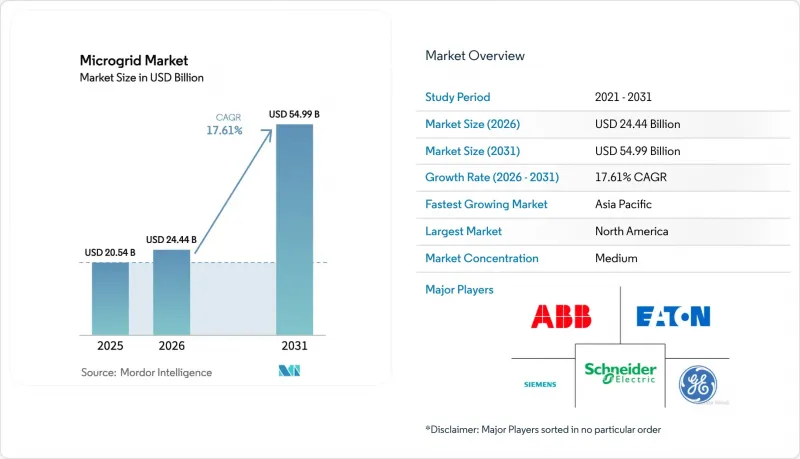
Behind that growth are falling inverter and battery costs, grid-forming technology that lets renewable penetration exceed 90%, and policy mandates that now tie resilience directly to regulated returns. Utility pilots are scaling into full feeder-level projects, military bases are racing toward net-zero targets, and software has become the margin engine even as hardware commoditizes. Growing wildfire liabilities in the western United States, diesel logistics in island nations, and the need for black-start capability at data centers all reinforce the business case for distributed, self-sufficient power systems. Together, these forces continue to shift project finance away from grant-driven pilots toward structured, performance-based contracts.
Global Microgrid Market Trends and Insights
Accelerated Rural Electrification in Africa & South Asia
World Bank data show 8,700 mini-grids serving 4.1 million people were installed in 34 African nations between 2020 and 2024, yet 600 million residents still lack reliable electricity; this unmet demand represents a USD 42 billion investment gap through 2030 in the microgrid market.[1] The International Finance Corporation mobilized USD 500 million of blended finance between 2024 and 2025, cutting developer capital costs in Nigeria and Kenya by six percentage points. India's Ministry of New and Renewable Energy budgeted INR 34.4 billion (USD 413 million) for 2024-2025 to solarize 200,000 agricultural pumps, displacing 1.2 billion liters of diesel annually. Bangladesh's Infrastructure Development Company Limited funded 1,850 additional solar mini-grids in 2024, while the Asian Development Bank committed USD 1.1 billion in 2025 to hybrid systems across South and Southeast Asia. Together, these initiatives narrow the cost of capital and shorten build cycles for off-grid microgrids that substitute costly diesel fuel.
IT/OT Convergence Spurs Advanced Microgrid Controllers in North America
The National Electrical Manufacturers Association published the US 80056-2024 standard, creating a common data model for bidirectional exchange between operational technology devices and enterprise IT systems supporting the microgrid market. As a result, microgrid controllers now integrate weather forecasts, wholesale price signals, and building-management inputs to optimize dispatch every 15 minutes. Schneider Electric's EcoStruxure Microgrid Advisor cut peak-demand charges by 23% across 47 U.S. sites by mid-2025, while ABB's Ability Energy Manager links directly with enterprise resource-planning suites to automate demand-response bids in PJM's capacity market. Cybersecurity, however, remains uneven: a 2024 National Institute of Standards and Technology audit found unified authentication missing in 62% of surveyed projects. Standardization accelerates controller roll-outs yet raises the bar for compliance.
Fragmented Codes Stalling Inter-connection Approvals in U.S. States
FERC Order 2023 streamlined generator queues, yet state-level processes still diverge in the microgrid market: California's cluster studies cut median approval time to 18 months in 2024, while Texas's serial study left 142 GW waiting. New York now insists that microgrids above 5 MW provide synthetic inertia, delaying 23 projects totaling 87 MW. Florida imposed a one-year moratorium on new applications in August 2024, freezing USD 1.2 billion of planned investment. Until state codes align, developers will hedge by favoring behind-the-meter systems or markets with clearer rules.
Other drivers and restraints analyzed in the detailed report include:
- Modular "Box" Microgrids for Disaster-Recovery in Caribbean Islands
- Utility-led Community Resilience Programs in U.S. & Australia
- Subsidy Claw-Back Risk in India's PM-KUSUM Programme
For complete list of drivers and restraints, kindly check the Table Of Contents.
Segment Analysis
Grid-connected configurations held 62.3% of 2025 deployments, providing utilities with non-wire alternatives to costly transmission upgrades while offering ancillary-service revenue across the microgrid market. Off-grid systems remain the lifeline for 733 million people without reliable electricity, largely in sub-Saharan Africa and South Asia. Off-grid assets deliver higher internal rates of return where diesel costs exceed USD 1.40 per liter and transmission tariffs approach USD 0.04 per kWh. For grid-tied projects, capacity-market participation, for example, PJM's USD 269.92 per MW-day clearing price, adds an extra income stream that lifts payback.
Hybrid connectivity now sits between the two models in the microgrid market. Puerto Rico mandates automatic transfer switching for microgrids above 5 MW, while California's updated Rule 21 requires smart inverters that ride through voltage and frequency disturbances. Satellite backhaul, often via Starlink, is lowering maintenance costs by enabling remote diagnostics at hundreds of African sites. Across all geographies, islanding capability is shifting from an optional feature to a project requirement.
Hardware still represented 63.3% of microgrid market revenue in 2025, yet lithium-ion batteries and PV modules both keep falling in price, compressing integrator margins. Software, by contrast, now earns 25% to 35% gross margins and is projected to expand at a 22.3% CAGR. Machine-learning dispatch can lift revenue by optimizing charge-discharge cycles against 15-minute wholesale prices and demand-charge windows. As-a-service contracts have emerged: Engie retains asset ownership and sells power below the grid tariff, lowering customer capex. Performance-based operations agreements with availability guarantees above 98% are now standard on public-sector procurements.
The Microgrid Market Report is Segmented by Connectivity (Grid-Connected and Off-Grid), Offering (Hardware, Software, and Services), Power Sources (Solar Photovoltaic, Combined Heat and Power, Fuel Cells, and More), Type (AC Microgrids, DC Microgrids, and More), Power Rating (Up To 1 MW, 1 To 5 MW, and More), End-User (Utilities, Commercial and Industrial, and Residential), and Geography (North America, Asia-Pacific, and More).
Geography Analysis
North America held 38.6% of installations in 2025, supported by a USD 1.8 billion incentive outlay in California and Department of Defense mandates for net-zero bases. Canada financed 18 Indigenous-led microgrids between 2024 and 2025, and Mexico's reopened distributed-generation market sparked 67 MW of industrial projects. State-level code fragmentation remains the leading bottleneck south of the border.
Asia-Pacific is the fastest-growing region at a 23.7% CAGR through 2031. India's PM-KUSUM solarizes agricultural pumps at scale, Japan enforces post-Fukushima resilience standards, and China's 14th Five-Year Plan targets 50 GW of distributed solar in frontier provinces. Southeast Asian islands substitute costly diesel imports with solar-battery systems, while Australia's neighborhood battery initiatives marry wildfire mitigation with community storage.
Europe, with 22% market share in 2025, pioneers grid-forming technology: Finland's 90 MW battery provides synthetic inertia, and Sweden has awarded a 200 MW project. Incentives in the United Kingdom and Spain accelerate community batteries on islands and weak grids. Cybersecurity directives under NIS2 raise compliance costs but improve operator readiness.
South America and the Middle East & Africa together account for 18% of installations, yet post near-20% growth. Brazil leverages biomass feedstock, Argentina revives RenovAr, and Colombia maps 340 off-grid communities. In the Gulf, oil companies deploy hybrid systems to cut diesel burn, while South Africa's utilities approve private microgrids to offset chronic load-shedding.
- ABB Ltd
- Siemens AG
- Schneider Electric SE
- General Electric Company
- Hitachi Energy Ltd
- Eaton Corporation PLC
- Honeywell International Inc.
- Toshiba Corporation
- S&C Electric Company
- ENGIE EPS SA
- Standard Microgrid Inc.
- PowerSecure Inc.
- Bloom Energy Corporation
- Caterpillar Inc.
- Wartsila Corporation
- Rolls-Royce Power Systems AG (MTU)
- Ameresco Inc.
- Tesla Inc.
- Enphase Energy Inc.
- Heila Technologies
- Spirae LLC
- Xendee Corporation
- HOMER Energy LLC
- AutoGrid Systems
Additional Benefits:
- The market estimate (ME) sheet in Excel format
- 3 months of analyst support
TABLE OF CONTENTS
1 Introduction
- 1.1 Study Assumptions & Market Definition
- 1.2 Scope of the Study
2 Research Methodology
3 Executive Summary
4 Market Landscape
- 4.1 Market Overview
- 4.2 Market Drivers
- 4.2.1 Accelerated Rural Electrification in Africa & South Asia
- 4.2.2 IT/OT Convergence Spurs Advanced Microgrid Controllers in North America
- 4.2.3 Modular "Box" Microgrids for Disaster-Recovery in Caribbean Islands
- 4.2.4 Utility-led Community Resilience Programs in U.S. & Australia
- 4.2.5 Grid-Forming Inverters Enabling 90%+ Renewables in Nordic Markets
- 4.2.6 Defense-Funded Net-Zero Bases Driving Hybrid Microgrids (NATO & INDOPACOM)
- 4.3 Market Restraints
- 4.3.1 Fragmented Codes Stalling Inter-connection Approvals in U.S. States
- 4.3.2 Subsidy Claw-Back Risk in India's PM-KUSUM Programme
- 4.3.3 Lithium-ion Price Volatility Disrupting CAPEX Planning 2024-25
- 4.3.4 Limited Cyber-security Standards for Multi-Vendor Projects
- 4.4 Supply-Chain Analysis
- 4.5 Regulatory Outlook (Targets, Policies)
- 4.6 Technological Outlook
- 4.7 Porter's Five Forces
- 4.7.1 Bargaining Power of Suppliers
- 4.7.2 Bargaining Power of Buyers
- 4.7.3 Threat of New Entrants
- 4.7.4 Threat of Substitutes
- 4.7.5 Intensity of Competitive Rivalry
5 Market Size & Growth Forecasts
- 5.1 By Connectivity
- 5.1.1 Grid-Connected Microgrids
- 5.1.2 Off-Grid/Islanded Microgrids
- 5.2 By Offering
- 5.2.1 Hardware (Power Generators, Energy-Storage Systems, Power Converters & Inverters, and Controllers)
- 5.2.2 Software (Energy Management Platforms, and Microgrid Controllers)
- 5.2.3 Services (Engineering, Procurement & Construction (EPC), Operations & Maintenance (O&M), and Consulting & Advisory)
- 5.3 By Power Source
- 5.3.1 Solar Photovoltaic (PV)
- 5.3.2 Combined Heat and Power (Natural Gas)
- 5.3.3 Diesel Generators
- 5.3.4 Wind
- 5.3.5 Fuel Cells
- 5.3.6 Others (Biomass, Hydro)
- 5.4 By Type
- 5.4.1 AC Microgrids
- 5.4.2 DC Microgrids
- 5.4.3 Hybrid AC/DC Microgrids
- 5.5 By Power Rating
- 5.5.1 Below 1 MW
- 5.5.2 1 to 5 MW
- 5.5.3 5 to 10 MW
- 5.5.4 Above 10 MW
- 5.6 By End-User
- 5.6.1 Utilities
- 5.6.2 Commercial and Industrial
- 5.6.3 Residential
- 5.7 By Geography
- 5.7.1 North America
- 5.7.1.1 United States
- 5.7.1.2 Canada
- 5.7.1.3 Mexico
- 5.7.2 Europe
- 5.7.2.1 United Kingdom
- 5.7.2.2 Germany
- 5.7.2.3 France
- 5.7.2.4 Spain
- 5.7.2.5 Nordic Countries
- 5.7.2.6 Russia
- 5.7.2.7 Rest of Europe
- 5.7.3 Asia-Pacific
- 5.7.3.1 China
- 5.7.3.2 India
- 5.7.3.3 Japan
- 5.7.3.4 South Korea
- 5.7.3.5 ASEAN Countries
- 5.7.3.6 Rest of Asia-Pacific
- 5.7.4 South America
- 5.7.4.1 Brazil
- 5.7.4.2 Argentina
- 5.7.4.3 Colombia
- 5.7.4.4 Rest of South America
- 5.7.5 Middle East and Africa
- 5.7.5.1 United Arab Emirates
- 5.7.5.2 Saudi Arabia
- 5.7.5.3 South Africa
- 5.7.5.4 Egypt
- 5.7.5.5 Rest of Middle East and Africa
- 5.7.1 North America
6 Competitive Landscape
- 6.1 Market Concentration
- 6.2 Strategic Moves (M&A, Partnerships, PPAs)
- 6.3 Market Share Analysis (Market Rank/Share for key companies)
- 6.4 Company Profiles (includes Global level Overview, Market level overview, Core Segments, Financials as available, Strategic Information, Products & Services, and Recent Developments)
- 6.4.1 ABB Ltd
- 6.4.2 Siemens AG
- 6.4.3 Schneider Electric SE
- 6.4.4 General Electric Company
- 6.4.5 Hitachi Energy Ltd
- 6.4.6 Eaton Corporation PLC
- 6.4.7 Honeywell International Inc.
- 6.4.8 Toshiba Corporation
- 6.4.9 S&C Electric Company
- 6.4.10 ENGIE EPS SA
- 6.4.11 Standard Microgrid Inc.
- 6.4.12 PowerSecure Inc.
- 6.4.13 Bloom Energy Corporation
- 6.4.14 Caterpillar Inc.
- 6.4.15 Wartsila Corporation
- 6.4.16 Rolls-Royce Power Systems AG (MTU)
- 6.4.17 Ameresco Inc.
- 6.4.18 Tesla Inc.
- 6.4.19 Enphase Energy Inc.
- 6.4.20 Heila Technologies
- 6.4.21 Spirae LLC
- 6.4.22 Xendee Corporation
- 6.4.23 HOMER Energy LLC
- 6.4.24 AutoGrid Systems
7 Market Opportunities & Future Outlook
- 7.1 White-space & Unmet-Need Assessment

