PUBLISHER: Mordor Intelligence | PRODUCT CODE: 2044260

PUBLISHER: Mordor Intelligence | PRODUCT CODE: 2044260
Asia-Pacific Acrylic Adhesives - Market Share Analysis, Industry Trends & Statistics, Growth Forecasts (2026 - 2031)
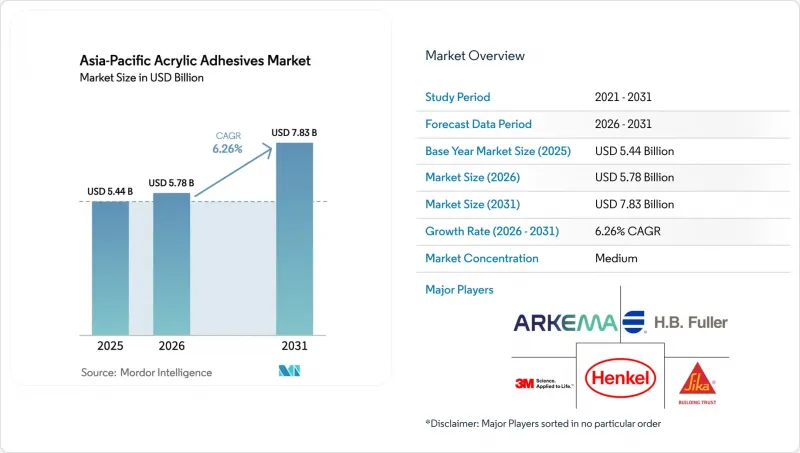
The Asia-Pacific Acrylic Adhesives Market size is projected to expand from USD 5.44 billion in 2025 and USD 5.78 billion in 2026 to USD 7.83 billion by 2031, registering a CAGR of 6.26% between 2026 and 2031. Expanding e-commerce packaging, accelerating electric-vehicle component assembly, and tighter regional VOC (Volatile Organic Compound) regulations underpin steady volume growth. Packaging lines continue to specify water-borne acrylic chemistries because they meet recyclability targets and deliver rapid peel-seal performance, while battery makers adopt thermally conductive acrylic hybrids that dissipate heat in cell-to-pack designs. Producers are also relocating capacity toward Thailand, Malaysia, and Vietnam to capture double-digit tax incentives that lower effective capex on new reactors. Feedstock cost swings, however, still compress margins, with 2025 methyl methacrylate prices falling 21% before rebounding in early 2026 on Middle-East supply shocks.
Asia-Pacific Acrylic Adhesives Market Trends and Insights
Surge in Electric Vehicle and Electronics Manufacturing
Battery-cell production remains the principal catalyst for specialty acrylic demand. CATL shipped 661 GWh of lithium-ion batteries in 2025 at 96.9% utilization, prompting adhesive developers to supply thermally conductive, vibration-resistant acrylic hybrids that bond cells directly to pack enclosures. Hubei Huitian invested RMB 97.68 million (USD 13.59 million) in 2025 for a new latex binder line and partnered with Tailan New Energy on solid-state battery adhesives that will reach commercial scale after 2027. Semiconductor localization amplifies the pull; NANPAO formed a 2025 joint venture to formulate ultra-low outgassing chip-package adhesives suited to advanced nodes. South Korea's market for silicon-carbide power-chip adhesives is projected to triple to KRW 850 billion (USD 598.4 million) by 2030, sustaining demand for nano-silver and acrylic-based die attach solutions.
Regulatory Push Toward Low-VOC, Water-Borne Systems
China's GB 33372-2020 limits solvent-borne acrylics to 510 g/L VOC, whereas water-borne analogs must stay below 50 g/L in indoor uses, forcing widespread line conversions to emulsion polymerization and longer oven zones. Singapore's Super Low-Energy building program and Malaysia's Green Technology Investment Allowance reinforce similar thresholds, encouraging formulators to certify products under ISO 14024 ecolabels. The European Union Packaging and Packaging Waste Regulation, effective 2025, adds an external compliance lever because Asia-made flexible packs must hit 30% recycled content by 2030. BASF's Acrodur resins showcased at CHINAPLAS 2025 demonstrate the commercial pivot, offering thermally crosslinkable, formaldehyde-free water-borne acrylics compatible with 75% regenerated fibers.
Acrylic-Monomer Price Volatility and Feedstock Risk
Methyl methacrylate prices fell to USD 1,275 per ton by December 2025, 21% below January, before Mitsubishi Chemical announced a price rise in March 2026 as Middle-East tensions disrupted naphtha flows that supply over 60% of regional cracker feedstock. BASF followed with USD 100 per ton acrylate increases in March 2026, citing higher logistics and energy outlays. Such whipsaw movements erode forward-pricing visibility and drive formulators toward dual sourcing and higher safety stocks.
Other drivers and restraints analyzed in the detailed report include:
- Expansion of Flexible Packaging for E-Commerce Fulfillment
- Mega Construction Projects Across India and ASEAN
- Intensifying PU and Epoxy Substitution in High-Strength Joints
For complete list of drivers and restraints, kindly check the Table Of Contents.
Segment Analysis
Packaging commanded 59.56% of the Asia-Pacific acrylic adhesives market share in 2025. Rising parcel volumes from cross-border e-commerce and retailer commitments to curb single-use plastics sustain high-volume water-borne consumption in carton sealing and flexible laminations. The Asia-Pacific Acrylic Adhesives market size tied to automotive uses is expanding at the fastest CAGR of 6.72% duirng the forecast period (2026-2031) because lightweight multi-material bodies and silicon-carbide inverters need heat-resistant joints. Building and construction demand is diverging: China's adhesive volumes soften with its 1.8% uptick in residential starts, but India, Vietnam, and Malaysia deliver mid-single-digit gains through data-center and semiconductor-fab work. Footwear exporters in India gain from the EU FTA tariff removal, spurring incremental acrylic purchases for PU-lined leather uppers.
The Asia-Pacific Acrylic Adhesives Market Report is Segmented by End-User Industry (Aerospace, Automotive, Building and Construction, Footwear and Leather, Healthcare, Packaging, and More), Technology (Reactive, Solvent-Borne, UV-Cured Adhesives, and Water-Borne), and Country (Australia, China, India, Indonesia, Malaysia, Singapore, South Korea, and Rest of Asia-Pacific). The Market Forecasts are Provided in Terms of Value (USD).
List of Companies Covered in this Report:
- 3M
- Arkema
- artience Co., Ltd.
- Avery Dennison Corporation
- BASF
- Dow Inc.
- Dymax Corporation
- H.B. Fuller Company
- Henkel AG & Co. KGaA
- Hubei Huitian New Materials Co., Ltd.
- Huntsman Corporation
- ITW Performance Polymers
- Jowat SE
- Kangda New Materials (Group) Co., Ltd.
- NANPAO RESINS CHEMICAL GROUP
- Permabond LLC
- Pidilite Industries Ltd.
- Sika AG
Additional Benefits:
- The market estimate (ME) sheet in Excel format
- 3 months of analyst support
TABLE OF CONTENTS
1 Introduction
- 1.1 Study Assumptions & Market Definition
- 1.2 Scope of the Study
2 Research Methodology
3 Executive Summary
4 Market Landscape
- 4.1 Market Overview
- 4.2 Market Drivers
- 4.2.1 Surge in Electric Vehicle and electronics manufacturing in China-led hubs
- 4.2.2 Regulatory push toward low-VOC, water-borne systems
- 4.2.3 Expansion of flexible packaging for e-commerce fulfilment
- 4.2.4 Mega construction projects across India and ASEAN
- 4.2.5 ASEAN tax-holiday schemes catalysing local adhesive output
- 4.3 Market Restraints
- 4.3.1 Acrylic-monomer price volatility and feedstock risk
- 4.3.2 Intensifying PU and epoxy substitution in high-strength joints
- 4.3.3 Compliance cost of solvent-borne VOC abatement
- 4.4 Value Chain Analysis
- 4.5 Distribution Channel Analysis
- 4.6 Regulatory Landscape
- 4.7 Porter's Five Forces
- 4.7.1 Threat of New Entrants
- 4.7.2 Bargaining Power of Suppliers
- 4.7.3 Bargaining Power of Buyers
- 4.7.4 Threat of Substitutes
- 4.7.5 Competitive Rivalry
5 Market Size & Growth Forecasts (Value)
- 5.1 By End-user Industry
- 5.1.1 Aerospace
- 5.1.2 Automotive
- 5.1.3 Building and Construction
- 5.1.4 Footwear and Leather
- 5.1.5 Healthcare
- 5.1.6 Packaging
- 5.1.7 Other End-user Industries
- 5.2 By Technology
- 5.2.1 Reactive
- 5.2.2 Solvent-borne
- 5.2.3 UV-Cured Adhesives
- 5.2.4 Water-borne
- 5.3 By Country
- 5.3.1 Australia
- 5.3.2 China
- 5.3.3 India
- 5.3.4 Indonesia
- 5.3.5 Japan
- 5.3.6 Malaysia
- 5.3.7 Singapore
- 5.3.8 South Korea
- 5.3.9 Thailand
- 5.3.10 Rest of Asia-Pacific
6 Competitive Landscape
- 6.1 Market Concentration
- 6.2 Strategic Moves
- 6.3 Market Share/Raking Analysis
- 6.4 Company Profiles {(includes Global level Overview, Market level overview, Core Segments, Financials as available, Strategic Information, Products & Services, and Recent Developments)}
- 6.4.1 3M
- 6.4.2 Arkema
- 6.4.3 artience Co., Ltd.
- 6.4.4 Avery Dennison Corporation
- 6.4.5 BASF
- 6.4.6 Dow Inc.
- 6.4.7 Dymax Corporation
- 6.4.8 H.B. Fuller Company
- 6.4.9 Henkel AG & Co. KGaA
- 6.4.10 Hubei Huitian New Materials Co., Ltd.
- 6.4.11 Huntsman Corporation
- 6.4.12 ITW Performance Polymers
- 6.4.13 Jowat SE
- 6.4.14 Kangda New Materials (Group) Co., Ltd.
- 6.4.15 NANPAO RESINS CHEMICAL GROUP
- 6.4.16 Permabond LLC
- 6.4.17 Pidilite Industries Ltd.
- 6.4.18 Sika AG
7 Market Opportunities and Future Outlook
- 7.1 White-space and Unmet-Need Assessment

