PUBLISHER: Mordor Intelligence | PRODUCT CODE: 2044288

PUBLISHER: Mordor Intelligence | PRODUCT CODE: 2044288
Europe Electronic Manufacturing Services - Market Share Analysis, Industry Trends & Statistics, Growth Forecasts (2026 - 2031)
The Europe electronic manufacturing services market size is projected to be USD 76.78 billion in 2025, USD 80.79 billion in 2026, and reach USD 103.14 billion by 2031, growing at a CAGR of 5.01% from 2026 to 2031.
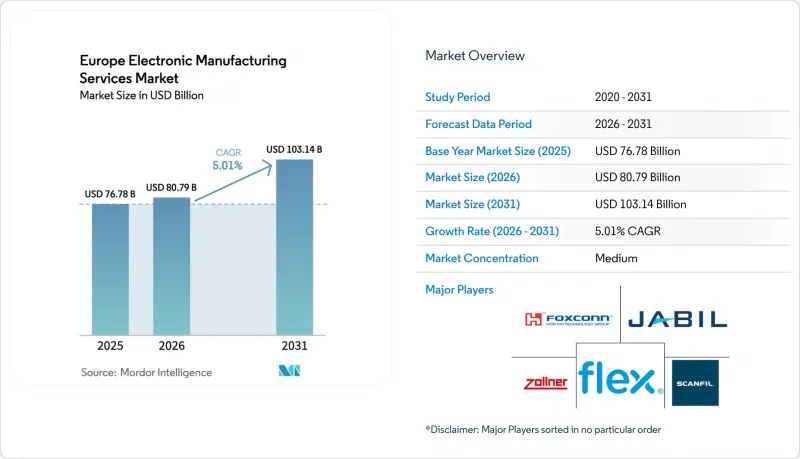
The momentum of the Europe electronics manufacturing services market stems from legislation that prioritizes supply-chain transparency, mounting demand for local capacity in automotive, industrial, and medical verticals, and the ongoing relocation of high-mix, low-volume programs from Asia to compliant European plants. Contract manufacturers that can prove ISO 14001 alignment and Corporate Sustainability Reporting Directive readiness are securing multi-year frameworks, while providers lacking carbon-accounting systems are losing bids to rivals offering traceable, low-emission assembly. Near-shoring also shortens prototype cycles from eight to three weeks, an advantage that offsets labor premiums through faster design iterations and lower freight expense. Automation, collaborative robotics, and AI-driven optical inspection continue to trim direct labor content, narrowing the cost delta with Asia to roughly 20% for complex assemblies, down from 40% five years earlier.
Europe Electronic Manufacturing Services Market Trends and Insights
Rising Outsourcing of Electronics Production by European OEMs
OEMs are channeling capital away from in-house lines toward software and electrification, pushing complex board population and box build into the hands of contract partners that already meet ISO 13485 and IPC standards. Siemens' 2025 divestiture of its Amberg PCB operation and Bosch's deeper collaboration with Zollner typify the transition, allowing manufacturers to release cash tied up in surface-mount lines and reflow ovens. Outsourcing penetration in Europe climbed to 38% in 2025 yet still trails Asia, implying runway for the Europe electronics manufacturing services market to convert additional captive plants. Providers able to co-locate engineering with manufacturing speed revisions from prototype to pilot in under a week, a cycle that captive plants rarely match. The trend is most pronounced in medical and industrial programs, where compliance and revision-control overhead favor specialist EMS partners.
Surge in Automotive Electronics Demand
Each battery electric vehicle embeds three to five times more PCB area than its combustion predecessor, and Europe's legal green-light for Level-3 autonomous functions is adding lidar, radar, and high-compute domain controllers. Volkswagen PowerCo's BMS co-development with Kontron and widespread adoption of 48-volt architectures increase silicon-carbide and gallium-nitride module demand. EMS sites that master flip-chip and wire-bond assembly under automotive-grade thermal cycling secure higher-margin content and long contracts. As Tier-1 suppliers push software-defined vehicles, they rely on EMS partners to iterate hardware every 18 months. This momentum positions automotive as the fastest advancing slice of the Europe electronic manufacturing services market through 2031.
Higher European Labor and Energy Costs vs. Asia
Fully loaded German labor averages EUR 35 per hour (USD 39.6) against EUR 4 in Vietnam (USD 4.5), a gulf only partly bridged by robotics. Industrial power in Germany cost EUR 0.18 per kWh (USD 0.20) during 2025, more than double Chinese rates, eroding margins on wave solder and selective-solder lines. Although automation trimmed direct labor minutes by 25%, amortization of robotics and inspection cameras keeps overhead high. Products that mandate European proximity, such as BMS modules subject to the Battery Regulation, survive the premium, but price-sensitive consumer gear does not. The imbalance caps the upper range of the Europe electronics manufacturing services market CAGR until energy-price convergence or more aggressive automation emerges.
Other drivers and restraints analyzed in the detailed report include:
- Near-Shoring Triggered by Supply-Chain Security Legislation
- CSRD-Driven Demand for Low-Carbon EMS Facilities
- Skilled-Labor Gap in Advanced SMT and Automation
For complete list of drivers and restraints, kindly check the Table Of Contents.
Segment Analysis
Europe electronic manufacturing services market size for PCB assembly commanded 41.22% of revenue in 2025, yet electromechanical box build is posting a 6.11% CAGR through 2031 as OEMs outsource enclosure integration, cable harnessing, and functional test benches. The migration frees OEM cash otherwise tied up in clean rooms and climate-controlled chambers, simultaneously reducing headcount dedicated to compliance audits. EMS providers capture additional margin by bundling firmware flashing and in-circuit verification, locking clients into multi-year agreements with penalty clauses for schedule slippage.
Industrial and medical programs fuel the surge because product lifecycles run a decade or more, and engineering change notifications often cascade deep into assembly. Box-build plants located near design centers in Germany and Switzerland complete engineering feedback loops in days, diminishing the impact of labor premiums by avoiding air freight on reworked sub-assemblies. The Europe electronic manufacturing services market gains further momentum as providers embed supply-chain orchestration software that pulls real-time component availability into scheduling, allowing split-lot kitting and concurrent engineering on low-volume runs. In turn, ODM-style engineering services grow alongside, enabling EMS firms to tweak board layouts for manufacturability without incurring redesign cycles that jeopardize regulatory approvals.
Contract manufacturing held a 63.71% share of the Europe electronic manufacturing services market in 2025, reflecting entrenched consignment models where OEMs own parts and EMS firms charge labor fees. However, hybrid and turnkey contracts, projected at a 5.67% CAGR, are resetting liability frameworks by making EMS vendors responsible for component sourcing, obsolescence, and traceability. Smaller OEMs embrace the model because it taps the bulk-buying leverage of distributors like Arrow and Avnet, thereby insulating them from allocation shortages that defined 2024-2025.
Turnkey deals also empower EMS houses to swap pin-compatible alternates instantly, bypassing OEM engineering change orders and preventing production stops. Providers with deep balance sheets underwrite six months of safety stock, a strategy out of reach for niche players. Consequently, scale advantages accumulate, prompting consolidation as evidenced by Kontron's integration of KATEK that merged design, procurement, and assembly inside a single ERP backbone. The Europe EMS market therefore witnesses a progressive concentration among operators capable of absorbing inventory carrying costs while maintaining just-in-time delivery metrics for critical medical and automotive projects.
The Europe Electronic Manufacturing Services Market Report is Segmented by Service Type (Engineering Services, and More), Business Model (Contract Manufacturing (CM), Original Design Manufacturing (ODM), and More), Manufacturing Process (Surface Mount Technology (SMT), Through-Hole Technology (THT), and More), End-User (Industrial, Automotive, and More), and Geography. The Market Forecasts are Provided in Terms of Value (USD).
List of Companies Covered in this Report:
- Foxconn Technology Group
- Flex Ltd.
- Jabil Inc.
- Zollner Elektronik AG
- GPV Group
- Scanfil Plc
- Videoton Holding
- Kontron AG
- Kitron ASA
- Cicor Group
- HANZA AB
- LACROIX Electronics
- NOTE AB
- Neways Electronics
- BMK Group
- Melecs EWS
- Variosystems AG
- TT Electronics Plc
- INCAP Oy
- Norautron AS
Additional Benefits:
- The market estimate (ME) sheet in Excel format
- 3 months of analyst support
TABLE OF CONTENTS
1 INTRODUCTION
- 1.1 Study Assumptions and Market Definition
- 1.2 Scope of the Study
2 RESEARCH METHODOLOGY
3 EXECUTIVE SUMMARY
4 MARKET LANDSCAPE
- 4.1 Market Overview
- 4.2 Market Drivers
- 4.2.1 Rising Outsourcing of Electronics Production by European OEMs
- 4.2.2 Surge in Automotive Electronics Demand (EVs, ADAS)
- 4.2.3 Growth of High-Mix, Low-Volume Industrial and Medical Devices
- 4.2.4 EU Battery-Booster Incentives for Local BMS and Power-Electronics
- 4.2.5 Near-shoring Triggered by Supply-Chain Security Legislation
- 4.2.6 CSRD-Driven Demand for Low-Carbon EMS Facilities
- 4.3 Market Restraints
- 4.3.1 Higher European Labour and Energy Costs vs. Asia
- 4.3.2 Ongoing Component Shortages and Inventory Risk
- 4.3.3 Skilled-Labour Gap in Advanced SMT and Automation
- 4.3.4 Fragmented EU Compliance Burden for Smaller EMS Firms
- 4.4 Industry Value Chain Analysis
- 4.5 Regulatory Landscape
- 4.6 Technological Outlook
- 4.7 Impact of Macroeconomic Factors on the Market
- 4.8 Porter's Five Forces Analysis
- 4.8.1 Bargaining Power of Suppliers
- 4.8.2 Bargaining Power of Buyers
- 4.8.3 Threat of New Entrants
- 4.8.4 Threat of Substitutes
- 4.8.5 Intensity of Competitive Rivalry
5 MARKET SIZE AND GROWTH FORECASTS (VALUE)
- 5.1 By Service Type
- 5.1.1 Electronic Manufacturing Services
- 5.1.1.1 PCB Assembly
- 5.1.1.2 Electromechanical Assembly/Box Build
- 5.1.1.3 Prototyping
- 5.1.1.4 Other Electronic Manufacturing Services
- 5.1.2 Engineering Services
- 5.1.3 Test and Development Implementation Services
- 5.1.4 Logistics Services
- 5.1.5 Other Service Types
- 5.1.1 Electronic Manufacturing Services
- 5.2 By Business Model
- 5.2.1 Contract Manufacturing (CM)
- 5.2.2 Original Design Manufacturing (ODM)
- 5.2.3 Hybrid / Turnkey / Other Business Models
- 5.3 By Manufacturing Process
- 5.3.1 Surface Mount Technology (SMT)
- 5.3.2 Through-Hole Technology (THT)
- 5.3.3 Advanced Packaging / Hybrid Processes
- 5.4 By End-user
- 5.4.1 Mobile Devices (Smartphones and Tablets)
- 5.4.2 Consumer Electronics
- 5.4.3 Computer (PCs/Desktop/Laptops)
- 5.4.4 Industrial
- 5.4.5 Automotive
- 5.4.6 Communication
- 5.4.7 Lighting
- 5.4.8 Medical
- 5.4.9 Other End-users
- 5.5 By Geography
- 5.5.1 Europe
- 5.5.1.1 Germany
- 5.5.1.2 United Kingdom
- 5.5.1.3 Rest of Europe
- 5.5.1 Europe
6 COMPETITIVE LANDSCAPE
- 6.1 Market Concentration
- 6.2 Strategic Moves
- 6.3 Market Share Analysis
- 6.4 Company Profiles (includes Global Level Overview, Market Level Overview, Core Segments, Financials as available, Strategic Information, Market Rank/Share for key companies, Products and Services, and Recent Developments)
- 6.4.1 Foxconn Technology Group
- 6.4.2 Flex Ltd.
- 6.4.3 Jabil Inc.
- 6.4.4 Zollner Elektronik AG
- 6.4.5 GPV Group
- 6.4.6 Scanfil Plc
- 6.4.7 Videoton Holding
- 6.4.8 Kontron AG
- 6.4.9 Kitron ASA
- 6.4.10 Cicor Group
- 6.4.11 HANZA AB
- 6.4.12 LACROIX Electronics
- 6.4.13 NOTE AB
- 6.4.14 Neways Electronics
- 6.4.15 BMK Group
- 6.4.16 Melecs EWS
- 6.4.17 Variosystems AG
- 6.4.18 TT Electronics Plc
- 6.4.19 INCAP Oy
- 6.4.20 Norautron AS
7 MARKET OPPORTUNITIES AND FUTURE OUTLOOK
- 7.1 White-space and Unmet-Need Assessment

