
PUBLISHER: Mordor Intelligence | PRODUCT CODE: 2044293

PUBLISHER: Mordor Intelligence | PRODUCT CODE: 2044293
Recycled Plastics - Market Share Analysis, Industry Trends & Statistics, Growth Forecasts (2026 - 2031)
The Recycled Plastics Market size is projected to be USD 72.66 billion in 2025, USD 77.93 billion in 2026, and reach USD 111.10 billion by 2031, growing at a CAGR of 7.35% from 2026 to 2031.
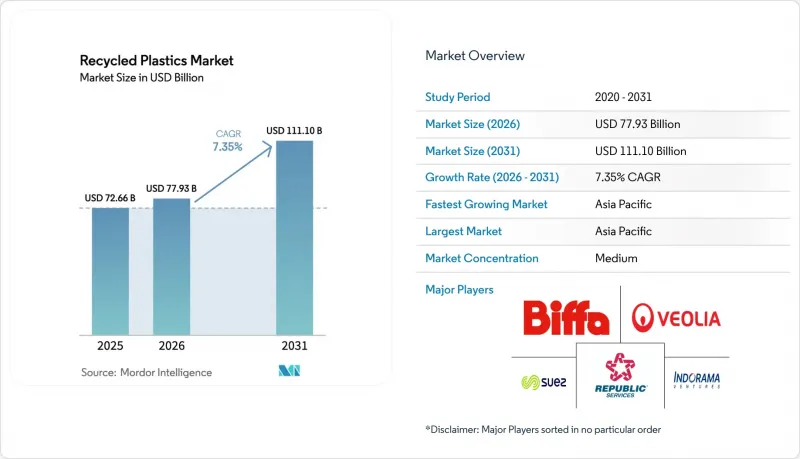
Regulatory pressure is now the primary force shaping supply chains, led by the European Union's Packaging and Packaging Waste Regulation that establishes minimum recycled content thresholds across plastic packaging categories beginning in 2026. Asia-Pacific leads demand and capacity build-out as Extended Producer Responsibility frameworks spread across major Southeast Asian markets alongside China's nationwide expansion of waste-sorting programs. Technology maturation is visible in enzymatic PET depolymerization reaching commercial timelines at Carbios-led facilities and in the use of long-term offtake contracts that stabilize recycler revenue and unlock financing. North America continues to add infrastructure with support from U.S. Environmental Protection Agency grants, though collection and contamination variability limit the share of food-grade output today.Automotive and other engineering uses are fast-growing as OEM programs align with circularity goals and end-of-life requirements, while packaging remains the anchor application under content mandates and brand targets.
Global Recycled Plastics Market Trends and Insights
EU PPWR 30% Recycled-Content Mandate Drives Closed Loop Investment
The European Union's Packaging and Packaging Waste Regulation entered into force on February, 2025, and applies from August, 2026, setting minimum recycled content thresholds for plastic packaging, including 30% for contact-sensitive PET, 10% for other contact-sensitive plastics, 30% for single-use beverage bottles, and 35% for the remaining categories, with further increases through 2040. This clarity has enabled new project financing for advanced closed-loop capacity, including Veolia's commitment to a tray-to-tray PET facility in Shrewsbury with planned throughput of 80,000 tonnes per year, supported by a GBP 70 million investment (USD 88.9 million). Loop Industries also advanced its first European Infinite Loop license at BASF's Schwarzheide site, with an initial license payment of EUR 10 million (USD 10.8 million) and a target of 70,000 metric tons per year by 2030. Producer-responsibility fee modulation based on recyclability grades in markets like France adds further price signals that favor mono-material over multi-layer designs. Imports of recyclate face rigorous equivalence and compliance requirements under EU food-contact regulations, reinforcing investment in domestic, auditable supply.
Sustained Virgin HDPE Prices Above USD 1,600/t Improve rPE Economics
When virgin high-density polyethylene prices remain elevated, converters reconsider recycled HDPE and LDPE for packaging and industrial uses that can tolerate or benefit from PCR content. Mandates and content targets also underpin stable demand for natural rHDPE in beverage and household applications. The Association of Plastic Recyclers reported that reclaimers across the United States and Canada could process nearly 2 billion additional pounds annually if feedstock quality and end-market demand are sustained. This available capacity allows the recycled plastics market to respond faster when virgin price arbitrage improves PCR economics. The combination of sustained virgin price premiums and incremental policy pressure supports higher recycled-content utilization in durable and semi-durable applications.
rPET Flake Oversupply in Europe Compresses Recycler Margins
Periods of oversupply in European rPET markets reduce pricing for flakes and compress margins for recyclers, especially when brand demand tracks the minimum thresholds under the Single-Use Plastics Directive for beverage bottles. Inventory build-ups and seasonality can intensify pressure, which in turn defers investments in quality upgrades and reduces run rates. Collection costs and energy prices also influence cost parity against virgin PET, reinforcing the need for EPR fee signals and consistent enforcement. Clarifications under EU food-contact rules sustain high-quality standards, yet they require additional documentation and process validation. Improved deposit-return performance and harmonized specifications can help stabilize demand at higher recycled-content levels within the recycled plastics market.
Other drivers and restraints analyzed in the detailed report include:
- China Zero-Waste Cities 2.0 Expands Household Plastics Collection Infrastructure
- U.S. EPA USD 375 Million Recycling-Infrastructure Grants Unlock Regional Capacity
- Escalating Marine Insurance & Asia-EU Freight Costs Pressure Feedstock Routes
For complete list of drivers and restraints, kindly check the Table Of Contents.
Segment Analysis
Polyethylene accounted for 29.18% in 2025, led by high-density polyethylene in rigid packaging and low-density or linear low-density polyethylene in film applications, supported by a mature collection and recycling infrastructure. Mechanical reclaimers in the United States and Canada also indicated material headroom to process more polyolefins if bale quality and downstream demand hold steady.
The "Other Plastics" segment is expected to grow at the fastest CAGR at 9.15%, driven primarily by the automotive and electronics sectors. Demand for these recycled engineering polymers is surging as manufacturers strive to meet stringent sustainability targets. High-performance recycled ABS, PC, and PA offer excellent mechanical properties, making them highly viable, eco-friendly substitutes for virgin resins in complex, durable manufacturing applications while advancing global circular economy initiatives.
Mechanical recycling accounted for 70.8% of activity in 2025, reflecting the installed base of washing, extrusion, and pelletizing lines that feed packaging, construction, and automotive applications. The recycled plastics market size for chemical routes is projected to expand at 8.71% CAGR through 2031 as brands seek food-contact and high-spec polymers from mixed or contaminated streams. The Association of Plastic Recyclers has documented significant unused capacity potential across PET, HDPE, PP, and film, contingent on better feedstock supply and consistent demand signals. Food-contact regulation shifts in the European Union place more emphasis on certifying decontamination processes, which raises both quality and traceability requirements that favor investment in proven technologies.
Advanced routes such as depolymerization complement mechanical methods by converting hard-to-recycle streams into monomers or purified polymers ready for high-value applications. Adoption patterns vary by sector, with packaging brands prioritizing food-grade consistency while automotive and electronics focus on functional performance benchmarks. Standards, certifications, and chain-of-custody documentation influence buyer confidence alongside cost, which supports steady growth in contracted volumes. As more commercial plants demonstrate reliable output, chemical recycling's role is expected to grow within the recycled plastics market without displacing mechanical recycling's large base.
The Recycled Plastics Market is Segmented by Polymer Type (Polyethylene, Polyethylene Terephthalate, and Others), by Recycling Process (Mechanical, Chemical/Advanced, and Others), by Product Form (Flakes, Powder, and Others), by End-Use Application (Packaging, Building & Construction, and Others), and by Geography (North America, Europe, Asia-Pacific and More). The Market Forecasts are Provided in Terms of Value (USD).
Geography Analysis
Asia-Pacific led with 48.7% share in 2025 and is projected to grow at 8.32% CAGR through 2031 as EPR programs expand across fast-growing consumer markets and large urban clusters standardize waste sorting. China's Zero-Waste Cities 2.0 is scaling to about 200 cities from 2026 to 2030, targeting 60% participation by 2027 and aiming for comprehensive coverage by 2035, which expands feedstock availability and quality. Shanghai's regulation raised household sorting compliance and improved the city's overall recycling rate, both of which support higher quality rPET and polyolefin streams. Chemical recycling projects are also emerging in the region, including trial operations of new units designed to handle contaminated films and mixed plastics. This mix of policy, infrastructure, and technology signals durable growth for the recycled plastics market in Asia-Pacific.
Europe followed with a significant market share in 2025 as PPWR requirements for minimum recycled content and recyclability stimulate closed-loop investments across Member States. The Single-Use Plastics Directive's 25% rPET target for beverage bottles in 2025 and 30% by 2030 continues to anchor demand for high-quality bottle-grade PCR. New projects include tray-to-tray PET lines in the United Kingdom alongside advanced depolymerization investments supported by state aid and innovation funding. The combination of fee modulation and brand targets encourages mono-material designs and clear labeling that improve recyclability outcomes. As import compliance tightens for food-contact applications, local supply gains an advantage where traceability is critical.
North America is addressing infrastructure gaps through federal program funding and growing state EPR laws while reclaimers report sizable unused capacity that could be activated with better feedstock quality and steady demand. Mechanical recyclers across PET, HDPE, PP, and film have the processing headroom to add output as brand specifications align and bale contamination falls. Large resin producers and converters are signing long-term agreements for advanced recycled and purified PCR feedstocks that supply mass-balance portfolios and enable food-contact or high-spec uses. As these agreements scale, they help reduce the volatility faced by reclaimers and catalyze new investments in lines that serve the recycled plastics market.
- Veolia
- Indorama Ventures
- Biffa
- Republic Services
- Suez
- KW Plastics
- Plastipak Holdings
- Loop Industries
- MBA Polymers
- Brightmark
- Agilyx
- Waste Management Inc.
- Clean Harbors
- CarbonLite
- Eastman Chemical
- BASF SE
- SABIC
- LyondellBasell
- Covestro
- REMondis
- Custom Polymers
- Green Line Polymers
- Berry Global
- PureCycle Technologies
Additional Benefits:
- The market estimate (ME) sheet in Excel format
- 3 months of analyst support
TABLE OF CONTENTS
1 Introduction
- 1.1 Study Assumptions & Market Definition
- 1.2 Scope of the Study
2 Research Methodology
3 Executive Summary
4 Market Landscape
- 4.1 Market Overview
- 4.2 Market Drivers
- 4.2.1 EU Packaging & Packaging-Waste Regulation (PPWR) 30 % recycled-content mandate
- 4.2.2 China's "Zero-Waste Cities 2.0" rollout boosting household plastics collection
- 4.2.3 U.S. EPA USD 375 million Recycling-Infrastructure Grants unlocking new capacity
- 4.2.4 Commercial start-up of enzymatic PET depolymerisation technology
- 4.2.5 Corporate ?recycled-plastic PPAs? providing price floors for recyclers
- 4.2.6 Sustained high virgin-polymer prices (less than USD 1 600/ton HDPE), improving recycled polyethylene (rPE) economics
- 4.3 Market Restraints
- 4.3.1 rPET flake oversupply in Europe compressing recycler margins
- 4.3.2 Escalating marine-insurance & freight costs on Asia-EU feedstock routes
- 4.3.3 EU legal ambiguity on chemical-recycling mass-balance claims cooling investment
- 4.3.4 Skilled-labour shortage for robotics-enabled MRFs delaying yield gains
- 4.4 Value / Supply-Chain Analysis
- 4.5 Regulatory Outlook
- 4.6 Technological Outlook
- 4.7 Industry Attractiveness - Porter?s Five Forces
- 4.7.1 Threat of New Entrants
- 4.7.2 Bargaining Power of Buyers
- 4.7.3 Bargaining Power of Suppliers
- 4.7.4 Threat of Substitutes
- 4.7.5 Intensity of Competitive Rivalry
- 4.8 Impact of Geopolitical Events & Inflationary Pressures
5 Market Size & Growth Forecasts (Value, In USD Billion)
- 5.1 By Polymer Type
- 5.1.1 Polyethylene
- 5.1.1.1 High-Density Polyethylene (HDPE)
- 5.1.1.2 Low/Linear-Low Density Polyethylene (LD/LLDPE)
- 5.1.2 Polyethylene Terephthalate (PET)
- 5.1.3 Polypropylene (PP)
- 5.1.4 Polyvinyl Chloride (PVC)
- 5.1.5 Polystyrene (PS)
- 5.1.6 Other Plastics (ABS, PC, PA, etc.)
- 5.1.1 Polyethylene
- 5.2 By Recycling Process
- 5.2.1 Mechanical Recycling
- 5.2.2 Chemical / Advanced Recycling (Pyrolysis, Depolymerisation, Dissolution)
- 5.2.3 Energy Recovery (Plastic-to-Fuel)
- 5.2.4 Others (Biological - enzymatic/ microbial)
- 5.3 By Product Form
- 5.3.1 Flakes
- 5.3.2 Pellets/ Granules
- 5.3.3 Powder
- 5.3.4 Others (Chips, Regrind, Sheets, etc.)
- 5.4 By End-Use Application
- 5.4.1 Packaging
- 5.4.1.1 Food-Grade
- 5.4.1.2 Non-Food Grade
- 5.4.2 Building & Construction
- 5.4.3 Automotive
- 5.4.4 Electrical & Electronics
- 5.4.5 Textiles & Apparel
- 5.4.6 Consumer Products
- 5.4.7 Agriculture & Horticulture
- 5.4.8 Other Applications (General Manufacturing, Medical Devices, etc.)
- 5.4.1 Packaging
- 5.5 By Geography
- 5.5.1 North America
- 5.5.1.1 United States
- 5.5.1.2 Canada
- 5.5.1.3 Rest of North America
- 5.5.2 South America
- 5.5.2.1 Brazil
- 5.5.2.2 Argentina
- 5.5.2.3 Rest of South America
- 5.5.3 Europe
- 5.5.3.1 Germany
- 5.5.3.2 United Kingdom
- 5.5.3.3 France
- 5.5.3.4 Italy
- 5.5.3.5 Spain
- 5.5.3.6 BENELUX (Belgium, Netherlands, and Luxembourg)
- 5.5.3.7 NORDICS (Denmark, Finland, Iceland, Norway, and Sweden)
- 5.5.3.8 Rest of Europe
- 5.5.4 Middle East and Africa
- 5.5.4.1 Saudi Arabia
- 5.5.4.2 United Arab Emirates
- 5.5.4.3 Turkey
- 5.5.4.4 South Africa
- 5.5.4.5 Nigeria
- 5.5.4.6 Egypt
- 5.5.4.7 Rest of Middle East and Africa
- 5.5.5 Asia-Pacific
- 5.5.5.1 China
- 5.5.5.2 India
- 5.5.5.3 Japan
- 5.5.5.4 South Korea
- 5.5.5.5 ASEAN (Indonesia, Thailand, Philippines, Malaysia, Vietnam)
- 5.5.5.6 Rest of Asia-Pacific
- 5.5.1 North America
6 Competitive Landscape
- 6.1 Market Concentration
- 6.2 Strategic Moves (M&A, Capacity, JVs)
- 6.3 Market Share Analysis
- 6.4 Company Profiles {(includes Global level Overview, Market level overview, Core Segments, Financials as available, Strategic Information, Products & Services, and Recent Developments)}
- 6.4.1 Veolia
- 6.4.2 Indorama Ventures
- 6.4.3 Biffa
- 6.4.4 Republic Services
- 6.4.5 Suez
- 6.4.6 KW Plastics
- 6.4.7 Plastipak Holdings
- 6.4.8 Loop Industries
- 6.4.9 MBA Polymers
- 6.4.10 Brightmark
- 6.4.11 Agilyx
- 6.4.12 Waste Management Inc.
- 6.4.13 Clean Harbors
- 6.4.14 CarbonLite
- 6.4.15 Eastman Chemical
- 6.4.16 BASF SE
- 6.4.17 SABIC
- 6.4.18 LyondellBasell
- 6.4.19 Covestro
- 6.4.20 REMondis
- 6.4.21 Custom Polymers
- 6.4.22 Green Line Polymers
- 6.4.23 Berry Global
- 6.4.24 PureCycle Technologies
7 Market Opportunities & Future Outlook
- 7.1 White-Space & Unmet-Need Assessment

