PUBLISHER: Mordor Intelligence | PRODUCT CODE: 2060419

PUBLISHER: Mordor Intelligence | PRODUCT CODE: 2060419
Africa Olive - Market Share Analysis, Industry Trends & Statistics, Growth Forecasts (2026 - 2031)
According to Mordor Intelligence, the african olives market size is projected to grow from USD 4.20 billion in 2025 to USD 4.46 billion in 2026 and is anticipated to reach USD 6.06 billion by 2031, registering a CAGR of 7.4% during 2026-2031.
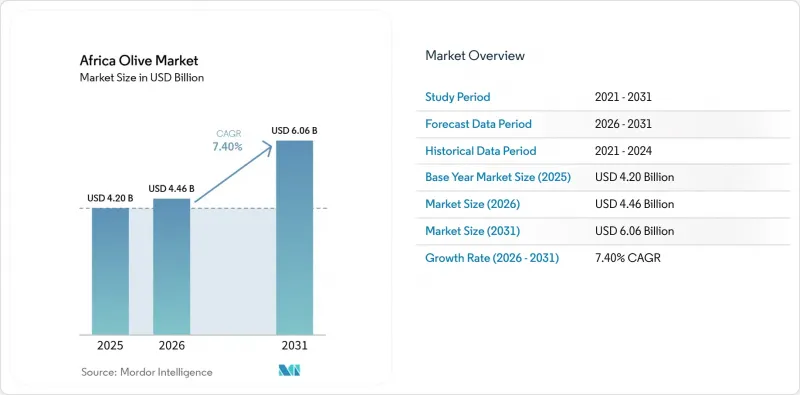
This report is Segmented by Country (Morocco, Algeria, Tunisia, and the More). The Report Includes Production Analysis (Volume), Consumption Analysis (Value and Volume), Import Analysis (Value and Volume), Export Analysis (Value and Volume), Wholesale Price Trend Analysis and Forecast, List of Key Players, and More. The Market Forecasts are Provided in Terms of Value (USD) and Volume (Metric Tons).
Africa Olive Market Trends and Insights
Rising Health Shift Toward Mediterranean Diets
The growing adoption of Mediterranean dietary patterns is contributing to increased demand for olive-based products in both global and African markets. Olive oil, a central element of this diet, is appreciated for its health benefits, such as cardiovascular support and nutritional value. This shift in consumer preferences is influencing both domestic consumption and export demand for olives and olive-derived products. According to the International Olive Council, the Mediterranean diet is projected to remain widely acknowledged as one of the healthiest dietary patterns globally in 2025, underscoring the importance of olives in health-oriented consumption trends . This is increasing olive demand by driving health awareness and boosting the consumption of table olives among health-conscious consumers worldwide.
Subsidized Olive Seedling Programs in North Africa
Government-supported olive seedling programs in North Africa are playing a crucial role in enhancing the region's long-term supply capacity and export competitiveness. Algeria's Ministry of Agriculture has set a target to expand olive cultivation to 1 million hectares by 2030. As of 2024, olive groves span approximately 443,000 hectares, with over 65 million productive trees nationwide . These efforts aim to increase farmer incomes, optimize land use, and solidify Algeria's position as a model for olive sector development in the region.
Climate-Change-Induced Drought Cycles
Climate change-driven drought cycles are directly affecting the stability of olive production in North Africa. Recent industry data indicates that Morocco's olive oil production dropped to 90,000 metric tons in the 2024/2025 crop year, significantly below the five-year average of 141,600 metric tons. This decline is attributed to persistent drought and elevated temperatures. The reduction in yields and disruption of supply consistency underscore water scarcity as a major constraint on olive production and overall market growth in Africa.
Other drivers and restraints analyzed in the detailed report include:
- Growth in Clean-Label Organic Olive Oil Exports
- AI-Driven Precision Irrigation Boosting Olive Yields
- International Olive-Oil Price Volatility
For complete list of drivers and restraints, kindly check the Table Of Contents.
Additional Benefits:
- The market estimate (ME) sheet in Excel format
- 3 months of analyst support
TABLE OF CONTENTS
1 Introduction
- 1.1 Study Assumptions and Market Definition
- 1.2 Scope of the Study
2 Research Methodology
3 Executive Summary
4 Market Landscape
- 4.1 Market Overview
- 4.2 Market Drivers
- 4.2.1 Rising health shift toward Mediterranean diets
- 4.2.2 Subsidized olive seedling programs in North Africa
- 4.2.3 Growth in clean-label organic olive oil exports
- 4.2.4 AI-driven precision irrigation boosting olive yields
- 4.2.5 Blockchain traceability premiums in extra virgin olive oil exports
- 4.2.6 Carbon credit monetization for regenerative olive farming
- 4.3 Market Restraints
- 4.3.1 Climate-change-induced drought cycles
- 4.3.2 International olive-oil price volatility
- 4.3.3 Limited cold-pressing capacity outside North Africa
- 4.3.4 Threat of Xylella fastidiosa spread into Maghreb groves
- 4.4 Opportunities
- 4.5 Challenges
- 4.6 Value Chain Analysis
- 4.7 Technologies and usage of AI in the Industry
- 4.8 Input Market Analysis
- 4.8.1 Seeds
- 4.8.2 Fertilizers
- 4.8.3 Crop Protection Chemicals
- 4.9 Distribution Channel Analysis
- 4.10 Market Sentiment Analysis
- 4.11 PESTLE Analysis
5 Market Size and Growth Forecast (Value and Volume)
- 5.1 By Geography
- 5.1.1 Africa
- 5.1.1.1 Morocco
- 5.1.1.1.1 Production Analysis (Area Harvested, Yield, and Production Volume)
- 5.1.1.1.2 Consumption Analysis (Consumption Value and Volume)
- 5.1.1.1.3 Import Market Analysis (Import Value, Volume, and Key Supplying Markets)
- 5.1.1.1.4 Export Market Analysis (Export Value, Volume, and Key Destination Markets)
- 5.1.1.1.5 Wholesale Price Trend Analysis and Forecast
- 5.1.1.1.6 Regulatory Framework
- 5.1.1.1.7 List of Key Players
- 5.1.1.1.8 Logistics and Infrastructure
- 5.1.1.1.9 Seasonality Analysis
- 5.1.1.2 Algeria
- 5.1.1.2.1 Production Analysis (Area Harvested, Yield, and Production Volume)
- 5.1.1.2.2 Consumption Analysis (Consumption Value and Volume)
- 5.1.1.2.3 Import Market Analysis (Import Value, Volume, and Key Supplying Markets)
- 5.1.1.2.4 Export Market Analysis (Export Value, Volume, and Key Destination Markets)
- 5.1.1.2.5 Wholesale Price Trend Analysis and Forecast
- 5.1.1.2.6 Regulatory Framework
- 5.1.1.2.7 List of Key Players
- 5.1.1.2.8 Logistics and Infrastructure
- 5.1.1.2.9 Seasonality Analysis
- 5.1.1.3 Tunisia
- 5.1.1.3.1 Production Analysis (Area Harvested, Yield, and Production Volume)
- 5.1.1.3.2 Consumption Analysis (Consumption Value and Volume)
- 5.1.1.3.3 Import Market Analysis (Import Value, Volume, and Key Supplying Markets)
- 5.1.1.3.4 Export Market Analysis (Export Value, Volume, and Key Destination Markets)
- 5.1.1.3.5 Wholesale Price Trend Analysis and Forecast
- 5.1.1.3.6 Regulatory Framework
- 5.1.1.3.7 List of Key Players
- 5.1.1.3.8 Logistics and Infrastructure
- 5.1.1.3.9 Seasonality Analysis
- 5.1.1.4 Egypt
- 5.1.1.4.1 Production Analysis (Area Harvested, Yield, and Production Volume)
- 5.1.1.4.2 Consumption Analysis (Consumption Value and Volume)
- 5.1.1.4.3 Import Market Analysis (Import Value, Volume, and Key Supplying Markets)
- 5.1.1.4.4 Export Market Analysis (Export Value, Volume, and Key Destination Markets)
- 5.1.1.4.5 Wholesale Price Trend Analysis and Forecast
- 5.1.1.4.6 Regulatory Framework
- 5.1.1.4.7 List of Key Players
- 5.1.1.4.8 Logistics and Infrastructure
- 5.1.1.4.9 Seasonality Analysis
- 5.1.1.5 Libya
- 5.1.1.5.1 Production Analysis (Area Harvested, Yield, and Production Volume)
- 5.1.1.5.2 Consumption Analysis (Consumption Value and Volume)
- 5.1.1.5.3 Import Market Analysis (Import Value, Volume, and Key Supplying Markets)
- 5.1.1.5.4 Export Market Analysis (Export Value, Volume, and Key Destination Markets)
- 5.1.1.5.5 Wholesale Price Trend Analysis and Forecast
- 5.1.1.5.6 Regulatory Framework
- 5.1.1.5.7 List of Key Players
- 5.1.1.5.8 Logistics and Infrastructure
- 5.1.1.5.9 Seasonality Analysis
- 5.1.1.1 Morocco
- 5.1.1 Africa
6 End Use and Application
- 6.1 Primary Applications and Emerging Applications
- 6.2 Consumption Breakdown by Industries
7 Competitive Landscape
- 7.1 Overview of the Competition
- 7.2 Recent Developments
- 7.3 Market Concentration Analysis
8 Market Opportunity and Future Outlook

