PUBLISHER: Mordor Intelligence | PRODUCT CODE: 2061508

PUBLISHER: Mordor Intelligence | PRODUCT CODE: 2061508
South America Olive - Market Share Analysis, Industry Trends & Statistics, Growth Forecasts (2026 - 2031)
According to Mordor Intelligence, the south america olive market was valued at USD 0.88 billion in 2025 and is projected to grow from USD 0.88 billion in 2026 to USD 1.33 billion by 2031, registering a CAGR of 8.5% during 2026-2031.
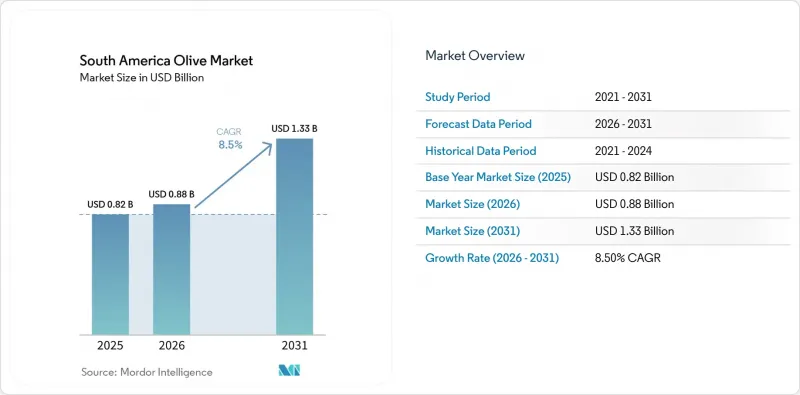
This report is Segmented by Country (Argentina, Chile, and Peru). The Report Includes Production Analysis (Volume), Consumption Analysis (Value and Volume), Import Analysis (Value and Volume), Export Analysis (Value and Volume), and Wholesale Price Trend Analysis and Forecast, List of Key Players and More. The Market Forecasts are Provided in Terms of Value (USD) and Volume (Metric Tons).
South America Olive Market Trends and Insights
Rising Olive Production Meeting Intra-Regional Demand
Olive production in South America is increasing in response to growing intra-regional demand. The International Olive Council reports that Argentina's table olive production reached 96,000 metric tons in 2024/25, a 17% increase compared to the previous year . This growth demonstrates the expansion of supply capacity as producers scale output to meet rising demand, particularly from neighboring markets. Favorable conditions and established cultivation systems have supported this production growth, solidifying South America's position as a significant supplier in olive trade.
Growing Demand for Virgin and Extra-Virgin Olive Oil
The growing demand for premium olive-based products is contributing to the expansion of the South American olive market. Increasing consumer preference for high-quality, natural, and traceable products is prompting producers to adopt improved cultivation practices and enhance quality. This focus is boosting the demand for superior-grade olives, particularly in export-driven markets. Consequently, producers in countries like Argentina and Chile are prioritizing quality differentiation and value-added production. This development enhances the olive value chain by improving price realization, increasing competitiveness, and supporting sustained market growth in the region.
Climatic Anomalies (El Nino and La Nina) Impacting Yields
Climatic anomalies, including temperature fluctuations and irregular rainfall patterns linked to El Nino and La Nina events, continue to impact the stability of olive production in South America. According to the World Meteorological Organization, an El Nino event is projected to develop from mid-2026, which is likely to influence global temperature and rainfall patterns, including critical agricultural areas. These climate variations affect precipitation distribution and increase the occurrence of extreme weather events, such as floods and droughts, across South America . This directly disrupts flowering cycles and fruit development, leading to uncertainty in yield stability and complicating harvest planning in key olive-producing regions.
Other drivers and restraints analyzed in the detailed report include:
- Government Incentives Supporting Orchards and Drip Irrigation
- Expansion of Retail Chains for Certified Table Olives
- High Production Costs versus Imported Mediterranean Olives
For complete list of drivers and restraints, kindly check the Table Of Contents.
Additional Benefits:
- The market estimate (ME) sheet in Excel format
- 3 months of analyst support
TABLE OF CONTENTS
1 Introduction
- 1.1 Study Assumptions and Market Definition
- 1.2 Scope of the Study
2 Research Methodology
3 Executive Summary
4 Market Landscape
- 4.1 Market Overview
- 4.2 Market Drivers
- 4.2.1 Rising olive production meeting intra-regional demand
- 4.2.2 Growing demand for virgin and extra-virgin olive oil
- 4.2.3 Government incentives supporting orchards and drip irrigation
- 4.2.4 Expansion of retail chains for certified table olives
- 4.2.5 Adoption of climate-resilient varieties and precision farming
- 4.2.6 Growth in olive-based nutraceutical products
- 4.3 Market Restraints
- 4.3.1 Climatic anomalies (El Nino and La Nina) impacting yields
- 4.3.2 High production costs versus imported Mediterranean olives
- 4.3.3 Limited mechanization in hilly areas increasing losses
- 4.3.4 Fluctuating farm-gate prices affecting smallholder profitability
- 4.4 Opportunities
- 4.5 Challenges
- 4.6 Value Chain Analysis
- 4.7 Technologies and usage of AI in the Industry
- 4.8 Input Market Analysis
- 4.8.1 Seeds
- 4.8.2 Fertilizers
- 4.8.3 Crop Protection Chemicals
- 4.9 Distribution Channel Analysis
- 4.10 Market Sentiment Analysis
- 4.11 PESTLE Analysis
5 Market Size and Growth Forecast (Value and Volume)
- 5.1 By Geography
- 5.1.1 South America
- 5.1.1.1 Argentina
- 5.1.1.1.1 Production Analysis (Area Harvested, Yield, and Production Volume)
- 5.1.1.1.2 Consumption Analysis (Consumption Value and Volume)
- 5.1.1.1.3 Import Market Analysis (Import Value, Volume, and Key Supplying Markets)
- 5.1.1.1.4 Export Market Analysis (Export Value, Volume, and Key Destination Markets)
- 5.1.1.1.5 Wholesale Price Trend Analysis and Forecast
- 5.1.1.1.6 Regulatory Framework
- 5.1.1.1.7 List of Key Players
- 5.1.1.1.8 Logistics and Infrastructure
- 5.1.1.1.9 Seasonality Analysis
- 5.1.1.2 Peru
- 5.1.1.2.1 Production Analysis (Area Harvested, Yield, and Production Volume)
- 5.1.1.2.2 Consumption Analysis (Consumption Value and Volume)
- 5.1.1.2.3 Import Market Analysis (Import Value, Volume, and Key Supplying Markets)
- 5.1.1.2.4 Export Market Analysis (Export Value, Volume, and Key Destination Markets)
- 5.1.1.2.5 Wholesale Price Trend Analysis and Forecast
- 5.1.1.2.6 Regulatory Framework
- 5.1.1.2.7 List of Key Players
- 5.1.1.2.8 Logistics and Infrastructure
- 5.1.1.2.9 Seasonality Analysis
- 5.1.1.3 Chile
- 5.1.1.3.1 Production Analysis (Area Harvested, Yield, and Production Volume)
- 5.1.1.3.2 Consumption Analysis (Consumption Value and Volume)
- 5.1.1.3.3 Import Market Analysis (Import Value, Volume, and Key Supplying Markets)
- 5.1.1.3.4 Export Market Analysis (Export Value, Volume, and Key Destination Markets)
- 5.1.1.3.5 Wholesale Price Trend Analysis and Forecast
- 5.1.1.3.6 Regulatory Framework
- 5.1.1.3.7 List of Key Players
- 5.1.1.3.8 Logistics and Infrastructure
- 5.1.1.3.9 Seasonality Analysis
- 5.1.1.1 Argentina
- 5.1.1 South America
6 End Use and Application
- 6.1 Primary Applications and Emerging Applications
- 6.2 Consumption Breakdown by Industries
7 Competitive Landscape
- 7.1 Overview of the Competition
- 7.2 Recent Developments
- 7.3 Market Concentration Analysis
8 Market Opportunities and Future Outlook

