
PUBLISHER: Mordor Intelligence | PRODUCT CODE: 2061498

PUBLISHER: Mordor Intelligence | PRODUCT CODE: 2061498
United States Lime - Market Share Analysis, Industry Trends & Statistics, Growth Forecasts (2026 - 2031)
According to Mordor Intelligence, the united states lime market size was valued at USD 2.50 billion in 2025 and is estimated to grow from USD 2.61 billion in 2026 to reach USD 3.21 billion by 2031, at a CAGR of 4.23% during the forecast period 2026 to 2031.
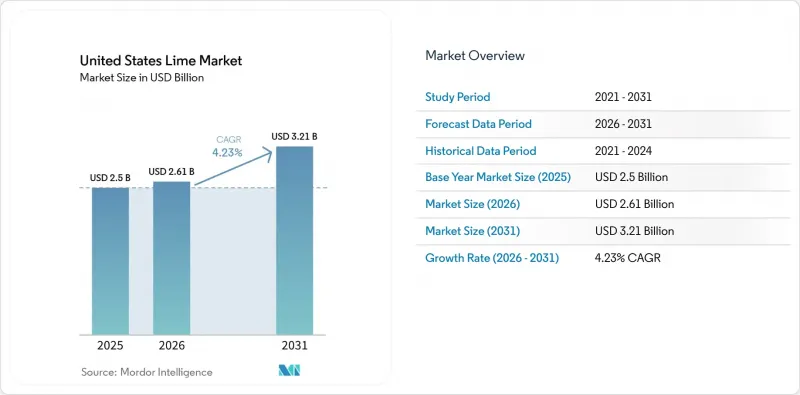
The United States Lime Market Report Includes Production Analysis (Volume), Consumption Analysis (Value and Volume), Import Analysis (Value and Volume), Export Analysis (Value and Volume), Wholesale Price Trend Analysis and Forecast, List of Key Players, and More. The Market Forecasts are Provided in Terms of Value (USD) and Volume (Metric Tons).
United States Lime Market Trends and Insights
Low-Sugar Beverage Reformulation Favors Lime Flavor
Reduced-sugar beverage reformulation has made lime more important because it helps hold taste balance when sugar content falls. That role is especially relevant in sparkling drinks, electrolyte beverages, and functional waters where tartness supports a cleaner finish. As more brands lean on stevia and monk fruit, lime has become a dependable flavor anchor rather than a seasonal accent. This matters to the United States lime market because derivative demand from juice concentrates and natural flavor systems adds another layer of consumption beyond fresh produce sales. It also gives importers and processors a broader demand base that can soften some seasonal swings in distributor purchasing.
Hispanic Menu Growth Lifts Everyday Lime Usage
Everyday lime use has widened as Hispanic food moves further into mainstream restaurant and retail formats. Dishes that once sat mainly in specialist outlets now appear in fast-casual chains, grocery meal kits, and general restaurant menus, which raises routine lime usage across a larger customer base. The shift is not limited to one demographic group because younger consumers increasingly treat lime as a normal ingredient in tacos, seafood, grilled foods, and fresh drinks. This has helped the United States lime market move toward steadier weekly consumption rather than narrow holiday spikes. Over time, that pattern supports a more durable demand floor because repeat household use becomes less dependent on seasonal occasions.
Mexican Supply Shocks Drive Price Volatility
The United States lime market faces significant risk due to heavy reliance on Mexico. Disruptions from weather, logistics, or security issues in Mexico quickly impact wholesale, retail, and foodservice pricing. Criminal cartel activity in Michoacan, which produced over 1 million metric tons of lime in 2024 (SIAP), adds further disruption beyond conventional supply chain monitoring. United States buyers are forced to maintain costly South American backup supplies, even during periods of Mexican abundance, as Colombia and Peru lack Mexico's scale. This creates sharp supply fluctuations, complicating planning for downstream customers.
Other drivers and restraints analyzed in the detailed report include:
- Cocktail and Foodservice Recovery Lifts Fresh-Squeeze Demand
- Premium Pricing Supports Orchard Renewal and Agronomy Investment
- Citrus Greening and Weather Stress Limit United States Orchard Scaling
For complete list of drivers and restraints, kindly check the Table Of Contents.
Additional Benefits:
- The market estimate (ME) sheet in Excel format
- 3 months of analyst support
TABLE OF CONTENTS
1 Introduction
- 1.1 Study Assumptions and Market Definition
- 1.2 Scope of the Study
2 Research Methodology
3 Executive Summary
4 Market Landscape
- 4.1 Market Overview
- 4.2 Market Drivers
- 4.2.1 Low-sugar beverage reformulation favors lime flavor
- 4.2.2 Hispanic menu growth lifts everyday lime usage
- 4.2.3 Cocktail and foodservice recovery lifts fresh-squeeze demand
- 4.2.4 Premium pricing supports orchard renewal and agronomy investment
- 4.2.5 Colombia and Peru reduce offseason stockouts
- 4.2.6 Potential Hawaii mainland access expands domestic supply optionality
- 4.3 Market Restraints
- 4.3.1 Mexican supply shocks drive price volatility
- 4.3.2 Citrus greening and weather stress limit United States orchard scaling
- 4.3.3 Tariff and border-policy uncertainty complicates sourcing plans
- 4.3.4 Colombian quality variability raises rejection and sorting costs
- 4.4 Opportunities
- 4.5 Challenges
- 4.6 Value Chain Analysis
- 4.7 Technologies and usage of AI in the Industry
- 4.8 Input Market Analysis
- 4.8.1 Seeds
- 4.8.2 Fertilizers
- 4.8.3 Crop Protection Chemicals
- 4.9 Distribution Channel Analysis
- 4.10 Market Sentiment Analysis
- 4.11 PESTLE Analysis
5 Market Size and Growth Forecasts (Value and Volume)
- 5.1 United States
- 5.1.1 Production Analysis
- 5.1.1.1 Production Volume
- 5.1.1.1.1 Area Harvested and Yield
- 5.1.1.2 Consumption Analysis (Value and Volume)
- 5.1.1.3 Trade Analysis (Value and Volume)
- 5.1.1.3.1 Import Market Analysis
- 5.1.1.3.1.1 Import Value and Volume
- 5.1.1.3.1.2 Key Supplying Markets
- 5.1.1.3.2 Export Market Analysis
- 5.1.1.3.2.1 Export Value and Volume
- 5.1.1.3.2.2 Key Destinations Markets
- 5.1.1.3.1 Import Market Analysis
- 5.1.1.4 Wholesale Price Trend Analysis and Forecast
- 5.1.1.5 Regulatory Framework
- 5.1.1.6 Logistic and Infrastructure
- 5.1.1.7 Seasonality Analysis
- 5.1.1.1 Production Volume
- 5.1.1 Production Analysis
6 End Use Applications and Industries
- 6.1 Primary Applications and Emerging Applications
- 6.2 Consumption Breakdown by Industries
7 Competitive Landscape
- 7.1 Overview of the Competition
- 7.2 Recent Developments
- 7.3 Market Concentration Analysis
- 7.4 List of Key Players
- 7.4.1 Wonderful Citrus LLC
- 7.4.2 Sunkist Growers, Inc.
- 7.4.3 Fresh Del Monte Produce Inc.
- 7.4.4 Brooks Tropicals, LLC
- 7.4.5 SiCar Farms Ltd Co.
- 7.4.6 Exp. Group LLC
- 7.4.7 Tropifresh USA LLC
- 7.4.8 B&S Grupo Exportador, S.A. de C.V.
- 7.4.9 I. Kunik Company
- 7.4.10 La Huerta Imports Inc.
- 7.4.11 ISPE Produce Inc.
- 7.4.12 Fresco Produce, LLC
- 7.4.13 CIL Fresh, LLC
- 7.4.14 New Limeco LLC
- 7.4.15 Trucco, Inc.
8 Market Opportunities and Future Outlook

