
PUBLISHER: Mordor Intelligence | PRODUCT CODE: 2061530

PUBLISHER: Mordor Intelligence | PRODUCT CODE: 2061530
China Lime - Market Share Analysis, Industry Trends & Statistics, Growth Forecasts (2026 - 2031)
According to Mordor Intelligence, the china lime market size is projected to be USD 3.41 billion in 2025, USD 3.54 billion in 2026, and reach USD 4.33 billion by 2031, growing at a CAGR of 4.11% from 2026 to 2031.
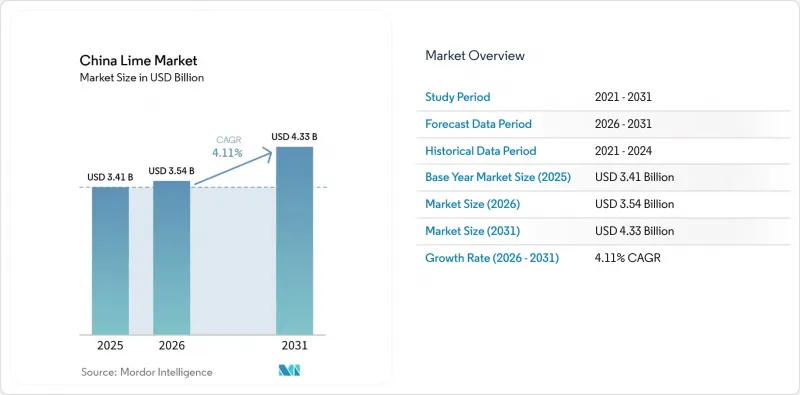
The China Lime Market Report Includes Production Analysis (Volume), Consumption Analysis (Value and Volume), Import Analysis (Value and Volume), Export Analysis (Value and Volume), Wholesale Price Trend Analysis and Forecast, List of Key Players, and More. The Market Forecasts are Provided in Terms of Value (USD) and Volume (Metric Tons).
China Lime Market Trends and Insights
Rapid Penetration of High-Yield Tahiti Cultivars
Tahiti cultivars yield more than 40% fruit than legacy lines and crop year-round in subtropical microclimates, cutting orchard payback to under five years. Wanzhou authorities work with the Chinese Academy of Citrus Research to optimize germplasm and extend shelf life by up to fourteen days This performance shortens orchard payback periods and improves growers' profitability. Local authorities, working with research institutions, are focusing on optimizing germplasm and extending shelf life to support market expansion. Contract farming models have demonstrated that quality enforcement can lift farmers' incomes, while niche varieties such as finger lime highlight opportunities in ultra-premium markets. Together, these developments illustrate how varietal upgrades are reshaping the lime industry, offering growers improved returns and positioning China as a competitive supplier in both domestic and export channels. Hainan's industrial cultivation of finger lime in Qionghai exceeds 300 acres, with the fruit priced at RMB 600 to 700 per kilogram (USD 85 to USD 100). Known as 'citrus caviar,' its high value and EU export qualification highlight its potential in global high-end culinary markets.
Rising Demand from Beverage and Craft Cocktail Industry
China's beverage sector is driving strong demand for fresh lime, with ready-to-drink tea, craft cocktails, and bubble tea chains increasingly relying on natural fruit inputs. Bars in major cities emphasize authenticity by insisting on fresh lime juice, while large beverage companies have launched programs to source directly from producing regions, ensuring consistent quality standards. The craft beer segment and specialty tea chains are replacing synthetic flavor concentrates with fresh fruit, tightening supply chains, and rewarding reliable growers. This shift reflects consumer preferences for natural ingredients and premium experiences, positioning lime as a critical input across multiple beverage categories. The trend is projected to continue as urban consumers embrace healthier, fresher, and more authentic drink options.
Weather-Induced Production Volatility
China's lime production faces significant risks from extreme weather events such as typhoons and droughts, particularly in regions like Guangxi and Yunnan. These conditions can sharply reduce annual output, creating volatility in supply and pricing. Irrigation deficits during critical growth stages further compound yield risks, leaving farmers vulnerable to climate exposure. Crop insurance coverage remains limited, forcing growers to rely on self-insurance, which discourages long-term investment in orchards and infrastructure. This lack of protection undermines confidence in expanding lime acreage and highlights the need for stronger risk management frameworks. Addressing weather-induced volatility will be essential for stabilizing production and ensuring sustainable growth in the lime sector.
Other drivers and restraints analyzed in the detailed report include:
- Expanding Domestic Nutraceutical Vitamin C Segment
- Growth of Value-Added Lime Derivatives
- Citrus Greening Disease and Phytosanitary Costs
For complete list of drivers and restraints, kindly check the Table Of Contents.
Additional Benefits:
- The market estimate (ME) sheet in Excel format
- 3 months of analyst support
TABLE OF CONTENTS
1 Introduction
- 1.1 Study Assumptions and Market Definition
- 1.2 Scope of the Study
2 Research Methodology
3 Executive Summary
4 Market Landscape
- 4.1 Market Overview
- 4.2 Market Drivers
- 4.2.1 Rapid penetration of high-yield Tahiti cultivars
- 4.2.2 Rising demand from China's beverage and craft cocktail industry
- 4.2.3 Expanding domestic nutraceutical and vitamin-C supplement segment
- 4.2.4 Growth of value-added lime derivatives
- 4.2.5 Government programs promoting citrus acreage conversion
- 4.2.6 E-commerce cold-chain upgrades enabling nationwide distribution
- 4.3 Market Restraints
- 4.3.1 Weather-induced production volatility
- 4.3.2 Citrus greening disease risk and phytosanitary costs
- 4.3.3 Logistics bottlenecks in remote mountainous orchards
- 4.3.4 Fertilizer and farm-input price inflation
- 4.4 Opportunities
- 4.5 Challenges
- 4.6 Value Chain Analysis
- 4.7 Technologies and usage of AI in the Industry
- 4.8 Input Market Analysis
- 4.8.1 Seeds
- 4.8.2 Fertilizers
- 4.8.3 Crop Protection Chemicals
- 4.9 Distribution Channel Analysis
- 4.10 Market Sentiment Analysis
- 4.11 PESTLE Analysis
5 Market Size and Growth Forecasts (Value and Volume)
- 5.1 China
- 5.1.1 Production Analysis
- 5.1.1.1 Production Volume
- 5.1.1.2 Area Harvested and Yield
- 5.1.2 Consumption Analysis (Value and Volume)
- 5.1.3 Trade Analysis (Value and Volume)
- 5.1.3.1 Import Market Analysis
- 5.1.3.1.1 Import Value and Volume
- 5.1.3.1.2 Key Supplying Markets
- 5.1.3.2 Export Market Analysis
- 5.1.3.2.1 Export Value and Volume
- 5.1.3.2.2 Key Destinations Markets
- 5.1.3.1 Import Market Analysis
- 5.1.4 Wholesale Price Trend Analysis and Forecast
- 5.1.5 Regulatory Framework
- 5.1.6 Logistic and Infrastructure
- 5.1.7 Seasonality Analysis
- 5.1.1 Production Analysis
6 End Use Applications
- 6.1 Primary Applications and Emerging Applications
- 6.2 Consumption Breakdown by Industries
7 Competitive Landscape
- 7.1 Overview of the Competition
- 7.2 Recent Developments
- 7.3 Market Concentration Analysis
- 7.4 List of Key Players
- 7.4.1 Chongqing Zhongxian Lemon Sci-Tech Development Co., Ltd.
- 7.4.2 Sinocham (Guangxi) Citrus Group Co., Ltd. (Sinocham Group Co., Ltd.)
- 7.4.3 Yunnan Yingrui Citrus Industry Co., Ltd.
- 7.4.4 Guangxi Yufeng Agriculture and Animal Husbandry Group Co., Ltd.
- 7.4.5 Zhaoyuan Jiahe Fruit and Vegetable Co., Ltd.
- 7.4.6 Guangxi Nongken Group Co., Ltd. (Guangxi State Farm Bureau)
- 7.4.7 Huanong Fresh Produce Holdings Co., Ltd. (Huanong Group Co., Ltd.)
- 7.4.8 Guangxi Lvzhi Agricultural Technology Co., Ltd.
- 7.4.9 Guangzhou Jiabao Agricultural Products Co., Ltd.
- 7.4.10 Hainan Xiangtai Agriculture Co., Ltd.
- 7.4.11 Chongqing Hongshi Agricultural Development Co., Ltd.
- 7.4.12 Guizhou Meitan Fruit Industry Co., Ltd.
- 7.4.13 Yunnan Chenggong Citrus Co., Ltd.
- 7.4.14 Sichuan Xingnong Modern Agriculture Co., Ltd.
- 7.4.15 Guangxi Yexiang International Fruit Co., Ltd.
8 Market Opportunities and Future Outlook

