
PUBLISHER: Mordor Intelligence | PRODUCT CODE: 2061576

PUBLISHER: Mordor Intelligence | PRODUCT CODE: 2061576
Africa Lime - Market Share Analysis, Industry Trends & Statistics, Growth Forecasts (2026 - 2031)
According to Mordor Intelligence, the africa lime market size is projected to grow from USD 208 million in 2025 to USD 220.5 million in 2026 and is forecast to reach USD 296.4 million by 2031, registering a CAGR of 6.1% during 2026-2031.
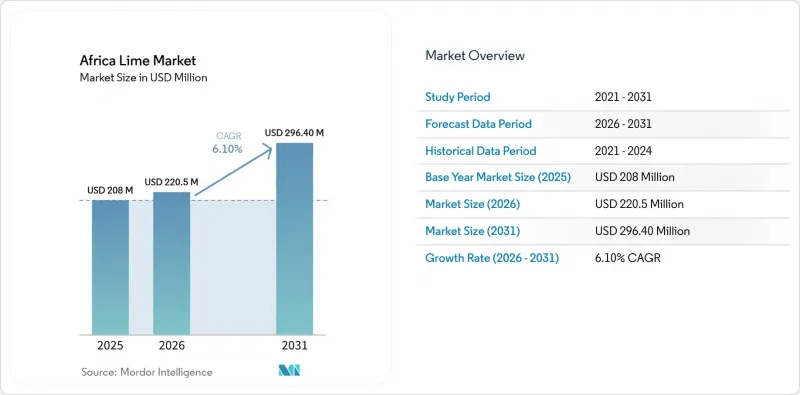
This report is Segmented by Country (South Africa, Egypt, Sudan, Algeria and the Rest of Africa). The Market Forecasts are Provided in Terms of Value (USD) and Volume (Metric Tons) for all the Above Segments.
Africa Lime Market Trends and Insights
Growing Use of Lime Preservatives in Ready-to-Drink Beverages
A study conducted by researchers from Universitas Airlangga, Indonesia, published in 2026, demonstrated that lime juice exhibits significant antimicrobial activity. The study reported inhibition zones of 23-12 mm against Staphylococcus aureus, 21-13 mm against Pseudomonas aeruginosa, and 18-10 mm against Escherichia coli across tested concentrations . These results highlight lime juice's effectiveness in inhibiting key spoilage and pathogenic bacteria, confirming its potential as a natural preservative. This evidence aligns with the growing use of lime-based ingredients in clean-label ready-to-drink beverages, particularly in regions where manufacturers are transitioning away from synthetic preservatives.
Rising Demand from Pharmaceutical and Nutraceutical Applications
A 2024 study by researchers from Pukyong National University, Korea Food Research Institute, and the University of Southern California revealed that lime peel-derived extracts contain hesperidin at 66.44 mg/g, eriocitrin at 46.17 mg/g, and narirutin at 86.77 mg/g. These results demonstrate the high concentration of bioactive flavonoids in lime peel, which are extensively used in pharmaceutical and nutraceutical applications. The findings support the increasing industrial use of lime by-products for value-added extraction, encouraging processors to improve recovery efficiency and driving the growing demand for secondary lime products in global and African markets.
Pest Pressure from Huanglongbing (HLB) and Fruit Fly
A 2025 study by researchers from the University of Technology and Applied Sciences, Oman, revealed that Huanglongbing (HLB) infection in lime results in substantial yield losses, increased fruit drop, and eventual tree mortality, significantly diminishing production capacity. The study also noted that HLB has already been identified in lime-growing regions of Oman, presenting a critical threat to citrus productivity. These findings underscore the severe impact of the disease on lime cultivation, as it degrades fruit quality, hastens orchard decline, and heightens management challenges and production risks.
Other drivers and restraints analyzed in the detailed report include:
- Government Support for Citrus Orchard Revitalization Programs
- Export Tariff Reductions Under The African Continental Free Trade Area (AfCFTA)
- Volatile Farm-Gate Prices Beyond Peak Export Seasons
For complete list of drivers and restraints, kindly check the Table Of Contents.
Additional Benefits:
- The market estimate (ME) sheet in Excel format
- 3 months of analyst support
TABLE OF CONTENTS
1 Introduction
- 1.1 Study Assumptions and Market Definition
- 1.2 Scope of the Study
2 Research Methodology
3 Executive Summary
4 Market Landscape
- 4.1 Market Overview
- 4.2 Market Drivers
- 4.2.1 Growing use of lime preservatives in ready-to-drink beverages
- 4.2.2 Rising demand from pharmaceutical and nutraceutical applications
- 4.2.3 Government support for citrus orchard revitalization programs
- 4.2.4 Export tariff reductions under the African Continental Free Trade Area (AfCFTA)
- 4.2.5 Vertical farming enabling year-round lime seedling supply
- 4.2.6 Carbon-credit funding for lime agroforestry expansion
- 4.3 Market Restraints
- 4.3.1 Pest pressure from Huanglongbing (HLB) and fruit fly
- 4.3.2 Volatile farm-gate prices beyond peak export seasons
- 4.3.3 High post-harvest losses from weak cold-chain infrastructure
- 4.3.4 Competition from synthetic citric acid alternatives
- 4.4 Opportunities
- 4.5 Challenges
- 4.6 Value Chain Analysis
- 4.7 Technologies and usage of AI in the Industry
- 4.8 Input Market Analysis
- 4.8.1 Seeds/Saplings
- 4.8.2 Fertilizers
- 4.8.3 Crop Protection Chemicals
- 4.9 Distribution Channel Analysis
- 4.10 Market Sentiment Analysis
- 4.11 PESTLE Analysis
5 Market Size and Growth Forecast (Value and Volume)
- 5.1 By Geography
- 5.1.1 Africa
- 5.1.1.1 South Africa
- 5.1.1.1.1 Production Analysis (Area Harvested, Yield, and Production Volume)
- 5.1.1.1.2 Consumption Analysis (Consumption Value and Volume)
- 5.1.1.1.3 Import Market Analysis (Import Value, Volume, and Key Supplying Markets)
- 5.1.1.1.4 Export Market Analysis (Export Value, Volume, and Key Destination Markets)
- 5.1.1.1.5 Wholesale Price Trend Analysis and Forecast
- 5.1.1.1.6 Regulatory Framework
- 5.1.1.1.7 List of Key Players
- 5.1.1.1.8 Logistics and Infrastructure
- 5.1.1.1.9 Seasonality Analysis
- 5.1.1.2 Egypt
- 5.1.1.2.1 Production Analysis (Area Harvested, Yield, and Production Volume)
- 5.1.1.2.2 Consumption Analysis (Consumption Value and Volume)
- 5.1.1.2.3 Import Market Analysis (Import Value, Volume, and Key Supplying Markets)
- 5.1.1.2.4 Export Market Analysis (Export Value, Volume, and Key Destination Markets)
- 5.1.1.2.5 Wholesale Price Trend Analysis and Forecast
- 5.1.1.2.6 Regulatory Framework
- 5.1.1.2.7 List of Key Players
- 5.1.1.2.8 Logistics and Infrastructure
- 5.1.1.2.9 Seasonality Analysis
- 5.1.1.3 Sudan
- 5.1.1.3.1 Production Analysis (Area Harvested, Yield, and Production Volume)
- 5.1.1.3.2 Consumption Analysis (Consumption Value and Volume)
- 5.1.1.3.3 Import Market Analysis (Import Value, Volume, and Key Supplying Markets)
- 5.1.1.3.4 Export Market Analysis (Export Value, Volume, and Key Destination Markets)
- 5.1.1.3.5 Wholesale Price Trend Analysis and Forecast
- 5.1.1.3.6 Regulatory Framework
- 5.1.1.3.7 List of Key Players
- 5.1.1.3.8 Logistics and Infrastructure
- 5.1.1.3.9 Seasonality Analysis
- 5.1.1.4 Algeria
- 5.1.1.4.1 Production Analysis (Area Harvested, Yield, and Production Volume)
- 5.1.1.4.2 Consumption Analysis (Consumption Value and Volume)
- 5.1.1.4.3 Import Market Analysis (Import Value, Volume, and Key Supplying Markets)
- 5.1.1.4.4 Export Market Analysis (Export Value, Volume, and Key Destination Markets)
- 5.1.1.4.5 Wholesale Price Trend Analysis and Forecast
- 5.1.1.4.6 Regulatory Framework
- 5.1.1.4.7 List of Key Players
- 5.1.1.4.8 Logistics and Infrastructure
- 5.1.1.4.9 Seasonality Analysis
- 5.1.1.5 Tunisia
- 5.1.1.5.1 Production Analysis (Area Harvested, Yield, and Production Volume)
- 5.1.1.5.2 Consumption Analysis (Consumption Value and Volume)
- 5.1.1.5.3 Import Market Analysis (Import Value, Volume, and Key Supplying Markets)
- 5.1.1.5.4 Export Market Analysis (Export Value, Volume, and Key Destination Markets)
- 5.1.1.5.5 Wholesale Price Trend Analysis and Forecast
- 5.1.1.5.6 Regulatory Framework
- 5.1.1.5.7 List of Key Players
- 5.1.1.5.8 Logistics and Infrastructure
- 5.1.1.5.9 Seasonality Analysis
- 5.1.1.6 Rest of Africa
- 5.1.1.6.1 Production Analysis (Area Harvested, Yield, and Production Volume)
- 5.1.1.6.2 Consumption Analysis (Consumption Value and Volume)
- 5.1.1.6.3 Import Market Analysis (Import Value, Volume, and Key Supplying Markets)
- 5.1.1.6.4 Export Market Analysis (Export Value, Volume, and Key Destination Markets)
- 5.1.1.6.5 Wholesale Price Trend Analysis and Forecast
- 5.1.1.6.6 Regulatory Framework
- 5.1.1.6.7 List of Key Players
- 5.1.1.6.8 Logistics and Infrastructure
- 5.1.1.6.9 Seasonality Analysis
- 5.1.1.1 South Africa
- 5.1.1 Africa
6 End Use and Application
- 6.1 Primary Applications and Emerging Applications
- 6.2 Consumption Breakdown by Industries
7 Competitive Landscape
- 7.1 Overview of the Competition
- 7.2 Recent Developments
- 7.3 Market Concentration Analysis
8 Market Opportunity and Future Outlook

