
PUBLISHER: Mordor Intelligence | PRODUCT CODE: 2061537

PUBLISHER: Mordor Intelligence | PRODUCT CODE: 2061537
Asia-Pacific Beauty And Personal Care Products - Market Share Analysis, Industry Trends & Statistics, Growth Forecasts (2026 - 2031)
According to Mordor Intelligence, the asia-pacific beauty and personal care products market size is expected to grow from USD 147.51 billion in 2025 to USD 159.33 billion in 2026 and is forecast to reach USD 216.93 billion by 2031 at 8.02% CAGR over 2026-2031.
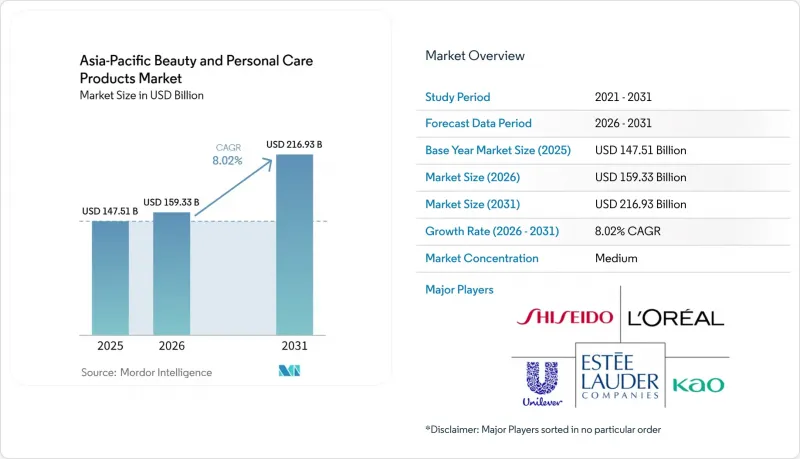
This report is Segmented by Product Type (Personal Care Products, and Cosmetics/Make-Up Products), Category (Mass Products and Premium Products), Ingredient Type (Natural and Conventional), Distribution Channel (Health and Beauty Stores, Supermarkets/Hypermarkets, and More), and Geography (China, India, and More). The Market Forecasts are Provided in Terms of Value (USD).
Asia-Pacific Beauty And Personal Care Products Market Trends and Insights
Rising demand for premium and natural beauty products
Rising demand for premium and natural beauty products is a key driver of growth in the Asia-Pacific beauty and personal care products market, supported by changing consumer preferences toward safer and higher-quality formulations. Consumers across the region are increasingly seeking products made with natural, plant-based, and sustainably sourced ingredients due to growing awareness of health, wellness, and environmental impacts. Premium beauty products are gaining traction as rising disposable incomes enable consumers to spend more on specialized skincare, clean-label cosmetics, and high-performance formulations. According to a survey by Retail Asia, around 49% of Asia-Pacific consumers consider natural product attributes, including ethical and environmental factors, when making cosmetic purchases, while 81% view natural labeling as essential or desirable in 2024. This shift is encouraging manufacturers to expand premium and natural product portfolios and invest in ingredient transparency and sustainable packaging.
Increasing beauty and self-care awareness among consumers
Increasing beauty and self-care awareness among consumers is a significant driver of the Asia-Pacific beauty and personal care products market, as individuals increasingly prioritize personal grooming, skincare routines, and overall wellness. Rising exposure to digital media, beauty influencers, and online tutorials has enhanced consumer knowledge about skincare ingredients, product benefits, and preventive care. Consumers are becoming more proactive in maintaining skin health and appearance, leading to higher demand for daily-use personal care products as well as specialized solutions such as anti-aging, hydration, and sun protection products. Growing urbanization and changing lifestyles have further encouraged regular self-care practices, particularly among younger demographics. In addition, increasing participation of men in grooming and personal care routines is expanding the consumer base across multiple product categories.
Stringent regulatory requirements and compliance challenges
Stringent regulatory requirements and compliance challenges act as a significant restraint on the Asia-Pacific beauty and personal care products market. Countries across the region maintain varying standards related to product safety, ingredient approvals, labeling norms, and advertising claims, making regulatory compliance complex for manufacturers. Companies must adhere to detailed testing procedures, certification processes, and documentation requirements before launching new products, which increases time-to-market. Frequent updates to cosmetic regulations and restrictions on certain chemical ingredients further add to operational uncertainty. For multinational brands, navigating diverse regulatory frameworks across multiple countries can raise administrative and legal costs. Smaller and emerging companies may face greater barriers due to limited resources for compliance management.
Other drivers and restraints analyzed in the detailed report include:
- Growing influence of social media and beauty influencers
- Increasing male grooming and inclusive beauty trends
- Counterfeit and unbranded product market growth
For complete list of drivers and restraints, kindly check the Table Of Contents.
Segment Analysis
Personal care products accounted for the largest share of the Asia-Pacific beauty and personal care products market in 2025, contributing 85.12% of total revenue. The dominance of this segment is primarily driven by strong and consistent consumer demand for everyday essentials such as skincare, haircare, oral care, and hygiene products. Rising awareness of personal hygiene, increasing urbanization, and growing disposable incomes across emerging economies have significantly supported the expansion of this category. In addition, frequent product innovation, including natural, organic, and dermatologically tested formulations, has strengthened consumer trust and repeat purchases. The widespread availability of personal care products across both offline and online retail channels has further reinforced market penetration.
The cosmetics segment, although smaller in terms of market share at 14.88% in 2025, is projected to be the fastest-growing category, registering a CAGR of 7.51% through 2031. Growth in this segment is supported by rising beauty consciousness among younger consumers and increasing influence of social media trends and beauty influencers. Expanding demand for premium, personalized, and multifunctional cosmetic products is also accelerating market growth. Furthermore, the growing adoption of makeup products among male consumers and the expansion of professional beauty services are contributing to increased product usage. Continuous innovation in formulations, including long-lasting, skin-friendly, and clean-label cosmetics, is attracting a broader consumer base.
The mass segment held the largest share of the Asia-Pacific beauty and personal care products market in 2025, accounting for 75.39% of total sales. Its strong market position is supported by widespread affordability and accessibility, making these products appealing to a broad consumer base across both developed and emerging economies in the region. Mass-market products benefit from extensive distribution through supermarkets, convenience stores, pharmacies, and online platforms, ensuring strong product visibility and availability. In addition, frequent product launches and promotional strategies help brands maintain high sales volumes within this segment. Growing urban populations and rising demand for everyday personal care essentials further contribute to sustained consumption.
The premium segment, while smaller in market share at 24.61% in 2025, is emerging as the fastest-growing category, advancing at a CAGR of 8.03%. Growth in this segment is largely driven by rising disposable incomes and increasing consumer willingness to spend on high-quality and specialized beauty products. Consumers are increasingly seeking advanced formulations, natural ingredients, and products that offer targeted skincare and wellness benefits. The influence of social media, beauty influencers, and evolving lifestyle aspirations has also encouraged the shift toward premium brands. Furthermore, premium products often emphasize sustainability, innovative packaging, and personalized solutions, which resonate strongly with younger and urban consumers.
List of Companies Covered in this Report:
- L'Oreal SA
- Shiseido Co., Ltd.
- Unilever PLC
- The Estee Lauder Companies Inc.
- Kao Corporation
- Amorepacific Group
- The Procter & Gamble Company
- Beiersdorf AG
- LG Household & Health Care Ltd.
- Kenvue, Inc.
- Coty Inc.
- The Colgate-Palmolive Company
- Henkel AG & Co. KGaA
- Natura &Co Holding S.A.
- Revlon Inc.
- Chanel SA
- LVMH Moet Hennessy Louis Vuitton
- Clarins Groupe
- Colorbar Cosmetics Pvt. Ltd.
- Honasa Consumer Ltd
Additional Benefits:
- The market estimate (ME) sheet in Excel format
- 3 months of analyst support
TABLE OF CONTENTS
1 INTRODUCTION
- 1.1 Study Assumptions and Market Definition
- 1.2 Scope of the Study
2 RESEARCH METHODOLOGY
3 EXECUTIVE SUMMARY
4 MARKET LANDSCAPE
- 4.1 Market Overview
- 4.2 Market Drivers
- 4.2.1 Rising demand for premium and natural beauty products
- 4.2.2 Increasing beauty and self-care awareness among consumers
- 4.2.3 Growing influence of social media and beauty influencers
- 4.2.4 Increasing male grooming and inclusive beauty trends
- 4.2.5 Technological innovations in beauty and skincare formulations
- 4.2.6 Growing demand for anti-aging and personalized beauty solutions
- 4.3 Market Restraints
- 4.3.1 Stringent regulatory requirements and compliance challenges
- 4.3.2 Supply chain disruptions and raw material price volatility
- 4.3.3 Counterfeit and unbranded product market growth
- 4.3.4 Environmental concerns over packaging waste and chemicals
- 4.4 Consumer Behaviour Analysis
- 4.5 Regulatory Outlook
- 4.6 Porter's Five Forces Analysis
- 4.6.1 Threat of New Entrants
- 4.6.2 Bargaining Power of Buyers/Consumers
- 4.6.3 Bargaining Power of Suppliers
- 4.6.4 Threat of Substitute Products
- 4.6.5 Intensity of Competitive Rivalry
5 MARKET SIZE AND GROWTH FORECASTS (VALUE)
- 5.1 By Product Type
- 5.1.1 Personal Care Products
- 5.1.1.1 Hair Care
- 5.1.1.1.1 Shampoo
- 5.1.1.1.2 Conditioner
- 5.1.1.1.3 Hair Colourant
- 5.1.1.1.4 Hair Styling Products
- 5.1.1.1.5 Others
- 5.1.1.2 Skin Care
- 5.1.1.2.1 Facial Care Products
- 5.1.1.2.2 Body Care Products
- 5.1.1.2.3 Lip and Nail Care Products
- 5.1.1.3 Bath and Shower
- 5.1.1.3.1 Shower Gels
- 5.1.1.3.2 Soaps
- 5.1.1.3.3 Others
- 5.1.1.4 Oral Care
- 5.1.1.4.1 Toothbrush
- 5.1.1.4.2 Toothpaste
- 5.1.1.4.3 Mouthwashes and Rinses
- 5.1.1.4.4 Others
- 5.1.1.5 Men's Grooming Products
- 5.1.1.6 Deodorants and Antiperspirants
- 5.1.1.7 Perfumes and Fragrances
- 5.1.1.1 Hair Care
- 5.1.2 Cosmetics/Make-up Products
- 5.1.2.1 Facial Cosmetics
- 5.1.2.2 Eye Cosmetics
- 5.1.2.3 Lip and Nail Make-up Products
- 5.1.1 Personal Care Products
- 5.2 By Category
- 5.2.1 Premium Products
- 5.2.2 Mass Products
- 5.3 By Ingredient Type
- 5.3.1 Natural and Organic
- 5.3.2 Conventional/Synthetic
- 5.4 By Distribution Channel
- 5.4.1 Health & Beauty Stores
- 5.4.2 Supermarkets/Hypermarkets
- 5.4.3 Online Retail Stores
- 5.4.4 Other Channels
- 5.5 By Geography
- 5.5.1 China
- 5.5.2 India
- 5.5.3 Japan
- 5.5.4 Australia
- 5.5.5 Indonesia
- 5.5.6 South Korea
- 5.5.7 Thailand
- 5.5.8 Singapore
- 5.5.9 Rest of Asia-Pacific
6 COMPETITIVE LANDSCAPE
- 6.1 Market Concentration
- 6.2 Strategic Moves
- 6.3 Market Share Analysis
- 6.4 Company Profiles (includes Global-level Overview, Market-level Overview, Core Segments, Financials (if available), Strategic Information, Market Rank/Share, Products and Services, Recent Developments)
- 6.4.1 L'Oreal SA
- 6.4.2 Shiseido Co., Ltd.
- 6.4.3 Unilever PLC
- 6.4.4 The Estee Lauder Companies Inc.
- 6.4.5 Kao Corporation
- 6.4.6 Amorepacific Group
- 6.4.7 The Procter & Gamble Company
- 6.4.8 Beiersdorf AG
- 6.4.9 LG Household & Health Care Ltd.
- 6.4.10 Kenvue, Inc.
- 6.4.11 Coty Inc.
- 6.4.12 The Colgate-Palmolive Company
- 6.4.13 Henkel AG & Co. KGaA
- 6.4.14 Natura &Co Holding S.A.
- 6.4.15 Revlon Inc.
- 6.4.16 Chanel SA
- 6.4.17 LVMH Moet Hennessy Louis Vuitton
- 6.4.18 Clarins Groupe
- 6.4.19 Colorbar Cosmetics Pvt. Ltd.
- 6.4.20 Honasa Consumer Ltd
7 MARKET OPPORTUNITIES AND FUTURE OUTLOOK

