
PUBLISHER: Mordor Intelligence | PRODUCT CODE: 2061578

PUBLISHER: Mordor Intelligence | PRODUCT CODE: 2061578
Point Of Care Diagnostics - Market Share Analysis, Industry Trends & Statistics, Growth Forecasts (2026 - 2031)
According to Mordor Intelligence, the point of care diagnostics market size is projected to expand from USD 53.63 billion in 2025 and USD 58.76 billion in 2026 to USD 92.92 billion by 2031, registering a CAGR of 9.90% between 2026 to 2031.
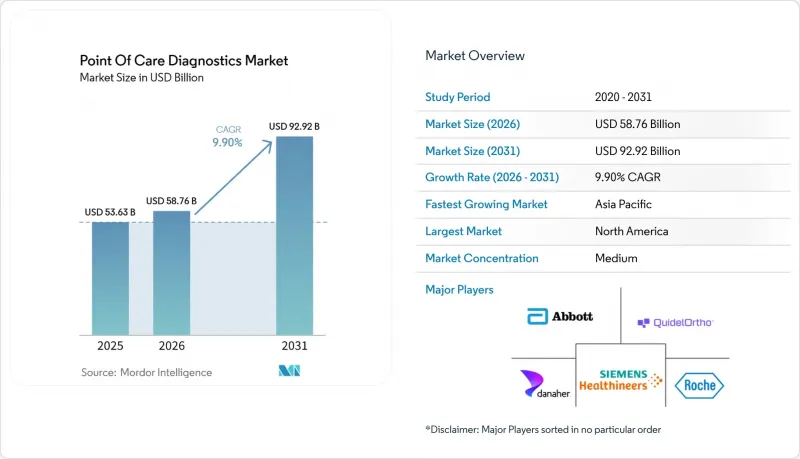
This report is Segmented by Product (Glucose Monitoring Kits, Infectious Disease Testing Kits, and More), Platform (Lateral Flow Assays, Microfluidics-Based Platforms, and More), Sample Type (Blood, Urine, and More), Mode of Purchase (Over-The-Counter (OTC) and Prescription-Based), End User (Hospitals & Clinics, and More), and Geography. Market Forecasts are Provided in Terms of Value (USD).
Global Point Of Care Diagnostics Market Trends and Insights
Rising Prevalence of Chronic and Infectious Diseases
Globally, 537 million adults lived with diabetes in 2024, and the International Diabetes Federation projects 643 million by 2030, underscoring sustained demand for glucose monitoring kits.Parallel outbreaks, such as dengue in Southeast Asia and mpox in Central Africa, have prompted governments to stockpile rapid diagnostic tests. WHO prequalified 12 new malaria rapid tests in 2025, allowing procurement agencies to source assays that meet stringent sensitivity thresholds for low-parasitemia detection. Abbott supplied 15 million malaria tests to India's National Health Mission the same year, covering districts where laboratory microscopy remains unavailable in 40% of primary health centers. Cepheid's GeneXpert MTB/RIF Ultra assay shortened tuberculosis time-to-treatment in South African clinics from 14 days to under 2 hours, demonstrating the clinical advantage of rapid molecular testing. This dual burden of chronic management and outbreak response creates a structural tailwind that lifts the point-of-care diagnostics market across income settings.
Technological Advances and Home-Based POC Uptake
Medicare introduced CPT 99454 in the 2025 Physician Fee Schedule, reimbursing USD 64 per patient per month for devices transmitting physiological data at least 16 days a month. Roche's CoaguChek systems now qualify for virtual INR consultations under this code, while Abbott's Bluetooth-enabled FreeStyle Libre 3 Plus streams glucose readings every minute for remote insulin titration. Dexcom's over-the-counter Stelo sensor, approved in June 2024, opened continuous glucose monitoring to 30 million U.S. Type 2 diabetics previously outside insurance coverage. Smartphone penetration above 70% in many emerging markets further lowers barriers for cloud-linked diagnostic devices. As sensor miniaturization converges with reimbursement reform, the hospital-centric testing model is giving way to decentralized, patient-directed workflows that expand the point-of-care diagnostics market.
Stringent Regulations and Reimbursement Gaps
FDA guidance issued in 2024 raised analytical validation thresholds for POC molecular tests to at least 95% positive and 98% negative percent agreement across three diverse clinical sites. CMS then cut payment for several CLIA-waived codes by 8-12% in the 2025 fee schedule, squeezing the economics for smaller practices. Private insurers, such as Anthem, introduced prior-authorization rules that limit respiratory pathogen panels to high-risk patients. In Europe, the In Vitro Diagnostic Regulation deadline of May 2025 forced roughly 30% of legacy POC devices off the market because manufacturers could not secure notified-body audits. These policy shifts raise compliance costs and curb near-term adoption, tempering growth in the point-of-care diagnostics market.
Other drivers and restraints analyzed in the detailed report include:
- Surge in CLIA-Waived Molecular Respiratory Tests
- Increasing Regulatory Approvals for Novel Assays
- Product Recalls and Accuracy Concerns
For complete list of drivers and restraints, kindly check the Table Of Contents.
Segment Analysis
Glucose monitoring kits maintained 37.94% of the point-of-care diagnostics market share in 2025, supported by the ubiquity of capillary blood glucose meters and the rapid uptake of CGM sensors. Infectious disease kits, however, are forecast to grow at a 10.27% CAGR through 2031 as global health agencies prequalify new rapid assays for malaria, tuberculosis, and sexually transmitted infections. Cardiometabolic panels built around high-sensitivity troponin and BNP markers are standard in 85% of U.S. emergency departments for rapid myocardial infarction rule-outs. Coagulation kits, led by Roche's CoaguChek, benefit from Medicare reimbursement for patient self-testing of INR. Pregnancy and fertility kits retain high volume in retail channels, while digital ovulation monitors are carving premium subsegments. Blood gas and electrolyte cartridges remain mission-critical in critical care units, and AI-enabled hematology analyzers such as Sight Diagnostics' OLO are lowering the entry threshold for urgent care clinics.
The product mix is likely to rebalance as closed-loop insulin delivery systems pair CGMs with automated pumps, yet novel infectious disease panels promise faster relative growth. Manufacturers that integrate wireless connectivity and cloud analytics into commodity product lines stand to extend lifetime revenue per user, fortifying their positions within the point of care diagnostics market.
Lateral flow assays captured 34.12% of revenue share in 2025, driven by entrenched pregnancy and antigen test volumes. Molecular diagnostics platforms, however, are scaling at a 10.51% CAGR, supported by PCR cartridges that deliver sample-to-answer results in under 30 minutes without high-complexity lab certification. Dipsticks and test strips remain the highest-volume consumables but face commoditization as smartphone cameras replace dedicated optical readers.
Microfluidic cartridges, such as Abbott's i-STAT, house multiple chemistries, electrolytes, blood gases, and cardiac markers in a palm-sized single-use chip that returns results in under 10 minutes. Immunoassay analyzers serve mid-throughput hospital labs, bridging the gap between bedside testing and central automation. As PCR becomes simpler and cheaper, molecular systems are expected to erode lateral flow's share in physician offices, home care, and retail clinics, further expanding the market for high-sensitivity diagnostics at the point of care.
Geography Analysis
North America retained 45.67% revenue share in 2025, supported by a dense network of CLIA-certified physician office laboratories and generous Medicare coverage for both molecular and remote monitoring devices. The FDA cleared 47 POC devices in 2024 under its accelerated 510(k) process, fostering rapid commercialization cycles. Cepheid maintains an installed base of 12,000 GeneXpert units across urgent care centers and emergency departments, driving cartridge growth of 35% year over year in Q3 2024. However, reimbursement cuts for certain waived tests and private-payer prior authorization hurdles may temper future expansion.
Asia-Pacific is the fastest-growing region, projected to log a 10.74% CAGR through 2031 as China and India roll out rural health initiatives. China's NMPA cleared Roche's cobas Liat system in 2024, unlocking access to a network of 36,000 township clinics serving 600 million residents. India's National Health Mission distributed 15 million Abbott malaria rapid tests in 2025 to areas where microscopy is unavailable in 40% of primary centers. Japan, South Korea, and Australia are also expanding coverage for CGM and AI-enabled diagnostics, expanding the point-of-care diagnostics market in developed Asia.
Europe is navigating the stringent IVDR regime that removed roughly 30% of legacy POC devices from the market by May 2025. Germany expanded reimbursement for patient-managed INR testing, while the UK's National Health Service deployed Roche cobas Liat units in 200 general practices to curb inappropriate antibiotic prescribing. Southern European nations procured rapid respiratory assays ahead of the 2025 flu season, acknowledging laboratory staffing gaps in rural areas. Cold-chain limitations continue to constrain molecular cartridge deployment in parts of Africa and remote Pacific islands, yet donor-funded programs are bridging those gaps. Overall, regional policies and infrastructure investments shape a mosaic of opportunities that together reinforce the growth trajectory of the point of care diagnostics market.
- Abbott Laboratories
- Accubiotech Co. Ltd.
- Beckton Dickinson
- bioMerieux
- Bio-Rad Laboratories
- Chembio Diagnostics Inc.
- Danaher Corporation (Cepheid & Beckman Coulter)
- EKF Diagnostics
- Roche
- HemoCue AB
- Johnson & Johnson
- LumiraDx
- Nova Biomedical
- Orasure Technologies
- PTS Diagnostics
- QuidelOrtho
- Radiometer Medical ApS
- Sekisui Diagnostics
- Siemens Healthineers
- Trinity Biotech plc
- Werfen (Instrumentation Laboratory)
Additional Benefits:
- The market estimate (ME) sheet in Excel format
- 3 months of analyst support
TABLE OF CONTENTS
1 Introduction
- 1.1 Study Assumptions & Market Definition
- 1.2 Scope of the Study
2 Research Methodology
3 Executive Summary
4 Market Landscape
- 4.1 Market Overview
- 4.2 Market Drivers
- 4.2.1 Rising Prevalence of Chronic & Infectious Diseases
- 4.2.2 Technological Advances & Home-Based POC Uptake
- 4.2.3 Surge In CLIA-Waived Molecular Respiratory Tests
- 4.2.4 Increasing Regulatory Approvals for Novel Assays
- 4.2.5 AI-Enabled Smartphone Lateral-Flow Analytics
- 4.2.6 Microfluidic Paper-Chips in Philanthropic Screenings
- 4.3 Market Restraints
- 4.3.1 Stringent Regulations & Reimbursement Gaps
- 4.3.2 Product Recalls & Accuracy Concerns
- 4.3.3 QC Non-Compliance Penalties in US Pols
- 4.3.4 Cold-Chain Gaps for Molecular Cartridges in Africa
- 4.4 Supply-Chain Analysis
- 4.5 Regulatory Landscape
- 4.6 Technological Outlook
- 4.7 Porter's Five Forces
- 4.7.1 Threat of New Entrants
- 4.7.2 Bargaining Power of Suppliers
- 4.7.3 Bargaining Power of Buyers
- 4.7.4 Threat of Substitutes
- 4.7.5 Competitive Rivalry
5 Market Size & Growth Forecasts (Value)
- 5.1 By Product
- 5.1.1 Glucose Monitoring Kits
- 5.1.2 Infectious Disease Testing Kits
- 5.1.3 Cardiometabolic Testing Kits
- 5.1.4 Coagulation Monitoring Kits
- 5.1.5 Pregnancy & Fertility Testing Kits
- 5.1.6 Blood Gas / Electrolyte & Metabolite Kits
- 5.1.7 Hematology Testing Kits
- 5.1.8 Tumor / Cancer Marker Testing Kits
- 5.1.9 Urinalysis Testing Kits
- 5.1.10 Cholesterol Test Strips
- 5.2 By Platform
- 5.2.1 Lateral Flow Assays
- 5.2.2 Dipsticks & Test Strips
- 5.2.3 Microfluidics-Based Platforms
- 5.2.4 Immunoassays (CLIA & FIA)
- 5.2.5 Molecular Diagnostics (PCR, INAAT)
- 5.3 By Sample Type
- 5.3.1 Blood
- 5.3.2 Urine
- 5.3.3 Saliva
- 5.3.4 Nasal / Throat Swab
- 5.3.5 Other Specimens (Sweat, Tear, CSF)
- 5.4 By Mode of Purchase
- 5.4.1 Over-the-Counter (OTC)
- 5.4.2 Prescription-Based
- 5.5 By End User
- 5.5.1 Hospitals & Clinics
- 5.5.2 Home-Care Settings
- 5.5.3 Others
- 5.6 By Geography
- 5.6.1 North America
- 5.6.1.1 United States
- 5.6.1.2 Canada
- 5.6.1.3 Mexico
- 5.6.2 Europe
- 5.6.2.1 Germany
- 5.6.2.2 United Kingdom
- 5.6.2.3 France
- 5.6.2.4 Italy
- 5.6.2.5 Spain
- 5.6.2.6 Rest of Europe
- 5.6.3 Asia-Pacific
- 5.6.3.1 China
- 5.6.3.2 India
- 5.6.3.3 Japan
- 5.6.3.4 South Korea
- 5.6.3.5 Australia
- 5.6.3.6 Rest of Asia-Pacific
- 5.6.4 Middle East & Africa
- 5.6.4.1 GCC
- 5.6.4.2 South Africa
- 5.6.4.3 Rest of Middle East & Africa
- 5.6.5 South America
- 5.6.5.1 Brazil
- 5.6.5.2 Argentina
- 5.6.5.3 Rest of South America
- 5.6.1 North America
6 Competitive Landscape
- 6.1 Market Concentration
- 6.2 Market Share Analysis
- 6.3 Company Profiles {(includes Global level Overview, Market level overview, Core Segments, Financials as available, Strategic Information, Market Rank/Share for key companies, Products & Services, and Recent Developments)}
- 6.3.1 Abbott Laboratories
- 6.3.2 Accubiotech Co. Ltd.
- 6.3.3 Becton, Dickinson and Company
- 6.3.4 bioMerieux SA
- 6.3.5 Bio-Rad Laboratories Inc.
- 6.3.6 Chembio Diagnostics Inc.
- 6.3.7 Danaher Corporation (Cepheid & Beckman Coulter)
- 6.3.8 EKF Diagnostics
- 6.3.9 F. Hoffmann-La Roche Ltd.
- 6.3.10 HemoCue AB
- 6.3.11 Johnson & Johnson (LifeScan)
- 6.3.12 LumiraDx
- 6.3.13 Nova Biomedical Corporation
- 6.3.14 OraSure Technologies Inc.
- 6.3.15 PTS Diagnostics
- 6.3.16 QuidelOrtho Corporation
- 6.3.17 Radiometer Medical ApS
- 6.3.18 Sekisui Diagnostics
- 6.3.19 Siemens Healthineers AG
- 6.3.20 Trinity Biotech plc
- 6.3.21 Werfen (Instrumentation Laboratory)
7 Market Opportunities & Future Outlook
- 7.1 White-Space & Unmet-Need Assessment

