PUBLISHER: Mordor Intelligence | PRODUCT CODE: 2061599

PUBLISHER: Mordor Intelligence | PRODUCT CODE: 2061599
Fragrance And Perfume - Market Share Analysis, Industry Trends & Statistics, Growth Forecasts (2026 - 2031)
According to Mordor Intelligence, the fragrance and perfume market is expected to grow from USD 78.10 billion in 2025 and USD 83.54 billion in 2026 to USD 119.29 billion by 2031, registering a CAGR of 7.36% between 2026 and 2031.
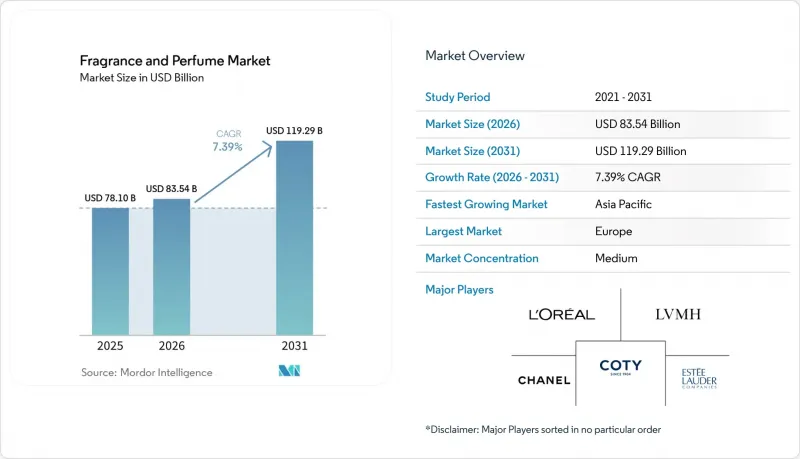
This report is Segmented by Product Type (Parfum, Eau De Parfum, Eau De Toilette, and More), Category (Mass and Premium), End User (Men, Women, and Unisex), Distribution Channel (Supermarkets/Hypermarkets, Specialty Stores, and More), and Geography (North America, Europe, Asia-Pacific, South America, and Middle East and Africa). The Market Forecasts are Provided in Terms of Value (USD).
Global Fragrance And Perfume Market Trends and Insights
Shift toward natural, clean-label, and sustainable fragrance formulations
Heightened consumer scrutiny around ingredient transparency, safety, and environmental impact is accelerating the shift toward natural, clean-label, and sustainable fragrance formulations globally. The clean-label movement is fundamentally reshaping fragrance development, prompting brands to invest in sustainable sourcing, green chemistry, and low-impact manufacturing processes rather than incremental reformulations. Leading players are adopting biodegradable delivery systems, advanced encapsulation technologies, and renewable inputs to reduce environmental footprints while maintaining performance. At the ingredient level, brands are phasing out synthetic musks, phthalates, and regulated allergens in line with the International Fragrance Association's (IFRA) 51st Amendment, effective 2024. Innovations from suppliers, including sustainable berry accords and sandalwood substitutes, are further expanding the clean ingredient palette while alleviating pressure on scarce natural resources. Retail-led exclusion lists in the United States and Europe, particularly among specialty beauty chains, are reinforcing compliance and transparency across both premium and mass segments. The trend is most pronounced in premium and prestige categories, where consumers demonstrate a willingness to pay for products aligned with ethical values, regulatory compliance, and perceived health and sustainability benefits.
Growing demand for niche, artisanal, and bespoke fragrances
Consumers are increasingly moving away from mass-market fragrances toward niche and artisanal brands that emphasize craftsmanship, originality, and exclusivity. Differentiation through unique scent profiles, limited-edition launches, and strong brand storytelling has enabled niche houses to gain share, particularly in mature markets such as North America and Europe, where affluent consumers curate "fragrance wardrobes" for different occasions and moods. Major luxury groups including LVMH, Estee Lauder, and Puig have responded through acquisitions and investments in high-growth niche brands such as Byredo, Le Labo, and Maison Francis Kurkdjian, which have delivered double-digit growth supported by direct-to-consumer models and controlled scarcity. In Asia-Pacific, domestic niche labels such as To Summer and Wenxian Documents are gaining traction as local provenance and cultural narratives resonate with emerging luxury consumers. Retail strategies are evolving toward specialty and mono-brand boutiques that offer immersive, educational experiences around ingredients, composition, and perfumery artistry. Despite fragmentation complicating share tracking, niche fragrances continue to unlock premium white spaces, allowing creative perfumers to command premium price points with limited reliance on mass advertising.
Rising penetration of counterfeit and grey-market fragrances
The growing circulation of counterfeit and grey-market fragrances poses a significant restraint on the global fragrance and perfume industry, eroding legitimate sales, weakening brand equity, and exposing consumers to serious health risks. Counterfeit fragrances frequently contain substandard ethanol or methanol and other unverified chemical compounds, which can cause skin irritation, allergic reactions, and longer-term health concerns, ultimately undermining consumer confidence in branded offerings. Regulatory authorities across key markets continue to flag the scale of the issue. Complaints to UK Trading Standards rose by 35% in 2024, driven largely by fake fragrances sold through e-commerce platforms that exploit fragmented enforcement and cross-border trade loopholes . Premium and luxury fragrances are particularly affected, as higher retail prices and strong brand recognition make them attractive targets for illicit replication. Beyond consumer safety risks, counterfeiting damages brand reputation and dilutes exclusivity, weakening long-term customer loyalty and slowing category growth. As counterfeit networks become more sophisticated, effective mitigation increasingly requires coordinated action among regulatory authorities, brand owners, e-commerce platforms, and technology providers. Without stronger enforcement and standardized authentication frameworks, the continued proliferation of counterfeit and grey-market fragrances is expected to remain a structural challenge for the industry.
Other drivers and restraints analyzed in the detailed report include:
- Social media influence and celebrity-led brand collaborations
- Premiumization and rising demand for luxury fragrance offerings
- Heightened consumer concerns over synthetic and allergenic ingredients
For complete list of drivers and restraints, kindly check the Table Of Contents.
Segment Analysis
Eau de Parfum (EDP) remains the cornerstone of the global fragrance and perfume market, accounting for an estimated 54.34% share in 2025. Its leadership is anchored in a compelling balance of scent intensity, longevity, and versatility, making it suitable for both everyday wear and special occasions. Leading houses such as Dior, Chanel, Gucci, Mugler, and Hermes continue to refresh this segment through intense flankers and elevated formulations, often priced significantly above standard EDPs yet achieving strong sell-through. Meanwhile, lighter formats such as Eau de Toilette are gradually losing share in mature Western markets, although they remain relevant in warmer climates and alongside emerging formats like body mists, which have gained traction through social media-driven affordability.
Parfum is the fastest-growing concentration segment, projected to expand at a CAGR of 8.23% through 2031, reflecting the broader premiumization trend shaping the fragrance and perfume market. Growth is particularly strong in the Middle East and Asia-Pacific, where cultural preferences favor richer, more intense scent experiences, and where premium packaging enhances gifting appeal. Beyond traditional sprays, adjacent formats such as solid perfumes and alcohol-free oils are gaining relevance among travelers and consumers seeking low-VOC, skin-friendly, or religiously compliant options. Supported by sustainability initiatives and IFRA-aligned green chemistry principles, these concentrated and alternative formats create incremental entry points into the market, adding value without undermining the central role of EDP as the category's volume and revenue anchor.
The premium segment continues to anchor the global fragrance and perfume market, holding an estimated 65.25% share in 2025 and standing out as the fastest-growing category with a projected CAGR of 8.45%. Growth is driven by consumers' increasing willingness to allocate discretionary spending toward experiential and emotionally resonant luxury, with fragrance positioned as an attainable yet expressive indulgence. Leading luxury houses are reinforcing this momentum through selective distribution strategies that preserve exclusivity, protect margins, and enhance brand mystique, while simultaneously advancing sustainability initiatives such as refillable formats and ethically sourced ingredients. Premium fragrances are also benefiting from strong retail visibility and expanding digital storytelling, which offers consumers deeper insight into craftsmanship, ingredient provenance, and creative heritage, factors that increasingly justify premium price points.
The rise of "masstige" offerings, combining upscale cues with more attainable price points, is increasingly narrowing the distinction between mass and premium tiers and redefining competitive dynamics. At the same time, premium brands are leading the shift toward experiential retail, using immersive store concepts and tailored services to deepen emotional connections with consumers. Digital channels are further accelerating this trend by expanding reach beyond traditional luxury touchpoints and transparently showcasing craftsmanship, ingredients, and creative processes that reinforce premium credentials. Conversely, the growing influence of masstige products and higher input costs are squeezing margins in the mass segment, compelling players to sharpen their value propositions, rationalize product ranges, and invest selectively in brand-led differentiation to remain competitive.
Geography Analysis
North America continues to anchor the global fragrance and perfume market, accounting for an estimated 46.22% share in 2025, supported by its long-standing perfumery heritage and concentration of luxury maisons. The United States remains a global export leader, bolstered by high per-capita spending and discerning consumer tastes, cementing its dominance in premium and niche fragrances. While growth in this mature market is tempered, North America showcases its dynamism. Countries like the United States, Canada, and Mexico uphold the significance of specialty and department stores, thanks to a robust culture of in-store trials. Moreover, the rising popularity of body mists and refillable packaging underscores a shift: even the traditionally-minded North American consumers are now gravitating towards fragrance expressions that resonate with sustainability and contemporary lifestyles.
Asia-Pacific stands out as the fastest-growing region, projected to expand at a CAGR of 10.05% and form the primary engine of future market growth. China and India are at the forefront, driven by rising disposable incomes, rapid urbanization, and evolving lifestyle aspirations that position fragrance as a daily-use and self-expression product. For example, in 2024, urban residents accounted for about 66% of China's total population, whereas India's urban population represented roughly 35% of its total population . China's market is scaling rapidly on the back of higher per-capita spending, increased male adoption, and premiumization, while India is registering double-digit growth as modern retail penetrates tier-two cities and consumers explore offerings beyond traditional attars. Strategic investments by global groups into local brands underscore confidence in indigenous storytelling and culturally resonant positioning, reinforcing Asia-Pacific's role as the innovation and volume growth frontier.
Europe, the Middle East and Africa, and South America exhibit differentiated yet complementary growth trajectories shaped by culture, regulation, and retail evolution. North America delivers steady growth, with the United States market emphasizing premium, clean-label formulations and leveraging high online penetration to scale direct-to-consumer and indie brands. In the Middle East, fragrance is deeply embedded in cultural identity, with oud-based compositions dominating premium shelves and large-scale retail developments supporting luxury expansion. South America, led by Brazil and Argentina, balances affordability and aspiration through accessible luxury, sustainability-led narratives, and refillable formats, despite macroeconomic volatility. Across these regions, digital platforms and strong gifting traditions amplify seasonal demand, ensuring that geography-specific product development and cultural alignment remain central to competitive success in the global fragrance and perfume market.
- Chanel SA
- The Estee Lauder Companies Inc.
- LVMH Moet Hennessy Louis Vuitton SE
- Coty Inc.
- L'Oreal SA
- Puig SL
- Shiseido Company Limited
- Natura and Co.
- Interparfums Inc.
- Hermes International SA
- Revlon Inc.
- Mary Kay Inc.
- Oriflame Holding AG
- Bath and Body Works Inc.
- Amorepacific Corporation
- Beiersdorf AG
- Ajmal Perfumes LLC
- Arabian Oud Co
- Swiss Arabian Perfume Group
- Kering SA
Additional Benefits:
- The market estimate (ME) sheet in Excel format
- 3 months of analyst support
TABLE OF CONTENTS
1 INTRODUCTION
- 1.1 Study Assumptions and Market Definition
- 1.2 Scope of the Study
2 RESEARCH METHODOLOGY
3 EXECUTIVE SUMMARY
4 MARKET LANDSCAPE
- 4.1 Market Overview
- 4.2 Market Drivers
- 4.2.1 Shift toward natural, clean-label, and sustainable fragrance formulations
- 4.2.2 Growing demand for niche, artisanal, and bespoke fragrances
- 4.2.3 Social media influence and celebrity-led brand collaborations
- 4.2.4 Premiumization and rising demand for luxury fragrance offerings
- 4.2.5 Expansion of e-commerce and direct-to-consumer fragrance platforms
- 4.2.6 Increasing focus on personal grooming, self-expression, and experiential consumption
- 4.3 Market Restraints
- 4.3.1 Rising penetration of counterfeit and grey-market fragrances
- 4.3.2 Heightened consumer concerns over synthetic and allergenic ingredients
- 4.3.3 Supply chain volatility impacting availability of key aroma chemicals and naturals
- 4.3.4 Increasingly stringent ingredient safety, disclosure, and labeling regulations
- 4.4 Consumer Behavior Analysis
- 4.5 Regulatory Outlook
- 4.6 Porter's Five Forces Analysis
- 4.6.1 Bargaining Power of Suppliers
- 4.6.2 Bargaining Power of Buyers
- 4.6.3 Threat of New Entrants
- 4.6.4 Threat of Substitutes
- 4.6.5 Degree of Competition
5 MARKET SIZE AND GROWTH FORECASTS (VALUE)
- 5.1 By Product Type
- 5.1.1 Parfum
- 5.1.2 Eau de Parfum (EDP)
- 5.1.3 Eau de Toilette (EDT)
- 5.1.4 Eau de Cologne (EDC)
- 5.1.5 Other Product Types
- 5.2 By Category
- 5.2.1 Mass
- 5.2.2 Premium
- 5.3 By End User
- 5.3.1 Men
- 5.3.2 Women
- 5.3.3 Unisex
- 5.4 By Distribution Channel
- 5.4.1 Supermarkets/Hypermarkets
- 5.4.2 Specialty Stores
- 5.4.3 Online Retail Stores
- 5.4.4 Others Distribution Channels
- 5.5 By Geography
- 5.5.1 North America
- 5.5.1.1 United States
- 5.5.1.2 Canada
- 5.5.1.3 Mexico
- 5.5.1.4 Rest of North America
- 5.5.2 Europe
- 5.5.2.1 Germany
- 5.5.2.2 United Kingdom
- 5.5.2.3 France
- 5.5.2.4 Spain
- 5.5.2.5 Netherlands
- 5.5.2.6 Italy
- 5.5.2.7 Sweden
- 5.5.2.8 Poland
- 5.5.2.9 Belgium
- 5.5.2.10 Rest of Europe
- 5.5.3 Asia-Pacific
- 5.5.3.1 China
- 5.5.3.2 India
- 5.5.3.3 Japan
- 5.5.3.4 Australia
- 5.5.3.5 South Korea
- 5.5.3.6 Indonesia
- 5.5.3.7 Thailand
- 5.5.3.8 SIngapore
- 5.5.3.9 Rest of Asia-Pacific
- 5.5.4 South America
- 5.5.4.1 Brazil
- 5.5.4.2 Argentina
- 5.5.4.3 Colombia
- 5.5.4.4 Chile
- 5.5.4.5 Peru
- 5.5.4.6 Rest of South America
- 5.5.5 Middle East and Africa
- 5.5.5.1 United Arab Emirates
- 5.5.5.2 South Africa
- 5.5.5.3 Nigeria
- 5.5.5.4 Saudi Arabia
- 5.5.5.5 Egypt
- 5.5.5.6 Morocco
- 5.5.5.7 Turkey
- 5.5.5.8 Rest of Middle East and Africa
- 5.5.1 North America
6 COMPETITIVE LANDSCAPE
- 6.1 Market Concentration
- 6.2 Strategic Moves
- 6.3 Market Share Analysis
- 6.4 Company Profiles (Includes Global-level Overview, Market-level Overview, Core Segments, Financials, Strategic Info, Market Rank/Share, Products and Services, Recent Developments)
- 6.4.1 Chanel SA
- 6.4.2 The Estee Lauder Companies Inc.
- 6.4.3 LVMH Moet Hennessy Louis Vuitton SE
- 6.4.4 Coty Inc.
- 6.4.5 L'Oreal SA
- 6.4.6 Puig SL
- 6.4.7 Shiseido Company Limited
- 6.4.8 Natura and Co.
- 6.4.9 Interparfums Inc.
- 6.4.10 Hermes International SA
- 6.4.11 Revlon Inc.
- 6.4.12 Mary Kay Inc.
- 6.4.13 Oriflame Holding AG
- 6.4.14 Bath and Body Works Inc.
- 6.4.15 Amorepacific Corporation
- 6.4.16 Beiersdorf AG
- 6.4.17 Ajmal Perfumes LLC
- 6.4.18 Arabian Oud Co
- 6.4.19 Swiss Arabian Perfume Group
- 6.4.20 Kering SA
7 MARKET OPPURTUNITIES AND FUTURE OUTLOOK

