PUBLISHER: Mordor Intelligence | PRODUCT CODE: 2061704

PUBLISHER: Mordor Intelligence | PRODUCT CODE: 2061704
North America Modular Construction - Market Share Analysis, Industry Trends & Statistics, Growth Forecasts (2026 - 2031)
According to Mordor Intelligence, the north america modular construction market size was valued at USD 19.77 billion in 2025 and estimated to grow from USD 20.77 billion in 2026 to reach USD 26.58 billion by 2031, at a CAGR of 5.06% during the forecast period (2026-2031).
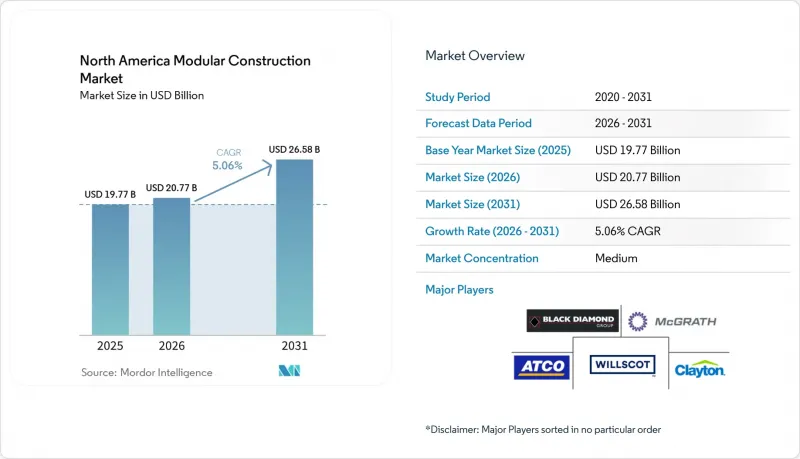
This report is Segmented by Construction (Permanent Modular, and Relocatable Modular), Material (Steel, Wood, Concrete, and Plastic), End-User Industry (Commercial, Industrial/Institutional, and Residential), and Geography (United States, Canada, and Mexico). The Market Forecasts are Provided in Terms of Value (USD).
North America Modular Construction Market Trends and Insights
Short Construction Timelines vs. Conventional Builds
Parallel site preparation and factory production routinely trim schedules by 30-50%, a decisive factor for investors seeking rapid revenue activation in the North America modular construction market. Large multifamily developers now embed modular execution into baseline pro-formas to hedge against weather-related downtime and labor bottlenecks. Digital production tracking synchronizes fabrication with just-in-time on-site craning, which secures critical-path activities such as facade installation and MEP commissioning. Quicker delivery also aligns with public-sector procurement targets that mandate occupancy within specified fiscal windows. Nevertheless, projects that require extensive design revisions during fabrication can erode speed advantages if approvals lag behind manufacturing queues.
Labor-Shortage Pressure on Site-Built Housing
The industry faced a shortfall of roughly 439,000 craft professionals in 2025, while one-fifth of the existing workforce is approaching retirement. By shifting trade-intensive work into climate-controlled plants, modular producers leverage specialization that elevates output per worker and stabilizes year-round employment in the North America modular construction market. Regionally unbalanced housing activity-from surging Atlantic Canada starts to slower Alberta pipelines-encourages national builders to source modules from hubs where talent pools remain deeper. In factory environments apprenticeship programs can operate consistently, whereas rotating field crews undermine training continuity.
Higher Upfront Capital and Logistics Costs
Launching a volumetric plant can require USD 10-50 million for line equipment, automated gantries, and quality-control labs in the North America modular construction market. Completed modules often travel hundreds of miles on escorted carriers, with freight representing as much as 15% of installed cost when fuel surcharges spike. Tariff exposure on imported steel and lumber further complicates fixed-price quoting. Small-scale developers struggle to finance such outlays unless long-term pipeline commitments lock in utilization above breakeven thresholds. Consolidation among regional haulers specializing in over-dimensioned cargo is underway to mitigate fragmented transport capacity.
Other drivers and restraints analyzed in the detailed report include:
- Rising Green-Building Mandates and Waste-Reduction Goals
- Government Incentives and Code Adoption for Modular
- Quality-Perception and Design-Flexibility Concerns
For complete list of drivers and restraints, kindly check the Table Of Contents.
Segment Analysis
Permanent units accounted for 64.62% of the North America modular construction market in 2025, underscoring the segment's ascendance from temporary classrooms to code-compliant multifamily and office assets. Clearer mortgage guidance and insurer parity with site-built structures underpin financing acceptance, while agencies purchasing securities now treat volumetric apartments equivalently to stick-built comparables. The segment's acceleration reflects landlords' preference for predictable life-cycle costs and tighter building envelopes that lower tenant energy expenses.
The relocatable sub-category is projected to grow at a 5.84% CAGR through 2031, propelled by disaster relief, remote workforce housing, and flexible educational capacity. Manufacturers increasingly offer hybrid chassis that bolt permanently yet can be disassembled if repurposing becomes attractive. Such optionality appeals to public agencies wary of stranded assets when demographic shifts alter space demand.
List of Companies Covered in this Report:
- Aries Building Systems. LLC
- ATCO Ltd.
- Boxx Modular (Black Diamond Group)
- Cavco Industries, Inc.
- Champion Home Builders, Inc.
- Clayton
- Dexterra Group Inc
- Guerdon, LLC
- Mobile Modular Management Corporation (McGrath RentCorp, Inc.)
- Modular Genius
- Modular System Sp. z o.o.
- Satellite Shelters, Inc.
- SEKISUI HOUSE, LTD.
- Silver Creek Modular, LLC
- Skender
- Triumph Modular Incorporated
- WillScot
Additional Benefits:
- The market estimate (ME) sheet in Excel format
- 3 months of analyst support
TABLE OF CONTENTS
1 Introduction
- 1.1 Study Assumptions and Market Definition
- 1.2 Scope of the Study
2 Research Methodology
3 Executive Summary
4 Market Landscape
- 4.1 Market Overview
- 4.2 Market Drivers
- 4.2.1 Short construction timelines vs. conventional builds
- 4.2.2 Labor-shortage pressure on site-built housing
- 4.2.3 Rising green-building mandates and waste-reduction goals
- 4.2.4 Government incentives and code adoption for modular
- 4.2.5 Hyperscale data-center shell demand
- 4.3 Market Restraints
- 4.3.1 Higher upfront capital and logistics costs
- 4.3.2 Quality-perception and design-flexibility concerns
- 4.3.3 Interstate oversize-load transport regulations
- 4.4 Value Chain Analysis
- 4.5 Porter's Five Forces Analysis
- 4.5.1 Bargaining Power of Suppliers
- 4.5.2 Bargaining Power of Consumers
- 4.5.3 Threat of New Entrants
- 4.5.4 Threat of Substitutes
- 4.5.5 Intensity of Competitive Rivalry
5 Market Size and Growth Forecasts (Value)
- 5.1 By Construction
- 5.1.1 Permanent Modular
- 5.1.2 Relocatable Modular
- 5.2 By Material
- 5.2.1 Steel
- 5.2.2 Wood
- 5.2.3 Concrete
- 5.2.4 Plastic
- 5.3 By End-user Industry
- 5.3.1 Commercial
- 5.3.2 Industrial/Institutional
- 5.3.3 Residential
- 5.4 By Geography
- 5.4.1 United States
- 5.4.2 Canada
- 5.4.3 Mexico
6 Competitive Landscape
- 6.1 Market Concentration
- 6.2 Strategic Moves
- 6.3 Market Share (%)/Ranking Analysis
- 6.4 Company Profiles (includes Global level Overview, Market level overview, Core Segments, Financials as available, Strategic Information, Market Rank/Share for key companies, Products and Services, and Recent Developments)
- 6.4.1 Aries Building Systems. LLC
- 6.4.2 ATCO Ltd.
- 6.4.3 Boxx Modular (Black Diamond Group)
- 6.4.4 Cavco Industries, Inc.
- 6.4.5 Champion Home Builders, Inc.
- 6.4.6 Clayton
- 6.4.7 Dexterra Group Inc
- 6.4.8 Guerdon, LLC
- 6.4.9 Mobile Modular Management Corporation (McGrath RentCorp, Inc.)
- 6.4.10 Modular Genius
- 6.4.11 Modular System Sp. z o.o.
- 6.4.12 Satellite Shelters, Inc.
- 6.4.13 SEKISUI HOUSE, LTD.
- 6.4.14 Silver Creek Modular, LLC
- 6.4.15 Skender
- 6.4.16 Triumph Modular Incorporated
- 6.4.17 WillScot
7 Market Opportunities and Future Outlook
- 7.1 White-Space and Unmet-Need Assessment

