
PUBLISHER: Mordor Intelligence | PRODUCT CODE: 2061708

PUBLISHER: Mordor Intelligence | PRODUCT CODE: 2061708
Germany Lubricants - Market Share Analysis, Industry Trends & Statistics, Growth Forecasts (2026 - 2031)
According to Mordor Intelligence, the germany lubricants market size is expected to decline from 604.12 million liters in 2025 to 598.92 million liters in 2026 and is forecast to reach 573.61 million liters by 2031 at -0.86% CAGR over 2026-2031.
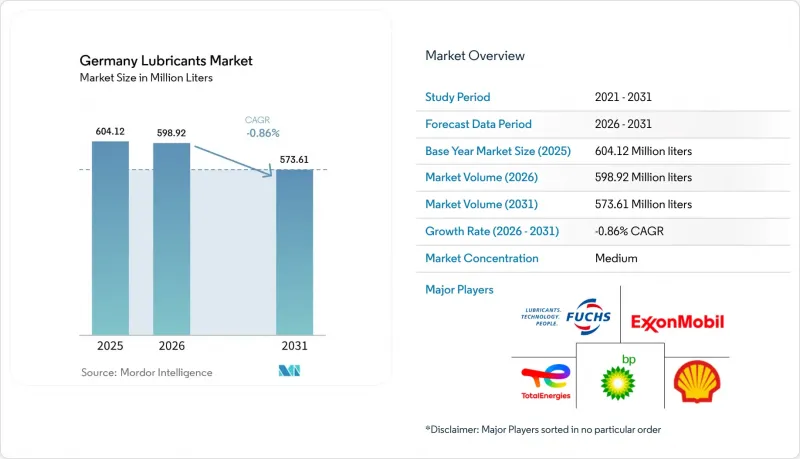
This report is Segmented by Product Type (Automotive Engine Oil, Industrial Engine Oil, Transmission Fluids, Gear Oil, Brake Fluids, Hydraulic Fluids, Greases, Process Oil, and More), End-User Industry (Automotive, Marine, Aerospace, Heavy Equipment, and Industrial), Base Stock Type (Mineral Oil-Based, Synthetic, Semi-Synthetic, and Bio-Based). Market Forecasts are Provided in Volume (Liters).
Germany Lubricants Market Trends and Insights
Manufacturing-PMI Rebound Lifting Metalworking Fluids
In December 2025, Germany's machinery and motor-vehicle plants experienced a significant dip in output before stabilizing. Every uptick in the PMI subsequently bolstered the demand for metal-cutting. Predictive-maintenance emulsions, now integrated with IoT sensors, have successfully extended sump life, leading to a reduction in disposal volumes. Suppliers in Baden-Wurttemberg have already begun synchronizing coolant replenishment with CNC utilization, achieving a notable reduction in downtime. Meanwhile, a shift from formaldehyde releasers to ester-based semi-synthetics has allowed for easy compliance with ISO 6743-7, ensuring surface finish quality isn't compromised. As production stabilizes, these process enhancements are expected to compound, driving modest volume growth even in a contracting German lubricants market.
EV-Specific E-Fluids and Thermal-Management Oils
By 2026, the Verband der Automobilindustrie forecasts significant growth in battery electric vehicle (BEV) registrations compared to the subdued figures of 2024. Each BEV necessitates dielectric coolants with thermal conductivity greater than 0.15 W/m*K, alongside e-axle oils specifically formulated for electrical insulation and reduced friction. Contracts for factory-fill supplies enhance drivetrain efficiency. Synthetic-ester coolants designed for electric vehicle batteries ensure viscosity stability across a wide temperature range. As automotive fleets transition to electric, these specialized fluids are emerging as the most rapidly expanding segment in Germany's lubricants market.
European Refinery Closures Tightening Base-Oil Supply
BP has announced plans to close down its crude capacity at Gelsenkirchen. Meanwhile, Shell repurposed its Wesseling facility into a site capable of producing Group III base oil. In recent years, Germany experienced a significant decline in base-oil sales, which compelled blenders to source premium stocks from the ARA hub. Additionally, smaller formulators, lacking long-term offtake contracts, have been grappling with margin compression, a situation that could hasten industry consolidation.
Other drivers and restraints analyzed in the detailed report include:
- Offshore-Wind and Green-Hydrogen Turbine-Fluid Demand
- EU Batteries Regulation Fostering Electrolyte Know-How
- Upcoming PFAS Ban Threatening High-Temp Greases
For complete list of drivers and restraints, kindly check the Table Of Contents.
Segment Analysis
Automotive engine oil dominated at 29.72% in 2025. However, ultra-low-viscosity formulations such as 0W-16 and 0W-20 revolutionized the market, allowing for fill volume reductions and extending service intervals significantly. Metalworking fluids show the only positive trend, inching forward at 0.06% CAGR through 2031 as PMI rebounds. Synthetic turbine and transformer oils rode the wave of demand from offshore wind projects and grid upgrades. Meanwhile, brake fluids evolved, with upgrades to DOT 5.1 to better handle the intense heat from regenerative braking. Consequently, the market for engine oils in Germany contracted at a pace outstripping the broader market decline.
In 2025, industrial oil, transmission fluid, and gear oil collectively commanded a significant portion of the market volume, bolstered by long drain intervals favored by commercial fleets. Hydraulic fluids and greases, accounting for a notable share, faced competition from electro-hydraulic actuation substitutes. In a market where basic mineral products waned, specialty blends that leveraged IoT condition monitoring carved out a niche in the German lubricants landscape.
List of Companies Covered in this Report:
- ADDINOL
- BP p.l.c.
- Carl Bechem GmbH
- Exxon Mobil Corporation
- FUCHS
- Kluber Lubrication
- LIQUI MOLY GmbH
- Quaker Chemical Corporation
- ROWE Mineralolwerk GmbH
- SCT Lubricants
- Shell plc
- TotalEnergies
- Valvoline
- Zeller+Gmelin
Additional Benefits:
- The market estimate (ME) sheet in Excel format
- 3 months of analyst support
TABLE OF CONTENTS
1 Introduction
- 1.1 Study Assumptions and Market Definition
- 1.2 Scope of the Study
2 Research Methodology
3 Executive Summary
4 Market Landscape
- 4.1 Market Overview
- 4.2 Market Drivers
- 4.2.1 Manufacturing-PMI rebound lifting metal-working fluids
- 4.2.2 EV-specific e-fluids and thermal-management oils
- 4.2.3 Offshore-wind and green-hydrogen turbine-fluid demand
- 4.2.4 EU Batteries Regulation fostering electrolyte know-how
- 4.2.5 CSRD-driven uptake of re-refined base oils
- 4.3 Market Restraints
- 4.3.1 European refinery closures tightening base-oil supply
- 4.3.2 Upcoming PFAS ban threatening high-temp greases
- 4.3.3 EV-subsidy withdrawal distorting specialty-fluid mix
- 4.4 Value Chain Analysis
- 4.5 Regulatory Framework
- 4.6 End-User Trends
- 4.6.1 Automotive Industry
- 4.6.2 Manufacturing Industry
- 4.6.3 Power Generation Industry
- 4.7 Porter's Five Forces
- 4.7.1 Bargaining Power of Suppliers
- 4.7.2 Bargaining Power of Buyers
- 4.7.3 Threat of New Entrants
- 4.7.4 Threat of Substitutes
- 4.7.5 Degree of Competition
5 Market Size and Growth Forecasts (Volume)
- 5.1 By Product Type
- 5.1.1 Automotive Engine Oil
- 5.1.2 Industrial Engine Oil
- 5.1.3 Transmission Fluids
- 5.1.4 Gear Oil
- 5.1.5 Brake Fluids
- 5.1.6 Hydraulic Fluids
- 5.1.7 Greases
- 5.1.8 Process Oil (Including Rubber Process Oil and White Oil)
- 5.1.9 Metalworking Fluids
- 5.1.10 Turbine Oil
- 5.1.11 Transformer Oil
- 5.1.12 Other Product Types
- 5.2 By End-user Industry
- 5.2.1 Automotive
- 5.2.1.1 Passenger Vehicles
- 5.2.1.2 Commercial Vehicles
- 5.2.1.3 Two-Wheelers
- 5.2.2 Marine
- 5.2.3 Aerospace
- 5.2.4 Heavy Equipment
- 5.2.4.1 Construction
- 5.2.4.2 Mining
- 5.2.4.3 Agriculture
- 5.2.5 Industrial
- 5.2.5.1 Power Generation
- 5.2.5.2 Metallurgy and Metalworking
- 5.2.5.3 Textiles
- 5.2.5.4 Oil and Gas
- 5.2.5.5 Other End-Use Industries
- 5.2.1 Automotive
- 5.3 By Base Stock Type
- 5.3.1 Mineral Oil-Based Lubricants
- 5.3.2 Synthetic Lubricants
- 5.3.3 Semi-Synthetic Lubricants
- 5.3.4 Bio-Based Lubricants
6 Competitive Landscape
- 6.1 Market Concentration
- 6.2 Strategic Moves
- 6.3 Market Share(%)/Ranking Analysis
- 6.4 Company Profiles (includes Global Overview, Market Overview, Core Segments, Financials, Strategic Information, Products and Services, Recent Developments)
- 6.4.1 ADDINOL
- 6.4.2 BP p.l.c.
- 6.4.3 Carl Bechem GmbH
- 6.4.4 Exxon Mobil Corporation
- 6.4.5 FUCHS
- 6.4.6 Kluber Lubrication
- 6.4.7 LIQUI MOLY GmbH
- 6.4.8 Quaker Chemical Corporation
- 6.4.9 ROWE Mineralolwerk GmbH
- 6.4.10 SCT Lubricants
- 6.4.11 Shell plc
- 6.4.12 TotalEnergies
- 6.4.13 Valvoline
- 6.4.14 Zeller+Gmelin
7 Market Opportunities and Future Outlook
- 7.1 White-space and Unmet-need Assessment
8 Key Strategic Questions for CEOs

