PUBLISHER: Mordor Intelligence | PRODUCT CODE: 2061721

PUBLISHER: Mordor Intelligence | PRODUCT CODE: 2061721
India Buy Now Pay Later Services - Market Share Analysis, Industry Trends & Statistics, Growth Forecasts (2026 - 2031)
According to Mordor Intelligence, india buy now pay later (BPNL) services market size in 2026 is estimated at USD 37.03 billion, growing from 2025 value of USD 30.88 billion with 2031 projections showing USD 91.86 billion, growing at 19.94% CAGR over 2026-2031.
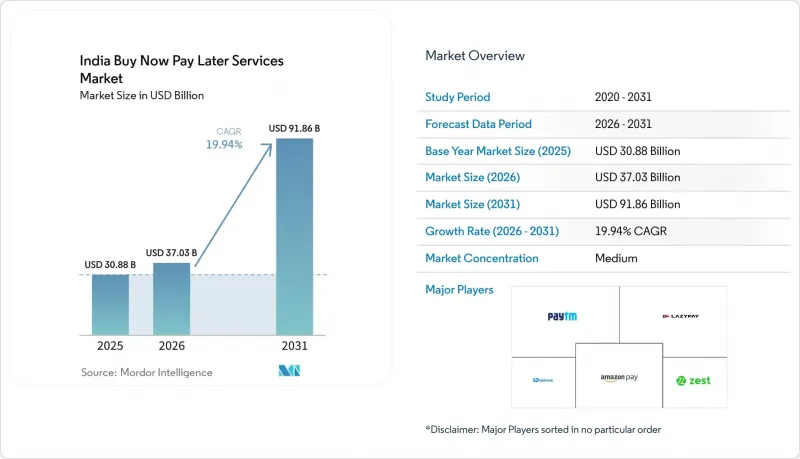
This report is Segmented by Channel (Online and POS), End User Type (Consumer Electronics, Fashion & Apparel, Healthcare and Wellness, Home Improvement, and More), Age Group (Generation Z, Millennials, Generation X, and More), and Provider (Fintechs, Banks, Others). The Market Forecasts are Provided in Terms of Value (USD).
India Buy Now Pay Later Services Market Trends and Insights
Rapid UPI-driven instant credit underwriting in Tier II & Tier III cities
The convergence of UPI and pre-sanctioned credit lines lets shoppers in smaller cities access checkout finance within seconds, eliminating paperwork and raising eligibility for "new-to-credit" users. Companies such as HDFC Bank and ICICI Bank now overlay PayLater accounts on standard QR payments, while super.money processed 124.83 million UPI-credit transactions in January 2025 alone. The outcome is a wider India buy now pay later (BPNL) services market customer base, higher ticket sizes, and stronger merchant acceptance in locations that previously lacked formal credit infrastructure.
Low credit-card penetration fueling alternative credit
With card penetration at only 5% of adults, the Indian BNPL market fills a systemic gap rather than merely offering convenience. Adoption could reach 100 million users by 2026 as consumers opt for instalments that sidestep interest-heavy revolving debt. Seamless UPI routing removes onboarding friction and positions BNPL as the de facto digital credit rail for discretionary as well as essential purchases.
RBI curbs on prepaid credit lines tighten operating models
Draft guidelines now treat BNPL balances as formal loans, forcing non-banks to partner with regulated entities, raise capital, and overhaul disclosures. Compliance outlays climb, eligibility narrows, and some providers pause expansion until revised frameworks stabilize.
Other drivers and restraints analyzed in the detailed report include:
- Merchants push to cut COD returns and lift average order value
- RBI Account Aggregator & India Stack enable real-time data
- Rising short-tenor loan delinquencies impact unit economics
For complete list of drivers and restraints, kindly check the Table Of Contents.
Segment Analysis
Point-of-sale buy now pay later (BPNL) services is projected to grow at 24.08% CAGR, reflecting shoppers' preference for instantaneous QR-code credit at neighborhood stores. In 2025, the online route still held 82.90% of India buy now pay later (BPNL) services market revenue, but in-store momentum signals deeper integration between digital wallets and physical merchants. UPI-linked credit lines let buyers split payments without submitting new KYC forms, lowering friction and extending reach beyond e-commerce.
The India buy now pay later (BPNL) services market size for in-store purchases is projected to surge as payment processors embed instalment buttons inside existing POS software, allowing merchants to auto-offer tenure options on high-value items. As offline and online boundaries blur, providers focus on uniform user journeys that preserve repayment reminders, loyalty perks, and credit limits across multiple touchpoints. This omnichannel approach limits customer churn and raises lifetime value.
Consumer electronics retained 34.60% of the 2025 India buy now pay later (BPNL) services market share, since instalments align with average handset or appliance outlays. Yet, healthcare & wellness, growing at 25.58% CAGR, now pulls BNPL into essential spending where immediate liquidity gaps are critical. Hospitals and clinics integrate instant credit APIs, reducing admissions delays caused by upfront deposit requirements.
India's BNPL market size for healthcare procedures is forecast to multiply as providers package repayment schedules around insurance reimbursement cycles. Momentum in elective surgeries and wellness subscriptions signals durable demand, prompting specialized BNPL start-ups to partner with hospital networks and diagnostic chains. Diversification into healthcare cushions providers from discretionary-spend cycles tied to electronics or fashion.
List of Companies Covered in this Report:
- Paytm Postpaid
- LazyPay
- Simpl
- Amazon Pay Later
- MobiKwik ZIP
- ZestMoney
- Flipkart Pay Later
- ePayLater
- OlaMoney Postpaid
- Flexmoney
- MoneyTap
- Slice
- Capital Float (Axio)
- KreditBee
- Bajaj Finserv
- Paytail
- Uni Cards
- Kotak Mahindra
- HDFC FlexiPay
- ICICI PayLater
Additional Benefits:
- The market estimate (ME) sheet in Excel format
- 3 months of analyst support
TABLE OF CONTENTS
1 Introduction
- 1.1 Study Assumptions & Market Definition
- 1.2 Scope of the Study
2 Research Methodology
3 Executive Summary
4 Market Landscape
- 4.1 Market Overview
- 4.2 Market Drivers
- 4.2.1 Rapid UPI-Driven Instant Credit Underwriting in Tier II & III Cities
- 4.2.2 Low Credit Card Penetration Fueling Alternative Credit
- 4.2.3 Merchant Push to Cut COD Returns & Lift Average Order Value
- 4.2.4 RBI Account Aggregator & India Stack Enable Real-Time Data
- 4.2.5 Embedded BNPL for High-Ticket Healthcare & Education
- 4.2.6 Smartphone & Vernacular-App Penetration Expanding User-Base
- 4.3 Market Restraints
- 4.3.1 RBI Curbs on Pre-Paid Credit Lines Tighten Operating Models
- 4.3.2 Rising Short-Tenor Loan Delinquencies Impact Unit Economics
- 4.3.3 Consumer Data-Privacy Concerns over Alt-Data Harvesting
- 4.3.4 FinTech Funding Winter Restricts Loan-Book Expansion
- 4.4 Value / Supply-Chain Analysis
- 4.5 Regulatory Outlook
- 4.6 Technological Outlook
- 4.7 Porter's Five Forces
- 4.7.1 Bargaining Power of Buyers
- 4.7.2 Bargaining Power of Suppliers
- 4.7.3 Threat of New Entrants
- 4.7.4 Threat of Substitutes
- 4.7.5 Intensity of Competitive Rivalry
5 Market Size & Growth Forecasts (Value)
- 5.1 By Channel
- 5.1.1 Online
- 5.1.2 Point-of-Sale (In-store)
- 5.2 By End-Use Industry
- 5.2.1 Consumer Electronics
- 5.2.2 Fashion & Apparel
- 5.2.3 Healthcare & Wellness
- 5.2.4 Home Improvement
- 5.2.5 Travel & Leisure
- 5.2.6 Media & Entertainment
- 5.2.7 Other End-Use Industries
- 5.3 By Age Group
- 5.3.1 Generation Z (18-28 Years)
- 5.3.2 Millennials (29-44 Years)
- 5.3.3 Generation X (45-60 Years)
- 5.3.4 Baby Boomers (61-79 Years)
- 5.3.5 Silent Generation (80 Years and Above)
- 5.4 By Provider
- 5.4.1 Fintechs
- 5.4.2 Banks
- 5.4.3 Others
6 Competitive Landscape
- 6.1 Market Concentration
- 6.2 Strategic Moves
- 6.3 Market Share Analysis
- 6.4 Company Profiles (includes Global level Overview, Market level overview, Core Segments, Financials as available, Strategic Information, Market Rank/Share, Products & Services, Recent Developments)
- 6.4.1 Paytm Postpaid
- 6.4.2 LazyPay
- 6.4.3 Simpl
- 6.4.4 Amazon Pay Later
- 6.4.5 MobiKwik ZIP
- 6.4.6 ZestMoney
- 6.4.7 Flipkart Pay Later
- 6.4.8 ePayLater
- 6.4.9 OlaMoney Postpaid
- 6.4.10 Flexmoney
- 6.4.11 MoneyTap
- 6.4.12 Slice
- 6.4.13 Capital Float (Axio)
- 6.4.14 KreditBee
- 6.4.15 Bajaj Finserv
- 6.4.16 Paytail
- 6.4.17 Uni Cards
- 6.4.18 Kotak Mahindra
- 6.4.19 HDFC FlexiPay
- 6.4.20 ICICI PayLater
7 Market Opportunities & Future Outlook
- 7.1 White-Space & Unmet-Need Assessment

