PUBLISHER: Global Market Insights Inc. | PRODUCT CODE: 2083342

PUBLISHER: Global Market Insights Inc. | PRODUCT CODE: 2083342
Buy Now Pay Later Market Opportunity, Growth Drivers, Industry Trend Analysis, and Forecast 2026 - 2035
The Global Buy Now Pay Later (BNPL) Market was valued at USD 10.7 billion in 2025 and is estimated to grow at a CAGR of 21.9% to reach USD 76.4 billion by 2035.
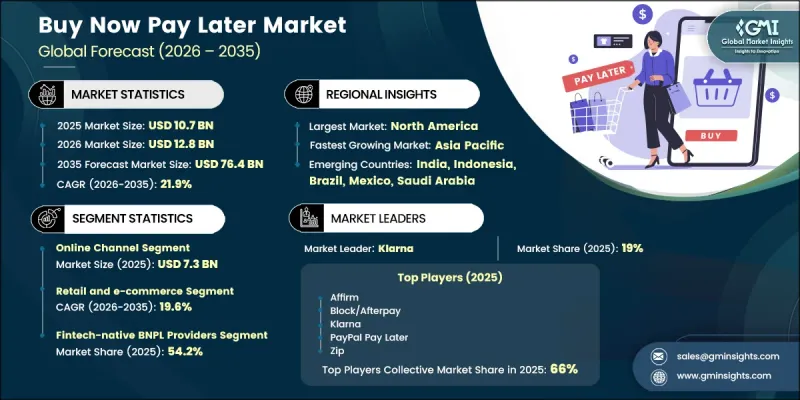
The market is experiencing rapid expansion as installment-based payment solutions become increasingly integrated across multiple industries, including retail, digital commerce, healthcare, education, travel, automotive services, and business financing. Consumer preference is steadily shifting toward flexible payment arrangements that offer greater budgeting control and predictable repayment schedules. At the same time, merchants are increasingly adopting BNPL solutions to improve transaction completion rates, enhance customer engagement, increase purchase values, and encourage repeat transactions. The growing digitalization of commerce continues to create favorable conditions for market expansion, as payment technologies can be integrated seamlessly across a broad range of online sales channels. The market is also gaining momentum in regions where traditional credit access remains limited, creating opportunities for alternative financing solutions. However, growing usage of short-term installment products has increased industry focus on responsible lending practices and risk management. As a result, providers are implementing advanced credit assessment frameworks, real-time affordability evaluations, dynamic spending controls, and enhanced reporting mechanisms to improve transparency and strengthen long-term sustainability. These developments are expected to support continued growth while encouraging greater consumer confidence and broader adoption of BNPL solutions worldwide.
| Market Scope | |
|---|---|
| Start Year | 2025 |
| Forecast Year | 2026-2035 |
| Start Value | $10.7 Billion |
| Forecast Value | $76.4 Billion |
| CAGR | 21.9% |
The online channel accounted for USD 7.3 billion in 2025, representing 68.2% share. Its leading position reflects the strong compatibility between installment payment solutions and modern digital purchasing environments. The widespread adoption of integrated payment technologies across e-commerce platforms has simplified deployment for merchants and accelerated customer acceptance. As online shopping continues to evolve, digital BNPL solutions are expected to remain a primary driver of market growth.
The retail and e-commerce segment held a 36.4% share in 2025 and is forecast to grow at a CAGR of 19.6% through 2035, growth across several emerging end-use sectors is expected to outpace traditional retail applications. Strong demand for installment-based purchasing options for higher-value products continues to support expansion within this segment.
North America Buy Now Pay Later Market was valued at USD 3.7 billion in 2025 and is forecast to reach USD 27.7 billion by 2035. The region remains one of the most developed and competitive BNPL markets globally, supported by widespread digital payment adoption, strong merchant participation, and increasing consumer preference for alternative financing options. Continued innovation in payment technology, expanding merchant networks, and rising consumer awareness are expected to sustain long-term regional growth.
Key participants operating in the global buy now pay later (BNPL) market include Klarna, Tabby, TreviPay, Splitit, PayPal Pay Later, Krevido, Affirm, Tamara, Scalapay, Zip Co, and Afterpay (Block). Companies operating in the buy now pay later (BNPL) market are focusing on several strategic initiatives to strengthen their market position and expand their customer reach. Leading providers are investing heavily in technology enhancements, artificial intelligence, and advanced risk assessment systems to improve credit decision-making and minimize default rates. Strategic partnerships with merchants, financial institutions, payment processors, and digital commerce platforms remain a key growth strategy for expanding distribution networks and increasing transaction volumes. Many companies are also diversifying their product portfolios by introducing longer-term installment options, business financing solutions, and sector-specific payment offerings. Geographic expansion into underserved markets is another important priority, enabling providers to access new customer segments. Additionally, firms are emphasizing regulatory compliance, consumer transparency, and responsible lending practices to build trust, improve customer retention, and create sustainable long-term growth opportunities across the evolving BNPL ecosystem.
Table of Contents
Chapter 1 Methodology
- 1.1 Research approach
- 1.2 Quality Commitments
- 1.2.1 GMI AI policy & data integrity commitment
- 1.2.1.1 Source consistency protocol
- 1.2.1 GMI AI policy & data integrity commitment
- 1.3 Research Trail & Confidence Scoring
- 1.3.1 Research Trail Components
- 1.3.2 Scoring Components
- 1.4 Data Collection
- 1.4.1 Partial list of primary sources
- 1.5 Data mining sources
- 1.5.1 Paid sources
- 1.5.1.1 Sources, by region
- 1.5.1 Paid sources
- 1.6 Base estimates and calculations
- 1.6.1 Base year calculation
- 1.7 Forecast model
- 1.7.1 Quantified market impact analysis
- 1.7.1.1 Mathematical impact of growth parameters on forecast
- 1.7.1 Quantified market impact analysis
- 1.8 Research transparency addendum
- 1.8.1 Source attribution framework
- 1.8.2 Quality assurance metrics
- 1.8.3 Our commitment to trust
Chapter 2 Executive Summary
- 2.1 Industry 360° synopsis
- 2.2 Key market trends
- 2.2.1 Regional
- 2.2.2 Channel
- 2.2.3 Payment Model
- 2.2.4 Customer
- 2.2.5 Service Provider
- 2.2.6 Age Group
- 2.2.7 End use
- 2.3 TAM analysis, 2026-2035
- 2.4 CXO perspectives: Strategic imperatives
Chapter 3 Industry Insights
- 3.1 Industry ecosystem analysis
- 3.1.1 Supplier landscape
- 3.1.2 Profit margin
- 3.1.3 Cost structure
- 3.1.4 Value addition at each stage
- 3.1.5 Factor affecting the value chain
- 3.1.6 Disruptions
- 3.2 Industry impact forces
- 3.2.1 Growth drivers
- 3.2.1.1 Rising demand for flexible payment structures
- 3.2.1.2 E-commerce market expansion
- 3.2.1.3 Limited access to traditional credit in emerging markets
- 3.2.1.4 Merchant adoption for conversion rate optimization
- 3.2.2 Industry pitfalls and challenges
- 3.2.2.1 Credit risk and consumer over-indebtedness
- 3.2.2.2 Regulatory uncertainty across major markets
- 3.2.3 Market opportunities
- 3.2.3.1 Omnichannel BNPL expansion
- 3.2.3.2 Non-retail vertical penetration in healthcare, automotive, and education
- 3.2.3.3 Embedded finance and white-label API partnerships
- 3.2.3.4 AI-driven underwriting and alternative credit scoring
- 3.2.1 Growth drivers
- 3.3 Growth potential analysis
- 3.4 Technology and innovation landscape
- 3.4.1 Current technological trends
- 3.4.2 Emerging technologies
- 3.5 Pricing analysis (Driven by Primary Research)
- 3.5.1 Merchant Discount Rate (MDR) & Revenue Model Trends
- 3.5.2 Consumer Fee Structures & Pricing Strategy by Player Type
- 3.6 Regulatory landscape
- 3.6.1 North America
- 3.6.1.1 Consumer Financial Protection Bureau (CFPB - United States)
- 3.6.1.2 Federal Reserve System (FRS - United States)
- 3.6.2 Europe
- 3.6.2.1 European Banking Authority (EBA)
- 3.6.2.2 European Commission (EC) - Consumer Credit Directive (CCD) framework
- 3.6.3 Asia Pacific
- 3.6.3.1 Reserve Bank of India (RBI - India)
- 3.6.3.2 Monetary Authority of Singapore (MAS - Singapore)
- 3.6.4 Latin America
- 3.6.4.1 Central Bank of Brazil (Banco Central do Brasil)
- 3.6.4.2 National Banking and Securities Commission (CNBV - Mexico)
- 3.6.5 Middle East & Africa
- 3.6.5.1 Saudi Central Bank (SAMA - Saudi Arabia)
- 3.6.5.2 Central Bank of the United Arab Emirates (CBUAE)
- 3.6.1 North America
- 3.7 Porter's analysis
- 3.8 PESTEL analysis
- 3.9 Patent analysis (Driven by Primary Research)
- 3.10 Impact of AI & Generative AI on the Market
- 3.10.1 AI-driven disruption of existing business models
- 3.10.2 Gen AI use cases & adoption roadmap by segment
- 3.10.3 Risks, limitations & regulatory considerations
- 3.11 BNPL service delivery infrastructure analysis
- 3.11.1 End-to-end BNPL transaction architecture
- 3.11.2 Core technology stack & platform architecture
- 3.11.3 API ecosystem & integration infrastructure
- 3.11.4 Credit underwriting & risk infrastructure
- 3.12 Sustainability and environmental aspects
- 3.12.1 Sustainable practices
- 3.12.2 Waste reduction strategies
- 3.12.3 Energy efficiency in production
- 3.12.4 Eco-friendly initiatives
- 3.12.5 Carbon footprint considerations
- 3.13 Forecast assumptions & scenario analysis (Driven by primary research)
- 3.13.1 Base Case key macro & industry variables driving CAGR
- 3.13.2 Optimistic Scenarios Favorable macro and industry tailwinds
- 3.13.3 Pessimistic Scenario Macroeconomic slowdown or industry headwinds
Chapter 4 Competitive Landscape, 2025
- 4.1 Introduction
- 4.2 Company market share analysis
- 4.2.1 North America
- 4.2.2 Europe
- 4.2.3 Asia Pacific
- 4.2.4 LATAM
- 4.2.5 MEA
- 4.3 Competitive analysis of major market players
- 4.4 Competitive positioning matrix
- 4.5 Key developments
- 4.5.1 Mergers & acquisitions
- 4.5.2 Partnerships & collaborations
- 4.5.3 New product launches
- 4.5.4 Expansion plans and funding
- 4.6 Company tier benchmarking
- 4.6.1 Tier classification criteria & qualifying thresholds
- 4.6.2 Tier positioning matrix by revenue, geography & innovation
Chapter 5 Market Estimates & Forecast, By Channel, 2022 - 2035 ($Bn, Transactional Value)
- 5.1 Key trends
- 5.2 Online
- 5.3 Point of Sale (POS) / In-Store
- 5.4 In-App / Platform-Embedded BNPL
Chapter 6 Market Estimates & Forecast, By Payment Model, 2022 - 2035 ($Bn, Transactional Value)
- 6.1 Key trends
- 6.2 Pay-in-4 / Short-Term Installment
- 6.3 Pay Later / Deferred Payment
- 6.4 Long-Term Installment Loans
- 6.5 Subscription BNPL
Chapter 7 Market Estimates & Forecast, By Customer, 2022 - 2035 ($Bn, Transactional Value)
- 7.1 Key trends
- 7.2 B2C (Business-to-Consumer) BNPL
- 7.3 B2B (Business-to-Business) BNPL
- 7.3.1 Invoice Financing BNPL
- 7.3.2 Supply Chain / Working Capital BNPL
- 7.3.3 Marketplace Seller Financing
Chapter 8 Market Estimates & Forecast, By Service Provider, 2022 - 2035 ($Bn, Transactional Value)
- 8.1 Key trends
- 8.2 Fintech-Native BNPL Providers
- 8.3 Bank / Financial Institution-Backed BNPL
- 8.4 Platform-Native / Big Tech BNPL
- 8.5 Retail-Led / White-Label BNPL
Chapter 9 Market Estimates & Forecast, By Age Group, 2022 - 2035 ($Bn, Transactional Value)
- 9.1 Key trends
- 9.2 18-27 (Gen Z)
- 9.3 28-43 (Millennials)
- 9.4 44-59 (Gen X)
- 9.5 60 & Above (Baby Boomers)
Chapter 10 Market Estimates & Forecast, By End Use, 2022 - 2035 ($Bn, Transactional Value)
- 10.1 Key trends
- 10.2 Retail & E-commerce
- 10.3 Consumer Electronics
- 10.4 Healthcare
- 10.5 Travel & Tourism
- 10.6 Leisure & Entertainment
- 10.7 Automotive
- 10.8 Home & Furnishings
- 10.9 Education
- 10.10 Others
Chapter 11 Market Estimates & Forecast, By Region, 2022 - 2035 ($Bn, Transactional Value)
- 11.1 Key trends
- 11.2 North America
- 11.2.1 U.S.
- 11.2.2 Canada
- 11.3 Europe
- 11.3.1 Germany
- 11.3.2 UK
- 11.3.3 France
- 11.3.4 Italy
- 11.3.5 Spain
- 11.3.6 Sweden
- 11.3.7 Switzerland
- 11.3.8 Netherlands
- 11.4 Asia Pacific
- 11.4.1 China
- 11.4.2 India
- 11.4.3 Japan
- 11.4.4 South Korea
- 11.4.5 Australia
- 11.4.6 Singapore
- 11.4.7 Malaysia
- 11.4.8 Indonesia
- 11.4.9 Thailand
- 11.5 Latin America
- 11.5.1 Brazil
- 11.5.2 Mexico
- 11.5.3 Argentina
- 11.6 MEA
- 11.6.1 South Africa
- 11.6.2 Saudi Arabia
- 11.6.3 UAE
Chapter 12 Company Profiles
- 12.1 Global players
- 12.1.1 Affirm Holdings
- 12.1.2 Afterpay (Block)
- 12.1.3 Klarna
- 12.1.4 PayPal Pay Later
- 12.1.5 Scalapay
- 12.1.6 Splitit
- 12.1.7 TreviPay
- 12.1.8 Zip
- 12.2 Regional players
- 12.2.1 Alma
- 12.2.2 CareCredit (Synchrony Financial)
- 12.2.3 Kredivo
- 12.2.4 Paidy
- 12.2.5 Sezzle
- 12.2.6 Simpl
- 12.2.7 Tabby
- 12.2.8 Tamara
- 12.3 Emerging players
- 12.3.1 Billie
- 12.3.2 ChargeAfter
- 12.3.3 Mondu
- 12.3.4 Wisetack

