
PUBLISHER: Mordor Intelligence | PRODUCT CODE: 2061734

PUBLISHER: Mordor Intelligence | PRODUCT CODE: 2061734
Italy Luxury Goods - Market Share Analysis, Industry Trends & Statistics, Growth Forecasts (2026 - 2031)
According to Mordor Intelligence, italy's luxury goods market is expected to reach USD 20.15 billion by 2026 and grow further to USD 24.07 billion by 2031, with a steady CAGR of 3.62%.
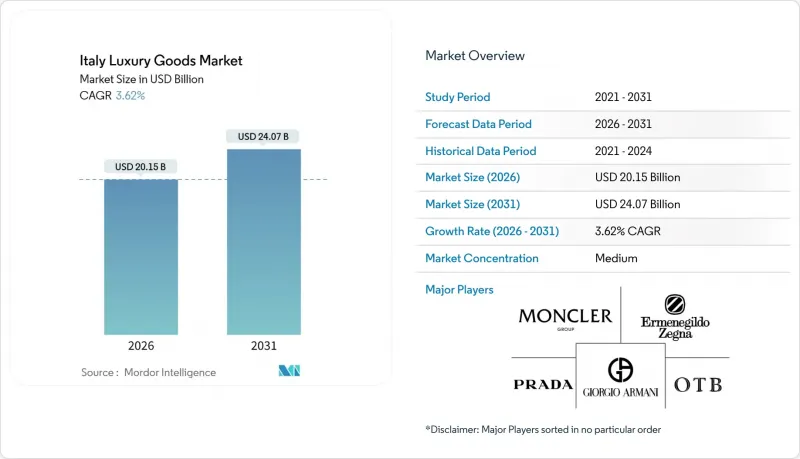
This report is Segmented by Product Type (Clothing and Apparel, Footwear, Eyewear, Leather Goods, Jewelry, Watches, and Beauty and Personal Care), End User (Men, Women, and Unisex), and Distribution Channel (Single-Brand Stores, Multi-Brand Stores, and Online Stores). The Market Forecasts are Provided in Terms of Value (USD).
Italy Luxury Goods Market Trends and Insights
Italian Craftsmanship in Luxury Goods Being Perceived as a Status Symbol
Italian craftsmanship has transitioned from merely a hallmark of quality to a pivotal competitive edge in the global luxury arena. This is especially evident in the watch segment, where Italian design now stands toe-to-toe with Swiss manufacturing. Italy's manufacturing ethos prioritizes handcrafted nuances, design innovation, and a rich cultural legacy over sheer technical engineering. The "Made in Italy" label has transcended its geographical roots, now symbolizing heritage, exclusivity, and unparalleled craftsmanship. Luxury brands leverage this prestigious positioning through four primary strategies: anchoring in Italian locales, sourcing premium materials, emphasizing meticulous manufacturing, and forging ties with Italy's culinary and cultural landmarks. The Italian government reinforced this market position by implementing an official certification seal in 2023 for Italian-manufactured products, aiming to ensure product authenticity and differentiate genuine Italian luxury items from unauthorized replicas . Domestically, luxury clothing and apparel emerge as key differentiators for affluent consumers. Italian shoppers, valuing premium quality, gravitate towards apparel that resonates with both local tastes and global trends. This segment is witnessing robust growth, largely fueled by the millennial and Gen Z demographics. These younger consumers are not only more attuned to seasonal launches and digital marketing but also demand corporate transparency. Their evolving consumption patterns are reshaping market dynamics, pushing manufacturers to marry product excellence with sustainability, ethical practices, and a touch of cultural authenticity.
Growing Demand for Sustainable High-end Materials
Italian luxury brands are prioritizing sustainability, largely due to the European Union's Digital Product Passport (DPP), which becomes mandatory by 2030. This regulation mandates comprehensive documentation of products' environmental credentials, pushing brands to guarantee transparency in their material sourcing and production. While navigating these compliance challenges is daunting, it presents Italian luxury houses with a chance to stand out in a crowded marketplace. The DPP aligns with the EU's Circular Economy Action Plan, which aims to make textiles durable, recyclable, and sustainably produced by 2030. Italy, as the fourth-largest apparel market in the European Union, reported an import value of EUR 18.2 billion in 2023, highlighting its pivotal role in the European textile industry . In light of these developments, Italian brands are channeling investments into traceable supply chains and embracing circular economy principles. Yet, the Italian market grapples with hurdles. While there's a push for sustainable apparel, consumer awareness lags, and many hesitate to pay extra for these products. Instead, decisions lean more towards price, fit, and quality. This gap highlights the urgency for brands to not only pioneer sustainable practices but also to educate consumers, aligning market demand with sustainability efforts.
Availability of Counterfeit Products
In 2024, the Italian Ministry of Enterprises intensified its battle against counterfeiting, seizing nearly 9,000 counterfeit products, shutting down 354 websites, and issuing over 2,000 fines. These actions stemmed from the enforcement measures of the "Made in Italy" law, designed to safeguard the integrity of Italian luxury goods. Counterfeiting remains a significant economic challenge, with repercussions that extend beyond mere financial losses. A study by the European Union Intellectual Property Office highlighted that counterfeiting has led to a loss of 160,000 jobs in Europe's clothing sector, with Italy bearing a substantial brunt. In response, 2023 amendments to the Code of Industrial Property bolstered protections for unregistered trademarks and trade secrets, reinforcing legal safeguards for intellectual property. Furthermore, the Italian Customs Agency has enhanced border control operations, leveraging advanced multimedia databases for more efficient identification and interception of counterfeit goods. Penalties for intellectual property infringement have been heightened, introducing stricter prison sentences and elevated fines as deterrents. These concerted efforts underscore Italy's commitment to safeguarding its luxury goods market and mitigating the broader economic impacts of counterfeiting.
Other drivers and restraints analyzed in the detailed report include:
- Influence of Social Media and Celebrity Endorsement
- Aggressive Marketing by Reputed Brands
- Lesser Demand from Price-Sensitive Consumers
For complete list of drivers and restraints, kindly check the Table Of Contents.
Segment Analysis
In 2025, clothing and apparel lead Italy's luxury goods market with a 47.85% share. This reflects Italy's strong fashion heritage and global reputation for craftsmanship. The country is a key supplier for European luxury brands and a production hub for top global fashion houses like Gucci, Prada, and Valentino. These brands maintain Italy's premium fashion status through traditional craftsmanship and steady consumer demand. The fashion industry is both a cultural symbol and a major economic contributor, employing millions and significantly boosting the national GDP.
Watches are the fastest-growing segment in Italy's luxury market, with a projected CAGR of 3.75% from 2026 to 2031. Their growth is driven by their appeal as investment assets and status symbols. Watches consistently achieve higher transaction values than other luxury items, showing their aspirational value. The second-hand watch market is expanding rapidly, especially among younger consumers who value the affordability, exclusivity, and prestige of pre-owned pieces. Neo-vintage models and independent watchmakers are gaining popularity, reflecting a shift toward unique and personalized luxury. These trends highlight the watch segment's strong growth potential and innovation.
List of Companies Covered in this Report:
- LVMH Moet Hennessy Louis Vuitton SE
- Kering SA
- Prada SpA
- Compagnie Financiere Richemont SA
- Giorgio Armani SpA
- Dolce & Gabbana S.r.l.
- Burberry Group plc
- Ermenegildo Zegna
- Salvatore Ferragamo SpA
- Tod's SpA
- Moncler SpA
- Chanel Limited
- Luxottica Group SpA
- OTB Group (Diesel, Maison Margiela, Marni)
- Safilo Group S.p.A
- Damiani SpA
- Capri Holdings Limited
- Rolex SA
- Hermes International SA
- Roberto Cavalli SpA
Additional Benefits:
- The market estimate (ME) sheet in Excel format
- 3 months of analyst support
TABLE OF CONTENTS
1 INTRODUCTION
- 1.1 Study Assumptions and Market Definition
- 1.2 Scope of the Study
2 RESEARCH METHODOLOGY
3 EXECUTIVE SUMMARY
4 MARKET LANDSCAPE
- 4.1 Market Overview
- 4.2 Market Drivers
- 4.2.1 Italian Craftsmanship in Luxury Goods Being Perceived as a Status Symbol
- 4.2.2 Growing Demand for Sustainable High-end Materials
- 4.2.3 Influence of Social Media and Celebrity Endorsement
- 4.2.4 Aggressive Marketing by Reputed Brands
- 4.2.5 Product Innovation in Terms of Raw Material and Design
- 4.2.6 Technology Integration in Luxury Retail Improves Shopping Experiences
- 4.3 Market Restraints
- 4.3.1 Availability of Counterfeit Products
- 4.3.2 Lesser Demand from Price-Sensitive Consumers
- 4.3.3 Brexit-related Trade Barriers Increase Operational Costs and Retail Prices
- 4.3.4 Labor Shortages in Specialized Craftsmanship
- 4.4 Consumer Behaviour Analysis
- 4.5 Regulatory Outlook
- 4.6 Porter's Five Forces Analysis
- 4.6.1 Bargaining Power of Suppliers
- 4.6.2 Bargaining Power of Buyers
- 4.6.3 Threat of New Entrants
- 4.6.4 Threat of Substitutes
- 4.6.5 Degree of Competition
5 MARKET SIZE AND GROWTH FORECASTS (VALUE)
- 5.1 By Product Type
- 5.1.1 Clothing and Apparel
- 5.1.2 Footwear
- 5.1.3 Eyewear
- 5.1.4 Leather Goods
- 5.1.5 Jewelry
- 5.1.6 Watches
- 5.1.7 Beauty and Personal Care
- 5.2 By End User
- 5.2.1 Men
- 5.2.2 Women
- 5.2.3 Unisex
- 5.3 By Distribution Channel
- 5.3.1 Single Brand Stores
- 5.3.2 Multi Brand Stores
- 5.3.3 Online Stores
6 COMPETITIVE LANDSCAPE
- 6.1 Market Concentration
- 6.2 Strategic Moves
- 6.3 Market Share Analysis
- 6.4 Company Profiles (includes Global level Overview, Market level overview, Core Segments, Financials as available, Strategic Information, Market Rank/Share for key companies, Products & Services, and Recent Developments)
- 6.4.1 LVMH Moet Hennessy Louis Vuitton SE
- 6.4.2 Kering SA
- 6.4.3 Prada SpA
- 6.4.4 Compagnie Financiere Richemont SA
- 6.4.5 Giorgio Armani SpA
- 6.4.6 Dolce & Gabbana S.r.l.
- 6.4.7 Burberry Group plc
- 6.4.8 Ermenegildo Zegna
- 6.4.9 Salvatore Ferragamo SpA
- 6.4.10 Tod's SpA
- 6.4.11 Moncler SpA
- 6.4.12 Chanel Limited
- 6.4.13 Luxottica Group SpA
- 6.4.14 OTB Group (Diesel, Maison Margiela, Marni)
- 6.4.15 Safilo Group S.p.A
- 6.4.16 Damiani SpA
- 6.4.17 Capri Holdings Limited
- 6.4.18 Rolex SA
- 6.4.19 Hermes International SA
- 6.4.20 Roberto Cavalli SpA
7 MARKET OPPORTUNITIES AND FUTURE OUTLOOK

