PUBLISHER: Mordor Intelligence | PRODUCT CODE: 2061746

PUBLISHER: Mordor Intelligence | PRODUCT CODE: 2061746
Video Streaming Software - Market Share Analysis, Industry Trends & Statistics, Growth Forecasts (2026 - 2031)
According to Mordor Intelligence, the video streaming software market size in 2026 is estimated at USD 18.95 billion, growing from 2025 value of USD 16.14 billion with 2031 projections showing USD 42.29 billion, growing at 17.41% CAGR over 2026-2031.
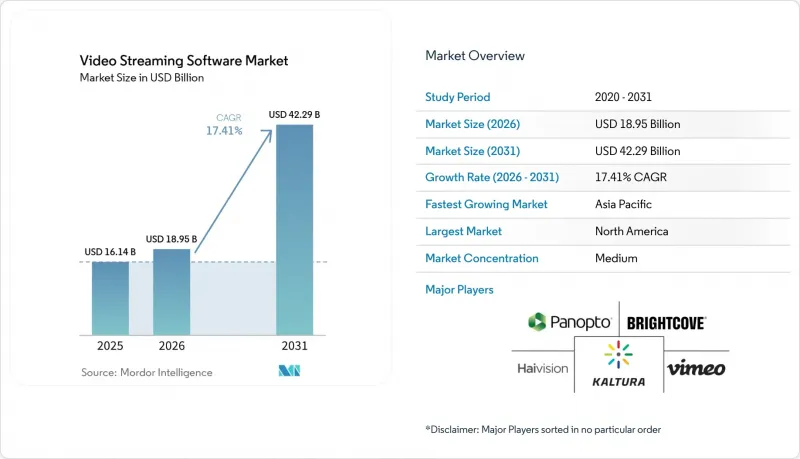
This report is Segmented by Component (Solutions, Services), Deployment Type (Cloud, On-Premise), Streaming Type (Live, Video On Demand), Vertical (Media and Entertainment, Corporate and Enterprise, and More), and Geography. The Market Forecasts are Provided in Terms of Value (USD).
Global Video Streaming Software Market Trends and Insights
Rapid 5G stand-alone networks transforming enterprise video in Asia-Pacific
Standalone 5G roll-outs have pushed end-to-end latency below 10 milliseconds in early manufacturing pilots. Factories now stream multi-angle HD feeds from robotic welding lines to remote inspectors, eliminating manual lag and keeping production running. When every fractional second saved translates into extra units produced per hour, management quickly assigns a budget to the video streaming software market for inline quality monitoring solutions. Emerging case studies travel fast across supply-chain consortia, expanding addressable demand beyond initial smart-factory adopters.
Cloud-native microservices shortening feature cycles for North-American OTT platforms
In 2024, many North American providers decomposed monoliths into containerised microservices that handle encoding, recommendation, and server-side ad insertion as independent workloads. Operators can now dial up only the microservice that spikes, such as recommendations during a celebrity live interview, without overspending on the rest of the stack. The resulting pay-as-you-grow economics reduce over-provisioning, fuel incremental R&D allocations, and attract new subscribers, feeding additional momentum into the video streaming software market.
Patent royalty escalation motivating open codecs among independent vendors
Rising minimum payments for adaptive-bitrate IP compel niche providers to trial royalty-free formats. One learning-management platform offset marginally larger file sizes by re-balancing bitrate ladders, saving licence fees and protecting gross margin. Server-side detection routines down-switch devices that lack support, providing a hedge against royalty hikes, yet placing downward pressure on the video streaming software market in segments most exposed to patent fees.
Other drivers and restraints analyzed in the detailed report include:
- Corporate hybrid-work townhalls fuelling live-video platforms in Europe
- Interactive livestream shopping catalysing ultra-low-latency tools in the Middle East
- GDPR data-transfer rulings reshaping EU platform architectures
For complete list of drivers and restraints, kindly check the Table Of Contents.
Segment Analysis
Solutions contributed the larger slice of 2025 revenue, estimated at 89.3%, because every deployment still needs a platform core to ingest, encode, and manage assets. That core foundation keeps the video streaming software market expanding as feature road-maps layer analytics, AI thumbnails, and automated QC onto the same codebase. Services revenue, however, is forecast to climb at 20.9% CAGR as overstretched IT departments outsource complex integrations such as speech-to-text tagging, event-driven transcodings, and zero-trust access controls. Managed contract, then monitor SLA compliance and patch vulnerabilities, creating sticky annuity streams. Over the forecast horizon, joint go-to-market programmes between platform suppliers and specialised integrators will channel incremental opportunities back into the video streaming software market.
Even with faster services growth, vendors that own the platform architecture preserve pricing power because customers rarely re-platform once content libraries and business logic are embedded. Continuous codec innovation triggers periodic upgrades that renew contracts, while analytics plug-ins feed dashboards correlating churn to buffer events. The interplay stabilises revenue and keeps the solutions layer at the centre of the video streaming software market even as service ecosystems flourish in parallel.
Cloud deployment captured 68.40% of the video streaming software market size in 2025 and is projected to grow at a 22.1% CAGR as operators gravitate toward elastic capacity that accommodates unpredictable traffic spikes. Edge nodes now handle just-in-time packaging and ad decisioning nearer to end-users, reducing startup time and offloading origin servers. The approach shone during a 2025 music festival where multi-camera 4K streams retained frame integrity despite fluctuating cellular conditions, reinforcing trust in cloud-edge architectures within the video streaming software market.
On-premise solutions remain viable when data sovereignty or sunk investments dictate local processing. Banks encode sensitive board meetings inside private centres, then push DRM-protected ladders to external CDNs for worldwide playback. Hybrid pipelines, capture on-premise, transcode in regional clouds, enforce geo-blocking at the edge, let operators blend compliance with elasticity. As single-pane consoles converge, decision makers weigh commercial terms rather than architectural philosophy, yet the momentum still favours cloud-first strategies that align with the broader video streaming software market.
Geography Analysis
North America held 37.60% of the video streaming software market in 2025 due to widespread broadband, dense hyperscale capacity, and an early cultural shift toward video-first workflows. Hospitals budget for compliant archives that convert regulatory burdens into searchable knowledge bases, while broadcasters embed predictive analytics that improve customer retention. A publicly listed vendor's 2024 SEC filing confirmed a strategic pivot toward automated engagement engines, and investors rewarded the move with valuation gains, signalling confidence in differentiated feature sets over commoditised delivery .
Asia-Pacific is set for roughly 19.4% CAGR thanks to mobile-first demographics and aggressive 5G stand-alone coverage that brings high-resolution, low-latency experiences into rural districts. Governments subsidise tower build-outs and local content production, turning language-specific subtitles and dubbing into standard bid requirements. Providers deploy multi-tenant regional clouds that segregate workloads by country while sharing control planes, balancing compliance with economies of scale and enlarging the total addressable slice of the video streaming software market.
Europe blends advanced consumer expectations with stringent privacy laws. After 2024 judicial rulings, platforms accelerated data-centre build-outs inside the bloc to ensure personal identifiers never exit EU borders. A UK broadcaster's migration of 7,000-plus hours of heritage content into a cloud-native workflow yielded a ten-fold uptick in parallel processing throughput . Though upfront costs spiked, turnaround times shrink, enabling same-day episodic release that viewers now expect. Advertiser-funded tiers gain traction, driving demand for SSAI modules tuned to European measurement frameworks and enlarging the regional opportunity within the video streaming software market.
- Brightcove Inc.
- Kaltura Inc.
- Amazon Web Services, Inc. (AWS Elemental)
- IBM Corporation
- Vimeo.com Inc.
- Panopto Inc.
- Haivision Systems Inc.
- Vbrick Systems Inc.
- Qumu Corporation
- Dacast
- Mux
- MediaPlatform, Inc.
- Bitmovin
- Akamai Technologies, Inc.
- Wowza Media Systems, LLC
- JW Player Inc.
- Google LLC (YouTube Live)
- Harmonic Inc.
- Telestream, LLC
- Cloudinary
- Synamedia Ltd.
- Verizon Media (Edgecast)
Additional Benefits:
- The market estimate (ME) sheet in Excel format
- 3 months of analyst support
TABLE OF CONTENTS
1 INTRODUCTION
- 1.1 Study Assumptions and Market Definition
- 1.2 Scope of the Study
2 RESEARCH METHODOLOGY
3 EXECUTIVE SUMMARY
4 MARKET LANDSCAPE
- 4.1 Market Overview
- 4.2 Market Drivers
- 4.2.1 Rapid rollout of 5G SA networks accelerating low-latency enterprise streaming demand in Asia-Pacific
- 4.2.2 Cloud-native micro-services adoption boosting SaaS OTT platforms in North America
- 4.2.3 Corporate spend on hybrid-work townhalls fuelling internal live-video platforms in Europe
- 4.2.4 Shoppable livestream commerce uptake driving interactive streaming tools in the Middle East
- 4.2.5 US CMS rules mandating secure tele-video archiving in healthcare
- 4.2.6 D2C sports-rights migration energising multi-CDN orchestration in South America
- 4.3 Market Restraints
- 4.3.1 Escalating adaptive-bitrate patent royalties squeezing smaller vendors
- 4.3.2 GDPR / Schrems-II hurdles limiting EU cross-border video data flows
- 4.3.3 Rural last-mile congestion in Africa undermining QoS SLAs
- 4.3.4 High creator churn on freemium platforms eroding SMB ARPU
- 4.4 Regulatory Outlook
- 4.5 Technological Outlook
- 4.6 Porter's Five Forces
- 4.6.1 Bargaining Power of Suppliers
- 4.6.2 Bargaining Power of Buyers
- 4.6.3 Threat of New Entrants
- 4.6.4 Threat of Substitutes
- 4.6.5 Competitive Rivalry
- 4.7 Investment Analysis
- 4.8 Pricing Analysis
- 4.8.1 Subscription-based
- 4.8.2 Advertising-supported
- 4.8.3 Transaction-based (Pay-per-View)
- 4.8.4 Hybrid / Freemium
5 MARKET SIZE AND GROWTH FORECASTS (VALUE USD BILLION)
- 5.1 By Component
- 5.1.1 Solutions
- 5.1.1.1 Video Management
- 5.1.1.2 Transcoding and Processing
- 5.1.1.3 Video Delivery and Post-Production
- 5.1.1.4 Video Analytics
- 5.1.2 Services
- 5.1.2.1 Professional Services
- 5.1.2.2 Managed Services
- 5.1.1 Solutions
- 5.2 By Deployment Type
- 5.2.1 Cloud
- 5.2.2 On-premise
- 5.3 By Streaming Type
- 5.3.1 Live
- 5.3.2 Video on Demand
- 5.4 By Vertical
- 5.4.1 Media and Entertainment
- 5.4.1.1 OTT Platforms
- 5.4.1.2 Broadcast and Cable TV Networks
- 5.4.1.3 Sports and Esports
- 5.4.2 Corporate and Enterprise
- 5.4.3 Education and eLearning
- 5.4.4 Healthcare and Telemedicine
- 5.4.5 Banking, Financial Services and Insurance (BFSI)
- 5.4.6 Other Verticals
- 5.4.1 Media and Entertainment
- 5.5 By Geography
- 5.5.1 North America
- 5.5.1.1 United States
- 5.5.1.2 Canada
- 5.5.2 Latin America
- 5.5.2.1 Brazil
- 5.5.2.2 Argentina
- 5.5.2.3 Mexico
- 5.5.2.4 Rest of Latin America
- 5.5.3 Europe
- 5.5.3.1 Germany
- 5.5.3.2 United Kingdom
- 5.5.3.3 France
- 5.5.3.4 Italy
- 5.5.3.5 Spain
- 5.5.3.6 Rest of Europe
- 5.5.4 Asia-Pacific
- 5.5.4.1 China
- 5.5.4.2 Japan
- 5.5.4.3 South Korea
- 5.5.4.4 India
- 5.5.4.5 Australia
- 5.5.4.6 New Zealand
- 5.5.4.7 Rest of Asia-Pacific
- 5.5.5 Middle East and Africa
- 5.5.5.1 United Arab Emirates
- 5.5.5.2 Saudi Arabia
- 5.5.5.3 South Africa
- 5.5.5.4 Rest of Middle East and Africa
- 5.5.1 North America
6 COMPETITIVE LANDSCAPE
- 6.1 Strategic Developments
- 6.2 Vendor Positioning Analysis
- 6.3 Company Profiles (includes Global level Overview, Market level overview, Core Segments, Financials as available, Strategic Information, Products and Services, and Recent Developments)
- 6.3.1 Brightcove Inc.
- 6.3.2 Kaltura Inc.
- 6.3.3 Amazon Web Services, Inc. (AWS Elemental)
- 6.3.4 IBM Corporation
- 6.3.5 Vimeo.com Inc.
- 6.3.6 Panopto Inc.
- 6.3.7 Haivision Systems Inc.
- 6.3.8 Vbrick Systems Inc.
- 6.3.9 Qumu Corporation
- 6.3.10 Dacast
- 6.3.11 Mux
- 6.3.12 MediaPlatform, Inc.
- 6.3.13 Bitmovin
- 6.3.14 Akamai Technologies, Inc.
- 6.3.15 Wowza Media Systems, LLC
- 6.3.16 JW Player Inc.
- 6.3.17 Google LLC (YouTube Live)
- 6.3.18 Harmonic Inc.
- 6.3.19 Telestream, LLC
- 6.3.20 Cloudinary
- 6.3.21 Synamedia Ltd.
- 6.3.22 Verizon Media (Edgecast)
7 MARKET OPPORTUNITIES AND FUTURE OUTLOOK
- 7.1 White-space and Unmet-need Assessment

