PUBLISHER: Mordor Intelligence | PRODUCT CODE: 2061795

PUBLISHER: Mordor Intelligence | PRODUCT CODE: 2061795
Singapore Heat Pump - Market Share Analysis, Industry Trends & Statistics, Growth Forecasts (2026 - 2031)
According to Mordor Intelligence, the singapore heat pump market size is projected to be USD 464.91 million in 2025, USD 486.36 million in 2026, and reach USD 593.82 million by 2031, growing at a CAGR of 4.07% from 2026 to 2031.
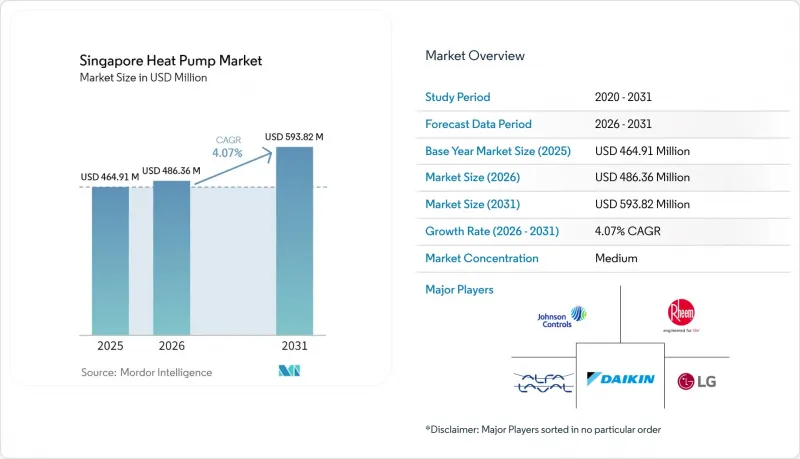
This report is Segmented by Source Type (Air Source, Water Source, and More), Technology (Air-To-Air, Air-To-Water, and More), Capacity (Below 10 KW, 10-50 KW, and More), Application (Space Heating, Industrial and Process Heating, and More), End User (Residential, Commercial, and More), Installation (New Installation, and Retrofit), and Geography. The Market Forecasts are Provided in Terms of Value (USD).
Singapore Heat Pump Market Trends and Insights
Surge in Public Sector Retrofit Grants Under Singapore Green Plan 2030
The Government earmarked SGD 63 million (USD 47 million) for the Grant for Energy Efficient Measures in Existing Buildings 2.0, extended to March 2027, to help commercial and municipal owners upgrade HVAC systems. Grant-related projects prioritize comprehensive packages that couple heat pumps with building-management software and chiller replacements, rewarding vendors that can deliver turnkey retrofits. Because eligible floor space is concentrated in the Central Business District and emerging polycentric hubs, contractors with prior relationships in those zones are winning early orders. Building owners also lean on partners that can navigate Green Mark paperwork and energy-performance verification to unlock disbursements. The three-year runway allows suppliers to lock in multiyear pipelines, tightening competition for high-capacity air-to-water units.
Mandatory Energy-Labeling Pushing Premium-Efficiency Heat Pumps
The National Environment Agency introduced a five-tick label and a uniform energy-factor test for water heaters effective 1 April 2025. Heat-pump water heaters consistently achieve four or five ticks, while conventional electric resistance units rarely reach two ticks, guiding buyers toward premium efficiency. Because manufacturers must lodge models with the agency before sales, smaller brands without accredited laboratories face entry barriers. Transparent labels highlight lifecycle savings and shrink the information gap that once made capital-intensive heat pumps a hard sell. As a result, distributors report a pivot in ordering patterns ahead of the April deadline, especially from hospitality chains seeking visible sustainability credentials.
High Initial Capex Versus Gas Water Heaters
Residential heat-pump water heaters cost about SGD 3,400 (USD 2,520) for a 60-liter unit against gas heaters under SGD 1,000 (USD 740). The extra wiring, drainage, and ventilation work adds another SGD 500 to 1,000 (USD 370 to 740). Because the Energy Efficiency Grant excludes individual homeowners, no offsetting subsidy shortens payback, so many owners still choose cheaper gas models. Resale-flat dwellers and condominium management committees often postpone upgrades until failures occur, constraining annual unit sales in the sub-10 kW class, even though operating savings reach SGD 500 (USD 370) over three years.
Other drivers and restraints analyzed in the detailed report include:
- Commercial and Municipal District-Cooling Expansion
- Growing Demand for Ultra-Low-GWP Refrigerant Systems Ahead of 2028 HFC Phase-Down
- Limited Roof and Plant Space in High-Rise Buildings
For complete list of drivers and restraints, kindly check the Table Of Contents.
Segment Analysis
Air-source units delivered 48.78% of the Singapore heat pump market share in 2025. Warm ambient air of 25 °C and above supports stable year-round coefficients of performance while avoiding costly boreholes or seawater intakes. Comparable upfront pricing and simpler permitting make the format the default for residential retrofits and small offices. In hybrid deployments, facility managers pair an air-source heat pump with a back-up gas boiler or electric element to arbitrage tariff fluctuations, driving a 4.81% CAGR forecast up to 2031. Water-source models serve niche maritime and petrochemical sites where seawater is plentiful, yet anti-corrosion expenses and discharge rules cap volume. Ground-source options remain rare because vertical drilling is price-prohibitive on land-scarce plots. Auditors certified under the Building and Construction Authority scheme often default to air-source recommendations, reinforcing incumbent momentum.
System suppliers increasingly pre-install smart controllers that modulate fan speeds and defrost cycles to handle Singapore's high humidity, reducing maintenance callbacks. Component makers such as Copeland rolled out digital scroll compressors fine-tuned for the tropical envelope, nudging market acceptance of higher-se efficiency classes. Even so, service companies report that customers remain cautious about refrigerant-charge limits inside shafts and rooftops, which keeps retrofit penetration below potential in older tower blocks.
Air-to-water platforms represented 51.31% of 2025 revenue and are set for a 5.02% CAGR through 2031, the quickest pace among technology groups. District-cooling networks in Marina Bay and Jurong Lake District distribute chilled water, so an air-to-water heat pump can supply both space-cooling and 60 °C domestic hot-water loads from a single shell-and-tube exchanger, cutting duplicate equipment. Air-to-air units remain common in public-housing corridors where split-unit air conditioners already populate balconies, but they lose share to hydronic systems in premium offices where owners value heat recovery. Water-to-water and ground-to-water selections, despite higher theoretical efficiencies, demand either seawater permits or boreholes that can delay projects for months, unsettling developers working on tight construction calendars.
Manufacturers now ship modular skids that fit inside constrained mechanical rooms and scale upward in 50 kW steps, an attractive feature for expansion phases in mixed-use projects. The National Environment Agency product-registration database shows a threefold increase in R290 and R1234ze air-to-water listings since 2025, confirming the technology's compliance momentum. Engineers who specify new podium plantrooms confess the deciding factor is often spatial: one multi-service module frees enough roof for PV arrays that boost Green Mark scores, satisfying corporate net-zero declarations.
List of Companies Covered in this Report:
- Johnson Controls International plc
- Rheem Manufacturing Company
- Alfa Laval AB
- Daikin Industries, Ltd.
- LG Electronics Inc.
- Carrier Global Corporation
- Mitsubishi Electric Asia Pte. Ltd.
- Copeland LP
- Panasonic Holdings Corporation
- AOS Bath Pte. Ltd.
- DENSO Corporation
- Danfoss A/S
- Temperzone Ltd.
- Gree Electric Appliances, Inc. of Zhuhai
- Trane Technologies plc
- Risen Thermohygro Services Pte. Ltd.
- Midea Group Co., Ltd.
- Ariston Holding N.V.
- Samsung Electronics Co., Ltd.
- Robert Bosch GmbH
Additional Benefits:
- The market estimate (ME) sheet in Excel format
- 3 months of analyst support
TABLE OF CONTENTS
1 INTRODUCTION
- 1.1 Study Assumptions and Market Definition
- 1.2 Scope of the Study
2 RESEARCH METHODOLOGY
3 EXECUTIVE SUMMARY
4 MARKET LANDSCAPE
- 4.1 Market Overview
- 4.2 Market Drivers
- 4.2.1 Surge in Public Sector Retrofit Grants under Singapore Green Plan 2030
- 4.2.2 Mandatory Energy-labeling Pushing Premium-Efficiency Heat Pumps
- 4.2.3 Commercial and Municipal District-Cooling Expansion (Marina Bay, Jurong Lake District, Tengah)
- 4.2.4 Rising Carbon-Tax Trajectory Incentivizing Electrified HVAC
- 4.2.5 Integration of High-COP Heat Pumps with Floating PV and Thermal Storage Pilots
- 4.2.6 Growing Demand for Ultra-Low-GWP Refrigerant Systems Ahead of 2028 HFC Phase-Down
- 4.3 Market Restraints
- 4.3.1 High Initial Capex Versus Gas Water Heaters
- 4.3.2 Installation and Technical Expertise Gaps
- 4.3.3 Limited Roof and Plant Space in High-Rise Buildings
- 4.3.4 Seasonal Grid-Reserve Margin Shortfalls during Peak Cooling Hours
- 4.4 Industry Value Chain Analysis
- 4.5 Regulatory Landscape
- 4.6 Technological Outlook
- 4.7 Porter's Five Forces Analysis
- 4.7.1 Bargaining Power of Suppliers
- 4.7.2 Bargaining Power of Buyers
- 4.7.3 Threat of New Entrants
- 4.7.4 Threat of Substitutes
- 4.7.5 Intensity of Competitive Rivalry
- 4.8 Impact of Macroeconomic Factors on the Market
5 MARKET SIZE AND GROWTH FORECASTS (VALUE)
- 5.1 By Source Type
- 5.1.1 Air Source
- 5.1.2 Water Source
- 5.1.3 Ground Source
- 5.1.4 Hybrid
- 5.2 By Technology
- 5.2.1 Air-to-Air
- 5.2.2 Air-to-Water
- 5.2.3 Water-to-Water
- 5.2.4 Ground-to-Water
- 5.3 By Capacity
- 5.3.1 Below 10 kW
- 5.3.2 10-50 kW
- 5.3.3 50-200 kW
- 5.3.4 Above 200 kW
- 5.4 By Application
- 5.4.1 Space Heating
- 5.4.2 Space Cooling
- 5.4.3 Domestic and Sanitary Hot Water
- 5.4.4 Industrial and Process Heating
- 5.4.5 Other Applications
- 5.5 By End User
- 5.5.1 Residential
- 5.5.2 Commercial
- 5.5.3 Industrial
- 5.6 By Installation
- 5.6.1 New Installation
- 5.6.2 Retrofit
6 COMPETITIVE LANDSCAPE
- 6.1 Market Concentration
- 6.2 Strategic Moves
- 6.3 Vendor Positioning Analysis
- 6.4 Company Profiles (includes Global Level Overview, Market Level Overview, Core Segments, Financials as available, Strategic Information, Market Rank/Share, Products and Services, Recent Developments)
- 6.4.1 Johnson Controls International plc
- 6.4.2 Rheem Manufacturing Company
- 6.4.3 Alfa Laval AB
- 6.4.4 Daikin Industries, Ltd.
- 6.4.5 LG Electronics Inc.
- 6.4.6 Carrier Global Corporation
- 6.4.7 Mitsubishi Electric Asia Pte. Ltd.
- 6.4.8 Copeland LP
- 6.4.9 Panasonic Holdings Corporation
- 6.4.10 AOS Bath Pte. Ltd.
- 6.4.11 DENSO Corporation
- 6.4.12 Danfoss A/S
- 6.4.13 Temperzone Ltd.
- 6.4.14 Gree Electric Appliances, Inc. of Zhuhai
- 6.4.15 Trane Technologies plc
- 6.4.16 Risen Thermohygro Services Pte. Ltd.
- 6.4.17 Midea Group Co., Ltd.
- 6.4.18 Ariston Holding N.V.
- 6.4.19 Samsung Electronics Co., Ltd.
- 6.4.20 Robert Bosch GmbH
7 MARKET OPPORTUNITIES AND FUTURE OUTLOOK
- 7.1 White-Space and Unmet-Need Assessment

