
PUBLISHER: Mordor Intelligence | PRODUCT CODE: 2061823

PUBLISHER: Mordor Intelligence | PRODUCT CODE: 2061823
Herbal Supplements - Market Share Analysis, Industry Trends & Statistics, Growth Forecasts (2026 - 2031)
According to Mordor Intelligence, the herbal supplements market size is projected to expand from USD 54.23 billion in 2025 and USD 57.03 billion in 2026 to USD 75.41 billion by 2031, registering a 5.75% CAGR between 2026 and 2031.
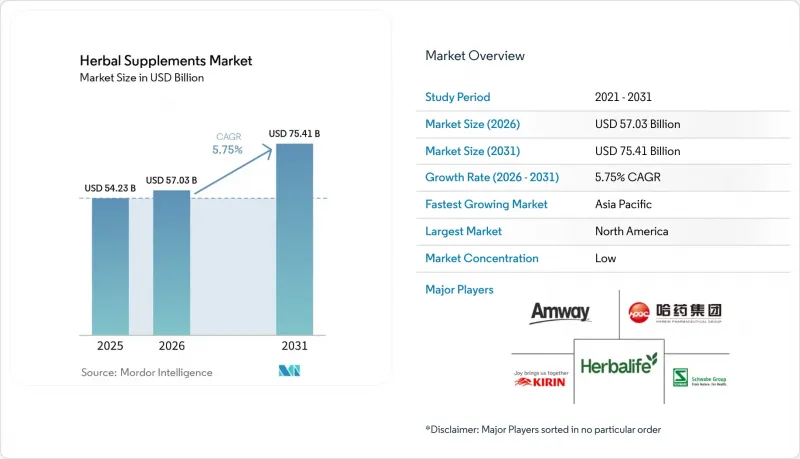
This report is Segmented by Product Type (Single Botanical, Combination Botanical), Form (Tablets, and More), Functionality/Health Benefits (Digestive and Gut Health, Stress, and More), Distribution Channel (Pharmacies and Drug Stores, Supermarkets/Hypermarkets, and More), and Geography (North America, Europe, and More). The Market Forecasts are Provided in Terms of Value (USD) and Volume (Tons).
Global Herbal Supplements Market Trends and Insights
Preference for natural and clean-label products
Consumer demand for transparency and natural ingredients is significantly transforming product development strategies within the herbal supplements market. This shift extends beyond ingredient sourcing to include sustainable packaging solutions, ethical harvesting practices, and a focus on environmental and social responsibility. For instance, Blackmores achieved B Corp certification in 2024, showcasing its commitment to sustainability and ethical business practices. Regulatory developments in the herbal supplements market are further accelerating the transition to natural products. The EU's Heads of Food Safety Agencies identified 117 substances for potential restriction in food supplements, compelling manufacturers to prioritize botanicals with established safety and efficacy profiles. Third-party certifications have also emerged as a critical factor for market access and consumer trust. Products with USP Verified certification, for example, enjoy an 84% trust rate among supplement users, emphasizing the growing importance of quality assurance and transparency. This increasing preference for natural formulations is driving advancements in extraction technologies, standardization processes, and clean-label solutions. These innovations enable manufacturers to deliver consistent potency, meet regulatory requirements, and align with evolving consumer expectations, positioning the industry for sustained growth.
Growth of e-commerce and digital platforms
The digital transformation of distribution has significantly reshaped the herbal supplements market, driving a notable increase in online sales. E-commerce platforms in the herbal supplements market have enabled direct-to-consumer interactions, eliminating traditional retail markups and offering personalized product recommendations tailored to individual health goals and preferences. This shift gained momentum during the COVID-19 pandemic, as consumers increasingly sought convenient and reliable access to health products. Social media platforms, particularly TikTok, have become critical in influencing consumer behavior, creating substantial product awareness and driving sales conversions. This trend is especially pronounced among younger demographics who favor natural health solutions. Additionally, digital platforms have introduced subscription-based models, which enhance customer retention and streamline predictive inventory management. These advancements address persistent supply chain challenges that have historically affected the industry. The integration of artificial intelligence into e-commerce platforms further enhances the consumer experience by enabling sophisticated product matching and delivering educational content. This empowers consumers to navigate the complex herbal supplement landscape with greater confidence and informed decision-making.
Quality control and product adulteration
Amid rising concerns in the herbal supplements market over product quality and authenticity, the American Herbal Products Association has rolled out Good Agricultural Practices to combat contamination and adulteration. The Botanical Adulterants Prevention Program has flagged prevalent substitution and contamination in widely used ingredients, underscoring the need for advanced authentication technologies, such as blockchain-based tracking systems. Regulatory bodies are ramping up their oversight efforts. Notably, an expert group from the EU has proposed restrictions on substances, including coumarin, curcumin, and hypericum perforatum, citing safety concerns. In a move echoing this heightened regulatory vigilance across Europe, the Netherlands is launching a notification system for food supplements, classifying herbal preparations into distinct risk groups. As supply chain transparency becomes paramount for market access, companies are channeling investments into vertical integration and forging direct sourcing relationships, all in a bid to uphold product integrity and traceability.
Other drivers and restraints analyzed in the detailed report include:
- Ageing populations driving preventive health spend
- Product innovation and personalization
- Competition from conventional pharmaceuticals and other natural products
For complete list of drivers and restraints, kindly check the Table Of Contents.
Segment Analysis
In the herbal supplements market, combination formulas represented a smaller share of 2025 sales, they are anticipated to grow at a faster pace than the overall herbal supplements market, with a robust CAGR of 6.15% projected through 2031. Insights from network pharmacology indicate that piperine can enhance curcumin's bioavailability by an impressive 2000%, enabling the use of lower dosages while improving tolerability. These clinically validated synergies not only justify a price premium of 20-35% but also drive stronger consumer loyalty, as evidenced by higher repeat purchase rates compared to single-ingredient products. Leading brands like Foria Wellness leverage multi-herb blends, incorporating ingredients such as reishi, chaga, ashwagandha, and L-theanine, to position their SKUs as comprehensive wellness solutions. These products are marketed as holistic rituals designed to address multiple health concerns, including stress management, sleep enhancement, and cognitive support.
Single botanical products in the herbal supplements market, however, continue to dominate, contributing 68.27% of 2025 revenue. Their success is attributed to simpler regulatory requirements and greater consumer familiarity. For instance, psyllium emerged as the leading product in U.S. mainstream channels, generating USD 289.45 million in 2024. This performance was supported by an FDA-approved claim linking soluble fiber to heart health benefits. Despite this, the market for single botanical products faces challenges such as saturation and limited opportunities for differentiation, which have slowed growth. To address these challenges, brands are increasingly positioning these staple products as entry-level offerings, using them as a gateway to upsell consumers to more profitable combination formulas within the broader herbal supplements market.
Geography Analysis
In 2025, North America maintained its position as the leading regional contributor, accounting for 40.98% of global revenue. U.S. herbal supplement sales rose to USD 13.23 billion, reflecting a 5.4% year-over-year growth. The direct-to-consumer segment experienced significant growth, reaching a 29% penetration rate, highlighting the increasing preference for online subscriptions. The FDA's 2025 approval of NMN as a dietary supplement resolved uncertainties surrounding novel ingredients. Furthermore, tariff reductions on turmeric and ginger lowered landed costs, intensifying price competition with synthetic alternatives. Canada benefits from its streamlined Natural Health Product regime, while Mexico leverages cross-border e-commerce and growing urban incomes. Retailers across North America are emphasizing third-party testing in response to past adulteration issues, pushing suppliers to obtain ISO 22000 certification to retain shelf space.
Asia-Pacific is anticipated to grow at the fastest rate in the herbal supplements market, with a projected 6.87% CAGR through 2031. China's oral plant extract sector, valued at CNY 60.2 billion (approximately USD 8.5 billion), and India's emergence as a global sourcing hub, supported by Sami-Sabinsa's USD 15 million capacity expansion, are key growth drivers. In early 2026, three major acquisitions in India underscored the trend of domestic brand consolidation. Meanwhile, social commerce platforms like Shopee and TikTok are driving demand in Southeast Asia. Japan's aging population is boosting demand for cognitive and mobility botanicals, further supported by government recognition of traditional medicine in mainstream healthcare. Although regulatory timelines vary across ASEAN countries, the overall trend of liberalization is reducing barriers for international players with region-specific products.
Europe, despite its regulatory complexities, continues to experience steady growth. The EU's Traditional Herbal Medicinal Products Directive facilitates the entry of botanical supplements with a history of traditional use. Europe's strong focus on sustainability aligns well with the values of botanical supplements, increasing demand for ethically sourced and eco-friendly products. Germany leads the European herbal supplements market, demonstrating widespread acceptance of natural health products and benefiting from a well-established retail network. Post-Brexit, the UK's regulatory landscape is ripe with opportunities for innovative botanical formulations, even those facing hurdles in other EU territories. Yet, the region grapples with challenges, notably the EU's impending 2025 ban on botanicals with hydroxyanthracene derivatives, necessitating product tweaks and supply chain realignments. Meanwhile, South America and the Middle East & Africa emerge as potential hotspots, driven by a rising health consciousness and maturing retail landscapes, albeit with many markets still navigating underdeveloped regulatory terrains.
- Herbalife Nutrition Ltd.
- Dr. Willmar Schwabe GmbH & Co. KG (Nature's way)
- Harbin Pharmaceutical Group Co., Ltd (GNC)
- Amway Corporation
- NOW Foods
- Gaia Herbs
- Swanson Health
- Arkopharma
- Kirin Holdings Company, Limited. (Blackmores)
- Himalaya Wellness
- Pure Mountain Botanicals
- Sanofi(Qunol)
- Nestle S.A (Solgar)
- Force Factor
- Nature's Bounty (The Bountiful Co.)
- Pharmavite (Nature Made)
- Rainbow Light
- New Chapter
- Snap Supplements
- Carlyle Nutritionals
Additional Benefits:
- The market estimate (ME) sheet in Excel format
- 3 months of analyst support
TABLE OF CONTENTS
1 INTRODUCTION
- 1.1 Study Assumptions and Market Definition
- 1.2 Scope of the Study
2 RESEARCH METHODOLOGY
3 EXECUTIVE SUMMARY
4 MARKET LANDSCAPE
- 4.1 Market Overview
- 4.2 Market Drivers
- 4.2.1 Preference for natural and clean-label products
- 4.2.2 Growth of e-commerce and digital platforms
- 4.2.3 Ageing populations driving preventive health spend
- 4.2.4 Product innovation and personalization
- 4.2.5 Influence of traditional medicine systems
- 4.2.6 Technological advancements in cultivation and processing
- 4.3 Market Restraints
- 4.3.1 Quality control and product adulteration
- 4.3.2 Competition from conventional pharmaceuticals and other natural products
- 4.3.3 Supply chain vulnerabilities
- 4.3.4 Regulatory inconsistencies
- 4.4 Supply-Chain Analysis
- 4.5 Regulatory Landscape
- 4.6 Technological Outlook
- 4.7 Porter's Five Forces Analysis
- 4.7.1 Threat of New Entrants
- 4.7.2 Bargaining Power of Buyers
- 4.7.3 Bargaining Power of Suppliers
- 4.7.4 Threat of Substitutes
- 4.7.5 Intensity of Competitive Rivalry
5 MARKET SIZE AND GROWTH FORECASTS (VALUE)
- 5.1 By Type
- 5.1.1 Single Botanical
- 5.1.2 Combination Botanical
- 5.2 By Form
- 5.2.1 Tablets
- 5.2.2 Capsules/Softgels
- 5.2.3 Gummies/Chews
- 5.2.4 Powders
- 5.2.5 Others
- 5.3 By Functionality/Health Benefits
- 5.3.1 Digestive and Gut Health
- 5.3.2 Stress, Sleep and Cognitive Health
- 5.3.3 Immune Support
- 5.3.4 Others
- 5.4 By Distribution Channel
- 5.4.1 Pharmacies and Drug Stores
- 5.4.2 Supermarkets/Hypermarkets
- 5.4.3 Online Retail Stores
- 5.4.4 Other Distribution Channels
- 5.5 By Geography
- 5.5.1 North America
- 5.5.1.1 United States
- 5.5.1.2 Canada
- 5.5.1.3 Mexico
- 5.5.1.4 Rest of North America
- 5.5.2 Europe
- 5.5.2.1 Germany
- 5.5.2.2 United Kingdom
- 5.5.2.3 Italy
- 5.5.2.4 France
- 5.5.2.5 Spain
- 5.5.2.6 Netherlands
- 5.5.2.7 Poland
- 5.5.2.8 Belgium
- 5.5.2.9 Sweden
- 5.5.2.10 Rest of Europe
- 5.5.3 Asia-Pacific
- 5.5.3.1 China
- 5.5.3.2 India
- 5.5.3.3 Japan
- 5.5.3.4 Australia
- 5.5.3.5 Indonesia
- 5.5.3.6 South Korea
- 5.5.3.7 Thailand
- 5.5.3.8 Singapore
- 5.5.3.9 Rest of Asia-Pacific
- 5.5.4 South America
- 5.5.4.1 Brazil
- 5.5.4.2 Argentina
- 5.5.4.3 Colombia
- 5.5.4.4 Chile
- 5.5.4.5 Peru
- 5.5.4.6 Rest of South America
- 5.5.5 Middle East and Africa
- 5.5.5.1 South Africa
- 5.5.5.2 Saudi Arabia
- 5.5.5.3 United Arab Emirates
- 5.5.5.4 Nigeria
- 5.5.5.5 Egypt
- 5.5.5.6 Morocco
- 5.5.5.7 Turkey
- 5.5.5.8 Rest of Middle East and Africa
- 5.5.1 North America
6 COMPETITIVE LANDSCAPE
- 6.1 Market Concentration
- 6.2 Strategic Moves
- 6.3 Market Share Analysis
- 6.4 Company Profiles (includes Global level Overview, Market level overview, Core Segments, Financials as available, Strategic Information, Market Rank/Share for key companies, Products and Services, and Recent Developments)
- 6.4.1 Herbalife Nutrition Ltd.
- 6.4.2 Dr. Willmar Schwabe GmbH & Co. KG (Nature's way)
- 6.4.3 Harbin Pharmaceutical Group Co., Ltd (GNC)
- 6.4.4 Amway Corporation
- 6.4.5 NOW Foods
- 6.4.6 Gaia Herbs
- 6.4.7 Swanson Health
- 6.4.8 Arkopharma
- 6.4.9 Kirin Holdings Company, Limited. (Blackmores)
- 6.4.10 Himalaya Wellness
- 6.4.11 Pure Mountain Botanicals
- 6.4.12 Sanofi(Qunol)
- 6.4.13 Nestle S.A (Solgar)
- 6.4.14 Force Factor
- 6.4.15 Nature's Bounty (The Bountiful Co.)
- 6.4.16 Pharmavite (Nature Made)
- 6.4.17 Rainbow Light
- 6.4.18 New Chapter
- 6.4.19 Snap Supplements
- 6.4.20 Carlyle Nutritionals
7 MARKET OPPORTUNITIES AND FUTURE OUTLOOK

