PUBLISHER: Mordor Intelligence | PRODUCT CODE: 2061891

PUBLISHER: Mordor Intelligence | PRODUCT CODE: 2061891
Wet Wipes - Market Share Analysis, Industry Trends & Statistics, Growth Forecasts (2026 - 2031)
According to Mordor Intelligence, the wet wipes market size was valued at USD 19.11 million in 2025 and is estimated to grow from USD 19.55 million in 2026 to reach USD 22.85 million by 2031, at a CAGR of 3.17% from 2026 to 2031.
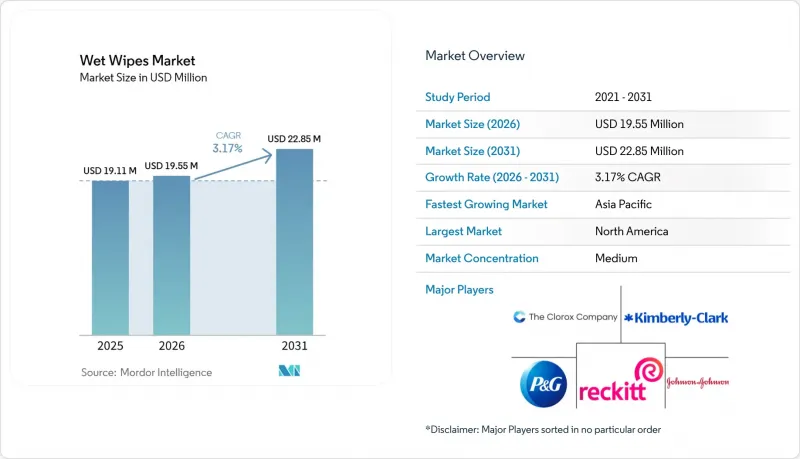
This report is Segmented by Product Type (Personal Care Wipes, Home Care Wipes, and Pet Wipes), Distribution Channel (Supermarkets/Hypermarkets, Drug Stores/Pharmacies, Convenience/Grocery Stores, Online Retail Stores, and Other Distribution Channels), and Geography (North America, Europe, Asia-Pacific, Middle East and Africa, South America). The Market Forecasts are Provided in Terms of Value (USD).
Global Wet Wipes Market Trends and Insights
Rising hygiene and sanitation consciousness
Households and institutions without a reliable water supply increasingly rely on disposable wipes for everyday cleaning, driving demand in densely populated urban areas across the Asia-Pacific and the Middle East. The growing emphasis on hygiene, coupled with convenience, has made wet wipes a staple in these regions. Public-sector procurement standards that prioritize biodegradable substrates are becoming more prevalent in school, transit, and healthcare tenders, signaling sustained volume growth for suppliers that meet these criteria. Additionally, workplace wellness mandates, such as Ontario's 2025 washroom cleaning rule, are further boosting institutional bulk orders . The wet wipes market continues to benefit from employers integrating surface disinfecting wipes into safety protocols and consumers maintaining pandemic-era hygiene practices. Brands that can demonstrate both germ-kill efficacy and environmental safety are gaining a competitive edge, particularly as regulatory scrutiny intensifies. Furthermore, advancements in product innovation, such as flushable and compostable wipes, are addressing environmental concerns while expanding the market's appeal.
Growth in travel and outdoor activities
International arrivals grew 4% to 1.52 billion in 2025, with Asia-Pacific up 6% and Africa up 8% . These trends are driving the demand for travel-size antibacterial wipes, particularly in airports, hotels, and convenience stores. The growing trend of pet-friendly travel is also contributing to this demand, as the majority of U.S. pet owners now vacation with their pets, creating a need for specialized products such as paw and ear wipes. Additionally, the rising popularity of outdoor recreation activities, including hiking, camping, and music festivals, has normalized the use of carry-along hygiene kits. This shift is fueling incremental sales across both personal care and surface disinfectant subsegments. The wet wipes market is capitalizing on these trends by offering innovative solutions such as resealable packs and multi-unit bundles that cater to specific consumer needs. These products are designed to comply with airline liquid restrictions and campsite disposal regulations, making them more convenient for travelers.
Environmental concerns over plastic-based wipes
Sewer blockages caused by non-flushable wipes cost UK utilities approximately USD 250 million annually, intensifying political and regulatory pressure for bans. Additionally, microplastic pollution has placed brands under increased scrutiny from NGOs and exposed retailers to potential reputational risks. Flushability regulations under the European Single-Use Plastics Directive now mandate clear labeling and impose extended producer responsibility fees, further squeezing margins for non-compliant products . In response, leading players in the wet wipes market are investing in innovative solutions, such as water-dispersible binders like polyvinyl alcohol and carboxymethyl cellulose, which disintegrate efficiently in wastewater systems. Companies are focusing on developing biodegradable and compostable alternatives to align with evolving consumer preferences and stricter environmental standards, ensuring long-term sustainability and market competitiveness.
Other drivers and restraints analyzed in the detailed report include:
- Premiumization and biodegradable substrates
- Rising marketing and advertisement initiatives
- Rising availability of alternatives
For complete list of drivers and restraints, kindly check the Table Of Contents.
Segment Analysis
Personal care wipes accounted for 72.81% of the revenue in 2025, driven by the widespread use of baby, cosmetic, and hand-and-body wipes as essential hygiene products across various demographics. The personal care segment is expected to maintain steady growth, while pet wipes are projected to be the fastest-growing category, with an annual growth rate of 4.02% through 2031. The increasing adoption of pets, particularly among Gen Z couples, and the convenience of subscription delivery models are fueling this growth. Pet wipes now feature innovative products such as antibacterial paw pads and deodorizing formulas that comply with airline carry-on regulations and hotel pet policies, further enhancing their appeal. Within the personal care segment, manufacturers are focusing on innovation to meet evolving consumer preferences and regulatory requirements. Skin-friendly preservatives and plant-based sheets are being incorporated to align with new flushability standards.
Baby wipes, while facing margin pressures from private-label competitors, continue to maintain consumer trust by emphasizing dermatologically tested claims and hypoallergenic formulations. Cosmetic wipes are increasingly incorporating advanced ingredients such as micellar water and vitamin C, catering to beauty-conscious consumers seeking quick, effective skincare solutions. These innovations are helping brands differentiate themselves in a competitive market. Home care wipes, although facing competition from reusable microfiber cloths, remain a staple in institutional settings due to their effectiveness in disinfecting and maintaining hygiene. The demand for disinfecting formats is particularly strong in healthcare facilities, schools, and offices, where hygiene standards are critical. Additionally, the growing awareness of hygiene and cleanliness among consumers has led to increased adoption of home care wipes for everyday cleaning tasks. Manufacturers are also exploring sustainable options, such as biodegradable materials, to address environmental concerns and appeal to eco-conscious consumers.
Geography Analysis
In 2025, North America accounted for 36.09% of the wet wipes market revenue, driven by high per-capita usage and extensive institutional procurement across schools, offices, and healthcare systems. State-level flushability labeling requirements in regions like California and Washington have added cost and complexity for manufacturers. However, the potential federal passage of the WIPPES Act could standardize these regulations. Corporate wellness initiatives continue to fuel demand for surface wipes in office environments, while the growing penetration of e-commerce accelerates the market share of private-label products. In Canada, regulatory trends closely follow those in the United States, while Mexico benefits from a rising middle class that supports the premiumization of wet wipes.
The Asia-Pacific region is expected to register the highest growth rate, with a projected CAGR of 3.64% from 2026 to 2031. Urbanization, inconsistent water supply, and the expansion of smartphone-driven retail channels are key factors driving this growth. China leads the region in volume, primarily through baby-wipe purchases, while India and Indonesia are experiencing double-digit value growth in natural-ingredient cosmetic wipes. E-commerce platforms enable domestic start-ups to bypass traditional retail barriers. Additionally, initiatives like Unicharm's dry-clean diaper recycling program highlight how local manufacturers are leveraging water conservation as a competitive advantage.
Europe faces increasing regulatory pressures under the Single-Use Plastics Directive, with national bans on plastic-based wipes set to take effect in December 2026 in Wales and by August 2027 in Scotland. Germany's Blue Angel certification amplifies the demand for fiber transparency, while Scandinavian retailers are delisting non-certified products. In the Middle East and Africa, the market is expanding from a smaller base, supported by a rebound in tourism surpassing previous levels and rising per-capita wipe usage due to drought conditions. In South America, market growth is concentrated in Brazil, Argentina, and Colombia, although currency volatility poses challenges for premium-priced products.
- The Clorox Company
- Kimberly-Clark Corporation
- Reckitt Benckiser Group PLC
- Procter & Gamble Co.
- Johnson & Johnson
- Unilever
- Nice-Pak Products Inc.
- Essity AB
- Hengan International Group
- Unicharm Corporation
- The Honest Company Inc.
- Pigeon Corporation
- WaterWipes UC
- Rockline Industries
- Albaad Massuot Yitzhak Ltd.
- Edgewell Personal Care
- SC Johnson
- TLC International
- Godrej Consumer Products
- PlusWipes
Additional Benefits:
- The market estimate (ME) sheet in Excel format
- 3 months of analyst support
TABLE OF CONTENTS
1 INTRODUCTION
- 1.1 Study Assumptions and Market Definition
- 1.2 Scope of the Study
2 RESEARCH METHODOLOGY
3 EXECUTIVE SUMMARY
4 MARKET LANDSCAPE
- 4.1 Market Overview
- 4.2 Market Drivers
- 4.2.1 Rising hygiene and sanitation consciousness
- 4.2.2 Rising marketing and advertisements initiatives
- 4.2.3 Growth in travel and outdoor activities
- 4.2.4 Premiumization and biodegradable substrates
- 4.2.5 Water-scarcity driven adoption in emerging hot-climate regions
- 4.2.6 Workplace wellness mandates boosting institutional demand
- 4.3 Market Restraints
- 4.3.1 Environmental concerns over plastic-based wipes
- 4.3.2 Rising availability of alternatives
- 4.3.3 High cost per use compared to traditional cleaning methods like soap and water
- 4.3.4 Frequent use may cause skin irritation or allergies in sensitive individuals
- 4.4 Consumer Demand Analysis
- 4.5 Regulatory Outlook
- 4.6 Porter's Five Forces
- 4.6.1 Threat of New Entrants
- 4.6.2 Bargaining Power of Buyers
- 4.6.3 Bargaining Power of Suppliers
- 4.6.4 Threat of Substitute Products
- 4.6.5 Intensity of Competitive Rivalry
5 MARKET SIZE AND GROWTH FORECASTS (VALUE)
- 5.1 By Product Type
- 5.1.1 Personal Care Wipes
- 5.1.2 Home Care Wipes
- 5.1.3 Pet Wipes
- 5.2 By Distribution Channel
- 5.2.1 Supermarkets/Hypermarkets
- 5.2.2 Drug Stores/Pharmacies
- 5.2.3 Convenience/Grocery Stores
- 5.2.4 Online Retail Stores
- 5.2.5 Other Distribution Channels
- 5.3 By Geography
- 5.3.1 North America
- 5.3.1.1 United States
- 5.3.1.2 Canada
- 5.3.1.3 Mexico
- 5.3.1.4 Rest of North America
- 5.3.2 Europe
- 5.3.2.1 Germany
- 5.3.2.2 United Kingdom
- 5.3.2.3 Italy
- 5.3.2.4 France
- 5.3.2.5 Spain
- 5.3.2.6 Netherlands
- 5.3.2.7 Poland
- 5.3.2.8 Belgium
- 5.3.2.9 Sweden
- 5.3.2.10 Rest of Europe
- 5.3.3 Asia-Pacific
- 5.3.3.1 China
- 5.3.3.2 India
- 5.3.3.3 Japan
- 5.3.3.4 Australia
- 5.3.3.5 Indonesia
- 5.3.3.6 South Korea
- 5.3.3.7 Thailand
- 5.3.3.8 Singapore
- 5.3.3.9 Rest of Asia-Pacific
- 5.3.4 Middle East and Africa
- 5.3.4.1 South Africa
- 5.3.4.2 Saudi Arabia
- 5.3.4.3 United Arab Emirates
- 5.3.4.4 Nigeria
- 5.3.4.5 Egypt
- 5.3.4.6 Morocco
- 5.3.4.7 Turkey
- 5.3.4.8 Rest of Middle East and Africa
- 5.3.5 South America
- 5.3.5.1 Brazil
- 5.3.5.2 Argentina
- 5.3.5.3 Colombia
- 5.3.5.4 Chile
- 5.3.5.5 Peru
- 5.3.5.6 Rest of South America
- 5.3.1 North America
6 COMPETITIVE LANDSCAPE
- 6.1 Market Concentration
- 6.2 Strategic Moves
- 6.3 Market Share Analysis
- 6.4 Company Profiles (includes Global level Overview, Market level overview, Core Segments, Financials as available, Strategic Information, Market Rank/Share for key companies, Products and Services, and Recent Developments)
- 6.4.1 The Clorox Company
- 6.4.2 Kimberly-Clark Corporation
- 6.4.3 Reckitt Benckiser Group PLC
- 6.4.4 Procter & Gamble Co.
- 6.4.5 Johnson & Johnson
- 6.4.6 Unilever
- 6.4.7 Nice-Pak Products Inc.
- 6.4.8 Essity AB
- 6.4.9 Hengan International Group
- 6.4.10 Unicharm Corporation
- 6.4.11 The Honest Company Inc.
- 6.4.12 Pigeon Corporation
- 6.4.13 WaterWipes UC
- 6.4.14 Rockline Industries
- 6.4.15 Albaad Massuot Yitzhak Ltd.
- 6.4.16 Edgewell Personal Care
- 6.4.17 SC Johnson
- 6.4.18 TLC International
- 6.4.19 Godrej Consumer Products
- 6.4.20 PlusWipes
7 MARKET OPPORTUNITIES AND FUTURE OUTLOOK

