
PUBLISHER: Mordor Intelligence | PRODUCT CODE: 2062049

PUBLISHER: Mordor Intelligence | PRODUCT CODE: 2062049
United States Chemical Warehousing And Storage - Market Share Analysis, Industry Trends & Statistics, Growth Forecasts (2026 - 2031)
According to Mordor Intelligence, the united states chemical warehousing and storage market size is expected to increase from USD 19.70 billion in 2025 to USD 20.38 billion in 2026 and reach USD 24.74 billion by 2031, growing at a CAGR of 3.95% over 2026-2031.
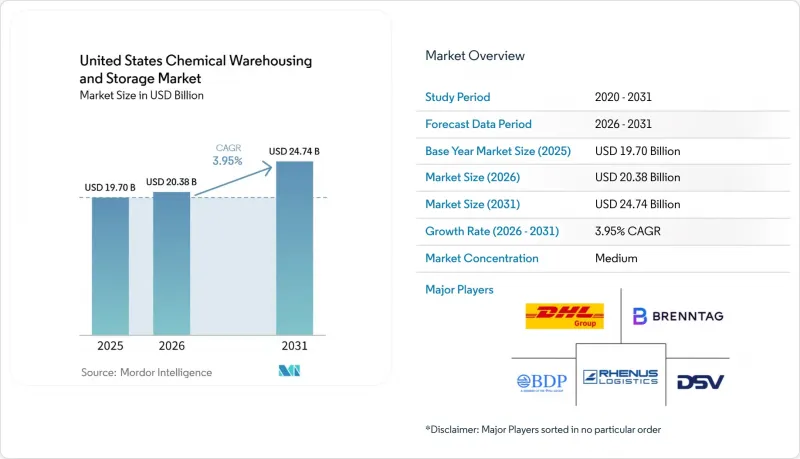
This report is Segmented by Warehouse Type (General Warehousing, Speciality Chemical Warehouse, and More), by Chemical Type (Flammable Liquids, Corrosives, and More), by End-User Industry (Basic Chemicals Manufacturing, Specialty Chemicals Manufacturing, and More), and by Regions (Northeast, Midwest, and More). The Market Forecasts are Provided in Terms of Value (USD Billion).
United States Chemical Warehousing And Storage Market Trends and Insights
Shale Gas Boom and Petrochemical Renaissance
New and proposed Gulf Coast crackers anchor multi-year demand for hazmat-compliant storage near production centers and export corridors. Shintech's USD 3.4 billion ethylene and chlor-alkali complex in Iberville Parish targets 2030 completion, and signals sustained feedstock-backed capacity growth in Louisiana. ExxonMobil is evaluating an ethane cracker and polyethylene plant near Corpus Christi with a potential USD 8.6 billion capital plan, which, if approved, would expand staging needs for polymers and intermediates buildouts add further pull. Venture Global approved the USD 8.6 billion CP2 project in Cameron Parish, while Cheniere filed to add four Corpus Christi trains that would lift peak capacity by 24 mtpa. These energy megaprojects require adjacent storage of refrigerants, corrosion inhibitors, and specialty process chemicals under strict segregation with real-time inventory tracking. Export logistics reinforce the cycle, as Energy Transfer's Flexport and Enterprise Products Partners' expansions shape occupancy and just-in-time inventory strategies near Nederland and the Houston Ship Channel.
Nearshoring and Reshoring of Chemical Manufacturing
Pharmaceutical and specialty chemical investments increase demand for temperature-controlled storage and validated quality systems close to the United States manufacturing lines. Corporate plans disclosed by leading pharma manufacturers highlight expanded active pharmaceutical ingredients and injectable therapy capacity that will rely on GDP-compliant warehousing and 21 CFR Part 11-validated monitoring. Distributor investments mirror this shift, as Cencora committed USD 1 billion through 2030 across national hubs, including a West Coast expansion and a cold-chain scale-up at Dothan, Alabama, to meet the rise in products that need 2-to-8 degree Celsius storage. Network consolidation also supports reshoring, with DSV completing the DB Schenker acquisition in 2025, enhancing cross-regional warehousing reach and standardization. Regional operators add value-added services such as trailer wash and maintenance at ports to reduce cycle times for liquid-bulk assets, reinforcing the United States chemical warehousing and storage market as nearshoring advances.
High Capital Investment for Hazmat-Compliant Facilities
Upgrading or building hazmat-ready warehouses requires significant capital for 120-minute fire-rated construction, segregated bunded zones, and foam-deluge and vapor-control systems. Operators are also updating hazard communication and safety data sheets to align with OSHA's 2024 final rule, which sets substance compliance by January 2026 and mixture compliance by July 2027. Economic impact assessments indicate one-time costs for file and label revisions and training, even as certain labeling changes reduce recurring compliance burdens. State and federal process changes, including e-Manifest use and record retention, add system and workflow workstreams that many sites integrate with quality management and WMS applications. Storage practices must meet EPA secondary-containment expectations, with adequate capacity and compatible materials for spills and stormwater, which drives site layout and capex plans. These obligations reinforce premium pricing for compliant sites in the United States chemical warehousing and storage market, where documented safety and inspection logs are essential for insurability and customer audits.
Other drivers and restraints analyzed in the detailed report include:
- Expansion of Gulf Coast Petrochemical Export Terminals
- Rising Specialty Chemicals Production Volumes
- Acute Shortage of Trained Hazardous Material Handlers
For complete list of drivers and restraints, kindly check the Table Of Contents.
Segment Analysis
Specialty chemical warehouses led with 34.12% in 2025, reflecting purpose-built facilities with rated fire walls, segregated bunded zones, and intrinsically safe handling that allow flammables, corrosives, and oxidizers to be managed in a single site while maintaining compliance. Temperature-controlled warehouses post the fastest growth at a projected 4.8% CAGR to 2031 as life sciences launches require validated chillers, redundant power, and 21 CFR Part 11-validated data loggers. DHL's million-square-foot healthcare hub in Annville is designed with GDP and GMP controls and Foreign Trade Zone status to align customs and tariff processes with time-sensitive pharma flows. Facilities that can blend safety, quality, and cold-chain reliability sustain rent premiums that exceed general industrial levels in the United States chemical warehousing and storage market.
Across the base, hazardous material warehouses combine enhanced ventilation, spill containment, and secondary containment plans with compatibility-controlled storage and routine drills. General chemical storage in shared sites continues to serve non-hazmat products and finished goods, but the fastest growth sits in temperature-controlled settings that pair automation with audit-ready documentation. Recent projects include EVERSANA's Memphis distribution center using AI-enabled robotics and a new WMS to expand cold capacity while sustaining on-time delivery metrics. These patterns consolidate demand around multi-client nodes that can standardize hazard controls and quality systems at scale for the United States chemical warehousing and storage industry.
List of Companies Covered in this Report:
- DHL Group
- Brenntag North America
- Rhenus Logistics
- BDP International
- DSV
- C.H. Robinson
- XPO Logistics
- HOYER Group
- ADLI Logistics
- CEVA Logistics
- Quantix Supply Chain
- R&S Logistics
- Talke Logistics
- Hellmann Worldwide Logistics
- Yusen Logistics (part of NYK Line)
- Bertschi AG
- Kuehne + Nagel
- Den Hartogh Logistics
- Weber Hazmat Logistics
- Odyssey Logistics & Technology Corporation
Additional Benefits:
- The market estimate (ME) sheet in Excel format
- 3 months of analyst support
TABLE OF CONTENTS
1 Introduction
- 1.1 Study Assumptions & Market Definition
- 1.2 Scope of the Study
2 Research Methodology
3 Executive Summary
4 Market Landscape
- 4.1 Market Overview
- 4.2 Market Drivers
- 4.2.1 Shale Gas Boom and Petrochemical Renaissance
- 4.2.2 Nearshoring and Reshoring of Chemical Manufacturing
- 4.2.3 Expansion of Gulf Coast Petrochemical Export Terminals
- 4.2.4 Rising Specialty Chemicals Production Volumes
- 4.2.5 Outsourcing Trend Among Chemical Manufacturers
- 4.2.6 Growing Cross-Border Chemical Trade with Mexico and Canada
- 4.3 Market Restraints
- 4.3.1 High Capital Investment for Hazmat-Compliant Facilities
- 4.3.2 Acute Shortage of Trained Hazardous Material Handlers
- 4.3.3 Escalating Insurance and Liability Premiums
- 4.3.4 Land Scarcity Near Major Port and Rail Terminals
- 4.4 Value / Supply-Chain Analysis
- 4.5 Regulatory Landscape
- 4.6 Technological Outlook
- 4.7 Porter's Five Forces
- 4.7.1 Threat of New Entrants
- 4.7.2 Bargaining Power of Suppliers
- 4.7.3 Bargaining Power of Buyers
- 4.7.4 Threat of Substitutes
- 4.7.5 Competitive Rivalry
- 4.8 Automation Integration in Chemical Inventory Management
- 4.9 Shift Toward Multi-Client Shared Chemical Storage Models
5 Market Size & Growth Forecasts (Value, USD Billion)
- 5.1 By Warehouse Type
- 5.1.1 General Warehousing
- 5.1.2 Speciality Chemical Warehouse
- 5.1.3 Hazardous Materials (HAZMAT) Warehouses
- 5.1.4 Temperature-Controlled Chemical Warehouses
- 5.2 By Chemical Type
- 5.2.1 Flammable Liquids
- 5.2.2 Corrosives
- 5.2.3 Toxic Substances
- 5.2.4 Oxidizers
- 5.2.5 Others
- 5.3 By End-user Industry
- 5.3.1 Basic Chemicals Manufacturing
- 5.3.2 Specialty Chemicals Manufacturing
- 5.3.3 Pharmaceuticals & Life Sciences
- 5.3.4 Agrochemicals
- 5.3.5 Paints, Coatings & Adhesives
- 5.3.6 Food & Feed Additives
- 5.3.7 Oil & Gas / Petrochemicals
- 5.3.8 Others
- 5.4 By Region - United States
- 5.4.1 Northeast
- 5.4.2 Midwest
- 5.4.3 Southeast
- 5.4.4 Southwest
- 5.4.5 West
6 Competitive Landscape
- 6.1 Market Concentration
- 6.2 Strategic Moves
- 6.3 Market Share Analysis
- 6.4 Company Profiles (includes Global level Overview, Market level overview, Core Segments, Financials as available, Strategic Information, Products & Services, and Recent Developments)
- 6.4.1 DHL Group
- 6.4.2 Brenntag North America
- 6.4.3 Rhenus Logistics
- 6.4.4 BDP International
- 6.4.5 DSV
- 6.4.6 C.H. Robinson
- 6.4.7 XPO Logistics
- 6.4.8 HOYER Group
- 6.4.9 ADLI Logistics
- 6.4.10 CEVA Logistics
- 6.4.11 Quantix Supply Chain
- 6.4.12 R&S Logistics
- 6.4.13 Talke Logistics
- 6.4.14 Hellmann Worldwide Logistics
- 6.4.15 Yusen Logistics (part of NYK Line)
- 6.4.16 Bertschi AG
- 6.4.17 Kuehne + Nagel
- 6.4.18 Den Hartogh Logistics
- 6.4.19 Weber Hazmat Logistics
- 6.4.20 Odyssey Logistics & Technology Corporation
7 Market Opportunities & Future Outlook

