PUBLISHER: Mordor Intelligence | PRODUCT CODE: 2062075

PUBLISHER: Mordor Intelligence | PRODUCT CODE: 2062075
Jojoba Oil - Market Share Analysis, Industry Trends & Statistics, Growth Forecasts (2026 - 2031)
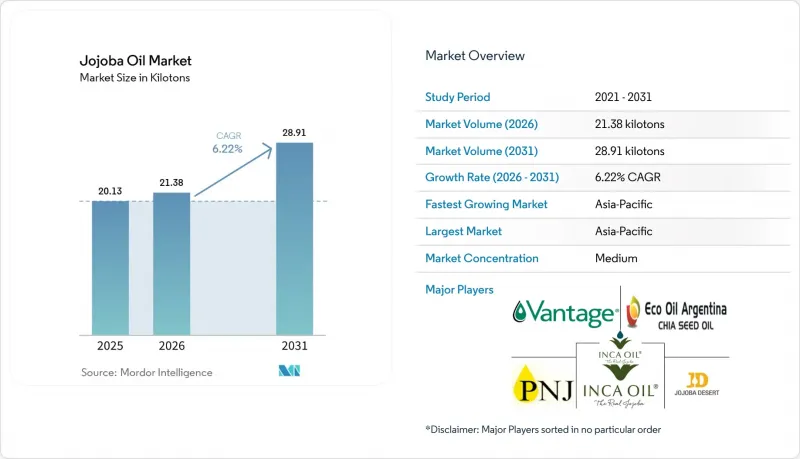
According to Mordor Intelligence, the jojoba oil market size was valued at 20.13 kilotons in 2025 and is estimated to grow from 21.38 kilotons in 2026 to reach 28.91 kilotons by 2031, at a CAGR of 6.22% during the forecast period (2026-2031).
This report is Segmented by Type (Cold-Pressed Jojoba Oil and Refined Jojoba Oil), Application (Cosmetics and Personal Care, Pharmaceuticals, Industrial, and Other Applications), and Geography (Asia-Pacific, North America, Europe, South America, and Middle East and Africa). The Market Forecasts are Provided in Terms of Volume (Tons).
Global Jojoba Oil Market Trends and Insights
Clean-Beauty and Organic Personal-Care Boom
Formulators are displacing silicones with jojoba because the oil's wax-ester backbone mirrors human sebum, offering occlusion without pore blockage. Fair for Life certification, renewed by Jojoba Desert in 2026, allows retailers such as Whole Foods to attach 15%-25% shelf premiums. EcoVadis Platinum status, secured in September 2025, amplifies acceptance among procurement teams at L'Oreal that are under Scope 3 scrutiny. Cold-pressed organic grades already hold 60.35% of the jojoba oil market, and EU Cosmetics Regulation EC 1223/2009 further narrows the field for synthetic emollients.
Cross-Industry Demand for High-Temperature Bio-Lubricants
Thermal stability above 300°C makes jojoba a drop-in fluid for aerospace actuators and MQL machining rigs that must meet EPA (Environmental Protection Agency) Vessel General Permit limits on petroleum discharge. Tribological studies report friction coefficients as low as 0.08, besting synthetic esters in boundary regimes. North American OEMs (original equipment manufacturers) accept the 2x cost premium because longer drain intervals reduce disposal fees that OSHA (Occupational Safety and Health Administration) categorizes as hazardous.
High Production Cost and Limited Cultivation Zones
Jojoba only thrives where annual rainfall sits below 400 mm, so growers wait 5 years for payback, a lag that keeps supply tight and capital shy. Production outlays run 3x higher than soybeans, and water scarcity in Arizona and La Rioja raises yield risk each season. Expansion into new geographies is hindered by the need for varietal trials, soil amendments, and pollinator management, delaying supply responses by half a decade or more.
Other drivers and restraints analyzed in the detailed report include:
- Premiumization in Men's Grooming and Scalp-Care Niches
- Blockchain-Enabled Farm-to-Flask Traceability Premiums
- Price Volatility from Fragmented Spot Trading
For complete list of drivers and restraints, kindly check the Table Of Contents.
Segment Analysis
Cold-pressed variants commanded 60.35% of the Jojoba Oil market size in 2025 and are pacing a 6.48% CAGR to 2031 as brands align with COSMOS (Cosmetic Organic and Natural Standard) and USDA (United States Department of Agriculture) Organic seals. The segment's volume leadership springs from vitamin E retention and the golden hue that consumers equate with minimal processing. Hydrogenated offshoots, produced from cold-pressed feedstock, are absorbing demand for plastic-free exfoliants.
Refined grades fill cost-sensitive SKUs in mass-market lotions and hydraulic fluids, yet trail with a growth clip. Solar-powered presses adopted by La Rioja cooperatives are closing cost gaps and reinforcing cold-pressed traction, underlining why the jojoba oil market continues to split between premium organic and functional industrial demand.
Geography Analysis
Asia-Pacific held 46.68% of volume in 2025 and is on track for a 6.82% CAGR to 2031. China's NMPA expedited organic-ingredient clearance, enabling indie clean-beauty brands to launch jojoba-rich serums within 90 days. India's Ayurvedic formulators integrate jojoba into scalp oils to combat humidity-driven barrier loss, and K-beauty routines in Seoul favor lightweight ampoules that showcase the oil's quick absorption.
North America benefits from Arizona and California farms that cut lead times to four weeks, insulating buyers from Red Sea route risks. The men's grooming wave, with beard oils at USD 46 per ounce, is amplifying SKU counts in direct-to-consumer channels. Canada's natural-products hubs in British Columbia rely on jojoba for therapeutic massage oils that meet Health Canada natural-health product rules.
Europe enforces EC 1223/2009, nudging formulators away from synthetic emollients toward Fair for Life-certified jojoba. Germany, the UK, and France anchor demand as L'Oreal and Beiersdorf upscale anti-aging portfolios. Nordic hair-care lines adopt jojoba to offset hard-water tangling, and Italy ties the oil to reef-safe after-sun lines that capitalize on Mediterranean tourism.
- All Organic Treasures GmbH
- ConnOils
- Croda International Plc
- Desert King International
- Earth Expo Company
- Eco Oil Argentina S.A
- Gustav Heess Oleochemische Erzeugnisse GmbH
- Hallstar
- Inca Oil SA
- Jojoba Desert
- Nutrix International LLC
- Provital
- Purcell Jojoba
- The Jojoba Company
- Vantage Specialty Chemicals Inc.
- VISHWAA NATURALS PVT. LTD.
Additional Benefits:
- The market estimate (ME) sheet in Excel format
- 3 months of analyst support
TABLE OF CONTENTS
1 Introduction
- 1.1 Study Assumptions and Market Definition
- 1.2 Scope of the Study
2 Research Methodology
3 Executive Summary
4 Market Landscape
- 4.1 Market Overview
- 4.2 Market Drivers
- 4.2.1 Clean-beauty and organic personal-care boom
- 4.2.2 Cross-industry demand for high-temperature bio-lubricants
- 4.2.3 Premiumization in men's grooming and scalp-care niches
- 4.2.4 Blockchain-enabled farm-to-flask traceability premiums
- 4.2.5 Policy-led agri-investments in arid-land cash crops
- 4.3 Market Restraints
- 4.3.1 High production cost and limited cultivation zones
- 4.3.2 Price volatility from fragmented spot trading
- 4.3.3 Emerging synthetic biotech wax-ester substitutes
- 4.4 Value Chain Analysis
- 4.5 Porter's Five Forces
- 4.5.1 Threat of New Entrants
- 4.5.2 Bargaining Power of Buyers
- 4.5.3 Bargaining Power of Suppliers
- 4.5.4 Threat of Substitutes
- 4.5.5 Competitive Rivalry
5 Market Size and Growth Forecasts (Volume)
- 5.1 By Type
- 5.1.1 Cold-Pressed Jojoba Oil
- 5.1.2 Refined Jojoba Oil
- 5.2 By Application
- 5.2.1 Cosmetics and Personal Care
- 5.2.2 Pharmaceuticals
- 5.2.3 Industrial
- 5.2.4 Other Applications (Food and Beverage and Animal Feed and Pet Care)
- 5.3 By Geography
- 5.3.1 Asia-Pacific
- 5.3.1.1 China
- 5.3.1.2 Japan
- 5.3.1.3 India
- 5.3.1.4 South Korea
- 5.3.1.5 ASEAN Countries
- 5.3.1.6 Rest of Asia-Pacific
- 5.3.2 North America
- 5.3.2.1 United States
- 5.3.2.2 Canada
- 5.3.2.3 Mexico
- 5.3.3 Europe
- 5.3.3.1 Germany
- 5.3.3.2 United Kingdom
- 5.3.3.3 France
- 5.3.3.4 Italy
- 5.3.3.5 Spain
- 5.3.3.6 Russia
- 5.3.3.7 NORDIC Countries
- 5.3.3.8 Rest of Europe
- 5.3.4 South America
- 5.3.4.1 Brazil
- 5.3.4.2 Argentina
- 5.3.4.3 Rest of South America
- 5.3.5 Middle-East and Africa
- 5.3.5.1 Saudi Arabia
- 5.3.5.2 South Africa
- 5.3.5.3 Rest of Middle-East and Africa
- 5.3.1 Asia-Pacific
6 Competitive Landscape
- 6.1 Market Concentration
- 6.2 Strategic Moves
- 6.3 Market Share(%)/Ranking Analysis
- 6.4 Company Profiles (includes Global Overview, Market Overview, Core Segments, Financials, Strategic Information, Products and Services, and Recent Developments)
- 6.4.1 All Organic Treasures GmbH
- 6.4.2 ConnOils
- 6.4.3 Croda International Plc
- 6.4.4 Desert King International
- 6.4.5 Earth Expo Company
- 6.4.6 Eco Oil Argentina S.A
- 6.4.7 Gustav Heess Oleochemische Erzeugnisse GmbH
- 6.4.8 Hallstar
- 6.4.9 Inca Oil SA
- 6.4.10 Jojoba Desert
- 6.4.11 Nutrix International LLC
- 6.4.12 Provital
- 6.4.13 Purcell Jojoba
- 6.4.14 The Jojoba Company
- 6.4.15 Vantage Specialty Chemicals Inc.
- 6.4.16 VISHWAA NATURALS PVT. LTD.
7 Market Opportunities and Future Outlook
- 7.1 White-space and Unmet-Need Assessment

