PUBLISHER: Mordor Intelligence | PRODUCT CODE: 2062181

PUBLISHER: Mordor Intelligence | PRODUCT CODE: 2062181
Retail Oil And Gas Logistics - Market Share Analysis, Industry Trends & Statistics, Growth Forecasts (2026 - 2031)
According to Mordor Intelligence, the retail oil and gas logistics market size is projected to expand from USD 24.22 billion in 2025 and USD 25.31 billion in 2026 to USD 31.09 billion by 2031, registering a CAGR of 4.20% between 2026 and 2031.
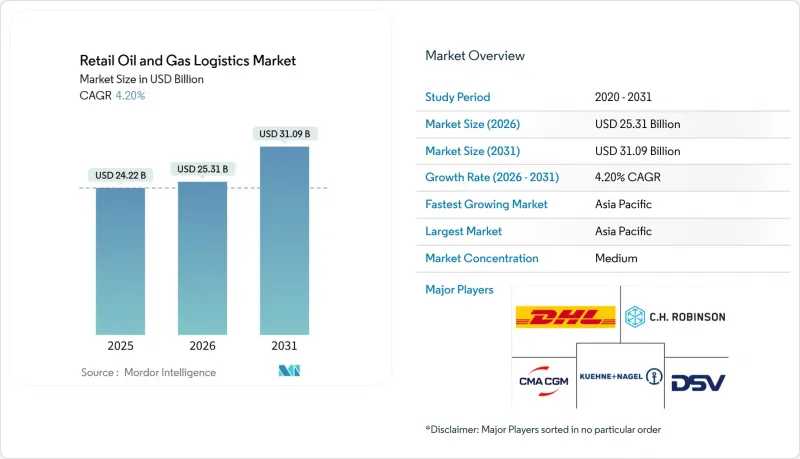
Muted headline growth conceals sweeping structural changes as providers transition from pure transport to integrated offerings that blend fuel delivery, forecourt inventory orchestration, and temperature-controlled handling for renewable blends. This report is Segmented by Service Type (Transportation, Storage & Warehousing, and More), by Fuel Type (Gasoline, Diesel, and More), by End User (Fuel Retailers, Convenience Stores & Hypermarkets, Industrial Retail Customers, Others), and by Region (North America, South America, Asia-Pacific, Europe, Middle East and Africa). The Market Forecasts are Provided in Terms of Value (USD).
Global Retail Oil And Gas Logistics Market Trends and Insights
Growth of Integrated Forecourt-Retail Formats (Fuel + Foodservice)
Large retailers are redesigning forecourts to merge fuel pumps with quick-service restaurants and convenience aisles, boosting per-site turnover and necessitating dual-temperature deliveries that protect both fuel quality and food freshness. Walmart's remodeling of 45 fuel sites in 2025 en route to more than 450 multi-category locations illustrates how unified footprints lift traffic and basket size. Integrated formats require synchronized scheduling, shared inventory systems, and cross-trained crews, enabling third-party logisticians to monetize premium bundled services.
Stricter Sulfur & Octane Standards Driving Specialized Handling
The EPA's January 2025 rule tightened sampling, testing, and inline-blending controls, forcing segmentation of tanker compartments and rigorous clean-down between loads. Certification agencies such as Bureau Veritas and SGS report surging demand for verification audits that reassure lenders and insurers. Logistics firms equipped with lab services and insulated compartments command price premiums while shrinking contamination risk.
Rising Insurance Premiums for Hazardous-Cargo Tanker Fleets
Underwriters tightened terms after high-profile incidents, lifting premiums by 30-40% on LNG and renewable fuel tankers. Safety tech exemptions, such as enhanced brake lights approved for Coffeyville Resources, showcase efforts to curb risk and regain pricing leverage. Smaller carriers lacking spread capacity face margin squeeze or exit. Meanwhile, evolving regulatory scrutiny and rising claims frequency continue to pressure underwriting strategies, challenging carriers to balance risk mitigation with competitive pricing.
Other drivers and restraints analyzed in the detailed report include:
- Expansion of Refined-Product Pipeline Networks in Developing Regions
- Drone-Assisted Stock Audits at Remote Filling Stations
- Certified Tanker-Driver Shortages Affecting Delivery Reliability
For complete list of drivers and restraints, kindly check the Table Of Contents.
Segment Analysis
Value-added services posted a 7.07% CAGR, the fastest within the retail oil and gas logistics market share, as shippers pay premiums for end-to-end visibility, onsite quality testing, and automated inventory reconciliation. Emerson's radar-based gauging illustrates how digital terminals lift turnover and shrink losses. Transportation still represents 52.89% of the retail oil and gas logistics market share in 2025, yet driver shortages and insurance costs force carriers to boost utilization via AI route planners and drone-fed stock data. The retail oil and gas logistics market size, tied to storage and warehousing, benefits from renewable blend segregation and chilled bays for biofuels.
Second-order effects include sticky customer contracts: once monitoring portals and automated billing are embedded in a retailer's ERP, switching costs rise, lifting renewal rates. Pay-per-use depots extend network reach without capital outlay, aligning with asset-light strategies. Meanwhile, pipeline operators capture steady tariff revenue in hub-and-spoke models, integrating last-mile tanker dispatch under unified SLAs to protect quality from trunk line to nozzle.
Geography Analysis
Asia-Pacific generated 33.75% of the retail oil and gas logistics market revenue in 2025 and is set for a 5.15% CAGR through 2031. China and India expand refinery throughput, while pipeline corridors move coastal output inland, tightening service-level requirements for tank-truck partners. Poor rural connectivity tempers live dispatch adoption, but low-earth-orbit satellite providers promise coverage upgrades that can unlock predictive replenishment in underserved provinces.
North America exhibits logistic modernization amid mature volumes. Five new product pipelines came online in 2024, rebalancing modes away from costly rail legs. Driver shortages heighten wage pressure, while renewable diesel adoption opens niches for thermostatic trucking. Volatile tax credits disrupt route economics, prompting carriers to maintain flexible fuel-agnostic fleets.
Europe confronts green-policy imperatives. Germany's EUR 20 billion (USD 23 billion) hydrogen grid plan under the European Clean Hydrogen Alliance foreshadows future blend logistics. Stringent liability laws magnify insurance costs, catalyzing mergers of sub-scale haulers. Middle East and Africa leverage producer status to integrate downstream supply chains; CEVA's Saudi JV exemplifies international-local tie-ups that fuse capital with market knowledge. South America's ethanol corridors create specialized tank demands, positioning Brazil as a biofuel export node.
- DHL Group
- CMA CGM Group
- Gulf Agency Company Limited
- DSV
- Kuehne + Nagel
- C.H. Robinson Worldwide Inc.
- Bollore SE
- Expeditors International
- Geodis
- UPS Supply Chain Solutions
- Noatum Holdings SLU
- Reliance Logistics Group Inc.
- Halcon Primo Logistics Pte Ltd.
- BDP International Inc.
- Berrio Logistics India Pvt. Ltd.
- NYK (Yusen Logistics Co. Ltd.)
- Tudor International Freight Ltd.
- Riada Shipping and Logistics
- A.P. Moller - Maersk
- GAC Logistics
Additional Benefits:
- The market estimate (ME) sheet in Excel format
- 3 months of analyst support
TABLE OF CONTENTS
1 Introduction
- 1.1 Study Assumptions & Market Definition
- 1.2 Scope of the Study
2 Research Methodology
3 Executive Summary
4 Market Landscape
- 4.1 Market Overview
- 4.2 Market Drivers
- 4.2.1 Growth of Integrated Forecourt-Retail Formats (Fuel + Foodservice)
- 4.2.2 Stricter Sulfur & Octane Standards Driving Specialized Handling
- 4.2.3 Expansion of Refined-Product Pipeline Networks in Developing Regions
- 4.2.4 Drone-Assisted Stock Audits at Remote Filling Stations
- 4.2.5 Pay-Per-Use Shared Depot Platforms for Independent Retailers
- 4.2.6 Temperature-Controlled Logistics for Renewable-Diesel Blends
- 4.3 Market Restraints
- 4.3.1 Rising Insurance Premiums for Hazardous-Cargo Tanker Fleets
- 4.3.2 Certified Tanker-Driver Shortages Affecting Delivery Reliability
- 4.3.3 Poor Digital Connectivity at Rural Outlets Limiting Live Dispatch
- 4.3.4 Volatile Renewable-Fuel Tax Credits Complicating Route Planning
- 4.4 Value / Supply-Chain Analysis
- 4.5 Regulatory Landscape
- 4.6 Technological Outlook
- 4.7 Porter's Five Forces
- 4.7.1 Threat of New Entrants
- 4.7.2 Bargaining Power of Suppliers
- 4.7.3 Bargaining Power of Buyers
- 4.7.4 Threat of Substitutes
- 4.7.5 Competitive Rivalry
- 4.8 Impact of Geo-Political Events on the Market
5 Market Size & Growth Forecasts
- 5.1 By Service Type (Value)
- 5.1.1 Transportation
- 5.1.1.1 Road
- 5.1.1.2 Rail
- 5.1.1.3 Sea and Inland (Including Barge)
- 5.1.2 Storage & Warehousing
- 5.1.3 Value-added Services and Others(metering, quality testing)
- 5.1.1 Transportation
- 5.2 By Fuel Type (Value)
- 5.2.1 Gasoline
- 5.2.2 Diesel
- 5.2.3 Jet Fuel
- 5.2.4 Liquefied Petroleum Gas (LPG)
- 5.2.5 Liquefied Natural Gas (LNG)
- 5.2.6 Others (bitumen, lubricants)
- 5.3 By End User (Value)
- 5.3.1 Fuel Retailers (Fuel Stations)
- 5.3.2 Convenience Stores & Hypermarkets
- 5.3.3 Industrial Retail Customers (Mining, Agriculture, Construction, Government, Aviation, Marine, etc.)
- 5.3.4 Others
- 5.4 By Geography (Value)
- 5.4.1 North America
- 5.4.1.1 United States
- 5.4.1.2 Canada
- 5.4.1.3 Mexico
- 5.4.2 South America
- 5.4.2.1 Brazil
- 5.4.2.2 Peru
- 5.4.2.3 Chile
- 5.4.2.4 Argentina
- 5.4.2.5 Rest of South America
- 5.4.3 Asia-Pacific
- 5.4.3.1 India
- 5.4.3.2 China
- 5.4.3.3 Japan
- 5.4.3.4 Australia
- 5.4.3.5 South Korea
- 5.4.3.6 South East Asia (Singapore, Malaysia, Thailand, Indonesia, Vietnam, and Philippines)
- 5.4.3.7 Rest of Asia-Pacific
- 5.4.4 Europe
- 5.4.4.1 United Kingdom
- 5.4.4.2 Germany
- 5.4.4.3 France
- 5.4.4.4 Spain
- 5.4.4.5 Italy
- 5.4.4.6 BENELUX (Belgium, Netherlands, and Luxembourg)
- 5.4.4.7 NORDICS (Denmark, Finland, Iceland, Norway, and Sweden)
- 5.4.4.8 Rest of Europe
- 5.4.5 Middle East and Africa
- 5.4.5.1 United Arab Emirates
- 5.4.5.2 Saudi Arabia
- 5.4.5.3 South Africa
- 5.4.5.4 Nigeria
- 5.4.5.5 Rest of Middle East And Africa
- 5.4.1 North America
6 Competitive Landscape
- 6.1 Market Concentration
- 6.2 Strategic Moves
- 6.3 Market Share Analysis
- 6.4 Company Profiles (includes Global level Overview, Market level overview, Core Segments, Financials as available, Strategic Information, Market Rank/Share for key companies, Products & Services, and Recent Developments)
- 6.4.1 DHL Group
- 6.4.2 CMA CGM Group
- 6.4.3 Gulf Agency Company Limited
- 6.4.4 DSV
- 6.4.5 Kuehne + Nagel
- 6.4.6 C.H. Robinson Worldwide Inc.
- 6.4.7 Bollore SE
- 6.4.8 Expeditors International
- 6.4.9 Geodis
- 6.4.10 UPS Supply Chain Solutions
- 6.4.11 Noatum Holdings SLU
- 6.4.12 Reliance Logistics Group Inc.
- 6.4.13 Halcon Primo Logistics Pte Ltd.
- 6.4.14 BDP International Inc.
- 6.4.15 Berrio Logistics India Pvt. Ltd.
- 6.4.16 NYK (Yusen Logistics Co. Ltd.)
- 6.4.17 Tudor International Freight Ltd.
- 6.4.18 Riada Shipping and Logistics
- 6.4.19 A.P. Moller - Maersk
- 6.4.20 GAC Logistics
7 Market Opportunities & Future Outlook
- 7.1 White-space & Unmet-need Assessment

