
PUBLISHER: Mordor Intelligence | PRODUCT CODE: 2062455

PUBLISHER: Mordor Intelligence | PRODUCT CODE: 2062455
Smart Baggage Handling System - Market Share Analysis, Industry Trends & Statistics, Growth Forecasts (2026 - 2031)
According to Mordor Intelligence, the smart baggage handling system market size was valued at USD 8.56 billion in 2025 and estimated to grow from USD 9.96 billion in 2026 to reach USD 21.19 billion by 2031, at a CAGR of 16.31% during the forecast period (2026-2031).
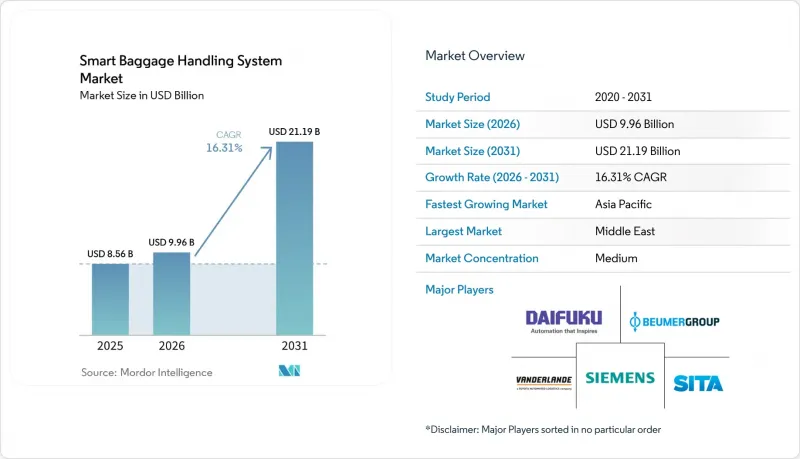
This report is Segmented by Product Type (Conveyors and Sorters, RFID and IoT Tracking Hardware, Autonomous Mobile Robots, and More), Solution (Checked-Baggage Reconciliation System, Self-Service Bag-Drop, and More), Technology (Barcode, RFID, BLE, and UWB), End-User (Tier-1, Tier-2, Tier-3 Airports, and More), and Geography. The Market Forecasts are Provided in Terms of Value (USD).
Global Smart Baggage Handling System Market Trends and Insights
Growing Mandate for End-to-End Baggage Tracking Under IATA Resolution 753
The 2018 regulation obliges carriers and handlers to record bag custody at acceptance, loading, transfer, and arrival. By 2024, 75% of airports and 44% of airlines were compliant, but many still rely on barcode-only scans that lack real-time visibility. Continuous RFID and Bluetooth Low Energy tracking trims mishandling a further 25% beyond barcode baselines. Carriers that serve a single international route must still upgrade entire networks to avert interline breakdowns, creating a multiplier effect for tag vendors. European and North American regulators enforce compliance more stringently, accelerating retrofit programs.
Rapid Airport Capacity Expansions in Asia-Pacific and the Middle East
Mega-projects such as Dubai's USD 35 billion Al Maktoum expansion and Riyadh's USD 293 million cargo hub are embedding autonomous sortation, robotic tugs, and AI flow optimization from inception. Greenfield sites bypass legacy constraints, allowing modular architectures that scale 30%-50% via firmware rather than concrete. China's Fuzhou Changle Airport illustrates this path, operating 6,000 bags per hour with RFID-enabled storage that flexes for early check-in. These deployments ripple into Africa as contractors replicate proven blueprints.
High Up-Front Capital Expenditure for Legacy System Modernization
Retrofitting a mid-sized hub costs USD 50-200 million with payback horizons of 8-12 years. Austin-Bergstrom spent USD 241.5 million in 2025, and Seattle-Tacoma has earmarked USD 190 million through 2028. Smaller airports struggle to amortize fixed costs, although FAA grants, such as Denver's USD 26.6 million award, soften the blow in the United States. Emerging markets rarely offer comparable subsidies, slowing adoption despite rising passenger expectations.
Other drivers and restraints analyzed in the detailed report include:
- Rising Passenger Preference for Touch-Free Self-Service Journeys
- Deployment of AI-Enabled Predictive Maintenance to Cut Conveyor Downtime
- Limited Standardization Across Airlines, Airports, and Technology Vendors
For complete list of drivers and restraints, kindly check the Table Of Contents.
Segment Analysis
Conveyors and sorters captured the largest share of 41.13% in the 2025 revenue slice, yet airports now pilot flexible robotic fleets to handle seasonal surges without permanent construction. The Smart Baggage Handling System market size for autonomous mobile robots is projected to expand at a 17.11% CAGR between 2026 and 2031. dnata's deployment of six TractEasy tractors at Dubai International Airport for AED 6 million (USD 1.6 million) validated the effectiveness of peak-period augmentation. EasyMile's tractors at Frankfurt logged 20,000 kilometers with 99.5% uptime, demonstrating industrial-grade reliability.
Robotics also lowers emissions by replacing diesel tugs, aligning with carbon-reduction mandates. Aurrigo's Auto-DollyTug trials at Schiphol and Changi target an 8%-12% drop in ground emissions. Cyberdyne's HAL exoskeleton pilots in Haneda cut musculoskeletal injuries 30%. These successes persuade Tier-3 airports that modular robots can deliver much of Tier-1 functionality at a fraction of capital outlay.
Checked-baggage reconciliation systems accounted for 36.32% of revenue in 2025, highlighting their critical role as the compliance backbone for the aviation industry. These systems ensure that baggage is accurately tracked and matched with passengers, reducing the risk of mishandling and improving operational efficiency. Real-time tracking, however, is projected to grow faster, with an annual growth rate of 17.09%, as airlines increasingly leverage data to proactively address potential misrouting issues. Collins Aerospace has reported sub-one-minute transaction times on its ARINC SelfDrop kiosks, which significantly reduce queuing space requirements at airports. Similarly, SITA's Bag Radar system identifies at-risk bags several hours in advance, enabling ground crews to intercept and resolve issues before passengers miss their connections.
Self-service technologies are also helping operators overcome labor bottlenecks, a persistent challenge in the aviation sector. For instance, Qatar Aviation Services has successfully saved 70,000 labor hours annually by integrating Amadeus software into its operations. This reduction in manual labor not only streamlines processes but also allows staff to focus on higher-value tasks. Although the lost-luggage recovery segment remains relatively small, every avoided mishandled bag contributes to preserving customer goodwill. This goodwill is a critical metric that directly influences Net Promoter Scores, which in turn can drive potential ancillary revenue opportunities for airlines.
Geography Analysis
Asia-Pacific dominated with 35.28% Smart Baggage Handling System market share in 2025, driven by China's rapid airport construction boom and India's ongoing privatization initiatives in the aviation sector. Greenfield projects, such as Fuzhou Changle International Airport and Delhi Terminal 1, are implementing end-to-end RFID networks and self-drop kiosks from the outset. This proactive approach allows these airports to bypass the challenges associated with brownfield retrofits, which often slow down modernization efforts in Western markets.
The Middle East is projected to be the fastest-growing region, with an impressive 18.31% CAGR through 2031. Dubai's Al Maktoum International Airport is targeting a capacity of 260 million annual passengers, supported by a fully autonomous baggage handling backbone. Similarly, Saudi Arabia's King Abdulaziz International Airport is planning to accommodate 114 million passengers by 2030, leveraging integrated RFID systems and predictive maintenance technologies. Sovereign wealth funds in the region are channeling significant investments into aviation infrastructure as part of broader economic diversification strategies, ensuring a steady flow of funding for long-term projects.
North America and Europe face unique challenges due to their century-old terminals, which must remain operational during extensive refurbishments. For instance, Austin-Bergstrom International Airport completed a USD 241.5 million upgrade in 2025, following a phased construction approach that minimized disruptions to flight operations. Similarly, Seattle-Tacoma International Airport is navigating comparable complexities, with its modernization efforts expected to continue through 2028. Meanwhile, South America and Africa, though still in the early stages of adoption, are exploring modular solutions that enable them to leapfrog to modern baggage-handling standards, bypassing the incremental upgrades seen in more developed regions.
- SITA N.V.
- Siemens Logistics GmbH
- Vanderlande Industries B.V.
- BEUMER Group GmbH & Co. KG
- Daifuku Co., Ltd.
- Collins Aerospace
- IBM Corporation
- Honeywell International Inc.
- Amadeus IT Group S.A.
- Scarabee Aviation Group B.V.
- G&S Airport Conveyor
- Brock Solutions Inc.
- Alstef Group
- Cobalt Robotics Inc.
- Blip Systems A/S
- Zensors Inc.
- Indra Sistemas S.A.
- RESA Airport Data Systems
- Lyngsoe Systems A/S
- Rockwell Automation, Inc.
Additional Benefits:
- The market estimate (ME) sheet in Excel format
- 3 months of analyst support
TABLE OF CONTENTS
1 INTRODUCTION
- 1.1 Study Assumptions and Market Definition
- 1.2 Scope of the Study
2 RESEARCH METHODOLOGY
3 EXECUTIVE SUMMARY
4 MARKET LANDSCAPE
- 4.1 Market Overview
- 4.2 Market Drivers
- 4.2.1 Growing Mandate for End-to-End Baggage Tracking Under IATA Resolution 753
- 4.2.2 Rapid Airport Capacity Expansions in Asia-Pacific and the Middle East
- 4.2.3 Rising Passenger Preference for Touch-Free Self-Service Journeys
- 4.2.4 Deployment of AI-Enabled Predictive Maintenance to Cut Conveyor Downtime
- 4.2.5 Integration of Digital Twins for Real-Time Baggage-Flow Optimization
- 4.2.6 Airports Monetizing Baggage Data Through Ancillary Revenue Streams
- 4.3 Market Restraints
- 4.3.1 High Up-Front Capital Expenditure for Legacy System Modernization
- 4.3.2 Limited Standardization Across Airlines, Airports, and Technology Vendors
- 4.3.3 Cybersecurity Vulnerabilities in IoT-Connected Baggage Networks
- 4.3.4 Shortage of Skilled Technicians for Robotics and Automation Upkeep
- 4.4 Impact of Macroeconomic Factors on the Market
- 4.5 Industry Value Chain Analysis
- 4.6 Regulatory Landscape
- 4.7 Technological Outlook
- 4.8 Porter's Five Forces Analysis
- 4.8.1 Bargaining Power of Suppliers
- 4.8.2 Bargaining Power of Buyers
- 4.8.3 Threat of New Entrants
- 4.8.4 Threat of Substitutes
- 4.8.5 Intensity of Competitive Rivalry
5 MARKET SIZE AND GROWTH FORECASTS (VALUE)
- 5.1 By Product Type
- 5.1.1 Conveyors and Sorters
- 5.1.2 RFID and IoT Tracking Hardware
- 5.1.3 Autonomous Mobile Robots
- 5.1.4 Software and Analytics Platforms
- 5.2 By Solution
- 5.2.1 Checked-Baggage Reconciliation System (BRS)
- 5.2.2 Self-Service Bag-Drop
- 5.2.3 Real-Time Baggage Tracking
- 5.2.4 Lost-Luggage Recovery and Return
- 5.3 By Technology
- 5.3.1 Barcode
- 5.3.2 Radio-Frequency Identification (RFID)
- 5.3.3 Bluetooth Low Energy (BLE)
- 5.3.4 Ultra-Wideband (UWB)
- 5.4 By End-User
- 5.4.1 Tier-1 (>=40 MPPA) Airports
- 5.4.2 Tier-2 (10-40 MPPA) Airports
- 5.4.3 Tier-3 (<10 MPPA) Airports
- 5.4.4 Airlines and Ground-Handling Companies
- 5.5 By Geography
- 5.5.1 North America
- 5.5.1.1 United States
- 5.5.1.2 Canada
- 5.5.1.3 Mexico
- 5.5.2 South America
- 5.5.2.1 Brazil
- 5.5.2.2 Argentina
- 5.5.2.3 Rest of South America
- 5.5.3 Europe
- 5.5.3.1 United Kingdom
- 5.5.3.2 Germany
- 5.5.3.3 France
- 5.5.3.4 Italy
- 5.5.3.5 Spain
- 5.5.3.6 Rest of Europe
- 5.5.4 Asia-Pacific
- 5.5.4.1 China
- 5.5.4.2 Japan
- 5.5.4.3 India
- 5.5.4.4 South Korea
- 5.5.4.5 Rest of Asia-Pacific
- 5.5.5 Middle East and Africa
- 5.5.5.1 Middle East
- 5.5.5.1.1 United Arab Emirates
- 5.5.5.1.2 Saudi Arabia
- 5.5.5.1.3 Rest of Middle East
- 5.5.5.2 Africa
- 5.5.5.2.1 South Africa
- 5.5.5.2.2 Egypt
- 5.5.5.2.3 Rest of Africa
- 5.5.5.1 Middle East
- 5.5.1 North America
6 COMPETITIVE LANDSCAPE
- 6.1 Market Concentration
- 6.2 Strategic Moves
- 6.3 Market Share Analysis
- 6.4 Company Profiles (includes Global Level Overview, Market Level Overview, Core Segments, Financials as available, Strategic Information, Market Rank/Share, Products and Services, Recent Developments)
- 6.4.1 SITA N.V.
- 6.4.2 Siemens Logistics GmbH
- 6.4.3 Vanderlande Industries B.V.
- 6.4.4 BEUMER Group GmbH & Co. KG
- 6.4.5 Daifuku Co., Ltd.
- 6.4.6 Collins Aerospace
- 6.4.7 IBM Corporation
- 6.4.8 Honeywell International Inc.
- 6.4.9 Amadeus IT Group S.A.
- 6.4.10 Scarabee Aviation Group B.V.
- 6.4.11 G&S Airport Conveyor
- 6.4.12 Brock Solutions Inc.
- 6.4.13 Alstef Group
- 6.4.14 Cobalt Robotics Inc.
- 6.4.15 Blip Systems A/S
- 6.4.16 Zensors Inc.
- 6.4.17 Indra Sistemas S.A.
- 6.4.18 RESA Airport Data Systems
- 6.4.19 Lyngsoe Systems A/S
- 6.4.20 Rockwell Automation, Inc.
7 MARKET OPPORTUNITIES AND FUTURE OUTLOOK
- 7.1 White-Space and Unmet-Need Assessment

