PUBLISHER: Mordor Intelligence | PRODUCT CODE: 2063246

PUBLISHER: Mordor Intelligence | PRODUCT CODE: 2063246
Spacer Fluid - Market Share Analysis, Industry Trends & Statistics, Growth Forecasts (2026 - 2031)
According to Mordor Intelligence, the spacer fluid market size was valued at USD 249.76 million in 2025 and is estimated to grow from USD 263.25 million in 2026 to reach USD 337.74 million by 2031, at a CAGR of 5.11% during the forecast period (2026-2031).
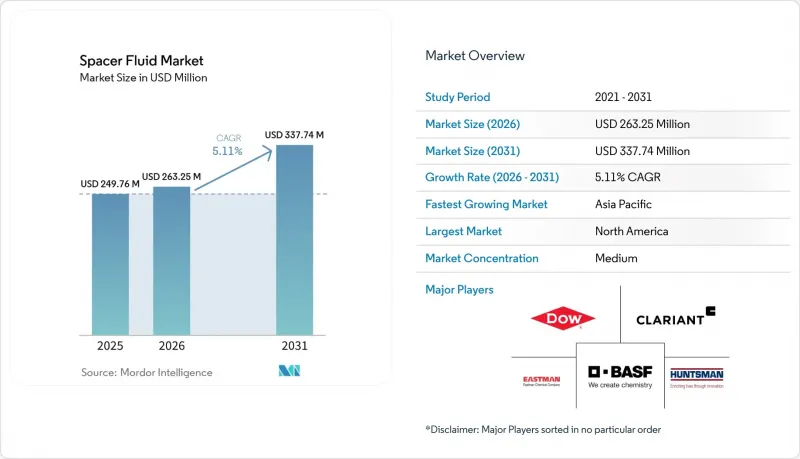
This report is Segmented by Fluid Base (Water-Based, Oil-Based, More), Additive Chemistry (Viscosifiers and Rheology Modifiers, More), Function (Primary Cementing, More), Reservoir Type (Carbonate, More), Well Type (HPHT, More), Location (Onshore and Offshore), and Geography (North America, Europe, Asia-Pacific, South America, and Middle East and Africa). The Market Forecasts are Provided in Terms of Value (USD).
Global Spacer Fluid Market Trends and Insights
ESG-driven methane-leak reduction mandates
Global climate policy is reshaping spacer specifications toward gas-migration prevention. The U.S. EPA's 2024 rule introduced a Waste Emissions Charge that rises to USD 1,500 per metric ton in 2026, compelling tighter density windows and surfactant packages that wet casing surfaces and curb micro-annulus formation. The European Union's Methane Regulation went live in 2024, extending liability to imported gas and elevating demand for ISO 13503-certified fluids. SLB's CemCRETE LiteCRETE polymer spacer, deployed in the Permian, cut gas migration by 40% relative to bentonite fluids. Operators increasingly insist on density tolerances of +-0.2 lb/gal to ensure annular seal integrity, especially in horizontal shale wells where pressure spikes can dislodge unset cement. In parallel, digital leak-detection platforms flag anomalies within minutes, forcing rapid remediation and further boosting premium spacer uptake.
Surge in HPHT and ultra-deepwater projects
Multi-billion-dollar deepwater complexes are moving the spacer fluid market toward synthetic and oil-based systems. Chevron's Anchor and Shell's Whale projects each operate beyond 20,000 psi and 350 °F, demanding thermally stable viscosifiers and densities up to 18 lb/gal. Petrobras awarded SLB a USD 430 million contract in 2024 covering 28 wells where nanoparticle-enhanced spacers maintain fluid-loss below 50 ml/30 min at 15,000 psi. Nanoparticles such as graphene oxide form impermeable cakes that safeguard zonal isolation while lowering formation damage. HPHT and ultra-deepwater demand is therefore tilting procurement toward synthetic-base fluids that biodegrade within discharge limits yet survive extreme bottomhole environments, underpinning long-cycle growth for premium chemistries.
Volatile pricing of specialty biopolymers
Xanthan hit USD 2,760 per metric ton in Jan 2026, up 10% year-on-year, after Chinese fermenters faced higher energy costs. Guar output fell 15% in India's 2024 kharif season due to erratic monsoon, then faced 10%-50% import duties, lifting costs for service companies reliant on Indian supply. Synthetic polymers offer consistency but raise environmental flags under EU REACH, limiting their ability to fully replace biopolymers. Spacers make up 5%-8% of total well costs, so cost spikes translate quickly into budget overruns, especially for re-frac and abandonment programs with tight economics.
Other drivers and restraints analyzed in the detailed report include:
- Rising shale re-fracturing programs in North America
- Digitally designed rheology-tunable spacer formulations
- Stricter discharge limits on surfactant toxicity
For complete list of drivers and restraints, kindly check the Table Of Contents.
Segment Analysis
Water-based formulations held 63.8% of the spacer fluid market share in 2025, thanks to low cost and easy handling. Yet polymer-rich switchable fluids are growing 220 basis points faster than the overall spacer fluid market, advancing at 7.3% CAGR to 2031 as pH-triggered gelling improves zonal isolation in horizontals. Oil-based products remain vital for HPHT and deepwater wells. Synthetic-base fluids favored in discharge-sensitive basins like the Gulf of Mexico, biodegrade within 28 days, a nd meet toxicity limits. Foamed and ultralight systems enable operations in depleted or low-pressure zones by cutting density to 6 lb/gal without losing viscosity.
Switchable fluids trim cement contamination by forming in-situ gels at pH 12 and above, a function that saved 10% spacer volume per well in Fervo Energy's 400-well geothermal program. Synthetic bases, often esters or polyalphaolefins, survive 450 °F for 12 hours, meeting geothermal and CCUS needs. Together, these premium niches are eroding the historical dominance of low-specification water-based systems, redefining the spacer fluid market size distribution.
Viscosifiers and rheology modifiers captured 34.5% of additive demand in 2025, but nano-enhanced systems are set to expand 7.5% CAGR through 2031, improving fluid-loss control by 30%-40% under HPHT conditions. Surfactants and wettability agents driven by the shift to biodegradable chemistries that meet NPDES toxicity tests. Lost-circulation materials and bridging fibers remain essential for naturally fractured reservoirs.
Silica nanoparticle spacers rolled out by Baker Hughes achieved fluid-loss below 50 ml/30 min at 350 °F, outclassing xanthan systems. Graphene oxide loading raised cement compressive strength by 15% in lab tests, supporting adoption in HPHT completions. The additive mix is therefore pivoting from bulk rheology modifiers to engineered nano-additives that elevate performance while nudging unit costs upward.
Geography Analysis
North America commanded 36.9% spacer fluid market share in 2025 on the back of 12,000 horizontal shale wells drilled in 2024, consuming 15 million barrels of completion fluids. Yet growth here moderates as capital pivots to re-fracs; Barnett campaigns showed 30%-50% production uplifts using hybrid spacers that cost USD 15,000-30,000 per well. Canada's Montney, buoyed by LNG export demand, needs sour-gas compatible spacers for H2S-rich wells.
Asia-Pacific is the fastest-growing region at 6.2% CAGR through 2031. India's 60% local-content rule for drilling chemicals by 2027 is spurring domestic xanthan fermentation and guar processing. CNOOC awarded USD 1.2 billion in drilling contracts requiring China-made spacers, while Indonesia's SKK Migas targets 50% local content by 2030, compelling multinationals to partner or build blending plants.
Europe reflects a dual focus on new developments like Johan Sverdrup and large-scale P&A. The UK regulator expects 2,000 North Sea wells to be abandoned by 2030, lifting demand for 16 lb/gal high-density spacers. South America, at 12%, is dominated by Brazil's pre-salt, where high-pressure wells use synthetic bases. The Middle East & Africa benefit from the Jafurah unconventional gas ramp-up and Ghasha ultra-sour gas, both favoring lost-circulation and corrosion-inhibited formulations.
- Halliburton Company
- Schlumberger (Now SLB)
- Baker Hughes Company
- Weatherford International
- CES Energy Solutions
- Newpark Resources Inc.
- TETRA Technologies Inc.
- Aubin Group
- Trican Well Service
- Calfrac Well Services
- Superior Energy Services
- Scomi Oiltools
- Nine Energy Service
- Petrochem Performance Chemicals
- Nalco Champion (Ecolab Energy)
- MI SWACO (SLB)
- Drilling Specialties Co. (DSCo)
- Panther Fluids Management
- Impact Fluid Solutions
- Obsidian Energy Chemicals
Additional Benefits:
- The market estimate (ME) sheet in Excel format
- 3 months of analyst support
TABLE OF CONTENTS
1 Introduction
- 1.1 Study Assumptions & Market Definition
- 1.2 Scope of the Study
2 Research Methodology
3 Executive Summary
4 Market Landscape
- 4.1 Market Overview
- 4.2 Market Drivers
- 4.2.1 ESG-driven methane-leak reduction mandates
- 4.2.2 Surge in HPHT & ultra-deepwater projects
- 4.2.3 Rising shale re-fracturing programs in North America
- 4.2.4 Digitally designed rheology-tunable spacer formulations
- 4.2.5 CCUS well retrofits requiring novel spacer chemistries
- 4.2.6 National oil company local-content rules (MENA, APAC)
- 4.3 Market Restraints
- 4.3.1 Volatile pricing of specialty biopolymers
- 4.3.2 Stricter discharge limits on surfactant toxicity
- 4.3.3 Supply bottlenecks for food-grade xanthan/guar post-El Nino
- 4.3.4 AI-based mud-in-place simulators lowering spacer volumes
- 4.4 Supply-Chain Analysis
- 4.5 Regulatory Landscape
- 4.6 Technological Outlook
- 4.7 Porter's Five Forces
- 4.7.1 Threat of New Entrants
- 4.7.2 Bargaining Power of Suppliers
- 4.7.3 Bargaining Power of Buyers
- 4.7.4 Threat of Substitutes
- 4.7.5 Intensity of Competitive Rivalry
5 Market Size & Growth Forecasts
- 5.1 By Fluid Base
- 5.1.1 Water-Based Spacer Fluid
- 5.1.2 Oil-Based Spacer Fluid
- 5.1.3 Synthetic-Based Spacer Fluid
- 5.1.4 Polymer-Rich Switchable Fluids
- 5.1.5 Others (Foamed, Ultralight, etc.)
- 5.2 By Additive Chemistry
- 5.2.1 Viscosifiers and Rheology Modifiers
- 5.2.2 Surfactants and Wettability Agents
- 5.2.3 LCM/Bridging Fibers
- 5.2.4 Nanoparticle-Enhanced Systems
- 5.3 By Function
- 5.3.1 Primary Cementing
- 5.3.2 Remedial/Plug and Abandon
- 5.3.3 Drilling Mud Displacement
- 5.3.4 Enhanced Oil Recovery (EOR)
- 5.3.5 Wellbore Cleanup and Other Uses
- 5.4 By Reservoir Type
- 5.4.1 Carbonate
- 5.4.2 Sandstone
- 5.4.3 Naturally Fractured
- 5.4.4 Others
- 5.5 By Well Type
- 5.5.1 Conventional Vertical
- 5.5.2 HPHT
- 5.5.3 Unconventional Shale/Tight
- 5.5.4 Directional/Horizontal
- 5.5.5 Geothermal
- 5.6 By Location
- 5.6.1 Onshore
- 5.6.2 Offshore
- 5.7 By Geography
- 5.7.1 North America
- 5.7.1.1 United States
- 5.7.1.2 Canada
- 5.7.1.3 Mexico
- 5.7.2 Europe
- 5.7.2.1 Germany
- 5.7.2.2 United Kingdom
- 5.7.2.3 France
- 5.7.2.4 Italy
- 5.7.2.5 NORDIC Countries
- 5.7.2.6 Russia
- 5.7.2.7 Rest of Europe
- 5.7.3 Asia-Pacific
- 5.7.3.1 China
- 5.7.3.2 India
- 5.7.3.3 Japan
- 5.7.3.4 South Korea
- 5.7.3.5 ASEAN Countries
- 5.7.3.6 Rest of Asia-Pacific
- 5.7.4 South America
- 5.7.4.1 Brazil
- 5.7.4.2 Argentina
- 5.7.4.3 Rest of South America
- 5.7.5 Middle East and Africa
- 5.7.5.1 Saudi Arabia
- 5.7.5.2 United Arab Emirates
- 5.7.5.3 South Africa
- 5.7.5.4 Egypt
- 5.7.5.5 Rest of Middle East and Africa
- 5.7.1 North America
6 Competitive Landscape
- 6.1 Market Concentration
- 6.2 Strategic Moves (M&A, Partnerships, PPAs)
- 6.3 Market Share Analysis (Market Rank/Share for key companies)
- 6.4 Company Profiles (includes Global level Overview, Market level overview, Core Segments, Financials as available, Strategic Information, Products & Services, and Recent Developments)
- 6.4.1 Halliburton Company
- 6.4.2 Schlumberger (Now SLB)
- 6.4.3 Baker Hughes Company
- 6.4.4 Weatherford International
- 6.4.5 CES Energy Solutions
- 6.4.6 Newpark Resources Inc.
- 6.4.7 TETRA Technologies Inc.
- 6.4.8 Aubin Group
- 6.4.9 Trican Well Service
- 6.4.10 Calfrac Well Services
- 6.4.11 Superior Energy Services
- 6.4.12 Scomi Oiltools
- 6.4.13 Nine Energy Service
- 6.4.14 Petrochem Performance Chemicals
- 6.4.15 Nalco Champion (Ecolab Energy)
- 6.4.16 MI SWACO (SLB)
- 6.4.17 Drilling Specialties Co. (DSCo)
- 6.4.18 Panther Fluids Management
- 6.4.19 Impact Fluid Solutions
- 6.4.20 Obsidian Energy Chemicals
7 Market Opportunities & Future Outlook
- 7.1 White-Space & Unmet-Need Assessment

