
PUBLISHER: Mordor Intelligence | PRODUCT CODE: 2063296

PUBLISHER: Mordor Intelligence | PRODUCT CODE: 2063296
Underfill Dispenser - Market Share Analysis, Industry Trends & Statistics, Growth Forecasts (2026 - 2031)
According to Mordor Intelligence, the underfill dispenser market size was valued at USD 66.71 billion in 2025 and estimated to grow from USD 71.33 billion in 2026 to reach USD 96.28 billion by 2031, at a CAGR of 6.18% during the forecast period (2026-2031).
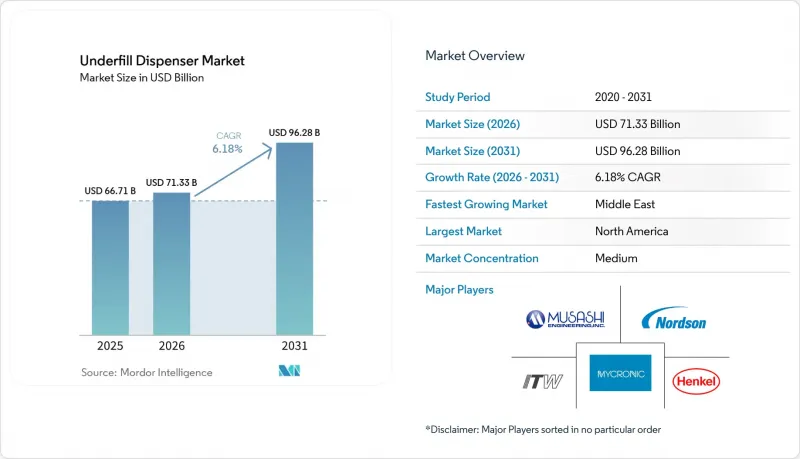
This report is Segmented by Product Type (Capillary Flow Underfill Dispensers, and More), Technology (Piezoelectric Jetting, Pneumatic Needle, and More), Application (Flip Chip Packaging, and More), End-User (Outsourced Semiconductor Assembly and Test (OSAT) Companies, and More), Dispensing Volume Range (Less Than 5 Nanolitres, and More), and Geography. The Market Forecasts are Provided in Value (USD).
Global Underfill Dispenser Market Trends and Insights
AI-Optimized Dispense Path Planning Reduces Cycle Time
Machine-learning algorithms embedded in vision systems now generate dispense trajectories that cut underfill cycle time by 15-25%, compared to rule-based programming, a capability that Coherix introduced in its 3D vision inspection systems deployed at TSMC's CoWoS packaging lines in 2025. These models assess the topography, substrate warpage, and reflow temperature history, then adjust nozzle approach angles and pressure in real time. Major assembly houses deploying the technology report that recipe development time has fallen from 50 hours to less than 10, freeing engineering resources for new package qualifications. Reliability gains are notable in silicon carbide power modules, where non-Newtonian underfill chemistries demand pressure profiles that legacy rule-based controllers cannot sustain. Faster path planning also raises equipment utilization, a key metric, as capital costs for top-tier jetting systems exceed USD 1 million.
Adoption of High-Density Heterogeneous Integration Packages
Chiplet topologies permeate artificial-intelligence accelerators and high-performance CPUs, driving die-to-die bump pitch below 40 micrometers. Underfill materials must carry filler particles no larger than 2 micrometers to avoid bridging between solder joints, pushing dispensers to deliver 1-4 nanoliter dots with +-1 micrometer accuracy. Dual-valve jetting platforms now switch instantly between capillary-flow and molded underfill chemistries, reducing line changeover from 90 minutes to 15 minutes. Assembly houses handling multiple substrate layouts inside the same shift report throughput lifts of 20-25%, reinforcing the competitive case for precision jetting in the underfill dispenser market.
High Capex of Advanced Jetting Platforms
Next-generation piezoelectric jetting dispensers bundled with inline vision, dual-valve setups, and Class-100 enclosures command USD 800,000-1,200,000 per unit. Small and mid-size assembly houses that process legacy ball-grid-array packages at modest margins cannot absorb these costs without external financing. The semiconductor equipment industry's aggregate capital expenditure reached USD 200 billion in 2026, yet equipment utilization rates for underfill dispensers averaged 65-70% as assembly lines cycled between flip chip, ball grid array, and wafer-level packaging processes that require different dispense recipes and material changeovers consuming 2-4 hours per transition. The ROI equation becomes more challenging when line utilization averages 65-70%, since crews change recipes several times per shift. Consequently, many second-tier providers still opt for pneumatic needle dispensers priced below USD 250,000, even though those tools cannot meet void targets for automotive or aerospace programs.
Other drivers and restraints analyzed in the detailed report include:
- Transition to 3D Chip-Stacking Demands Void-Free Underfill
- Increasing Demand for Automotive-Grade Power Semiconductors
- Limited Dispensing Throughput for Panel-Level Packaging Lines
For complete list of drivers and restraints, kindly check the Table Of Contents.
Segment Analysis
Jet dispensers accounted for the largest share of 2025 revenue, and the underfill dispenser market for jet platforms is forecast to grow at a 6.77% CAGR over 2026-2031. Their non-contact operation eliminates substrate scratches and allows sub-5-nanoliter dots, attributes crucial for chiplets separated by 25 micrometers or less. Hybrid machines that combine capillary-flow and jetting heads in a single frame now cut floor space by 40% and help factories consolidate multiple legacy processes onto a single line.
Needle systems still dominate high-viscosity encapsulants above 50,000 cP, but interest is waning as material suppliers reformulate chemistries to match the shear profiles of piezoelectric ejectors. Cost sensitivity keeps capillary-flow dispensers relevant in consumer electronics, where 3-5% void levels remain acceptable. Even so, AI-driven path planning lifts utilization for jetting platforms to nearly 80%, narrowing the total cost of ownership gap. As a result, the underfill dispenser market is seeing procurement budgets tilt decisively toward jet systems at both multinational and regional OSATs.
Piezoelectric jetting captured 34.54% of the revenue share in 2025, and its share of the underfill dispenser market is on track to widen, with a 6.94% CAGR projection. Printheads packing more than 1,500 nozzles now fire at 20 kHz, pushing hourly dot counts beyond 90,000 while holding +-2 micrometer positional tolerance. Pneumatic needle tools keep a share in Southeast Asian lines running 0.5 mm-pitch BGAs, but every major advanced-package roadmap specifies piezoelectric capability for die gaps below 20 micrometers.
Positive-displacement pumps and auger screws fill a niche for wafer-level packaging that requires sustained flow above 10 mL/min, volumes outside the comfort zone of piezo stacks. Film transfer has gained a foothold among ultra-thin MEMS modules under 200 μm tall, yet the lack of broad chemical support limits growth today. Overall, expanded machine vision integration and real-time dispense verification consolidate piezoelectric technology's leadership across mainstream heterogeneous integration programs in the underfill dispenser market.
Geography Analysis
Asia-Pacific generated 53.73% of 2025 revenue, anchored by Taiwan's cluster of advanced packaging plants that together consume more than 500 high-precision dispensers. South Korea added momentum in 2026 as a USD 12.9 billion HBM complex broke ground, underwriting orders for at least 40 top-tier jetting tools. Mainland China's 2.5D initiatives, driven by domestic GPU startups, lifted local demand by double digits even as export controls constrained EUV wafer capacity. Japan remains steady but leans on domestic suppliers that deliver incremental upgrades favored by automotive customers with conservative qualification schedules.
The Middle East is poised for a 6.57% CAGR and is the fastest regional climber. Sovereign wealth funds back multiple fabs in the United Arab Emirates and Saudi Arabia, including a USD 16 billion logic line bundled with chiplet assembly capability. Regional policy targets 50 homegrown semiconductor firms by 2028, and procurement documents already specify narrow-gap underfill dispensers matching those used in Taiwan.
North America and Europe progress at mid-single-digit rates as CHIPS Act incentives subsidize domestic packaging but struggle with engineering talent shortages. Pilot lines in Arizona and Saxony have installed precision jetters yet report extended operator-training times because only a few hundred engineers worldwide specialize in wafer-level underfill. South America and Africa remain nascent, although Brazilian automotive suppliers have begun qualifying void-free encapsulants for flex-fuel controllers, hinting at future uptick in regional orders for the underfill dispenser market.
- Nordson Corporation
- Musashi Engineering, Inc.
- Henkel AG & Co. KGaA
- Illinois Tool Works Inc. (Camalot Systems)
- Fisnar Inc.
- GPD Global
- Essemtec AG
- Mycronic AB
- MKS Instruments, Inc.
- Scheugenpflug GmbH
- Techcon Systems, Inc.
- SMART VISION Co., Ltd.
- bdtronic GmbH
- Shenzhen Second Intelligent Equipment Co., Ltd.
- Dispensing Technology Corporation
- PVA (Precision Valve & Automation, Inc.)
- ViscoTec Pumpen- u. Dosiertechnik GmbH
- Universal Instruments Corporation
- Fuji Corporation
- Panasonic Holdings Corporation
Additional Benefits:
- The market estimate (ME) sheet in Excel format
- 3 months of analyst support
TABLE OF CONTENTS
1 INTRODUCTION
- 1.1 Study Assumptions and Market Definition
- 1.2 Scope of the Study
2 RESEARCH METHODOLOGY
3 EXECUTIVE SUMMARY
4 MARKET LANDSCAPE
- 4.1 Market Overview
- 4.2 Market Drivers
- 4.2.1 AI-optimised Dispense Path Planning Reduces Cycle Time
- 4.2.2 Adoption of High-Density Heterogeneous Integration Packages
- 4.2.3 Transition to 3D Chip-Stacking Demands Void-Free Underfill
- 4.2.4 Increasing Demand for Automotive-Grade Power Semiconductors
- 4.2.5 Growth of Silicon Photonics and Co-Packaged Optics Assemblies
- 4.2.6 Emergence of Chiplet-Based Substrates with Narrow Gap Spacing
- 4.3 Market Restraints
- 4.3.1 High Capex of Advanced Jetting Platforms
- 4.3.2 Limited Dispensing Throughput for Panel-Level Packaging Lines
- 4.3.3 Shrinking Die Gaps Intensify Flux/Contamination Risk
- 4.3.4 Talent Shortage in Process Engineering for Wafer-Level Underfill
- 4.4 Industry Value-Chain Analysis
- 4.5 Regulatory Landscape
- 4.6 Impact of Macroeconomic Factors on the Market
- 4.7 Technological Outlook
- 4.8 Porter's Five Forces Analysis
- 4.8.1 Bargaining Power of Buyers
- 4.8.2 Bargaining Power of Suppliers
- 4.8.3 Threat of New Entrants
- 4.8.4 Threat of Substitutes
- 4.8.5 Intensity of Competitive Rivalry
5 MARKET SIZE AND GROWTH FORECASTS (VALUE)
- 5.1 By Product Type
- 5.1.1 Capillary Flow Underfill Dispensers
- 5.1.2 Jet Dispensing Systems
- 5.1.3 Combination / Hybrid Systems
- 5.1.4 Needle Dispensing Systems
- 5.2 By Technology
- 5.2.1 Piezoelectric Jetting
- 5.2.2 Pneumatic Needle
- 5.2.3 Auger Screw
- 5.2.4 Positive Displacement Pump
- 5.2.5 Film Transfer Systems
- 5.3 By Application
- 5.3.1 Flip Chip Packaging
- 5.3.2 Ball Grid Array (BGA) Packaging
- 5.3.3 Wafer Level Packaging (WLP)
- 5.3.4 MEMS and Sensor Packaging
- 5.3.5 Photonics and Optoelectronic Packaging
- 5.3.6 Power Semiconductor Packaging
- 5.4 By End-User
- 5.4.1 Outsourced Semiconductor Assembly and Test (OSAT) Companies
- 5.4.2 Integrated Device Manufacturers (IDMs)
- 5.4.3 Foundries
- 5.4.4 Electronics Manufacturing Services (EMS) Providers
- 5.4.5 Photonics Device Manufacturers
- 5.4.6 Research and Development Institutions / Labs
- 5.5 By Dispensing Volume Range
- 5.5.1 Less than 5 Nanolitres
- 5.5.2 5-30 Nanolitres
- 5.5.3 More than 30 Nanolitres
- 5.6 By Geography
- 5.6.1 North America
- 5.6.1.1 United States
- 5.6.1.2 Canada
- 5.6.1.3 Mexico
- 5.6.2 Europe
- 5.6.2.1 Germany
- 5.6.2.2 United Kingdom
- 5.6.2.3 France
- 5.6.2.4 Russia
- 5.6.2.5 Rest of Europe
- 5.6.3 Asia-Pacific
- 5.6.3.1 China
- 5.6.3.2 Japan
- 5.6.3.3 India
- 5.6.3.4 South Korea
- 5.6.3.5 Australia
- 5.6.3.6 Rest of Asia-Pacific
- 5.6.4 Middle East
- 5.6.4.1 Saudi Arabia
- 5.6.4.2 United Arab Emirates
- 5.6.4.3 Rest of Middle East
- 5.6.5 Africa
- 5.6.5.1 South Africa
- 5.6.5.2 Egypt
- 5.6.5.3 Rest of Africa
- 5.6.6 South America
- 5.6.6.1 Brazil
- 5.6.6.2 Argentina
- 5.6.6.3 Rest of South America
- 5.6.1 North America
6 COMPETITIVE LANDSCAPE
- 6.1 Market Concentration
- 6.2 Strategic Moves
- 6.3 Market Share Analysis
- 6.4 Company Profiles (includes Global Level Overview, Market Level Overview, Core Segments, Financials as available, Strategic Information, Market Rank/Share, Products and Services, Recent Developments)
- 6.4.1 Nordson Corporation
- 6.4.2 Musashi Engineering, Inc.
- 6.4.3 Henkel AG & Co. KGaA
- 6.4.4 Illinois Tool Works Inc. (Camalot Systems)
- 6.4.5 Fisnar Inc.
- 6.4.6 GPD Global
- 6.4.7 Essemtec AG
- 6.4.8 Mycronic AB
- 6.4.9 MKS Instruments, Inc.
- 6.4.10 Scheugenpflug GmbH
- 6.4.11 Techcon Systems, Inc.
- 6.4.12 SMART VISION Co., Ltd.
- 6.4.13 bdtronic GmbH
- 6.4.14 Shenzhen Second Intelligent Equipment Co., Ltd.
- 6.4.15 Dispensing Technology Corporation
- 6.4.16 PVA (Precision Valve & Automation, Inc.)
- 6.4.17 ViscoTec Pumpen- u. Dosiertechnik GmbH
- 6.4.18 Universal Instruments Corporation
- 6.4.19 Fuji Corporation
- 6.4.20 Panasonic Holdings Corporation
7 MARKET OPPORTUNITIES AND FUTURE OUTLOOK
- 7.1 White-Space and Unmet-Need Assessment

