PUBLISHER: Mordor Intelligence | PRODUCT CODE: 2114514

PUBLISHER: Mordor Intelligence | PRODUCT CODE: 2114514
Cattle Feed - Market Share Analysis, Industry Trends & Statistics, Growth Forecasts (2026 - 2031)
According to Mordor Intelligence, the cattle feed market size, estimated at USD 76.20 billion in 2025, is set to increase to USD 79.41 billion in 2026 and further climb to USD 98.23 billion by 2031, growing at a CAGR of 4.35% during the forecast period (2026-2031).
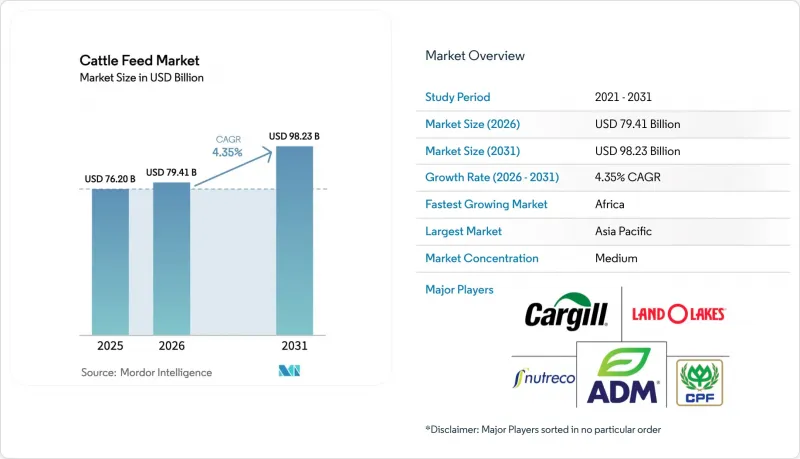
This report is Segmented by Animal Type (Dairy Cattle and Beef Cattle), by Ingredient (Cereals, Cakes and Mixes, Food Wastages, Feed Additives, and Other Ingredients), by Form (Pellets, Mash, Crumble, and Liquid), and by Geography (North America, South America, Europe, Asia Pacific, Middle East, and Africa). The Market Forecasts are Provided in Terms of Value in USD and Volume in Metric Tons.
Global Cattle Feed Market Trends and Insights
Government Incentives for Feed Fortification Programs
Governments in Kenya, Ethiopia, and India have introduced mandates requiring minimum inclusion of trace minerals and vitamins in cattle feed. These policies reduce effective costs for farmers and accelerate the transition away from traditional on-farm mixes. Kenya's subsidy program in 2024 covered 30% of the costs of fortified rations, which boosted compound feed demand by 120,000 metric tons in just nine months. India allocated INR 5 billion (USD 60.2 million) to build fortification infrastructure, with early adoption seen in Punjab and Haryana. The Food and Agriculture Organization's estimates suggest that compound feed penetration in Sub-Saharan Africa could reach 34% by 2028, creating strong opportunities for premix suppliers.
Escalating Demand for High Protein Dairy and Meat Products
Rising incomes in countries such as China and Saudi Arabia are driving higher consumption of milk and beef. This trend is pushing farms to adopt rations with elevated protein levels to meet production targets. In 2024, China's per-capita milk intake reached 42 kilograms, resulting in widespread adoption of diets with crude protein levels exceeding 18%. Saudi Arabia imported 1.2 million metric tons of compound feed to support its goal of achieving meat self-sufficiency. The demand has also fueled growth in liquid supplements containing rumen-protected fats, a segment now valued at USD 2.1 billion.
Volatile Grain Prices Impacting Input Costs
Grain price volatility continues to pose a challenge for feed manufacturers. Corn and soybean meal account for up to 75% of ration costs, leaving mills highly exposed to market swings. In 2024, Chicago corn prices fluctuated between USD 4.20 and USD 5.80 per bushel, compressing margins to below 3% in some quarters. Argentina's drought reduced soybean exports by 22%, forcing buyers to pay premiums of USD 40 per metric ton from Brazil. Smaller mills without hedging tools face severe liquidity pressures during such periods.
Other drivers and restraints analyzed in the detailed report include:
- Rapid Intensification of Cattle Farming in Emerging Economies
- Commercialization of Precision Feeding Technologies
- Shift Toward Plant-Based Diets in Mature Economies
For complete list of drivers and restraints, kindly check the Table Of Contents.
Segment Analysis
Dairy cattle continue to dominate the cattle feed market size, holding the largest share in 2025 at 53.2%. High-protein rations remain essential, but the rise of plant-based alternatives is putting pressure on processor margins. Large herds integrate bypass proteins and protected fats to sustain yields, while regulatory incentives under the Farm to Fork initiative encourage the adoption of low-emission feed technologies. Despite these advances, cost and palatability challenges still limit the widespread use of these technologies. Vertical integration by processors is also reshaping supply chains, diverting volumes from independent mills and consolidating control over feed formulations.
Beef cattle are positioned to expand more rapidly than dairy, advancing at a 5.2% CAGR through 2031. This reflects the cost competitiveness of feedlots compared to new pasture expansion in regions such as Brazil and Argentina, where land prices have increased significantly. Exporters are increasingly focused on marbling compliance to meet premium European Union quotas, further strengthening the outlook for beef finishing. Methane-reducing additives, though still at limited penetration, could become mainstream if carbon markets mature and incentives align with sustainability goals.
Complete Report Scope:
- By Animal Type
- Dairy Cattle
- Beef Cattle
- By Ingredient
- Cereals
- Cakes and Mixes
- Food Wastages
- Feed Additives
- Other Ingredients
- By Form
- Pellets
- Mash
- Crumble
- Liquid
- By Geography
- North America
- United States
- Canada
- Mexico
- Rest of North America
- South America
- Brazil
- Argentina
- Rest of South America
- Europe
- Germany
- United Kingdom
- France
- Spain
- Italy
- Russia
- Rest of Europe
- Asia-Pacific
- China
- India
- Japan
- Australia
- Rest of Asia-Pacific
- Middle East
- Saudi Arabia
- Turkey
- Rest of Middle East
- Africa
- South Africa
- Nigeria
- Rest of Africa
- North America
Geography Analysis
Asia Pacific captured the largest 2025 share at 36.6%, driven by China's industrialized dairies and India's sizable herd. Large-scale Chinese farms housing over 1,000 head now produce the majority of the nation's milk, accelerating the adoption of compound feed. India's cooperatives are investing in extension services and fortified rations, signaling significant upside potential in productivity. Regional demand is also supported by rising incomes and dietary shifts toward higher protein consumption, ensuring that the Asia Pacific region remains the anchor of global cattle feed demand in the years ahead.
Africa is forecast to grow at the fastest pace, advancing at a 5.5% CAGR through 2031. Subsidized credit programs and fortified ration mandates are driving the adoption of compound feed across dairy cooperatives. Food and Agriculture Organization estimates indicate that compound feed penetration could increase substantially by 2028, creating significant opportunities for premix suppliers. Nigeria's herd expansion and donor-backed feed mills are reshaping supply chains, while South Africa's advanced feedlots face infrastructure challenges. Africa's growth trajectory reflects both structural demand and policy-driven modernization of livestock systems.
North America has faced herd contractions due to drought-driven cow liquidations, while Europe contends with flexitarian diets and herd caps. South America is split between Brazil's expanding feedlot sector and Argentina's slowdown under tax pressures. The Middle East remains heavily reliant on imports, with countries constrained by water scarcity. These regions exhibit mixed dynamics, with some experiencing intensification of scaling, while others face structural headwinds. Together, they highlight the uneven pace of cattle feed adoption globally, with Asia-Pacific and Africa emerging as the clear growth leaders.
- Archer Daniels Midland Company
- Cargill Incorporated
- Land O'Lakes Incorporated
- Charoen Pokphand Foods Group
- DSM-Firmenich AG
- Nutreco N.V. (SHV Holdings N.V.)
- De Heus Animal Nutrition B.V.
- ForFarmers N.V.
- DBN Group
- Kemin Industries, Inc.
- New Hope Group
- Wen's Food Group
- Godrej Agrovet Limited (Godrej Group)
- Kent Nutrition Group (Kent Corporation)
- Alltech, Inc.
- Ridley Corporation
Additional Benefits:
- The market estimate (ME) sheet in Excel format
- 3 months of analyst support
TABLE OF CONTENTS
1 Introduction
- 1.1 Study Assumptions and Market Definition
- 1.2 Scope of the Study
2 Research Methodology
3 Executive Summary
4 Market Landscape
- 4.1 Market Overview
- 4.2 Market Drivers
- 4.2.1 Government incentives for feed fortification programs
- 4.2.2 Escalating demand for high-protein dairy and meat products
- 4.2.3 Rapid intensification of cattle farming in emerging economies
- 4.2.4 Commercialization of precision feeding technologies
- 4.2.5 Digital marketplaces simplifying feed procurement
- 4.2.6 Climate-resilient forage development boosting compound feed use
- 4.3 Market Restraints
- 4.3.1 Volatile grain prices impacting input costs
- 4.3.2 Shift toward plant-based diets in mature economies
- 4.3.3 Stringent anti-microbial regulations raising reformulation costs
- 4.3.4 Supply-chain disruptions from extreme weather events
- 4.4 Regulatory Landscape
- 4.5 Technological Outlook
- 4.6 Porter's Five Forces Analysis
- 4.6.1 Bargaining Power of Suppliers
- 4.6.2 Bargaining Power of Buyers/Consumers
- 4.6.3 Threat of New Entrants
- 4.6.4 Threat of Substitute Products
- 4.6.5 Intensity of Competitive Rivalry
5 Market Size and Growth Forecasts (Value and Volume)
- 5.1 By Animal Type
- 5.1.1 Dairy Cattle
- 5.1.2 Beef Cattle
- 5.2 By Ingredient
- 5.2.1 Cereals
- 5.2.2 Cakes and Mixes
- 5.2.3 Food Wastages
- 5.2.4 Feed Additives
- 5.2.5 Other Ingredients
- 5.3 By Form
- 5.3.1 Pellets
- 5.3.2 Mash
- 5.3.3 Crumble
- 5.3.4 Liquid
- 5.4 By Geography
- 5.4.1 North America
- 5.4.1.1 United States
- 5.4.1.2 Canada
- 5.4.1.3 Mexico
- 5.4.1.4 Rest of North America
- 5.4.2 South America
- 5.4.2.1 Brazil
- 5.4.2.2 Argentina
- 5.4.2.3 Rest of South America
- 5.4.3 Europe
- 5.4.3.1 Germany
- 5.4.3.2 United Kingdom
- 5.4.3.3 France
- 5.4.3.4 Spain
- 5.4.3.5 Italy
- 5.4.3.6 Russia
- 5.4.3.7 Rest of Europe
- 5.4.4 Asia-Pacific
- 5.4.4.1 China
- 5.4.4.2 India
- 5.4.4.3 Japan
- 5.4.4.4 Australia
- 5.4.4.5 Rest of Asia-Pacific
- 5.4.5 Middle East
- 5.4.5.1 Saudi Arabia
- 5.4.5.2 Turkey
- 5.4.5.3 Rest of Middle East
- 5.4.6 Africa
- 5.4.6.1 South Africa
- 5.4.6.2 Nigeria
- 5.4.6.3 Rest of Africa
- 5.4.1 North America
6 Competitive Landscape
- 6.1 Market Concentration
- 6.2 Strategic Moves
- 6.3 Market Share Analysis
- 6.4 Company Profiles (Includes Global Level Overview, Market Level Overview, Core Segments, Financials as Available, Strategic Information, Market Rank/Share for Key Companies, Products and Services, and Recent Developments)
- 6.4.1 Archer Daniels Midland Company
- 6.4.2 Cargill Incorporated
- 6.4.3 Land O'Lakes Incorporated
- 6.4.4 Charoen Pokphand Foods Group
- 6.4.5 DSM-Firmenich AG
- 6.4.6 Nutreco N.V. (SHV Holdings N.V.)
- 6.4.7 De Heus Animal Nutrition B.V.
- 6.4.8 ForFarmers N.V.
- 6.4.9 DBN Group
- 6.4.10 Kemin Industries, Inc.
- 6.4.11 New Hope Group
- 6.4.12 Wen's Food Group
- 6.4.13 Godrej Agrovet Limited (Godrej Group)
- 6.4.14 Kent Nutrition Group (Kent Corporation)
- 6.4.15 Alltech, Inc.
- 6.4.16 Ridley Corporation
7 Market Opportunities and Future Outlook

