PUBLISHER: Mordor Intelligence | PRODUCT CODE: 2063410

PUBLISHER: Mordor Intelligence | PRODUCT CODE: 2063410
South America Supply Chain Consulting Services - Market Share Analysis, Industry Trends & Statistics, Growth Forecasts (2026 - 2031)
According to Mordor Intelligence, the south america supply chain consulting services market size was valued at USD 0.941 billion in 2025 and estimated to grow from USD 0.987 billion in 2026 to reach USD 1.208 billion by 2031, at a CAGR of 4.12% during the forecast period (2026-2031).
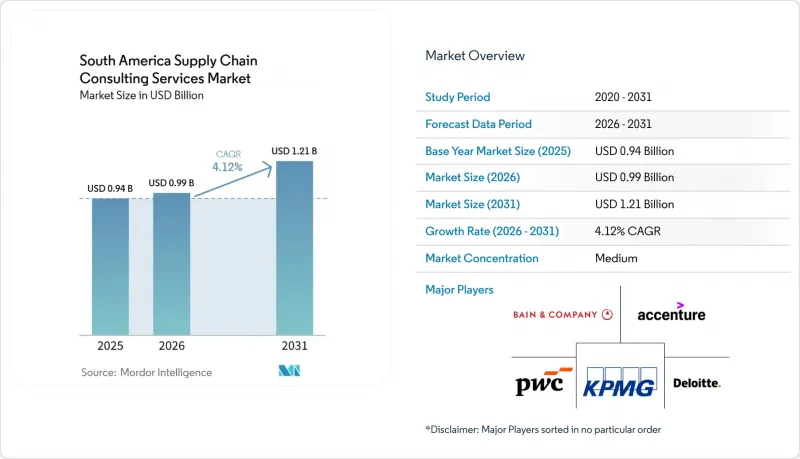
This report is Segmented by Service Type (Supply Chain Strategy and Network Design, Procurement and Sourcing, and More), End-User Industry (Retail and Ecommerce, Manufacturing, and More), Consulting Approach (Project-Based Consulting, Managed Services, and More), Organization Size (Large Enterprises, Smes), and Geography. The Market Forecasts are Provided in Terms of Value (USD).
South America Supply Chain Consulting Services Market Trends and Insights
Rising Adoption of Digital Supply Chain Transformation
Enterprises are consolidating fragmented ERP, procurement, and logistics systems onto cloud platforms that embed AI for process orchestration and predictive analytics. Vale's program to unify more than 20 purchasing tools under Coupa, covering USD 14 billion in annual spend, showcases how large asset-heavy firms are moving from pilot projects to scaled execution. Pharmaceutical manufacturer Uniao Quimica is following a similar path with SAP Ariba, targeting a May 2026 go-live that adds intelligent proposal evaluation. The region is also experimenting with agentic AI, as YPF and Globant deployed 46 digital agents across procurement and inventory workflows, freeing staff for strategic sourcing. Consulting firms benefit because most enterprises need external support to blueprint data architecture, redesign processes, and run change-management programs.
Need for Cost Optimization Across Enterprises
Regional logistics inefficiencies remain a structural drain on profitability, with costs sitting at almost double those in developed economies. Platform deployments such as Amazon Brazil's use of Optilogic's Cosmic Frog for scenario modeling illustrate how shippers are quantifying trade-offs among speed, service, and cost. Surveys of retail executives indicate that 66% plan to reconfigure their networks or diversify suppliers if trade-related costs rise, feeding a robust pipeline of consulting engagements focused on network design and inventory rightsizing. The Inter-American Development Bank estimates digitalization can shave up to 15% off logistics costs, underscoring the tangible ROI narrative that consultants use to close deals.
Shortage of Skilled Supply Chain Professionals
OECD research shows that SMEs perform most routine tasks at high risk of automation yet lack access to advanced training programs, leaving a gap in data analytics and process-engineering talent. KPMG warns that staffing constraints lengthen project timelines and raise day rates across Brazil and Argentina, limiting the scalability of consulting engagements. To mitigate, firms are launching capacity-building boot camps and partnering with universities to create feeder programs for junior analysts.
Other drivers and restraints analyzed in the detailed report include:
- Nearshoring Trends Driving Regional Supply Chain Reconfiguration
- Government Incentives for Green Logistics Initiatives
- High Consulting Fees for Small and Medium Enterprises
For complete list of drivers and restraints, kindly check the Table Of Contents.
Segment Analysis
Digital Supply Chain Transformation captured 21.78% of the South America supply chain consulting services market share in 2025, underscoring companies' prioritization of end-to-end visibility and AI-driven decision engines. Vale's program to automate more than 90 internal controls underscores the scale of multi-year digital mandates. Demand is reinforced by Amazon Brazil's real-time network twin, which continuously tests fulfillment scenarios. Sustainability and Green Supply Chain mandates, although smaller, are expanding at a 7.31% CAGR to 2031 as sovereign green-bond proceeds and BRL-denominated tax credits finance decarbonization roadmaps. Consultants are thus integrating carbon accounting modules into core transformation work, shortening payback horizons and widening the South America supply chain consulting services market size for ESG-linked offerings.
Beyond the two fastest-moving areas, network design and procurement optimization remain evergreen lines. IDB's projection of a potential USD 78 billion export uplift drives renewals of footprint analyses, while YPF's agentic AI experiment signals a pivot toward autonomous supplier evaluation. The service mix is rounded out by risk and resilience modeling, with clients requesting digital twins that overlay cyber, climate, and geopolitical stress tests. These expansions illustrate how the South America supply chain consulting services market continues to evolve from siloed advisory toward integrated, platform-enabled solutions.
Manufacturing commanded 35.59% of the South America supply chain consulting services market in 2025, led by complex automotive and mining value chains. Brazil's auto-parts revenue reached BRL 259.1 billion (USD 50.8 billion) in 2024, drawing consulting assignments in supplier rationalization and packaging redesign. Mining majors seek throughput gains and digital permitting, illustrated by Peru's USD 51.55 billion project pipeline that increasingly embeds supply-chain digitization. Energy and utilities, while smaller, is the fastest-growing vertical at 6.02% CAGR as IRENA forecasts USD 500 billion in annual renewable investment needs through 2050. This growth enlarges the South America supply chain consulting services market size devoted to grid logistics, electrolyser sourcing, and hydrogen corridor planning.
Retail and e-commerce engagements are riding a wave of fulfillment-center expansion. CEVA's 67,000 square-meter Amazon site, capable of 135,000 daily packages, showcases the scale at which omnichannel brands require process mapping and warehouse automation. Pharma, food, and beverage firms are likewise hiring consultants to modernize cold chains, comply with recycled-content mandates, and integrate serialization. The broadening client mix underpins a resilient revenue base even when commodity cycles soften.
List of Companies Covered in this Report:
- Accenture plc
- Deloitte Touche Tohmatsu Ltd
- KPMG International Ltd
- PricewaterhouseCoopers International Ltd
- Bain & Company Inc.
- Boston Consulting Group Inc.
- McKinsey & Company Inc.
- Ernst & Young Global Ltd
- International Business Machines Corporation (IBM Consulting)
- Capgemini SE
- Genpact Limited
- Chainalytics LLC
- NTT DATA Corporation
- Oliver Wyman Inc.
- AlixPartners LLP
- Kearney
- Infosys Limited
- Tata Consultancy Services Limited
- GEP Worldwide
- Alvarez & Marsal Holdings LLC
Additional Benefits:
- The market estimate (ME) sheet in Excel format
- 3 months of analyst support
TABLE OF CONTENTS
1 INTRODUCTION
- 1.1 Study Assumptions and Market Definition
- 1.2 Scope of the Study
2 RESEARCH METHODOLOGY
3 EXECUTIVE SUMMARY
4 MARKET LANDSCAPE
- 4.1 Market Overview
- 4.2 Market Drivers
- 4.2.1 Rising Adoption of Digital Supply Chain Transformation
- 4.2.2 Need for Cost Optimization Across Enterprises
- 4.2.3 Increasing Complexity of Regional Trade Regulations
- 4.2.4 Nearshoring Trends Driving Regional Supply Chain Reconfiguration
- 4.2.5 Rapid Growth of E-commerce Fulfillment Hubs in Secondary Cities
- 4.2.6 Government Incentives for Green Logistics Initiatives
- 4.3 Market Restraints
- 4.3.1 Shortage of Skilled Supply Chain Professionals
- 4.3.2 High Consulting Fees for Small and Medium Enterprises
- 4.3.3 Political Instability Affecting Long-Term Consulting Contracts
- 4.3.4 Fragmented Infrastructure Limiting Consulting Implementation ROI
- 4.4 Impact of Macroeconomic Factors on the Market
- 4.5 Industry Ecosystem Analysis
- 4.6 Regulatory Landscape
- 4.7 Technological Outlook
- 4.8 Porter's Five Forces Analysis
- 4.8.1 Bargaining Power of Buyers
- 4.8.2 Bargaining Power of Suppliers
- 4.8.3 Threat of New Entrants
- 4.8.4 Threat of Substitutes
- 4.8.5 Competitive Rivalry
5 MARKET SIZE AND GROWTH FORECASTS (VALUE)
- 5.1 By Service Type
- 5.1.1 Supply Chain Strategy and Network Design
- 5.1.2 Procurement and Sourcing
- 5.1.3 Logistics and Distribution Optimization
- 5.1.4 Inventory and Demand Planning
- 5.1.5 Digital Supply Chain Transformation
- 5.1.6 Sustainability and Green Supply Chain
- 5.1.7 Risk and Resilience Consulting
- 5.1.8 Other Service Types
- 5.2 By End-User Industry
- 5.2.1 Retail and E-commerce
- 5.2.2 Manufacturing
- 5.2.3 Food and Beverage
- 5.2.4 Healthcare and Pharmaceuticals
- 5.2.5 Automotive
- 5.2.6 Consumer Packaged Goods
- 5.2.7 Energy and Utilities
- 5.2.8 Other End-User Industries
- 5.3 By Consulting Approach
- 5.3.1 Project-Based Consulting
- 5.3.2 Managed Services
- 5.3.3 Training and Capacity Building
- 5.3.4 Advisory and Benchmarking
- 5.3.5 Other Consulting Approaches
- 5.4 By Organization Size
- 5.4.1 Large Enterprises
- 5.4.2 Small and Medium Enterprises
- 5.5 By Geography
- 5.5.1 Brazil
- 5.5.2 Argentina
- 5.5.3 Colombia
- 5.5.4 Chile
- 5.5.5 Peru
- 5.5.6 Rest of South America
6 COMPETITIVE LANDSCAPE
- 6.1 Market Concentration
- 6.2 Strategic Moves
- 6.3 Market Share Analysis
- 6.4 Company Profiles (includes Global Level Overview, Market Level Overview, Core Segments, Financials as available, Strategic Information, Market Rank/Share, Products and Services, Recent Developments)
- 6.4.1 Accenture plc
- 6.4.2 Deloitte Touche Tohmatsu Ltd
- 6.4.3 KPMG International Ltd
- 6.4.4 PricewaterhouseCoopers International Ltd
- 6.4.5 Bain & Company Inc.
- 6.4.6 Boston Consulting Group Inc.
- 6.4.7 McKinsey & Company Inc.
- 6.4.8 Ernst & Young Global Ltd
- 6.4.9 International Business Machines Corporation (IBM Consulting)
- 6.4.10 Capgemini SE
- 6.4.11 Genpact Limited
- 6.4.12 Chainalytics LLC
- 6.4.13 NTT DATA Corporation
- 6.4.14 Oliver Wyman Inc.
- 6.4.15 AlixPartners LLP
- 6.4.16 Kearney
- 6.4.17 Infosys Limited
- 6.4.18 Tata Consultancy Services Limited
- 6.4.19 GEP Worldwide
- 6.4.20 Alvarez & Marsal Holdings LLC
7 MARKET OPPORTUNITIES AND FUTURE OUTLOOK
- 7.1 White-Space and Unmet-Need Assessment

