PUBLISHER: Mordor Intelligence | PRODUCT CODE: 2073581

PUBLISHER: Mordor Intelligence | PRODUCT CODE: 2073581
Asia Pacific Strategic Consulting Services - Market Share Analysis, Industry Trends & Statistics, Growth Forecasts (2026 - 2031)
According to Mordor Intelligence, asia pacific strategic consulting services market size in 2026 is estimated at USD 11.64 billion, growing from 2025 value of USD 10.34 billion with 2031 projections showing USD 20.98 billion, growing at 12.52% CAGR over 2026-2031.
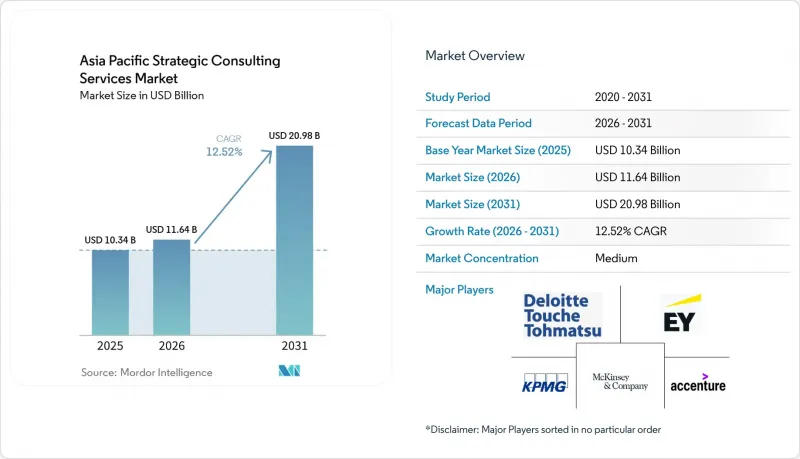
This report is Segmented by Service Type (Corporate Strategy, Digital Strategy, and More), End-User Industry (Financial Services, Retail and Consumer, and More), Enterprise Size (Large Enterprises, and Small and Medium Enterprises), Delivery Model (On-Site Consulting, Remote/Virtual Consulting, and More), and Geography. The Market Forecasts are Provided in Terms of Value (USD).
Asia Pacific Strategic Consulting Services Market Trends and Insights
Digital-transformation wave across Asia Pacific
Enterprises in the region accelerated digital spending following pandemic disruptions, with 44% of previously offline organizations planning to automate over half their non-automated processes by 2025. Consulting firms are seizing the opportunity by embedding AI throughout project lifecycles, raising utilization rates by up to 50% and enabling data-rich strategy sprints that shorten engagement timelines. Regulators are also shaping demand: Singapore's Monetary Authority issued transition planning guidelines, and Japan's Financial Services Agency published AI use frameworks that encourage structured advisory support. As clients favor expert-heavy teams, firms are migrating from pyramid to diamond staffing, pushing mid-level and specialist hiring higher and redefining talent economics across the Asia Pacific strategic consulting services market.
Surge in cross-border M and A and restructuring mandates
Supply-chain diversification and geopolitical realignment lifted regional deal volumes to multi-year highs in 2024, energizing transaction strategy practices. The complexity of navigating disparate regulatory codes and national security reviews gives a distinct edge to advisory teams with deep local credentials and collaborative toolsets. Technology-driven acquisitions such as IBM's USD 6.4 billion HashiCorp purchase underscore how software capabilities influence valuation thresholds, while spin-offs and carve-outs linked to de-risking strategies further expand restructuring pipelines. As a result, consultancies are formalizing geostrategy cells that translate macro risk signals into board-level action plans across ASEAN, Japan, and Australia.
Rising price sensitivity among large enterprise clients
C-suite buyers are renegotiating fee structures in response to macro uncertainty, shifting toward outcome-based pricing and shorter project cycles. Firms are countering with fixed-fee models underpinned by detailed ROI baselines and AI-enabled delivery accelerators that sustain margins even at lower blended rates. The emphasis on specialist staffing further compresses junior demand, intensifying the search for mid-level talent and fostering alumni networks that feed freelance marketplaces.
Other drivers and restraints analyzed in the detailed report include:
- Escalating demand for ESG / sustainability road-maps
- Embedded-finance disruption driving payments strategy work
- Intensifying competition from Big Tech and IT-services firms
For complete list of drivers and restraints, kindly check the Table Of Contents.
Segment Analysis
The digital strategy segment contributed 27.20% to Asia Pacific strategic consulting services market size in 2025 and remains the reference point for enterprise reinvention programs. Its dominance is rooted in AI integration, data modernization, and platform business model expansion that deliver quantifiable revenue lifts and cost efficiencies. ESG and sustainability consulting, though smaller today, is posting a 13.05% CAGR and is expected to chip away at traditional corporate strategy budgets, as disclosure mandates embed environmental metrics into boardroom agendas. M and A strategy rides the wave of supply-chain and geopolitical realignments, reinforcing demand for integrative transaction playbooks. Risk and compliance work remains resilient, fueled by tightening anti-money-laundering standards, cyber regulations, and digital sovereignty laws proliferating across Asia Pacific jurisdictions.
Service providers are differentiating by sector-specific accelerators and proprietary data assets that compress time to insight. For example, carbon-accounting platforms are embedded into ESG engagements, while digital twins accelerate manufacturing strategy design. These tools create recurring revenue streams via subscription or managed-service models, subtly shifting revenue mixes away from pure time-and-materials billing. In parallel, the Asia Pacific strategic consulting services market is witnessing consultancies spinning off specialist boutiques to maintain premium pricing and brand clarity in digital strategy and sustainability niches.
Financial institutions captured 24.12% of Asia Pacific strategic consulting services market share in 2025 as banks, insurers, and capital-market operators navigated digital disruption and regulatory tightrope walks. Fintech collaborations, open-banking interfaces, and embedded finance ecosystems require intricate transition blueprints that integrate technology, operations, and compliance layers. Life sciences and healthcare, meanwhile, is accelerating at a 13.70% CAGR, underpinned by demographic shifts, telehealth diffusion, and rising biotech investment. TMT players continue to seek guidance on 5G-enabled platforms, AI content generation, and data-privacy imperatives, while manufacturing clients demand Industry 4.0 roadmaps with decarbonization milestones.
Sector specialization is redefining delivery teams: consultants with dual backgrounds in, for instance, clinical research and data science, or payments operations and cybersecurity, now command premium billing rates. Government clients are selectively commissioning smart-city and public-finance transformation projects, although budget constraints temper overall growth. Across sectors, outcome metrics such as loan origination speed, patient adherence, or emissions reduction are baked into contracting terms, reinforcing result-based engagement models in the Asia Pacific strategic consulting services market.
Complete Report Scope:
- By Service Type
- Corporate Strategy
- Digital Strategy
- Operations Strategy
- M&A and Restructuring
- Sustainability and ESG Strategy
- Risk and Compliance Strategy
- By End-User Industry
- Financial Services
- Life Sciences and Healthcare
- Retail and Consumer
- Government and Public Sector
- Energy and Utilities
- Manufacturing
- Technology Media and Telecommunications
- Other End-User Industries
- By Enterprise Size
- Large Enterprises
- Small and Medium Enterprises (SMEs)
- By Delivery Model
- On-site Consulting
- Remote / Virtual Consulting
- Hybrid Consulting
- By Country
- China
- Japan
- India
- Australia
- South Korea
- Singapore
- Indonesia
- Malaysia
- Thailand
- Rest of Asia Pacific
List of Companies Covered in this Report:
- McKinsey and Company
- Boston Consulting Group
- Bain and Company
- A.T. Kearney Inc.
- Deloitte Touche Tohmatsu Limited
- Ernst and Young Global Limited
- KPMG International Limited
- PricewaterhouseCoopers International Limited
- Accenture plc
- Mercer LLC
- Oliver Wyman Group
- Roland Berger Holding GmbH
- L.E.K. Consulting LLC
- Strategy& (part of PwC)
- Capgemini Invent
- IBM Consulting
- Monitor Deloitte
- Arthur D. Little
- Nomura Research Institute Ltd.
- Frost and Sullivan Inc.
Additional Benefits:
- The market estimate (ME) sheet in Excel format
- 3 months of analyst support
TABLE OF CONTENTS
1 INTRODUCTION
- 1.1 Study Assumptions and Market Definition
- 1.2 Scope of the Study
2 RESEARCH METHODOLOGY
3 EXECUTIVE SUMMARY
4 MARKET LANDSCAPE
- 4.1 Market Overview
- 4.2 Market Drivers
- 4.2.1 Digital-transformation wave across Asia Pacific
- 4.2.2 Surge in cross-border M&A and restructuring mandates
- 4.2.3 Escalating demand for ESG/sustainability road-maps
- 4.2.4 Embedded-finance disruption driving payments strategy work
- 4.2.5 Freelance-consultant supply mismatch enabling new delivery models
- 4.2.6 Heavy-industry supply-chain decarbonisation (CBAM spill-overs)
- 4.3 Market Restraints
- 4.3.1 Rising price sensitivity among large enterprise clients
- 4.3.2 Intensifying competition from Big Tech and IT-services firms
- 4.3.3 Client skepticism on Gen-AI consulting ROI
- 4.3.4 Regional talent drain to freelance / in-house strategy teams
- 4.4 Industry Ecosystem Analysis
- 4.5 Regulatory Landscape
- 4.6 Technological Outlook
- 4.7 Porter's Five Forces Analysis
- 4.7.1 Threat of New Entrants
- 4.7.2 Bargaining Power of Buyers/Consumers
- 4.7.3 Bargaining Power of Suppliers
- 4.7.4 Threat of Substitute Products
- 4.7.5 Intensity of Competitive Rivalry
- 4.8 Impact of Macroeconomic Factors
5 MARKET SIZE AND GROWTH FORECASTS (VALUE)
- 5.1 By Service Type
- 5.1.1 Corporate Strategy
- 5.1.2 Digital Strategy
- 5.1.3 Operations Strategy
- 5.1.4 M&A and Restructuring
- 5.1.5 Sustainability and ESG Strategy
- 5.1.6 Risk and Compliance Strategy
- 5.2 By End-User Industry
- 5.2.1 Financial Services
- 5.2.2 Life Sciences and Healthcare
- 5.2.3 Retail and Consumer
- 5.2.4 Government and Public Sector
- 5.2.5 Energy and Utilities
- 5.2.6 Manufacturing
- 5.2.7 Technology Media and Telecommunications
- 5.2.8 Other End-User Industries
- 5.3 By Enterprise Size
- 5.3.1 Large Enterprises
- 5.3.2 Small and Medium Enterprises (SMEs)
- 5.4 By Delivery Model
- 5.4.1 On-site Consulting
- 5.4.2 Remote / Virtual Consulting
- 5.4.3 Hybrid Consulting
- 5.5 By Country
- 5.5.1 China
- 5.5.2 Japan
- 5.5.3 India
- 5.5.4 Australia
- 5.5.5 South Korea
- 5.5.6 Singapore
- 5.5.7 Indonesia
- 5.5.8 Malaysia
- 5.5.9 Thailand
- 5.5.10 Rest of Asia Pacific
6 COMPETITIVE LANDSCAPE
- 6.1 Market Concentration
- 6.2 Strategic Moves
- 6.3 Market Share Analysis
- 6.4 Company Profiles (includes Global level Overview, Market level overview, Core Segments, Financials as available, Strategic Information, Market Rank/Share for key companies, Products and Services, and Recent Developments)
- 6.4.1 McKinsey and Company
- 6.4.2 Boston Consulting Group
- 6.4.3 Bain and Company
- 6.4.4 A.T. Kearney Inc.
- 6.4.5 Deloitte Touche Tohmatsu Limited
- 6.4.6 Ernst and Young Global Limited
- 6.4.7 KPMG International Limited
- 6.4.8 PricewaterhouseCoopers International Limited
- 6.4.9 Accenture plc
- 6.4.10 Mercer LLC
- 6.4.11 Oliver Wyman Group
- 6.4.12 Roland Berger Holding GmbH
- 6.4.13 L.E.K. Consulting LLC
- 6.4.14 Strategy& (part of PwC)
- 6.4.15 Capgemini Invent
- 6.4.16 IBM Consulting
- 6.4.17 Monitor Deloitte
- 6.4.18 Arthur D. Little
- 6.4.19 Nomura Research Institute Ltd.
- 6.4.20 Frost and Sullivan Inc.
7 MARKET OPPORTUNITIES AND FUTURE OUTLOOK
- 7.1 White-space and unmet-need assessment

