
PUBLISHER: Mordor Intelligence | PRODUCT CODE: 2063617

PUBLISHER: Mordor Intelligence | PRODUCT CODE: 2063617
United Kingdom White Glove Delivery Services - Market Share Analysis, Industry Trends & Statistics, Growth Forecasts (2026 - 2031)
According to Mordor Intelligence, the united kingdom white glove delivery services market size is projected to be USD 2.13 billion in 2025, USD 2.27 billion in 2026, and reach USD 3.05 billion by 2031, growing at a CAGR of 6.12% from 2026 to 2031.
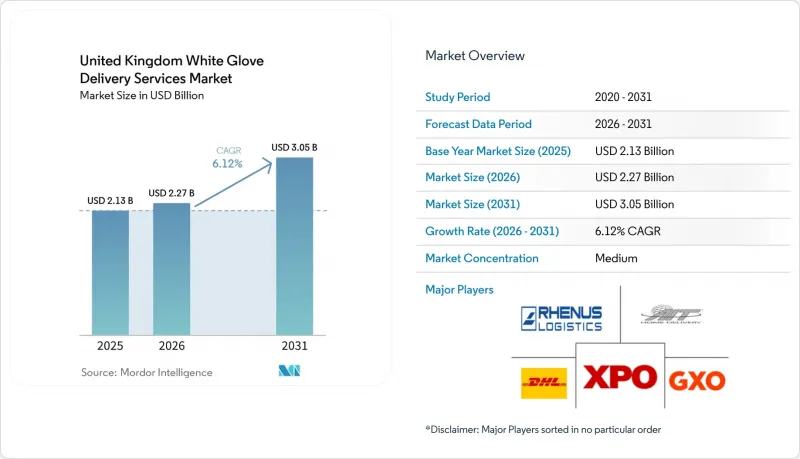
Rising online sales of bulky items like furniture and large appliances are expanding demand for two-person crews that can place products in the room of choice, assemble them, and clear packaging. This report is Segmented by Service Type (Standard White Glove Service, and More), by End-User Industry (Furniture & Home Goods, Consumer Electronics & Appliances, Healthcare & Medical Devices, Luxury Goods & Art, and More), and by Delivery Speed (Standard (2-5 Day), Next-Day / Nominated-Day, and Same-Day / Express), The Market Forecasts are Provided in Terms of Value (USD).
United Kingdom White Glove Delivery Services Market Trends and Insights
E-Commerce Boom in Bulky-Item Categories
Online sales of large items such as sofas, refrigerators, and big-screen televisions climbed 14.7% year on year in January 2026, the sharpest monthly rise since 2021. Bulky products require two-person crews for safe, room-of-choice delivery, so every uptick in this retail segment expands the addressable market for United Kingdom white glove delivery services. National data show the online share of total retail sales reached 28.2% in February 2026, with furniture and appliances among the fastest movers. Retailers are therefore retooling checkout flows to surface assembly add-ons, converting a cost center into a revenue stream. This structural shift is expected to support steady volume growth for premium crews well beyond the forecast window.
Customer-Experience-Led Value-Added Delivery Demand
Consumer sentiment analysis reveals that United Kingdom shoppers overwhelmingly identify poor delivery communication as their primary logistics frustration. Additionally, there is near-universal consumer dissatisfaction when couriers leave parcels in unsecured or unsafe locations. This favors the United Kingdom white glove delivery services market because appointment scheduling, call-ahead notifications, and in-home handoff are standard features. IKEA's February 2025 integration with TaskRabbit shows the commercial upside: customers who chose assembly lifted average order value by 4.7 times and cut returns on complex items by roughly 40%. Value-added reliability, not raw speed, is proving to be the stronger loyalty driver.
High Labor and Operating Cost Premium
Average heavy-goods-vehicle wages climbed from USD 41,000 in 2020 to USD 55,000 in 2025 after converting from sterling, while the National Living Wage rose 6.7% to USD 15.3 per hour in April 2025. Employer payroll taxes also increased, adding roughly USD 1.9 billion in extra labor costs across the logistics sector. Two-person crews double payroll per stop, and tight appointment windows cap daily drop density, squeezing profit per route. Fleet electrification reduces fuel spend but requires a significant capital outlay for trucks and depot chargers. Operators tied into legacy fixed-price contracts risk margin erosion unless they renegotiate to open-book terms.
Other drivers and restraints analyzed in the detailed report include:
- Returns Handling and Reverse Logistics Integration
- Consolidation and Capital Inflow from Global 3PLs
- Shortage of Skilled Two-Person Crews
For complete list of drivers and restraints, kindly check the Table Of Contents.
Segment Analysis
Standard white glove service accounted for 58.63% of the United Kingdom white glove delivery services market share in 2025, underscoring its role as the default two-person, room-of-choice option for bulky products. Demand in this core segment is anchored to furniture and appliance retailers that prize reliable appointment windows over raw speed. Yet the premium tier is where margin expansion lies. Premium white glove service is projected to grow at a 13.65% CAGR through 2031 as retailers increasingly bundle assembly, smart-home setup, and haul-away into checkout flows. IKEA's TaskRabbit integration, priced at USD 41.3 per job, lifted attach rates by 50% and reduced complex-item returns by roughly 40%, proving consumers will pay for turnkey convenience.
The upsell potential explains why global 3PLs such as GXO Logistics and DHL have integrated scheduling portals that surface premium add-ons at the point of booking. Larger fleets also support bespoke services such as climate-controlled art transport and white-glove handling for medical devices, areas where specialist insurers such as Lloyd's underwrite high-value cargo at 0.50% of declared value. Open-book contracts, which accounted for 79% of Wincanton's 2024 revenue, let operators pass through wage and fuel inflation to shippers, protecting profitability even as service complexity rises. As a result, the premium and customized tiers are expected to add more than USD 280 million to the United Kingdom white glove delivery services market size by 2031, despite representing a smaller volume base today. Operators that combine live tracking, certified technicians, and emissions-compliant trucks are best placed to capture this growth.
List of Companies Covered in this Report:
- Rhenus Logistics
- AIT Home Delivery (Panther Logistics)
- XPO Logistics (Including BJS Home Delivery)
- DHL Group
- Bishopsgate Logistics
- FedEx
- UPS Healthcare
- GXO Logistics (Wincanton Specialist Services)
- DSV (including DB Schenker)
- DX Freight Premium Logistics
- GS Transport Ltd
- Empire Delivery
- Secure UK Couriers
- Loom Loft Delivery Services
- Onit Logistics
- Loom Loft Delivery Services
- Shackletons White Glove
- Nicholas John Interiors (B Star VIP)
- Abitare UK Delivery
- John Lewis Two-Man Delivery Service
- IKEA TaskRabbit Assembly
Additional Benefits:
- The market estimate (ME) sheet in Excel format
- 3 months of analyst support
TABLE OF CONTENTS
1 Introduction
- 1.1 Study Assumptions and Market Definition
- 1.2 Scope of the Study
2 Research Methodology
3 Executive Summary
4 Market Landscape
- 4.1 Market Overview
- 4.2 Market Drivers
- 4.2.1 E-Commerce Boom in Bulky-Item Categories
- 4.2.2 Customer-Experience-Led Value-Added Delivery Demand
- 4.2.3 Returns Handling and Reverse Logistics Integration
- 4.2.4 Consolidation & Capital Inflow from Global 3PLs
- 4.2.5 Smart-Home Device Bundle Installations
- 4.2.6 ULEZ-Driven Shift to Compliant Premium Fleets
- 4.3 Market Restraints
- 4.3.1 High Labor and Operating Cost Premium
- 4.3.2 Shortage of Skilled Two-Person Crews
- 4.3.3 Damage Liability & Insurance Costs
- 4.3.4 Fragmented Subcontractor Networks Impacting Service Consistency
- 4.4 Value / Supply-Chain Analysis
- 4.5 Regulatory Landscape
- 4.6 Technological Outlook
- 4.7 Porter's Five Forces
- 4.7.1 Threat of New Entrants
- 4.7.2 Bargaining Power of Suppliers
- 4.7.3 Bargaining Power of Buyers
- 4.7.4 Threat of Substitutes
- 4.7.5 Competitive Rivalry
- 4.8 Impact of Geo-Political Events
5 Market Size and Growth Forecasts (Value)
- 5.1 By Service Type
- 5.1.1 Standard White Glove Service
- 5.1.2 Premium White Glove Service
- 5.1.3 Customized White Glove Service
- 5.2 By End-User Industry
- 5.2.1 Furniture and Home Goods
- 5.2.2 Consumer Electronics and Appliances
- 5.2.3 Healthcare and Medical Devices
- 5.2.4 Luxury Goods and Art
- 5.2.5 Other (Industrial Machinery, E-commerce and Retail, etc.)
- 5.3 By Delivery Speed
- 5.3.1 Standard (2 to 5 Day)
- 5.3.2 Next-Day / Nominated-Day
- 5.3.3 Same-Day / Express
6 Competitive Landscape
- 6.1 Market Concentration
- 6.2 Strategic Moves
- 6.3 Market Share Analysis
- 6.4 Company Profiles (includes Global level Overview, Market level overview, Core Segments, Financials as available, Strategic Information, Market Rank/Share for Key Companies, Products & Services, and Recent Developments)
- 6.4.1 Rhenus Logistics
- 6.4.2 AIT Home Delivery (Panther Logistics)
- 6.4.3 XPO Logistics (Including BJS Home Delivery)
- 6.4.4 DHL Group
- 6.4.5 Bishopsgate Logistics
- 6.4.6 FedEx
- 6.4.7 UPS Healthcare
- 6.4.8 GXO Logistics (Wincanton Specialist Services)
- 6.4.9 DSV (including DB Schenker)
- 6.4.10 DX Freight Premium Logistics
- 6.4.11 GS Transport Ltd
- 6.4.12 Empire Delivery
- 6.4.13 Secure UK Couriers
- 6.4.14 Loom Loft Delivery Services
- 6.4.15 Onit Logistics
- 6.4.16 Loom Loft Delivery Services
- 6.4.17 Shackletons White Glove
- 6.4.18 Nicholas John Interiors (B Star VIP)
- 6.4.19 Abitare UK Delivery
- 6.4.20 John Lewis Two-Man Delivery Service
- 6.4.21 IKEA TaskRabbit Assembly
7 Market Opportunities and Future Outlook
- 7.1 White-space and Unmet-need Assessment

