PUBLISHER: Mordor Intelligence | PRODUCT CODE: 2100754

PUBLISHER: Mordor Intelligence | PRODUCT CODE: 2100754
GCC Courier, Express, and Parcel (CEP) - Market Share Analysis, Industry Trends & Statistics, Growth Forecasts (2026 - 2031)
According to Mordor Intelligence, the GCC courier, express, and parcel market size in 2026 is estimated at USD 4.15 billion, growing from 2025 value of USD 3.89 billion with 2031 projections showing USD 5.76 billion, growing at 6.74% CAGR over 2026-2031.
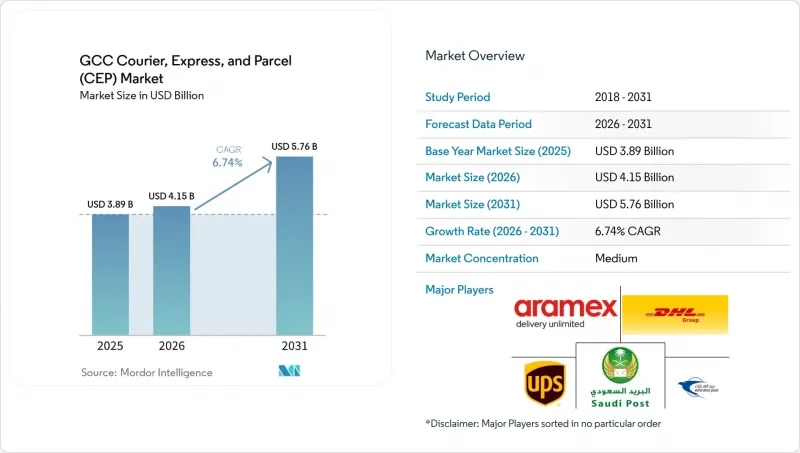
The GCC courier, express, and parcel market size trajectory underscores the region's evolution into a vital global logistics gateway within the broader GCC freight and logistics market. This report is Segmented by End User Industry (E-Commerce and More), Destination (Domestic and International), Speed of Delivery (Express and Non-Express), Shipment Weight (Heavy Weight Shipments and More), Mode of Transport (Air, Road, and Others), Model (Business-To-Business, and More), and Country (Saudi Arabia and More). The Market Forecasts are Provided in Terms of Value (USD).
GCC Courier, Express, and Parcel (CEP) Market Trends and Insights
Rapid E-Commerce Uptake Across GCC
Accelerating digital retail adoption is reshaping shipment profiles, with B2C parcels already representing 58.55% of 2024 volume. Harmonized tariff codes and single-window customs portals are trimming clearance cycles and raising consumer confidence in cross-border purchases. Operators are embedding AI-enabled route planning and demand forecasting to cut delivery cost per stop, while malls and airlines unlock latent real estate by offering pay-as-you-go fulfillment capacity. The result is a denser last-mile network, growing repeat purchase frequency, and heightened pressure to guarantee sub-24-hour delivery windows.
Large-Scale Government Logistics Investment
National infrastructure blueprints ring-fence multibillion-dollar allocations for bonded zones, smart gates, and inland ports. Saudi Arabia's USD 133.3 billion program funds multimodal corridors that connect industrial clusters with export gateways, while the UAE expands digital free zones to expedite e-commerce clearances. These public-sector injections lower throughput constraints, attract third-party logistics providers, and anchor foreign direct investment in warehouse automation and cold-chain fleets.
Persistently High Last-Mile Costs
Low address density beyond core metros forces longer routes, smaller drop clusters, and higher fuel burn per parcel. Escalating driver wages and vehicle compliance fees further compress margins, prompting operators to pool deliveries or deploy parcel lockers to limit doorstep runs.
Other drivers and restraints analyzed in the detailed report include:
- Surge in On-Demand and Same-Day Delivery
- Duty-Paid Cross-Border Programs
- Peak-Season Labor Bottlenecks
For complete list of drivers and restraints, kindly check the Table Of Contents.
Segment Analysis
E-commerce is the undisputed volume engine, accounting for 42.65% of 2025 demand. Flash-sale peaks align with regional shopping festivals, stressing network resilience yet offering lucrative surcharge opportunities. Return-rate mitigation has sparked investments in AI-driven fraud detection, smart packaging that reduces damage, and doorstep try-on services. Meanwhile, healthcare's 7.29% CAGR between 2026-2031 is capturing board-level attention. Pharma majors are mandating GDP-certified routes, redundant cold-room inventories, and end-to-end temperature telemetry. DHL's multi-billion-dollar commitment to life-science facilities adds credibility and sets new compliance benchmarks.
Primary industry and wholesale trade lanes continue to underpin heavyweight and palletized flows, benefiting from integrated multimodal solutions. Financial services rely on document and card dispatches, yet the digital switchover tempers future growth. Manufacturing's just-in-sequence replenishment models require synchronized pick-up windows and zero-defect delivery, encouraging carriers to deploy control-tower analytics that flag variance in real-time.
International parcels are growing at a 7.22% CAGR between 2026-2031, outstripping domestic routes that nonetheless command 64.81% revenue share in 2025. Harmonized duty-paid frameworks and near-shoring of inventory into bonded fulfillment centers unlock faster clearances, turning the GCC courier, express, and parcel market into a pivotal bridge between Asian exporters and African consumers. Operators channel capital into cross-border e-hubs at Jebel Ali and King Salman Park, co-locating customs, sortation, and value-added services to compress transit times. Blockchain-anchored document flows and API-integrated tariff engines are trimming error-prone manual data entry, supporting the continued growth of the GCC international express service industry. Although domestic routes benefit from proximity and simplified documentation, their profitability hinges on conquering last-mile density hurdles that continue to suppress margins beyond tier-1 cities.
Local businesses prize domestic networks for predictable overnight coverage, yet shoppers are widening their horizons, lured by international marketplace assortments and falling landed-cost uncertainty. The GCC courier, express, and parcel market size tied to international lanes will accelerate as free-trade pacts mature and operators bundle ancillary services such as returns consolidation and duty-refund processing. In tandem, SMEs leverage cross-border dropshipping to test new markets without stocking inventory abroad, swelling small-parcel counts. Domestic incumbents respond by layering loyalty programs and subscription models to defend share, but the geographic rebalancing is unmistakable.
Complete Report Scope:
- Destination
- Domestic
- International
- Speed of Delivery
- Express
- Non-Express
- Model
- Business-to-Business (B2B)
- Business-to-Consumer (B2C)
- Consumer-to-Consumer (C2C)
- Shipment Weight
- Heavy Weight Shipments
- Light Weight Shipments
- Medium Weight Shipments
- Mode of Transport
- Air
- Road
- Others
- End User Industry
- E-Commerce
- Financial Services (BFSI)
- Healthcare
- Manufacturing
- Primary Industry
- Wholesale and Retail Trade (Offline)
- Others
- Country
- Qatar
- Saudi Arabia
- UAE
- Rest of GCC
List of Companies Covered in this Report:
- Aramex
- DHL Group
- Emirates Post
- FedEx
- Postaplus
- Qatar Post
- Saudi Post- SPL (including Naqel Express)
- SMSA Express Transportation Company Ltd.
- Uber Technologies Inc.
- United Parcel Service (UPS)
Additional Benefits:
- The market estimate (ME) sheet in Excel format
- 3 months of analyst support
TABLE OF CONTENTS
1 Introduction
- 1.1 Study Assumptions and Market Definition
- 1.2 Scope of the Study
2 Research Methodology
3 Executive Summary
4 Market Landscape
- 4.1 Market Overview
- 4.2 Demographics
- 4.3 GDP Distribution by Economic Activity
- 4.4 GDP Growth by Economic Activity
- 4.5 Inflation
- 4.6 Economic Performance and Profile
- 4.6.1 Trends in E-Commerce Industry
- 4.6.2 Trends in Manufacturing Industry
- 4.7 Transport and Storage Sector GDP
- 4.8 Export Trends
- 4.9 Import Trends
- 4.10 Fuel Price
- 4.11 Logistics Performance
- 4.12 Infrastructure
- 4.13 Regulatory Framework
- 4.13.1 Qatar
- 4.13.2 Saudi Arabia
- 4.13.3 UAE
- 4.14 Value Chain and Distribution Channel Analysis
- 4.15 Market Drivers
- 4.15.1 Rapid E-Commerce Penetration Across GCC
- 4.15.2 Large-Scale Government Investment in Logistics Infrastructure
- 4.15.3 Surge in On-Demand and Same-Day Delivery Services
- 4.15.4 Harmonized Cross-Border Duty-Paid E-Commerce Programs
- 4.15.5 Early Rollout of Autonomous and Robotic Last-Mile Pilots
- 4.15.6 Fulfilment-as-a-Service Models by Malls and Airlines
- 4.16 Market Restraints
- 4.16.1 Persistently High Last-Mile Logistics Cost Base
- 4.16.2 Peak-Season Labor and Capacity Bottlenecks
- 4.16.3 Restrictive Drone-Delivery Regulations
- 4.16.4 Non-Standardized Addressing Outside Tier-1 Cities
- 4.17 Technology Innovations in the Market
- 4.18 Porter's Five Forces Analysis
- 4.18.1 Threat of New Entrants
- 4.18.2 Bargaining Power of Buyers
- 4.18.3 Bargaining Power of Suppliers
- 4.18.4 Threat of Substitutes
- 4.18.5 Competitive Rivalry
5 Market Size and Growth Forecasts (Value, USD)
- 5.1 Destination
- 5.1.1 Domestic
- 5.1.2 International
- 5.2 Speed of Delivery
- 5.2.1 Express
- 5.2.2 Non-Express
- 5.3 Model
- 5.3.1 Business-to-Business (B2B)
- 5.3.2 Business-to-Consumer (B2C)
- 5.3.3 Consumer-to-Consumer (C2C)
- 5.4 Shipment Weight
- 5.4.1 Heavy Weight Shipments
- 5.4.2 Light Weight Shipments
- 5.4.3 Medium Weight Shipments
- 5.5 Mode of Transport
- 5.5.1 Air
- 5.5.2 Road
- 5.5.3 Others
- 5.6 End User Industry
- 5.6.1 E-Commerce
- 5.6.2 Financial Services (BFSI)
- 5.6.3 Healthcare
- 5.6.4 Manufacturing
- 5.6.5 Primary Industry
- 5.6.6 Wholesale and Retail Trade (Offline)
- 5.6.7 Others
- 5.7 Country
- 5.7.1 Qatar
- 5.7.2 Saudi Arabia
- 5.7.3 UAE
- 5.7.4 Rest of GCC
6 Competitive Landscape
- 6.1 Market Concentration
- 6.2 Key Strategic Moves
- 6.3 Market Share Analysis
- 6.4 Company Profiles (Includes Global Level Overview, Market Level Overview, Core Segments, Financials as Available, Strategic Information, Market Rank/Share for Key Companies, Products and Services, and Recent Developments)
- 6.4.1 Aramex
- 6.4.2 DHL Group
- 6.4.3 Emirates Post
- 6.4.4 FedEx
- 6.4.5 Postaplus
- 6.4.6 Qatar Post
- 6.4.7 Saudi Post- SPL (including Naqel Express)
- 6.4.8 SMSA Express Transportation Company Ltd.
- 6.4.9 Uber Technologies Inc.
- 6.4.10 United Parcel Service (UPS)
7 Market Opportunities and Future Outlook
- 7.1 White-Space and Unmet-Need Assessment

