
PUBLISHER: Mordor Intelligence | PRODUCT CODE: 2099092

PUBLISHER: Mordor Intelligence | PRODUCT CODE: 2099092
Germany Out Of Home Delivery - Market Share Analysis, Industry Trends & Statistics, Growth Forecasts (2026 - 2031)
According to Mordor Intelligence, the Germany out-of-home (OOH) delivery market size was valued at USD 2.07 billion in 2025 and is estimated to grow from USD 2.16 billion in 2026 to USD 2.68 billion by 2031, registering a CAGR of 4.44% over the same period.
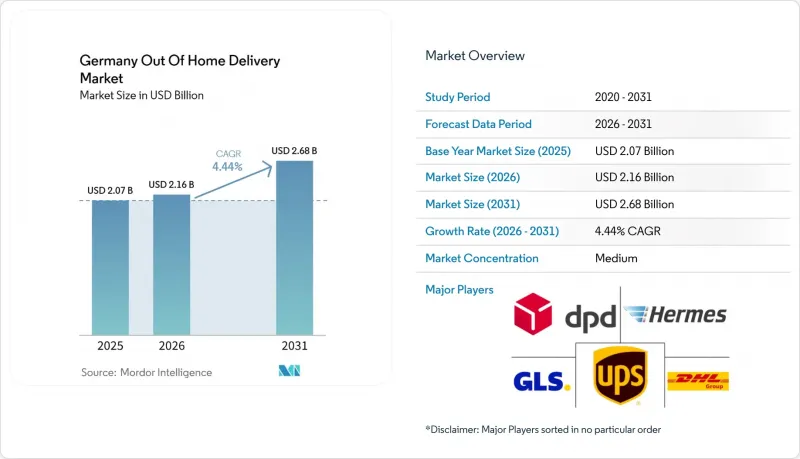
This report is Segmented by End-User Industry (E-Commerce, Financial Services (BFSI), Healthcare, Manufacturing, Primary Industry, Wholesale and Retail Trade (Offline), and Others), and by Business Model (Business-To-Business (B2B), Business-To-Consumer (B2C), and Consumer-To-Consumer (C2C)). The Market Forecasts are Provided in Terms of Value (USD).
Germany Out Of Home Delivery Market Trends and Insights
Unrivaled Consumer Adoption of APMs Led by Early Packstation Penetration Severe Logistics
The German out-of-home (OOH) delivery market retains a structural advantage from the early normalization of parcel lockers in daily consumer routines. DHL reported that its Packstation network exceeded 15,500 units in 2025, and that footprint placed 90% of German residents within 10 minutes of a unit. That level of proximity matters because repeated exposure makes lockers a default collection option rather than an occasional fallback in dense urban and suburban areas. DHL also began a registration-free Packstation pilot in July 2025, working with 20 retail partners, including CEWE, to reduce the remaining barrier for first-time users. The pilot broadens access for shoppers who had not enrolled in DHL's system, thereby expanding the user base without waiting for a major hardware change. As that habit base grows, the German out-of-home (OOH) delivery market becomes harder for late entrants to disrupt, because consumer familiarity and nearby locations matter as much as installed locker count.
Labor Shortages (Fachkraftemangel) Forcing Carrier Consolidation
Labor scarcity is reinforcing the case for delivery consolidation across the German out-of-home (OOH) delivery market. Stepstone Group found that demand for parcel deliverers in Germany rose 815% between 2019 and 2024, while demand for warehouse logistics specialists rose 479% over the same period. Pressure is even broader in transport, with the BGL reporting a shortfall of 120,000 truck drivers and public reporting noting that 4 in 10 active drivers are nearing retirement. Wage pressure is also moving in the same direction, with the statutory minimum wage for CEP workers rising from EUR 9.50 (USD 11.17) per hour in 2021 to EUR 12.82 (USD 15.08) per hour in 2025, while political discussion has centered on EUR 15 (USD 17.64) per hour. When labor is constrained and wages are rising, each locker bank and each efficient PUDO stop helps carriers protect route density and reduce repeated door-to-door handling. That is why the German out-of-home (OOH) delivery market is not only a convenience story, because it is also a workforce productivity response to persistent delivery labor scarcity.
Stringent Municipal Permitting (Sondernutzungserlaubnis) for Street-Level APMs
Permitting remains the clearest near-term brake on faster densification in the Germany out-of-home (OOH) delivery market. DHL board member Nikola Hagleitner said in 2025 that the permit process for new Packstations can be as complex as construction approval, and the company linked that burden to slower progress against an installation ambition of up to 3,000 lockers per year. The problem is not a lack of national demand; the delay stems from municipal variation in processes, documentation, public-space rules, and approval timing. BPEX argued in June 2025 that German cities need to integrate logistics planning into new district development if OOH infrastructure is to be rolled out on a more predictable schedule. That means deployment economics are affected not only by parcel demand and site quality, but also by local administrative capacity and willingness to treat lockers as essential urban logistics assets. Until those local processes become more consistent, the Germany out-of-home (OOH) delivery market will keep facing a slower conversion of investment intent into installed capacity.
Other drivers and restraints analyzed in the detailed report include:
- Exceptionally High Apparel Return Rates Favoring Frictionless PUDO Drop-Offs
- Expansion of Carrier-Agnostic and Shared Open Locker Networks
- Deeply Entrenched Historical Expectation of Free Home Delivery
For complete list of drivers and restraints, kindly check the Table Of Contents.
Segment Analysis
E-commerce held 39.68% of the German out-of-home (OOH) delivery market share in 2025 and is projected to expand at a 4.75% CAGR through 2031, making it both the largest and fastest-growing end-user segment. With German e-commerce penetration at 87%, the volume story has moved beyond simply adding new online shoppers and now centers more on how efficiently parcels and returns are handled. DHL's July 2025 registration-free Packstation pilot reflects that shift, because it is designed to capture shoppers who still default to home delivery and bring them into a locker flow without prior registration. The same logic is reinforced by the scale of reverse logistics, with return parcel volumes projected at 550 million in 2025 and creating a steady stream of drop-off interactions that support locker and PUDO usage beyond new orders alone. In practical terms, this means the German out-of-home (OOH) delivery industry is gaining most where retail logistics needs a repeatable, lower-friction consumer handover model.
Healthcare is drawing more strategic attention than its current revenue base alone would suggest in the Germany out-of-home (OOH) delivery market. The BPEX KEP Study 2025 identified healthcare as one of the few end-user groups expected to show sustained shipment volume growth in 2025 even as manufacturing and industrial activity remained weak. DHL reinforced that priority in May 2025 by expanding its Life Sciences and Healthcare campus in Florstadt to 100,000 sqm with capacity for more than 140,000 pallets of pharmaceutical and medical products. BFSI contributes more measured volumes through secure document and equipment movements, while manufacturing, primary industry, and offline wholesale and retail trade add steadier but slower-moving B2B collections that often fit shared PUDO and corporate lockbox use. Together, these smaller end-user groups do not displace e-commerce, but they deepen the Germany out-of-home (OOH) delivery market by broadening the mix of use cases and supporting higher-value service layers.
Complete Report Scope:
- By End-User Industry
- E-Commerce
- Financial Services (BFSI)
- Healthcare
- Manufacturing
- Primary Industry
- Wholesale and Retail Trade (Offline)
- Others
- By Business Model
- Business-to-Business (B2B)
- Business-to-Consumer (B2C)
- Consumer-to-Consumer (C2C)
List of Companies Covered in this Report:
- DHL Paket GmbH
- Hermes Germany GmbH
- DPD Deutschland GmbH
- GLS Germany GmbH & Co. OHG
- United Parcel Service Deutschland S.a r.l. & Co. OHG
- FedEx Express Germany GmbH
- Amazon Logistics GmbH
- trans-o-flex Express GmbH & Co. KG
- GO! Express & Logistics Deutschland GmbH
- nox Germany GmbH
- Night Star Express GmbH & Co. KG
- Packeta eCommerce GmbH
- PIN Mail AG
- CITIPOST GmbH
- Nordkurier Logistik GmbH & Co. KG
- MEDIA Logistik GmbH
- BWPOST GmbH & Co. KG
- LVZ Post GmbH
- sudmail GmbH
- arriva GmbH
- RPV Logistik GmbH
- Logistic-Mail-Factory GmbH
Additional Benefits:
- The market estimate (ME) sheet in Excel format
- 3 months of analyst support
TABLE OF CONTENTS
1 Introduction
- 1.1 Study Assumptions and Market Definition
- 1.2 Scope of the Study
2 Research Methodology
3 Executive Summary
4 Market Landscape
- 4.1 Market Overview
- 4.2 Market Drivers
- 4.2.1 Unrivaled Consumer Adoption of APMs Led by Early Packstation Penetration Severe Logistics
- 4.2.2 Labor Shortages (Fachkraftemangel) Forcing Carrier Consolidation
- 4.2.3 Exceptionally High Apparel Return Rates Favoring Frictionless PUDO Drop-Offs
- 4.2.4 Expansion of Carrier-Agnostic and Shared Open Locker Networks
- 4.2.5 Strict Environmental Zones (Umweltzonen) in Urban Centers Favoring OOH Hubs
- 4.2.6 B2B and Night-Time Express Lockbox Growth for Technical Services
- 4.3 Market Restraints
- 4.3.1 Stringent Municipal Permitting (Sondernutzungserlaubnis) for Street-Level APMs
- 4.3.2 Deeply Entrenched Historical Expectation of Free Home Delivery
- 4.3.3 Space Constraints in High-Density Retail for Expanding PUDO Footprints
- 4.3.4 Interoperability Resistance from Dominant Incumbent Networks
- 4.4 Value / Supply-Chain Analysis
- 4.5 Regulatory Landscape
- 4.6 Technological Outlook
- 4.7 Porter's Five Forces Analysis
- 4.7.1 Bargaining Power of Suppliers
- 4.7.2 Bargaining Power of Buyers
- 4.7.3 Threat of New Entrants
- 4.7.4 Threat of Substitutes
- 4.7.5 Industry Rivalry
- 4.8 Impact of Geopolitical Events on the Market
5 Market Size & Growth Forecasts (Value in USD)
- 5.1 By End-User Industry
- 5.1.1 E-Commerce
- 5.1.2 Financial Services (BFSI)
- 5.1.3 Healthcare
- 5.1.4 Manufacturing
- 5.1.5 Primary Industry
- 5.1.6 Wholesale and Retail Trade (Offline)
- 5.1.7 Others
- 5.2 By Business Model
- 5.2.1 Business-to-Business (B2B)
- 5.2.2 Business-to-Consumer (B2C)
- 5.2.3 Consumer-to-Consumer (C2C)
6 Competitive Landscape
- 6.1 Market Concentration
- 6.2 Strategic Moves
- 6.3 Market Share Analysis
- 6.4 Company Profiles (includes Global Level Overview, Market Level Overview, Core Segments, Financials as available, Strategic Information, Market Rank/Share, Products and Services, Recent Developments)
- 6.4.1 DHL Paket GmbH
- 6.4.2 Hermes Germany GmbH
- 6.4.3 DPD Deutschland GmbH
- 6.4.4 GLS Germany GmbH & Co. OHG
- 6.4.5 United Parcel Service Deutschland S.a r.l. & Co. OHG
- 6.4.6 FedEx Express Germany GmbH
- 6.4.7 Amazon Logistics GmbH
- 6.4.8 trans-o-flex Express GmbH & Co. KG
- 6.4.9 GO! Express & Logistics Deutschland GmbH
- 6.4.10 nox Germany GmbH
- 6.4.11 Night Star Express GmbH & Co. KG
- 6.4.12 Packeta eCommerce GmbH
- 6.4.13 PIN Mail AG
- 6.4.14 CITIPOST GmbH
- 6.4.15 Nordkurier Logistik GmbH & Co. KG
- 6.4.16 MEDIA Logistik GmbH
- 6.4.17 BWPOST GmbH & Co. KG
- 6.4.18 LVZ Post GmbH
- 6.4.19 sudmail GmbH
- 6.4.20 arriva GmbH
- 6.4.21 RPV Logistik GmbH
- 6.4.22 Logistic-Mail-Factory GmbH
7 Market Opportunities & Future Outlook
- 7.1 White-Space and Unmet-Need Assessment

