PUBLISHER: Mordor Intelligence | PRODUCT CODE: 2063685

PUBLISHER: Mordor Intelligence | PRODUCT CODE: 2063685
North America Bariatric Surgery Devices - Market Share Analysis, Industry Trends & Statistics, Growth Forecasts (2026 - 2031)
According to Mordor Intelligence, the north america bariatric surgery devices market size is expected to grow from USD 1.11 billion in 2025 to USD 1.17 billion in 2026 and is forecast to reach USD 1.52 billion by 2031 at 5.33% CAGR over 2026-2031.
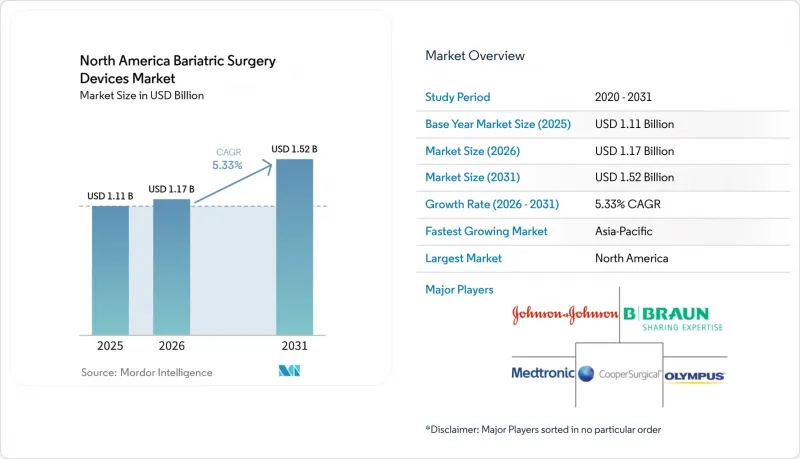
This report is Segmented by Procedure Type (Sleeve Gastrectomy, Roux-En-Y Gastric Bypass, and More), Device Type (Assisting Devices, Implantable Devices, Other Devices), End User (Hospitals & Specialty Clinics, and More), Patient Age Group (Adolescents, Adults, Geriatric), and Country (United States, Canada, Mexico). The Market Forecasts are Provided in Terms of Value (USD).
North America Bariatric Surgery Devices Market Trends and Insights
Surge in Adolescent Obesity Surgery Approvals
FDA clearance of Wegovy for 12-to-17-year-olds, coupled with 2023 pediatric guidelines, has raised adolescent surgical volumes by 15% between 2021 and 2023. Teen-targeted data showing sustained 20% BMI reduction over 10 years cements early intervention as a credible path. Sleeve gastrectomy represents 86% of these cases because its single-anastomosis technique yields lower leak risk and shorter operative times. Insurers increasingly treat severe adolescent obesity as a metabolic disease rather than a lifestyle issue, widening coverage. Early surgery extends lifetime comorbidity savings, counterbalancing adult volumes eroded by GLP-1 usage.
Wider Reimbursement for Robotic Bariatric Procedures
Medicare's 2025 payment of USD 19,458 for complex bariatric cases incentivizes robotic adoption that minimizes complications. Robots already assist 30% of regional bariatric operations, and eight-year registry data indicate lower revisional morbidity than laparoscopy. Commercial plans are dropping pre-authorizations at accredited centers, accelerating hospital capital-budget approvals despite inflation. Robotic staplers such as SureForm deliver 100% firing accuracy, reducing leak litigation exposure and validating premium device outlays.
Uptake of GLP-1 Drugs Delaying Surgery Decisions
GLP-1 prescriptions rose 132.6% from 2022-2023, coinciding with a 25.6% fall in surgeries among non-diabetic patients. Planned Medicare coverage for obesity drugs in 2026 may deepen deferrals. Nonetheless, concerns about lifelong drug cost and variable weight maintenance preserve a sizable surgical pipeline.
Other drivers and restraints analyzed in the detailed report include:
- Growing Medical Tourism Flows for Metabolic Surgery
- Entry of AI-Guided Stapling & Suturing Systems
- Shortage of Bariatric-Trained Surgical Workforce
For complete list of drivers and restraints, kindly check the Table Of Contents.
Segment Analysis
Sleeve gastrectomy captured 58.62% of 2025 revenue, representing the largest slice of the North America bariatric surgery devices market. Intragastric balloons, while accounting for a smaller base, are forecast at a 5.63% CAGR, the swiftest among procedure options. Sleeve popularity stems from single-row staple construction and preserved pyloric function, which lowers nutrient malabsorption concerns. Balloons align with payers favoring stepwise obesity care and with patients desiring reversible options, positioning the modality as an effective bridge to definitive intervention if needed.
Roux-en-Y gastric bypass remains second in volume for severe diabetes owing to superior metabolic outcomes, though complexity limits its growth. Adjustable bands have receded because of high revision rates. Hybrid methods such as SADI-S find traction in super-obese cohorts. Endoscopic sleeve gastroplasty blurs the medical-surgical divide, yet long-term durability evidence is still maturing.
List of Companies Covered in this Report:
- Medtronic
- Johnson & Johnson
- Boston Scientific
- Intuitive Surgical
- Olympus Corp.
- Teleflex
- Conmed
- Karl Storz
- Stryker
- ReShape Lifescience
- Allurion Technologies
- Spatz Medical Ltd.
- GI Dynamics Inc.
- Fractyl Health Inc.
- Asensus Surgical
- GT Metabolic Solutions Inc.
- Levita Magnetics Corp.
- MAS Bariatric Technologies
Additional Benefits:
- The market estimate (ME) sheet in Excel format
- 3 months of analyst support
TABLE OF CONTENTS
1 Introduction
- 1.1 Study Assumptions & Market Definition
- 1.2 Scope of the Study
2 Research Methodology
3 Executive Summary
4 Market Landscape
- 4.1 Market Overview
- 4.2 Market Drivers
- 4.2.1 Surge in Adolescent Obesity Surgery Approvals
- 4.2.2 Wider Reimbursement for Robotic Bariatric Procedures
- 4.2.3 Growing Medical-Tourism Flows for Metabolic Surgery
- 4.2.4 Entry of AI-guided Stapling & Suturing Systems
- 4.2.5 Corporate Wellness Programs Subsidising Surgery Costs
- 4.2.6 Long-Term Cardiovascular Outcome Data Boosting Clinical Acceptance
- 4.3 Market Restraints
- 4.3.1 Uptake of GLP-1 Drugs Delaying Surgery Decisions
- 4.3.2 Shortage of Bariatric-Trained Surgical Workforce
- 4.3.3 High Device Cost Amid Inflation-Driven Cap-ex Freezes
- 4.3.4 Litigation Risk Over Staple Line Leaks
- 4.4 Value / Supply-Chain Analysis
- 4.5 Regulatory Landscape
- 4.6 Technological Outlook
- 4.7 Porter's Five Forces Analysis
- 4.7.1 Threat of New Entrants
- 4.7.2 Bargaining Power of Suppliers
- 4.7.3 Bargaining Power of Buyers
- 4.7.4 Threat of Substitutes
- 4.7.5 Competitive Rivalry
5 Market Size & Growth Forecasts
- 5.1 By Procedure Type
- 5.1.1 Sleeve Gastrectomy
- 5.1.2 Roux-en-Y Gastric Bypass
- 5.1.3 Adjustable Gastric Banding
- 5.1.4 Biliopancreatic Diversion with Duodenal Switch
- 5.1.5 One Anastomosis Gastric Bypass
- 5.1.6 Endoscopic Sleeve Gastroplasty
- 5.1.7 Other Procedures
- 5.2 By Device Type
- 5.2.1 Assisting Devices
- 5.2.1.1 Suturing Device
- 5.2.1.2 Closure Device
- 5.2.1.3 Stapling Device
- 5.2.1.4 Trocars
- 5.2.1.5 Other Assisting Devices
- 5.2.2 Implantable Devices
- 5.2.2.1 Gastric Bands
- 5.2.2.2 Electrical Stimulation Devices
- 5.2.2.3 Gastric Balloons
- 5.2.2.4 Gastric Emptying
- 5.2.3 Other Devices
- 5.2.1 Assisting Devices
- 5.3 By End User
- 5.3.1 Hospitals & Specialty Clinics
- 5.3.2 Bariatric Surgery Centers
- 5.3.3 Ambulatory Surgical Centers
- 5.3.4 Others
- 5.4 By Patient Age Group
- 5.4.1 Adolescents (12-17)
- 5.4.2 Adults (18-64)
- 5.4.3 Geriatric (>=65)
- 5.5 Country
- 5.5.1 United States
- 5.5.2 Canada
- 5.5.3 Mexico
6 Competitive Landscape
- 6.1 Market Concentration
- 6.2 Market Share Analysis
- 6.3 Company Profiles (includes Global Level Overview, Market Level Overview, Core Segments, Financials as Available, Strategic Information, Market Rank/Share for Key Companies, Products & Services, and Recent Developments)
- 6.3.1 Medtronic
- 6.3.2 Johnson & Johnson (Ethicon)
- 6.3.3 Boston Scientific Corp.
- 6.3.4 Intuitive Surgical Inc.
- 6.3.5 Olympus Corp.
- 6.3.6 Teleflex Incorporated
- 6.3.7 Conmed Corp.
- 6.3.8 Karl Storz SE & Co. KG
- 6.3.9 Stryker Corp.
- 6.3.10 ReShape Lifesciences Inc.
- 6.3.11 Allurion Technologies Inc.
- 6.3.12 Spatz Medical Ltd.
- 6.3.13 GI Dynamics Inc.
- 6.3.14 Fractyl Health Inc.
- 6.3.15 Asensus Surgical Inc.
- 6.3.16 GT Metabolic Solutions Inc.
- 6.3.17 Levita Magnetics Corp.
- 6.3.18 MAS Bariatric Technologies
7 Market Opportunities & Future Outlook
- 7.1 White-space & Unmet-need Assessment

