PUBLISHER: Mordor Intelligence | PRODUCT CODE: 2120467

PUBLISHER: Mordor Intelligence | PRODUCT CODE: 2120467
Bariatric Surgery Devices - Market Share Analysis, Industry Trends & Statistics, Growth Forecasts (2026 - 2031)
According to Mordor Intelligence, the bariatric surgery devices market size is expected to grow from USD 2.83 billion in 2025 to USD 2.98 billion in 2026 and is forecast to reach USD 3.85 billion by 2031 at 5.28% CAGR over 2026-2031.
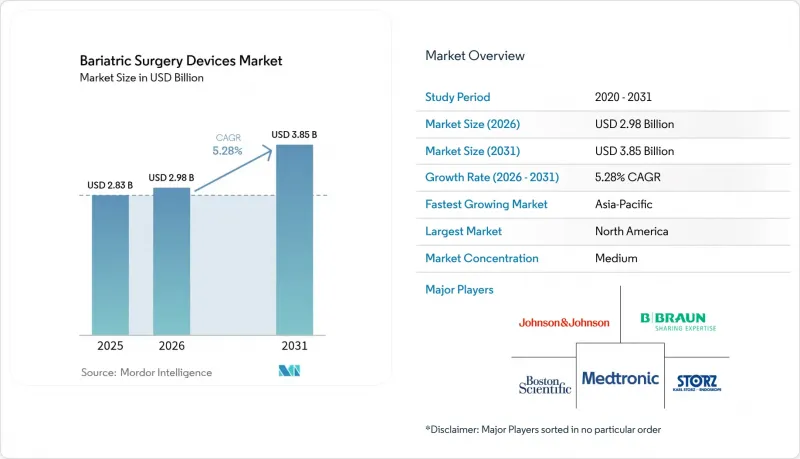
This report is Segmented by Device Type (Implantable Devices and More), Procedure Type (Sleeve Gastrectomy and More), Surgery Type (Minimally Invasive, Non-Invasive), End-User (Hospitals, Bariatric Surgery Clinics, Ambulatory Surgical Centers), and Geography (North America, Europe, Asia-Pacific, Middle East and Africa, South America). The Market Forecasts are Provided in Terms of Value (USD).
Global Bariatric Surgery Devices Market Trends and Insights
Rapid Rise in Morbid-Obesity Prevalence
More than 900 million adults currently live with obesity, a cohort that continues to grow in every major region and directly enlarges the addressable pool for metabolic procedures. Demand is especially strong among patients with body-mass indices >= 50 kg/m2, who often need more robust stapling and anastomosis solutions that command premium prices. Asia-Pacific countries are witnessing the steepest uptick in severe obesity, prompting health ministries to lower intervention thresholds to curtail downstream cardiovascular costs. Younger patients now represent a disproportionate share of surgical candidates, spurring suppliers to engineer devices with longer functional lifespans. Together, these demographic shifts reinforce the long-range expansion arc of the bariatric surgery devices market.
Expanding Insurance Coverage for Metabolic Surgery
Payer policy reforms are dismantling historical payment barriers. In 2026, Medicare will recognize obesity as a chronic disease that warrants comprehensive treatment, including surgery and anti-obesity medication. Major private insurers such as Blue Cross Blue Shield have already removed prior-authorization hurdles, cutting average approval time by fourteen days. Louisiana's Senate Bill 106 brought an additional 1 million residents under mandatory commercial coverage in 2024, immediately boosting regional procedure volumes. Sustained reimbursement tailwinds are forecast to add 1.2 percentage points to the sector's CAGR through 2030, cementing the bariatric surgery devices market as a cost-effective alternative to lifelong pharmacotherapy.
Growing Preference for Long-Acting GLP-1 Drugs
Weekly and bi-weekly formulations of semaglutide and tirzepatide have achieved rapid uptake, leading to a 25.6% dip in U.S. bariatric volume during peaks in prescription growth. Nonetheless, longitudinal data suggest that combined surgical-pharmacologic regimens boost excess-weight-loss rates and lower comorbidity relapse. Accordingly, market participants increasingly position devices as foundational interventions, with medication acting as adjunct therapy. This linkage tempers the headwind, moderating the negative CAGR impact to below one percentage point.
Other drivers and restraints analyzed in the detailed report include:
- Minimally Invasive & Robotic Platforms Adoption
- GLP-1 Drug Dropout Driving Surgical Conversions
- Limited Bariatric-Trained Surgeons in Emerging Markets
For complete list of drivers and restraints, kindly check the Table Of Contents.
Segment Analysis
Assisting devices retained a dominant 59.12% of the bariatric surgery devices market share in 2025, supported by staple-line reinforcement materials, powered staplers, and advanced energy systems. Product evolution centers on leak mitigation, with triple-row cartridge geometry and real-time impedance monitoring steadily reducing postoperative complication rates. Robotic stapling modules now integrate adaptive clamp force features that accommodate thicker gastric walls common in high-BMI patients, further boosting clinical confidence. Over the forecast horizon, assisting devices are projected to expand at a 5.62% CAGR, reflecting continuous incremental upgrades that encourage OR standardization and repeat purchases.
Implantable devices, though smaller in revenue terms, are adding high-value innovation layers such as magnet-enabled compression rings that create anastomoses without sutures or staples. Smart balloons capable of trans-oral placement are lowering thresholds for intervention among patients unwilling or unfit for surgery. This sub-segment's emerging role has strategic value: it introduces new customer groups to device-based weight-loss therapies and builds a future pipeline for more invasive treatments, thereby expanding the total accessible pie of the bariatric surgery devices market.
Sleeve gastrectomy held 42.93% of the bariatric surgery devices market size in 2025, anchored by clinical guidelines that endorse the sleeve for moderate-to-severe obesity. Manufacturers continue to refine curved tip staplers and pre-loaded buttress materials to shorten operative time by up to 18%. However, endoscopic sleeve gastroplasty (ESG) is closing the gap, posting a 6.18% CAGR on the strength of clinical evidence showing 13.6% total body-weight loss at 12 months with minimal adverse events. Hospitals increasingly position ESG as a day-case alternative that frees OR capacity for complex revisional work, indirectly stimulating sales of advanced suturing platforms and endoscopic accessories.
Cost-utility data place ESG at a five-year savings of USD 33,583 versus semaglutide, elevating its attractiveness for self-insured employers. Device makers are responding by bundling endoscopic suturing tools with AI-guided navigation to enhance stitch placement accuracy. Meanwhile, robotic-assisted Roux-en-Y remains relevant for super-obese patients and for those with severe reflux, sustaining demand for 30-mm reload staplers and single-site trocar kits. The procedural mosaic underscores the central thesis: a diversified technique portfolio enlarges the addressable field for the bariatric surgery devices market.
Complete Report Scope:
- By Device Type
- Implantable Devices
- Gastric Bands
- Gastric Balloons
- Gastric Electrical Stimulation Systems
- Duodeno-Jejunal Bypass Sleeves
- Assisting Devices
- Stapling Devices
- Suturing Devices
- Trocar & Access Systems
- Vessel-Sealing Devices
- Other Assistive Devices
- Implantable Devices
- By Procedure Type
- Sleeve Gastrectomy (SG)
- Roux-en-Y Gastric Bypass (RYGB)
- Adjustable Gastric Banding (AGB)
- Biliopancreatic Diversion with Duodenal Switch (BPD-DS)
- Endoscopic Sleeve Gastroplasty (ESG)
- Intragastric Balloon Placement
- Emerging Magnetic & VBLOC Procedures
- By Surgery Type
- Minimally Invasive
- Non-Invasive
- By End-User
- Hospitals
- Bariatric Surgery Clinics
- Ambulatory Surgical Centers
- By Geography
- North America
- United States
- Canada
- Mexico
- Europe
- Germany
- United Kingdom
- France
- Italy
- Spain
- Rest of Europe
- Asia-Pacific
- China
- Japan
- India
- Australia
- South Korea
- Rest of Asia-Pacific
- Middle East and Africa
- GCC
- South Africa
- Rest of Middle East and Africa
- South America
- Brazil
- Argentina
- Rest of South America
- North America
Geography Analysis
North America generated 41.72% of 2025 global revenue, propelled by broad insurance coverage and well-established surgeon networks. Although GLP-1 uptake trimmed case numbers during 2024, procedure volumes rebounded after dropout-driven conversions, producing a steady 4.96% CAGR outlook to 2031. Canada mirrors U.S. dynamics, but provincial funding caps introduce periodic wait-list fluctuations that shape quarterly device shipments.
Asia-Pacific is the fastest riser with a predicted 6.78% CAGR through 2031, reflecting the region's rapidly escalating obesity burden and expanding middle-class disposable income. China and India together accounted for more than 180,000 procedures in 2024, yet penetration remains below 2% of eligible candidates, revealing enormous untapped headroom. Medical-tourism hubs in Thailand and South Korea offer procedures at 30-50% lower cost than Western markets, but international patient flow is increasingly sensitive to accreditation status, pushing providers to adopt globally branded devices for trust assurance.
Europe sustains a moderate 5.29% expansion, underpinned by universal health systems that favor evidence-based device adoption. New medical-tourism safety standards released in 2025 compel overseas bariatric centers to document device traceability and surgeon credentials. South America and the Middle East & Africa together represent less than 10% of current revenue, yet advance at roughly 5.85% CAGR, energized by private-hospital investments and growing expatriate populations seeking quality care. Suppliers that align distribution with localized training initiatives stand to win incremental share as these nascent markets mature.
- Allurion Technologies
- Apollo Endosurgery
- Asensus Surgical
- Aspire Bariatrics
- B. Braun
- BariaTek Medical
- Boston Scientific
- Changzhou Ankang Medical Instruments Co., Ltd.
- Cousin Surgery
- GI Dynamics
- IntraPace
- Intuitive Surgical
- Johnson & Johnson
- Karl Storz
- Medtronic
- Olympus
- ReShape Lifescience
- Silimed Industria de Implantes
- Spatz Medical
- Teleflex
Additional Benefits:
- The market estimate (ME) sheet in Excel format
- 3 months of analyst support
TABLE OF CONTENTS
1 Introduction
- 1.1 Study Assumptions & Market Definition
- 1.2 Scope of the Study
2 Research Methodology
3 Executive Summary
4 Market Landscape
- 4.1 Market Overview
- 4.2 Market Drivers
- 4.2.1 Rapid Rise in Morbid-Obesity Prevalence
- 4.2.2 Expanding Insurance Coverage for Metabolic Surgery
- 4.2.3 Minimally Invasive & Robotic Platforms Adoption
- 4.2.4 Surge in Sleeve-Gastrectomy Procedures
- 4.2.5 GLP-1 Drug Dropout Driving Surgical Conversions
- 4.2.6 Magnet-Enabled Anastomosis & Smart Balloons Pipeline
- 4.3 Market Restraints
- 4.3.1 Growing Preference for Long-Acting GLP-1 Drugs
- 4.3.2 Limited Bariatric?Trained Surgeons in Emerging Markets
- 4.3.3 High Device & Procedure Cost
- 4.3.4 Stringent FDA Recalls on Staplers & Bands
- 4.4 Value Chain Analysis
- 4.5 Regulatory Landscape
- 4.6 Technological Outlook
- 4.7 Porter's Five Forces Analysis
- 4.7.1 Bargaining Power of Buyers
- 4.7.2 Bargaining Power of Suppliers
- 4.7.3 Threat of New Entrants
- 4.7.4 Threat of Substitutes
- 4.7.5 Intensity of Competitive Rivalry
5 Market Size & Growth Forecasts (Value)
- 5.1 By Device Type
- 5.1.1 Implantable Devices
- 5.1.1.1 Gastric Bands
- 5.1.1.2 Gastric Balloons
- 5.1.1.3 Gastric Electrical Stimulation Systems
- 5.1.1.4 Duodeno-Jejunal Bypass Sleeves
- 5.1.2 Assisting Devices
- 5.1.2.1 Stapling Devices
- 5.1.2.2 Suturing Devices
- 5.1.2.3 Trocar & Access Systems
- 5.1.2.4 Vessel-Sealing Devices
- 5.1.2.5 Other Assistive Devices
- 5.1.1 Implantable Devices
- 5.2 By Procedure Type
- 5.2.1 Sleeve Gastrectomy (SG)
- 5.2.2 Roux-en-Y Gastric Bypass (RYGB)
- 5.2.3 Adjustable Gastric Banding (AGB)
- 5.2.4 Biliopancreatic Diversion with Duodenal Switch (BPD-DS)
- 5.2.5 Endoscopic Sleeve Gastroplasty (ESG)
- 5.2.6 Intragastric Balloon Placement
- 5.2.7 Emerging Magnetic & VBLOC Procedures
- 5.3 By Surgery Type
- 5.3.1 Minimally Invasive
- 5.3.2 Non-Invasive
- 5.4 By End-User
- 5.4.1 Hospitals
- 5.4.2 Bariatric Surgery Clinics
- 5.4.3 Ambulatory Surgical Centers
- 5.5 By Geography
- 5.5.1 North America
- 5.5.1.1 United States
- 5.5.1.2 Canada
- 5.5.1.3 Mexico
- 5.5.2 Europe
- 5.5.2.1 Germany
- 5.5.2.2 United Kingdom
- 5.5.2.3 France
- 5.5.2.4 Italy
- 5.5.2.5 Spain
- 5.5.2.6 Rest of Europe
- 5.5.3 Asia-Pacific
- 5.5.3.1 China
- 5.5.3.2 Japan
- 5.5.3.3 India
- 5.5.3.4 Australia
- 5.5.3.5 South Korea
- 5.5.3.6 Rest of Asia-Pacific
- 5.5.4 Middle East and Africa
- 5.5.4.1 GCC
- 5.5.4.2 South Africa
- 5.5.4.3 Rest of Middle East and Africa
- 5.5.5 South America
- 5.5.5.1 Brazil
- 5.5.5.2 Argentina
- 5.5.5.3 Rest of South America
- 5.5.1 North America
6 Competitive Landscape
- 6.1 Market Concentration
- 6.2 Strategic Moves
- 6.3 Market Share Analysis
- 6.4 Company Profiles (includes Global level Overview, Market level overview, Core Segments, Financials as available, Strategic Information, Market Rank/Share for key companies, Products & Services, and Recent Developments)
- 6.4.1 Allurion Technologies, Inc.
- 6.4.2 Apollo Endosurgery
- 6.4.3 Asensus Surgical
- 6.4.4 Aspire Bariatrics
- 6.4.5 B. Braun Melsungen AG
- 6.4.6 BariaTek Medical
- 6.4.7 Boston Scientific
- 6.4.8 Changzhou Ankang Medical Instruments Co., Ltd.
- 6.4.9 Cousin Surgery
- 6.4.10 GI Dynamics
- 6.4.11 IntraPace
- 6.4.12 Intuitive Surgical
- 6.4.13 Johnson & Johnson
- 6.4.14 Karl Storz SE & Co. KG
- 6.4.15 Medtronic PLC
- 6.4.16 Olympus Corporation
- 6.4.17 ReShape Lifesciences Inc
- 6.4.18 Silimed Industria de Implantes
- 6.4.19 Spatz Medical
- 6.4.20 Teleflex Incorporated
7 Market Opportunities & Future Outlook

