PUBLISHER: Mordor Intelligence | PRODUCT CODE: 2113658

PUBLISHER: Mordor Intelligence | PRODUCT CODE: 2113658
China Bariatric Surgery - Market Share Analysis, Industry Trends & Statistics, Growth Forecasts (2026 - 2031)
According to Mordor Intelligence, the China bariatric surgery market size was valued at USD 181.78 million in 2025 and estimated to grow from USD 207.18 million in 2026 to reach USD 397.86 million by 2031, at a CAGR of 13.98% during the forecast period (2026-2031).
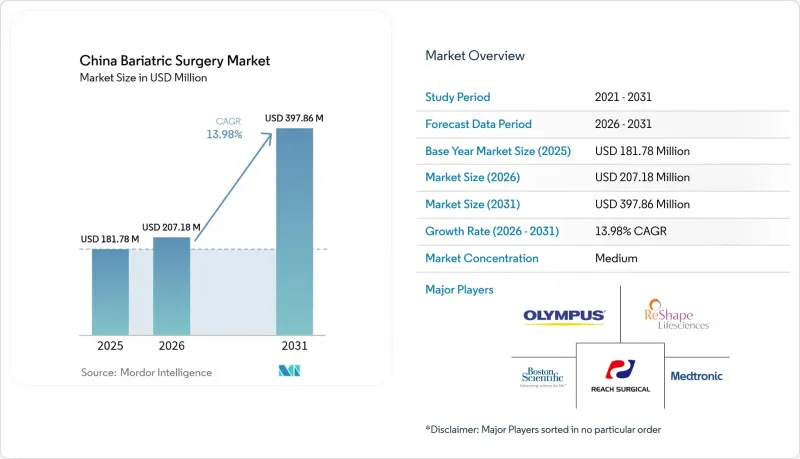
This report is Segmented by Device Type (Assisting Devices, Implantable Devices, Other Devices), Procedure Type (Sleeve Gastrectomy, Gastric Bypass, Adjustable Gastric Banding, Noninvasive Bariatric Surgery, and Others), and End User (Hospitals, Bariatric Surgery Clinics, and Others). The Market Forecasts are Provided in Terms of Value (USD).
China Bariatric Surgery Market Trends and Insights
Rising Obesity and Metabolic Disease Prevalence
Adult overweight and obesity combined are projected to reach 65.3% by 2030, exposing more than 300 million residents to cardiometabolic risk. The National Health Commission warns that obesity-related disorders could consume over RMB 400 billion in direct medical expenditure each year. Urban dietary shifts toward calorie-dense convenience food, reduced physical activity, and heightened stress collectively accelerate BMI escalation, especially in Beijing, Shanghai, Guangzhou, and Shenzhen. Healthcare payers respond by endorsing surgical therapy for severe disease because longitudinal data confirm superior glycemic control and durable weight loss compared with medication alone. The rising case load drives hospital administrators to expand operating theater capacity, recruit dietitians, and embed behavioral counseling inside peri-operative pathways for optimal long-term outcomes.
Government Guidelines Lowering BMI Thresholds for Surgery Eligibility
The October 2024 National Health Commission obesity guideline introduced BMI >= 32.5-or >= 27.5 with comorbid diabetes or hypertension-as formal criteria for metabolic surgery. The rule immediately doubles the surgical candidate pool relative to former consensus statements, forcing tertiary hospitals to scale bariatric wards and fellowship programs at a pace. Multidisciplinary evaluation-nutritionist, endocrinologist, surgeon, psychologist-became mandatory for listing approval, driving demand for case managers versed in long-term follow-up. Tier-1 hospitals adopted the standard within six months, and provincial centers are mandated to conform by 2026. Standardized thresholds also strengthen payer confidence, simplifying claims adjudication and reducing out-of-pocket variability for patients.
High Procedure and Device Costs
Total inpatient charges range from RMB 40,000 to RMB 80,000 (USD 5,600-11,200), reflecting imported energy devices, staplers, and prolonged admission time. National insurance reimburses diabetes remission-linked procedures but often excludes pure weight-loss indications, leaving patients to finance residual balances. Device localization trims list prices, yet margins remain thin under volume-based purchasing policies. District-level hospitals struggle to absorb significant capital expenditure for robotics, delaying geographic diffusion and perpetuating treatment disparities between coastal and inland regions.
Other drivers and restraints analyzed in the detailed report include:
- Rapid Adoption of Minimally Invasive and Robotic Platforms
- Inpatient Reimbursement Rules That Financially Favor Longer Peri-Operative Stays
- Shortage of Fellowship-Trained Bariatric Surgeons Outside Tier-1 Cities
For complete list of drivers and restraints, kindly check the Table Of Contents.
Segment Analysis
Stapling systems accounted for 32.10% of the China bariatric surgery market in 2025, reflecting their indispensability for longitudinal sleeve creation and gastrojejunostomy construction. The category's continued dominance rests on iterative reload innovation and new reinforcement accessories that optimize hemostasis. Domestic brands vie on price under centralized procurement, gradually displacing imports in county-level centers. Meanwhile, gastric balloons logged a 15.42% CAGR forecast to 2031. Enhanced silicone materials and outpatient endoscopic placement protocols shorten procedure times, permitting rapid adoption within specialized clinics. As volume rises, ancillary demand for closure devices, trocars, and hemostats grows in parallel, though at lower incremental rates because these consumables already form part of standardized laparoscopic kits. Gastric bands fall out of favor amid long-term erosion risk, and electrical stimulation devices remain niche for investigational cohorts.
Gastric emptying systems and transintestinal stents occupy an emerging frontier, appealing to patients seeking less invasive yet effective interventions. Their commercial trajectory hinges on longitudinal efficacy evidence and NMPA reimbursement categorization. Collectively, these device-level shifts underscore patient appetite for reversible or step-up therapies and providers' search for differentiated offerings that widen clinical portfolio without inflating capital cost.
Complete Report Scope:
- By Device Type
- Assisting Devices
- Suturing Devices
- Closure Devices
- Stapling Devices
- Trocars
- Other Assisting Devices
- Implantable Devices
- Gastric Bands
- Electrical Stimulation Devices
- Gastric Balloons
- Gastric Emptying Systems
- Other Devices
- Assisting Devices
- By Procedure Type
- Sleeve Gastrectomy
- Gastric Bypass
- Adjustable Gastric Banding
- Noninvasive Bariatric Surgery
- Others
- By End User
- Hospitals
- Bariatric Surgery Clinics
- Others
List of Companies Covered in this Report:
- Medtronic
- Johnson & Johnson
- B. Braun
- Boston Scientific
- Olympus Corp.
- Asensus Surgical
- ConMed Corp.
- Apollo Endosurgery
- Aspire Bariatrics
- ReShape Lifescience
- Changzhou Haiers Medical Devices
- Precision (Changzhou) Medical
- Reach Surgical
- Beijing Rixin Technology Co.
- MicroTech Medical (Nanjing)
- Suzhou Tiansong Medical Instrument
- Bohui Ruijin Medical
- Cousin Biotech
- Spatz FGIA Inc.
- Allurion Technologies
- Standard Bariatrics (Teleflex)
- Intuitive Surgical
- Grena
- Shanghai Bojin Medical
Additional Benefits:
- The market estimate (ME) sheet in Excel format
- 3 months of analyst support
TABLE OF CONTENTS
1 Introduction
- 1.1 Study Assumptions & Market Definition
- 1.2 Scope of the Study
2 Research Methodology
3 Executive Summary
4 Market Landscape
- 4.1 Market Overview
- 4.2 Market Drivers
- 4.2.1 Rising Obesity & Metabolic Disease Prevalence
- 4.2.2 Government Guidelines Lowering BMI Thresholds for Surgery Eligibility
- 4.2.3 Rapid Adoption of Minimally-invasive & Robotic Platforms
- 4.2.4 Inpatient Reimbursement Rules that Financially Favor Longer Peri-op Stays
- 4.2.5 NMPA Approval of Domestic Biological Staple-line Reinforcement Pads Boosting Surgeon Confidence
- 4.2.6 Expansion of National COMES Registry Driving Payer Trust & Quality Metrics
- 4.3 Market Restraints
- 4.3.1 High Procedure & Device Costs
- 4.3.2 Shortage of Fellowship-trained Bariatric Surgeons Outside Tier-1 Cities
- 4.3.3 Fast Uptake of GLP-1 Weight-loss Drugs Cannibalising Mild-obesity Surgical Demand
- 4.3.4 Rising Litigation over Micro-nutrient Deficiencies Increasing Insurer Scrutiny
- 4.4 Supply-Chain Analysis
- 4.5 Regulatory Landscape
- 4.6 Technological Outlook
- 4.7 Porter's Five Forces
- 4.7.1 Threat of New Entrants
- 4.7.2 Bargaining Power of Buyers/Consumers
- 4.7.3 Bargaining Power of Suppliers
- 4.7.4 Threat of Substitute Products
- 4.7.5 Intensity of Competitive Rivalry
5 Market Size & Growth Forecasts
- 5.1 By Device Type
- 5.1.1 Assisting Devices
- 5.1.1.1 Suturing Devices
- 5.1.1.2 Closure Devices
- 5.1.1.3 Stapling Devices
- 5.1.1.4 Trocars
- 5.1.1.5 Other Assisting Devices
- 5.1.2 Implantable Devices
- 5.1.2.1 Gastric Bands
- 5.1.2.2 Electrical Stimulation Devices
- 5.1.2.3 Gastric Balloons
- 5.1.2.4 Gastric Emptying Systems
- 5.1.3 Other Devices
- 5.1.1 Assisting Devices
- 5.2 By Procedure Type
- 5.2.1 Sleeve Gastrectomy
- 5.2.2 Gastric Bypass
- 5.2.3 Adjustable Gastric Banding
- 5.2.4 Noninvasive Bariatric Surgery
- 5.2.5 Others
- 5.3 By End User
- 5.3.1 Hospitals
- 5.3.2 Bariatric Surgery Clinics
- 5.3.3 Others
6 Competitive Landscape
- 6.1 Market Concentration
- 6.2 Market Share Analysis
- 6.3 Company Profiles (includes Global level Overview, Market level overview, Core Segments, Financials as available, Strategic Information, Market Rank/Share for key companies, Products, and Recent Developments)
- 6.3.1 Medtronic plc
- 6.3.2 Johnson & Johnson (Ethicon)
- 6.3.3 B. Braun Melsungen AG
- 6.3.4 Boston Scientific Corp.
- 6.3.5 Olympus Corp.
- 6.3.6 Asensus Surgical
- 6.3.7 ConMed Corp.
- 6.3.8 Apollo Endosurgery
- 6.3.9 Aspire Bariatrics Inc.
- 6.3.10 ReShape Lifesciences Inc.
- 6.3.11 Changzhou Haiers Medical Devices
- 6.3.12 Precision (Changzhou) Medical
- 6.3.13 Reach Surgical
- 6.3.14 Beijing Rixin Technology Co.
- 6.3.15 MicroTech Medical (Nanjing)
- 6.3.16 Suzhou Tiansong Medical Instrument
- 6.3.17 Bohui Ruijin Medical
- 6.3.18 Cousin Biotech
- 6.3.19 Spatz FGIA Inc.
- 6.3.20 Allurion Technologies
- 6.3.21 Standard Bariatrics (Teleflex)
- 6.3.22 Intuitive Surgical
- 6.3.23 Grena Ltd.
- 6.3.24 Shanghai Bojin Medical
7 Market Opportunities & Future Outlook
- 7.1 White-space & Unmet-Need Assessment

