PUBLISHER: Mordor Intelligence | PRODUCT CODE: 2063880

PUBLISHER: Mordor Intelligence | PRODUCT CODE: 2063880
Europe Animal Feed Organic Trace Minerals - Market Share Analysis, Industry Trends & Statistics, Growth Forecasts (2026 - 2031)
According to Mordor Intelligence, the europe animal feed organic trace minerals market is projected to grow from USD 420 million in 2025 to USD 450 million in 2026 and USD 700 million by 2031, with a CAGR of 9.24% from 2026 to 2031.
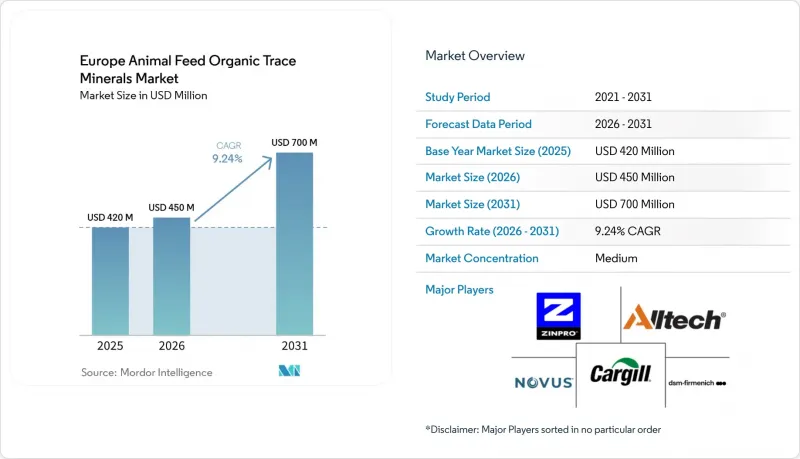
This report is Segmented by Mineral Type (Zinc, Copper, Iron, Selenium, Manganese, and Other Minerals), by Livestock (Poultry, Ruminants, Swine, and More), by Form (Amino-Acid Chelates, Proteinates/Polysaccharide Complexes, Propionates, and More), and by Geography (North America, South America, and More). The Market Forecasts are Provided in Terms of Value (USD).
Europe Animal Feed Organic Trace Minerals Market Trends and Insights
Shift Away from Antibiotic Growth Promoters
The European Union's stricter antimicrobial regulations are accelerating the adoption of organic trace minerals in animal feed. According to European Commission Implementing Regulation (EU) 2024/2598, issued in October 2024, stipulates that, effective 3 September 2026, only countries adhering to the European Union's ban on antimicrobial growth promoters will be permitted to export animal products to the region . Additionally, the regulation mandates official compliance certification for consignments entering the European Union market. These enhanced controls are prompting feed manufacturers and livestock integrators to transition to chelated organic trace minerals, which offer sustainable benefits by supporting gut health, immunity, and productivity without relying on antibiotic growth promoters.
Strict Bioavailability Requirements Under European Regulations
Strict standards set by the European Food Safety Authority (EFSA) regarding the safety, efficacy, and bioavailability of feed additives are driving the adoption of scientifically validated organic trace minerals across Europe. In May 2024, the European Commission reaffirmed the ongoing EFSA reassessment requirements for selenium-based feed additives and trace element compounds used in animal nutrition. These regulatory reviews are prompting feed manufacturers to focus on organic trace minerals with demonstrated absorption efficiency and safety. Consequently, the demand for high-quality chelated trace mineral additives is rising within the European feed industry, particularly for products backed by robust scientific evidence and long-term regulatory approvals.
Volatile Prices of Organic Mineral Chelates
Fluctuating freight and logistics costs are causing pricing instability for amino acids used in organic mineral chelates, hindering wider adoption among European feed manufacturers. Essential feed-grade amino acids, including lysine, threonine, tryptophan, and methionine, are critical in producing chelated trace minerals, making transportation and supply chain variations a significant factor in manufacturing costs. This pricing uncertainty is increasing procurement challenges for feed producers, particularly smaller mills with tighter profit margins. Consequently, many manufacturers remain cautious about increasing purchases of premium organic mineral formulations, limiting short-term market penetration in Europe.
Other drivers and restraints analyzed in the detailed report include:
- Rising Demand for Organic Meat and Dairy Products
- Consolidation of Premix Production Among Feed Mills
- Lengthy Approval Process for New Mineral Ligands
For complete list of drivers and restraints, kindly check the Table Of Contents.
Segment Analysis
The Europe animal feed organic trace minerals market share for the zinc segment accounted for the largest 38% in 2025. Zinc-based organic trace minerals are widely adopted in poultry, swine, and ruminant nutrition due to their role in enhancing immunity, supporting skeletal development, and improving feed efficiency. Feed manufacturers increasingly favor zinc amino acid chelates for their higher bioavailability and compatibility with antibiotic-free feeding systems. Copper chelates also exhibit stable demand as livestock producers aim to maintain animal performance while adhering to stricter mineral inclusion regulations.
The European organic trace minerals market for animal feed is projected to grow at the fastest 9.8% CAGR from 2026 to 2031, driven by the selenium segment. This growth is driven by the rising adoption of organic selenium compounds in aquaculture and in premium livestock nutrition programs that focus on improving reproductive performance and reducing oxidative stress. Feed formulators are increasingly incorporating selenium yeast and selenomethionine additives into precision nutrition strategies due to their enhanced retention and metabolic efficiency. Dual-mineral chelates combining zinc and selenium are also attracting industry attention for their ability to simplify premix formulations.
List of Companies Covered in this Report:
- Zinpro Corporation
- DSM-Firmenich AG
- Cargill, Incorporated
- Novus International, Inc. (Mitsui & Co., Ltd. and Nippon Soda Co., Ltd.)
- Alltech, Inc.
- Nutreco N.V.
- ADM
- Kemin Industries, Inc.
- Phibro Animal Health Corporation
- QualiTech, Inc.
- BASF SE
- Bluestar Adisseo Company
- Vilofoss A/S
- Kaesler Nutrition GmbH
- Animine S.A.
Additional Benefits:
- The market estimate (ME) sheet in Excel format
- 3 months of analyst support
TABLE OF CONTENTS
1 Introduction
- 1.1 Study Assumptions and Market Definition
- 1.2 Scope of the Study
2 Research Methodology
3 Executive Summary
4 Market Landscape
- 4.1 Market Overview
- 4.2 Market Drivers
- 4.2.1 Shift away from antibiotic growth promoters
- 4.2.2 Strict bioavailability requirements under European regulations
- 4.2.3 Rising demand for organic meat and dairy products
- 4.2.4 Consolidation of premix production among feed mills
- 4.2.5 Precision nutrition adoption with chelated trace minerals
- 4.2.6 Carbon labeling driving low-excretion mineral use
- 4.3 Market Restraints
- 4.3.1 Volatile prices of organic mineral chelates
- 4.3.2 Low awareness among small-scale farmers
- 4.3.3 Lengthy approval process for new mineral ligands
- 4.3.4 Competition from phytogenic and probiotic products
- 4.4 Regulatory Landscape
- 4.5 Technological Outlook
- 4.6 Porter's Five Forces
- 4.6.1 Bargaining Power of Suppliers
- 4.6.2 Bargaining Power of Buyers
- 4.6.3 Threat of New Entrants
- 4.6.4 Threat of Substitutes
- 4.6.5 Intensity of Competitive Rivalry
5 Market Size and Growth Forecasts (Value)
- 5.1 By Mineral Type
- 5.1.1 Zinc
- 5.1.2 Copper
- 5.1.3 Iron
- 5.1.4 Selenium
- 5.1.5 Manganese
- 5.1.6 Others
- 5.2 By Livestock
- 5.2.1 Poultry
- 5.2.2 Rminants
- 5.2.3 Swine
- 5.2.4 Aquaculture
- 5.2.5 Others
- 5.3 By Form
- 5.3.1 Amino-acid Chelates
- 5.3.2 Proteinates/Polysaccharide Complexes
- 5.3.3 Propionates
- 5.3.4 Other Chelated Forms
- 5.4 By Geography
- 5.4.1 Germany
- 5.4.2 France
- 5.4.3 Italy
- 5.4.4 Spain
- 5.4.5 United Kingdom
- 5.4.6 Poland
- 5.4.7 Rest of Europe
6 Competitive Landscape
- 6.1 Market Concentration
- 6.2 Strategic Moves
- 6.3 Market Share Analysis
- 6.4 Company Profiles (Includes Global Level Overview, Market Level Overview, Core Segments, Financials as Available, Strategic Information, Market Rank/Share for Key Companies, Products and Services, and Recent Developments)
- 6.4.1 Zinpro Corporation
- 6.4.2 DSM-Firmenich AG
- 6.4.3 Cargill, Incorporated
- 6.4.4 Novus International, Inc. (Mitsui & Co., Ltd. and Nippon Soda Co., Ltd.)
- 6.4.5 Alltech, Inc.
- 6.4.6 Nutreco N.V.
- 6.4.7 ADM
- 6.4.8 Kemin Industries, Inc.
- 6.4.9 Phibro Animal Health Corporation
- 6.4.10 QualiTech, Inc.
- 6.4.11 BASF SE
- 6.4.12 Bluestar Adisseo Company
- 6.4.13 Vilofoss A/S
- 6.4.14 Kaesler Nutrition GmbH
- 6.4.15 Animine S.A.
7 Market Opportunities and Future Outlook

