PUBLISHER: Mordor Intelligence | PRODUCT CODE: 2063938

PUBLISHER: Mordor Intelligence | PRODUCT CODE: 2063938
AI Protein Engineering - Market Share Analysis, Industry Trends & Statistics, Growth Forecasts (2026 - 2031)
According to Mordor Intelligence, the aI protein engineering market size is projected to expand from USD 1.5 billion in 2025 and USD 1.81 billion in 2026 to USD 4.75 billion by 2031, registering a CAGR of 21.20% between 2026 to 2031.
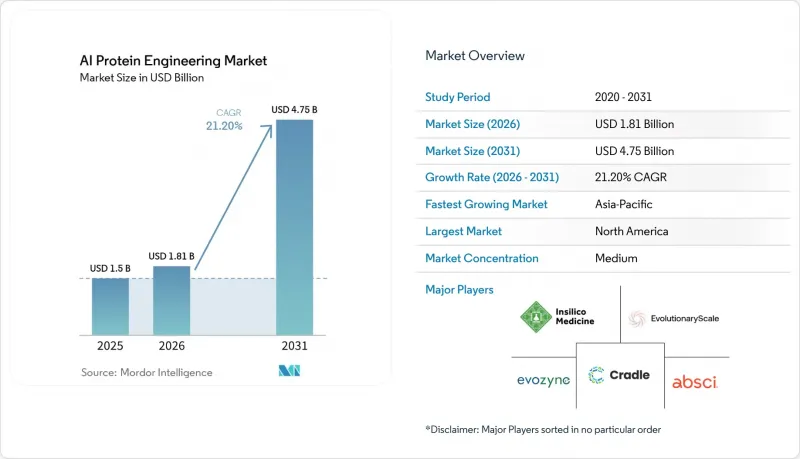
This report is Segmented by Component (Software and Mores), Protein Type (Monoclonal Antibodies, Eand More), Technology Approach (Rational Design, and More), Application (Drug Discovery, Agricultural Proteins, and More), End User (Pharmaceutical, and More), Deployment Mode (Cloud, On-Premises, Hybrid), and Geography (North America, Europe, and More). Market Forecasts in Value (USD).
Global AI Protein Engineering Market Trends and Insights
Biopharma Demand for Faster Biologics Discovery
The AI in protein engineering market is growing as drug developers prioritize faster biologics discovery, reduced iteration burdens, and access to challenging targets. Absci demonstrated its platform's ability to advance ABS-201 from a preclinical concept to three dosed Phase 1 cohorts in two years, showcasing AI's role in shortening development cycles. The platform also showed that fewer than 100 designs per target could generate candidates for zero-prior epitopes, reducing reliance on large-scale screening. Partnerships with major pharmaceutical companies and significant funding indicate that this demand is integral to R&D strategies. Platforms integrating model output, experimental follow-up, and delivery are gaining traction over those offering standalone software.
Protein Foundation Models Improving De Novo Hit Generation
Advancements in foundation models that integrate sequence, structure, and function are driving the AI in protein engineering market. EvolutionaryScale's ESM3, trained on 2.8 billion protein sequences with 1.1 x 10^24 FLOPS, created novel fluorescent proteins equivalent to 500 million years of natural evolution, marking a leap in de novo design. This progress narrows the gap between AI-designed and traditionally discovered proteins, increasing AI's credibility for therapeutic and industrial applications. As model quality improves across the industry, proprietary experimental feedback is becoming a key differentiator. Companies with robust internal validation processes are better positioned to maintain competitive advantages.
Experimental Validation Bottlenecks and Wet-lab Cost Intensity
The AI in protein engineering market faces bottlenecks as in silico sequence generation outpaces laboratory validation. Each design-build-test-learn cycle of 96 variants still requires 59 hours of wet-lab processing, making the process capital-intensive even with robotics. This limits smaller biotech firms and academic teams that lack funding for automated infrastructure or repeated experimental rounds. Consequently, activity is concentrated in well-funded hubs with advanced resources like cloud computing and automation. Until cost-effective validation models are accessible, regional growth in this market will remain uneven.
Other drivers and restraints analyzed in the detailed report include:
- Wet-lab Automation Closing the Design-build-test Loop
- Multispecific Antibody Complexity Favoring AI-native Design Stacks
- Biosecurity and Regulatory Scrutiny for Novel Proteins
For complete list of drivers and restraints, kindly check the Table Of Contents.
Segment Analysis
In 2025, Software & Solutions held a 38.20% share of the AI in protein engineering market, reflecting early adoption trends. Biopharma users preferred software access to integrate protein language models rather than outsourcing entire programs. Schrodinger reported USD 199.5 million in software revenue, with top 20 pharma contract value rising 15.3% to USD 80.8 million. This phase allowed companies to test AI within existing workflows, aligning with internal procurement structures. Services are projected to grow at a 21.05% CAGR through 2031, as buyers increasingly seek end-to-end support for AI-designed programs nearing clinical use.
Monoclonal antibodies accounted for 39.78% of revenue in 2025, leading due to their established development and regulatory pathways. AI is reshaping this mature protein class, reducing experimental burdens in workflows. Vaccines & Antigens are expected to grow at a 21.76% CAGR through 2031, driven by regulatory approvals like SKYCovione. This growth expands the market from therapeutic antibodies to include prophylactic and antigen design programs, making vaccine-related work a credible extension of protein design.
Geography Analysis
In 2025, North America held a 44.32% share of the AI in protein engineering market, maintaining its position as the largest regional cluster by revenue, company concentration, and commercial readiness. This leadership is driven by strong biopharma ecosystems, significant venture capital investments, and a high density of foundational model start-ups collaborating with drug developers and translational labs. The region benefits from efficient integration between platform companies, wet-lab infrastructure, and capital providers, which accelerates the transition from discovery to funded development programs. Large-scale funding rounds further highlight the region's ability to attract global capital.
Europe holds a smaller share of the AI in protein engineering market but remains technically significant due to public research funding, academic expertise in protein engineering, and active translational projects feeding commercial pipelines. Funding initiatives, such as support for general-purpose protein engineering and autonomous bioprocess development, strengthen the scientific base that supports start-ups and collaborative industry programs. Research groups are advancing tools and systems for translational use, extending Europe's role from basic science to commercialization pathways. While smaller in scale, Europe contributes to method development, talent creation, and spin-out opportunities.
Asia-Pacific is forecast to grow at a 24.25% CAGR through 2031, making it the fastest-growing region in the AI in protein engineering market. Growth is driven by policy support, expanding biosynthetics capabilities, and the development of local datasets and platform companies in key countries like China, Japan, South Korea, and Australia. Regional initiatives, such as directives to integrate AI and biomanufacturing and advancements in protein sequence databases, are accelerating progress. While still in early stages, the Middle East, Africa, and South America are building familiarity with AI-designed biologics through participation in global clinical trial networks.
- Absci
- AI Proteins
- Arzeda
- Biomatter
- Cradle
- DenovAI Biotech
- Diffuse Bio
- EvolutionaryScale
- Evozyne
- Generate:Biomedicines
- Ginkgo Bioworks
- Insilico Medicine
- Isomorphic Labs
- Latent Labs
- Nabla Bio
- Profluent
- ProteinQure
- Recursion Pharmaceuticals
- Schrodinger
- XtalPi
Additional Benefits:
- The market estimate (ME) sheet in Excel format
- 3 months of analyst support
TABLE OF CONTENTS
1 Introduction
- 1.1 Study Assumptions & Market Definition
- 1.2 Scope of the Study
2 Research Methodology
3 Executive Summary
4 Market Landscape
- 4.1 Market Overview
- 4.2 Market Drivers
- 4.2.1 Biopharma Demand for Faster Biologics Discovery
- 4.2.2 Protein Foundation Models Improving De Novo Hit Generation
- 4.2.3 Wet-Lab Automation Closing the Design-Build-Test Loop
- 4.2.4 Expansion of Enzyme Engineering in Industrial Biotech and Food Systems
- 4.2.5 Multispecific Antibody Complexity Favoring AI-Native Design Stacks
- 4.2.6 Proprietary Assay-Data Network Effects Strengthening Platform Economics
- 4.3 Market Restraints
- 4.3.1 Experimental Validation Bottlenecks and Wet-Lab Cost Intensity
- 4.3.2 Biosecurity and Regulatory Scrutiny for Novel Proteins
- 4.3.3 Training-Data Provenance and IP Ambiguity
- 4.3.4 GPU Access and Sovereign-Compute Constraints
- 4.4 Value Chain Analysis
- 4.5 Regulatory Landscape
- 4.6 Technological Outlook
- 4.7 Porter's Five Forces Analysis
- 4.7.1 Threat of New Entrants
- 4.7.2 Bargaining Power of Suppliers
- 4.7.3 Bargaining Power of Buyers
- 4.7.4 Threat of Substitutes
- 4.7.5 Industry Rivalry
5 Market Size & Growth Forecasts (Value, USD)
- 5.1 By Component
- 5.1.1 Software & Solutions
- 5.1.2 Services
- 5.2 By Protein Type
- 5.2.1 Monoclonal Antibodies
- 5.2.2 Enzymes
- 5.2.3 Peptides & Miniproteins
- 5.2.4 Vaccines & Antigens
- 5.2.5 Cytokines & Growth Factors
- 5.3 By Technology Approach
- 5.3.1 Rational Design
- 5.3.2 Directed Evolution
- 5.3.3 De Novo Design
- 5.3.4 Hybrid / Semi-rational Design
- 5.3.5 Physics-informed Simulation
- 5.4 By Application
- 5.4.1 Drug Discovery & Biologics
- 5.4.2 Enzyme Engineering & Industrial Biotechnology
- 5.4.3 Agricultural & Food Proteins
- 5.4.4 Vaccines & Immunotherapy Design
- 5.4.5 Synthetic Biology & Research Tools
- 5.4.6 Diagnostics & Biosensors
- 5.5 By End User
- 5.5.1 Pharmaceutical Companies
- 5.5.2 Biotechnology Companies
- 5.5.3 Contract Research Organizations
- 5.5.4 Academic & Research Institutes
- 5.5.5 Agri-food & Industrial Biotechnology Companies
- 5.6 By Deployment Mode
- 5.6.1 Cloud
- 5.6.2 On-premises
- 5.6.3 Hybrid
- 5.7 By Geography
- 5.7.1 North America
- 5.7.1.1 United States
- 5.7.1.2 Canada
- 5.7.1.3 Mexico
- 5.7.2 Europe
- 5.7.2.1 Germany
- 5.7.2.2 United Kingdom
- 5.7.2.3 France
- 5.7.2.4 Italy
- 5.7.2.5 Spain
- 5.7.2.6 Rest of Europe
- 5.7.3 Asia-Pacific
- 5.7.3.1 China
- 5.7.3.2 India
- 5.7.3.3 Japan
- 5.7.3.4 South Korea
- 5.7.3.5 Australia
- 5.7.3.6 Rest of Asia-Pacific
- 5.7.4 Middle East and Africa
- 5.7.4.1 GCC
- 5.7.4.2 South Africa
- 5.7.4.3 Rest of Middle East and Africa
- 5.7.5 South America
- 5.7.5.1 Brazil
- 5.7.5.2 Argentina
- 5.7.5.3 Rest of South America
- 5.7.1 North America
6 Competitive Landscape
- 6.1 Market Concentration
- 6.2 Market Share Analysis
- 6.3 Company Profiles (includes Global level Overview, Market-level Overview, Core Segments, Financials, Strategic Information, Market Rank/Share, Products & Services, Recent Developments)
- 6.3.1 Absci
- 6.3.2 AI Proteins
- 6.3.3 Arzeda
- 6.3.4 Biomatter
- 6.3.5 Cradle
- 6.3.6 DenovAI Biotech
- 6.3.7 Diffuse Bio
- 6.3.8 EvolutionaryScale
- 6.3.9 Evozyne
- 6.3.10 Generate:Biomedicines
- 6.3.11 Ginkgo Bioworks
- 6.3.12 Insilico Medicine
- 6.3.13 Isomorphic Labs
- 6.3.14 Latent Labs
- 6.3.15 Nabla Bio
- 6.3.16 Profluent
- 6.3.17 ProteinQure
- 6.3.18 Recursion Pharmaceuticals
- 6.3.19 Schrodinger
- 6.3.20 XtalPi
7 Market Opportunities & Future Outlook
- 7.1 White-space & unmet-need assessment

