PUBLISHER: Mordor Intelligence | PRODUCT CODE: 2063965

PUBLISHER: Mordor Intelligence | PRODUCT CODE: 2063965
Core HR Software - Market Share Analysis, Industry Trends & Statistics, Growth Forecasts (2026 - 2031)
According to Mordor Intelligence, the core HR software market size reached USD 13.58 billion in 2025 and is expected to reach USD 14.74 billion in 2026, growing to USD 22.01 billion by 2031, at a CAGR of 8.34% from 2026 to 2031.
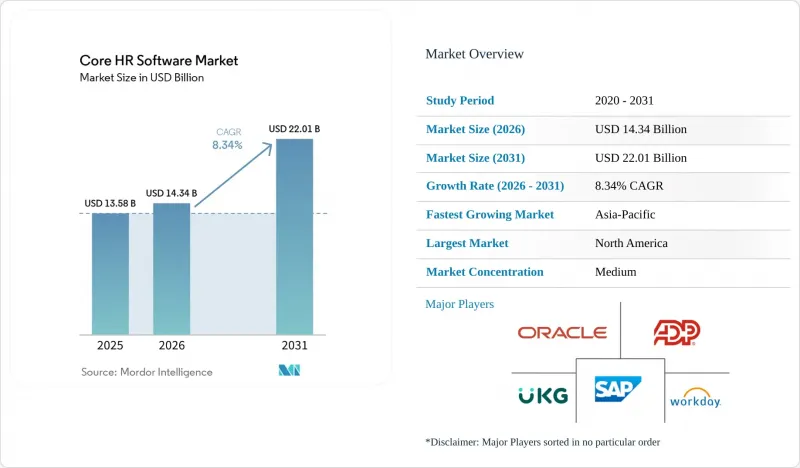
This report is Segmented by Component (Software, and Services), Deployment (Cloud, On-Premises, and Hybrid), Organization Size (SMEs, and Large Enterprises), Industry Vertical (IT and Telecom, BFSI, Healthcare and Lifesciences, Retail and E-Commerce, Manufacturing, Government and Public Sector, and More), and Geography (North America, and More). The Market Forecasts are Provided in Terms of Value (USD).
Global Core HR Software Market Trends and Insights
Cloud-First Adoption of HR Suites
Organizations continue to retire on-premises systems as quarterly SaaS releases deliver innovations that cannot be replicated behind the firewall. Vendor roadmaps increasingly couple cloud delivery with agentic AI, letting customers experiment with predictive attrition, automated compliance checks, and conversational self-service at minimal incremental cost. Multinational firms also lean on hyperscaler data centers to handle complex tax engines across dozens of jurisdictions. However, extracting and cleansing decades of payroll history before migration remains labor-intensive, reinforcing demand for implementation services.
AI-Driven Talent Analytics Integration
Large enterprises piloted AI-infused talent tools at scale in 2025, and corporate budgets for HR-focused AI climbed to a median of USD 1.6 million in 2026. Recent releases such as Workday's Talent Optimization and SAP's SuccessFactors agentic workflows move beyond descriptive dashboards, recommending promotions, surfacing succession risks, and drafting performance narratives automatically. Adoption is rapid in highly regulated sectors looking for audit trails, yet many mid-market firms still lack formal governance policies, slowing full deployment.
Data Residency and Sovereignty Concerns
Rules such as the GDPR in the European Union, the Personal Information Protection Law in China, and India's Digital Personal Data Protection Act mandate that certain employee attributes remain inside national borders. Vendors are therefore forced to maintain region-specific instances, which delays feature parity outside the United States and raises infrastructure costs. Buyers in defense, banking, and healthcare demand proof of local hosting, turning data residency into a primary evaluation criterion.
Other drivers and restraints analyzed in the detailed report include:
- Expansion of Remote and Hybrid Work Models
- Shift to Skills-Based Workforce Planning
- High Switching Costs From Legacy Suites
For complete list of drivers and restraints, kindly check the Table Of Contents.
Segment Analysis
The software segment captured 79.18% of the core HR software market share in 2025, thanks to large recurring subscriptions for payroll, benefits, and workforce analytics modules. Growth momentum is now tilting toward services because data migration, multi-country tax configuration, and AI governance demand specialized expertise. Managed payroll outsourcing, tier-1 help-desk support, and continuous optimization contracts are therefore widening the revenue base for systems integrators and vendor professional services teams.
The core HR software market size attributed to services is forecast to climb at an 8.87% CAGR between 2026 and 2031 as AI agents automate low-value tasks, freeing consultants to advise on skills frameworks and change management. SAP's SmartRecruiters integration, which auto-maps legacy recruiting workflows into SuccessFactors, already trims professional services hours by about 30%, demonstrating how automation can shift billable effort from configuration to strategy.
Cloud installations represented 72.46% of spending in 2025, reflecting strong buyer confidence in vendor-managed security, rapid feature delivery, and lower upfront capital expenditure compared to traditional on-premises deployments. Organizations are increasingly favoring cloud-based core HR systems due to their scalability, automatic updates, and ability to support distributed workforces, while also reducing the burden on internal IT teams for infrastructure maintenance and system upgrades. Yet the hybrid model is on track for a 9.28% CAGR through 2031, the fastest within deployment types, because it allows sensitive payroll data to stay on-premises while newer talent modules run in SaaS.
Maintaining real-time data synchronization across two environments is technically demanding and often requires middleware orchestration. UKG's early-2026 acquisition of Inova Payroll provides a hybrid-ready engine capable of operating inside air-gapped networks, a move aimed at regulated agencies that must balance sovereignty with modernization. Success will hinge on robust API governance, latency management, and clear division of security responsibilities between vendor and customer.
Geography Analysis
North America retained 38.96% of global revenue in 2025, benefiting from established consulting ecosystems, a concentration of large enterprise buyers, and relatively permissive data-transfer rules. Public-sector modernization remains a notable opportunity as the federal HR 2.0 initiative rolls out a hybrid core HCM to agencies such as the Department of Agriculture beginning in fiscal 2026, OPM.GOV. Growth is easing, however, because most Fortune 1000 organizations already run cloud or hybrid suites and are redirecting budgets toward skills marketplaces, employee experience layers, and analytics add-ons.
Asia-Pacific is forecast to register a 10.11% CAGR through 2031, outstripping every other region. Demand is strongest among mid-market firms in India, China, and Southeast Asia that are digitizing payroll for the first time, encouraged by government efforts to formalize employment contracts and improve tax compliance. Darwinbox raised USD 140 million in March 2025 to fund expansion beyond India, signaling investor belief in a sustained regional growth runway. Local data-protection laws in China and India favor domestic or regionally hosted platforms, giving vendors that maintain localized infrastructure a competitive edge.
Europe, South America, the Middle East and Africa collectively offer steady but fragmented demand patterns. GDPR-driven residency rules nudge multinational buyers toward hybrid or EU-specific cloud instances. Brazil leads South America on adoption because of its intricate e-social labor reporting, while Gulf Cooperation Council states mandate Wage Protection System payroll files, spurring specialized regional vendors. African markets are still nascent but exhibit high mobile use and interest in cloud payroll that leapfrogs on-premises deployments.
- Workday Inc.
- Oracle Corporation
- SAP SE
- Automatic Data Processing Inc.
- UKG Inc.
- Ceridian HCM Holding Inc.
- Paycom Software Inc.
- Cornerstone OnDemand Inc.
- BambooHR LLC
- Paylocity Holding Corporation
- Gusto Inc.
- Sage Group plc
- Rippling Inc.
- Zoho Corporation Pvt. Ltd.
- OrangeHRM Inc.
- SumTotal Systems LLC
- ClearCompany Inc.
- Ceipal Corp.
- Freshworks Inc.
- Darwinbox Digital Solutions Pvt. Ltd.
- Infor Inc.
- Paycor HCM Inc.
Additional Benefits:
- The market estimate (ME) sheet in Excel format
- 3 months of analyst support
TABLE OF CONTENTS
1 INTRODUCTION
- 1.1 Study Assumptions and Market Definition
- 1.2 Scope of the Study
2 RESEARCH METHODOLOGY
3 EXECUTIVE SUMMARY
4 MARKET LANDSCAPE
- 4.1 Market Overview
- 4.2 Market Drivers
- 4.2.1 Cloud-first Adoption of HR Suites
- 4.2.2 Expansion of Remote and Hybrid Work Models
- 4.2.3 Increasing Regulatory Reporting Complexity
- 4.2.4 AI-Driven Talent Analytics Integration
- 4.2.5 Shift to Skills-Based Workforce Planning
- 4.2.6 Rising Mid-Market Demand in Emerging Economies
- 4.3 Market Restraints
- 4.3.1 Data Residency and Sovereignty Concerns
- 4.3.2 High Switching Costs From Legacy Suites
- 4.3.3 Shortage of HR Tech Implementation Talent
- 4.3.4 Persistent Cyber-security and Privacy Breaches
- 4.4 Industry Value Chain Analysis
- 4.5 Regulatory Landscape
- 4.6 Technological Outlook
- 4.7 Impact of Macroeconomic Factors on the Market
- 4.8 Porter's Five Forces Analysis
- 4.8.1 Bargaining Power of Suppliers
- 4.8.2 Bargaining Power of Buyers
- 4.8.3 Threat of New Entrants
- 4.8.4 Threat of Substitutes
- 4.8.5 Intensity of Competitive Rivalry
5 MARKET SIZE AND GROWTH FORECASTS (VALUE)
- 5.1 By Component
- 5.1.1 Software
- 5.1.2 Services
- 5.2 By Deployment
- 5.2.1 Cloud
- 5.2.2 On-premises
- 5.2.3 Hybrid
- 5.3 By Organization Size
- 5.3.1 SMEs
- 5.3.2 Large Enterprises
- 5.4 By Industry Vertical
- 5.4.1 IT and Telecom
- 5.4.2 BFSI
- 5.4.3 Healthcare and Lifesciences
- 5.4.4 Retail and E-commerce
- 5.4.5 Manufacturing
- 5.4.6 Government and Public Sector
- 5.4.7 Other Industry Verticals
- 5.5 By Geography
- 5.5.1 North America
- 5.5.1.1 United States
- 5.5.1.2 Canada
- 5.5.1.3 Mexico
- 5.5.2 South America
- 5.5.2.1 Brazil
- 5.5.2.2 Argentina
- 5.5.2.3 Rest of South America
- 5.5.3 Europe
- 5.5.3.1 Germany
- 5.5.3.2 United Kingdom
- 5.5.3.3 France
- 5.5.3.4 Spain
- 5.5.3.5 Italy
- 5.5.3.6 Russia
- 5.5.3.7 Rest of Europe
- 5.5.4 Asia-Pacific
- 5.5.4.1 China
- 5.5.4.2 India
- 5.5.4.3 Japan
- 5.5.4.4 South Korea
- 5.5.4.5 Australia and New Zealand
- 5.5.4.6 Rest of Asia-Pacific
- 5.5.5 Middle East
- 5.5.5.1 Saudi Arabia
- 5.5.5.2 United Arab Emirates
- 5.5.5.3 Turkey
- 5.5.5.4 Rest of Middle East
- 5.5.6 Africa
- 5.5.6.1 South Africa
- 5.5.6.2 Nigeria
- 5.5.6.3 Egypt
- 5.5.6.4 Rest of Africa
- 5.5.1 North America
6 COMPETITIVE LANDSCAPE
- 6.1 Market Concentration
- 6.2 Strategic Moves
- 6.3 Market Share Analysis
- 6.4 Company Profiles (includes Global Level Overview, Market Level Overview, Core Segments, Financials as available, Strategic Information, Market Rank/Share, Products and Services, Recent Developments)
- 6.4.1 Workday Inc.
- 6.4.2 Oracle Corporation
- 6.4.3 SAP SE
- 6.4.4 Automatic Data Processing Inc.
- 6.4.5 UKG Inc.
- 6.4.6 Ceridian HCM Holding Inc.
- 6.4.7 Paycom Software Inc.
- 6.4.8 Cornerstone OnDemand Inc.
- 6.4.9 BambooHR LLC
- 6.4.10 Paylocity Holding Corporation
- 6.4.11 Gusto Inc.
- 6.4.12 Sage Group plc
- 6.4.13 Rippling Inc.
- 6.4.14 Zoho Corporation Pvt. Ltd.
- 6.4.15 OrangeHRM Inc.
- 6.4.16 SumTotal Systems LLC
- 6.4.17 ClearCompany Inc.
- 6.4.18 Ceipal Corp.
- 6.4.19 Freshworks Inc.
- 6.4.20 Darwinbox Digital Solutions Pvt. Ltd.
- 6.4.21 Infor Inc.
- 6.4.22 Paycor HCM Inc.
7 MARKET OPPORTUNITIES AND FUTURE OUTLOOK
- 7.1 White-space and Unmet-need Assessment

