PUBLISHER: Mordor Intelligence | PRODUCT CODE: 2064016

PUBLISHER: Mordor Intelligence | PRODUCT CODE: 2064016
United States High-Power LED Package - Market Share Analysis, Industry Trends & Statistics, Growth Forecasts (2026 - 2031)
According to Mordor Intelligence, the united states high-power LED package market size is expected to increase from USD 0.86 billion in 2025 to USD 0.88 billion in 2026 and reach USD 1.03 billion by 2031, growing at a CAGR of 3.16% over 2026-2031.
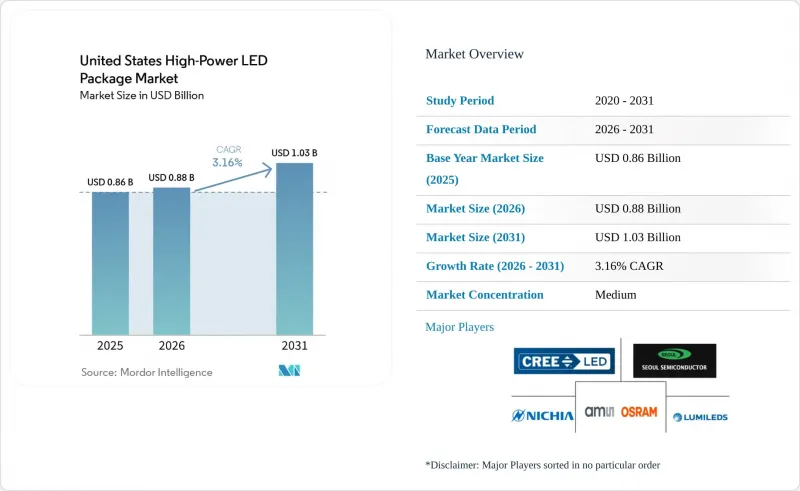
This report is Segmented by Power Range (1 W To 3 W, 3 W To 10 W, and Above 10 W), Architecture (Single-Die Packages, Multi-Die Packages, COB, and More), and Application (General Lighting, Automotive Lighting, Display and Backlighting, and More). The Market Forecasts are Provided in Terms of Value (USD).
United States High-Power LED Package Market Trends and Insights
Surge In Miniaturized High-Power LED Adoption For Horticulture Lighting
In controlled-environment agriculture, the shift toward compact LED packages with wall-plug efficiencies above 80% is reshaping vertical farming economics. These advanced packages deliver photosynthetic photon flux densities exceeding 2,000 µmol m-2 s-1, while second-generation emitters now achieve an impressive 4.1 µmol J-1. As a result, growers can reduce the number of fixtures required, lower HVAC loads due to improved efficiency, and realize payback periods of less than 18 months, making high-performance LEDs a cornerstone of sustainable indoor farming.
Energy-Efficiency Mandates Driving Retrofit Demand In Commercial Buildings
The Department of Energy has set a minimum standard of 45 lumens per watt for general-service lamps. In California, Title 24's open-ADR rules, combined with widespread utility rebates, have successfully incentivized 78% of the state's population. These measures have led to a significant pivot towards networked luminaires. These advanced luminaires now commonly integrate 3 to 10-watt packages equipped with demand-response capabilities. This shift is enabling quicker recovery of initial costs, even with the impending June 2026 expiration of Section 179D deductions.
Thermal Management Challenges Above 10 W Limiting Reliability
Packages that cross the 10-watt threshold face significant thermal management challenges, as heat dissipation becomes non-linear without advanced substrates like aluminum nitride (AlN) or silicon nitride (Si3N4). When these substrates are absent, the elevated junction temperatures can cause luminous efficacy to decline by roughly 5% for every 10 °C increase, which directly undermines performance in demanding applications. This thermal stress also compromises long-term reliability, with LM-80 testing often failing to project the desired 50,000-hour L90 lifetime, making substrate choice a critical determinant of both efficiency and durability.
Other drivers and restraints analyzed in the detailed report include:
- Declining Cost Of High Thermal Conductivity Substrates
- Advances In Flip-Chip Architecture Enabling Higher Lumen Density
- Patent Litigation Risk Around CSP And Flip-Chip Packages
For complete list of drivers and restraints, kindly check the Table Of Contents.
Segment Analysis
Packages of 1 W-3 W retained 48.77% of the United States high-power LED package market share in 2025, anchored in downlights and troffers that value mature footprints and price competition. Growth, however, is shifting upward: the above 10 W band is on a 3.58% CAGR trajectory to 2031 as vertical farms and matrix headlamps demand superior photon density. The United States high-power LED package market size for the above 10 W class benefits from premium pricing that offsets the 40-60% material uplift tied to aluminum nitride substrates.
Controlled-environment cultivators in California and Arizona tolerate higher capex because a single-percentage-point jump in efficacy can shave USD 8,000-12,000 from annual energy bills. Automotive OEMs echo this dynamic, Tesla's 2026 matrix system deploys dozens of high-flux dies to paint glare-free beams, a feature impossible with lower-wattage devices. Suppliers that can secure high-conductivity substrates and meet AEC-Q102 grades are therefore outpacing commodity package makers.
List of Companies Covered in this Report:
- Nichia Corporation
- Cree LED, an SGH Company
- Lumileds Holding B.V.
- Osram Opto Semiconductors GmbH
- Seoul Semiconductor Co., Ltd.
- Samsung Electronics Co., Ltd.
- LG Innotek Co., Ltd.
- Everlight Electronics Co., Ltd.
- Luminus Devices, Inc.
- Bridgelux, Inc.
- Lite-On Technology Corporation
- Toyoda Gosei Co., Ltd.
- Epistar Corporation
- Dominant Opto Technologies Sdn. Bhd.
- Edison Opto Corporation
- Citizen Electronics Co., Ltd.
- ProPhotonix Limited
- Crystal IS Inc.
- TT Electronics plc
- Advanced Optoelectronic Technology Inc.
Additional Benefits:
- The market estimate (ME) sheet in Excel format
- 3 months of analyst support
TABLE OF CONTENTS
1 INTRODUCTION
- 1.1 Study Assumptions and Market Definition
- 1.2 Scope of the Study
2 RESEARCH METHODOLOGY
3 EXECUTIVE SUMMARY
4 MARKET LANDSCAPE
- 4.1 Market Overview
- 4.2 Industry Supply-Chain Analysis
- 4.3 Market Drivers
- 4.3.1 Surge in Miniaturized High-Power LED Adoption for Horticulture Lighting
- 4.3.2 Energy-Efficiency Mandates Driving Retrofit Demand in Commercial Buildings
- 4.3.3 Declining Cost of High Thermal Conductivity Substrates
- 4.3.4 Advances in Flip-Chip Architecture Enabling Higher Lumen Density
- 4.3.5 Automotive Adaptive Headlamp Regulations (FMVSS-108 Updates)
- 4.3.6 Integration of Smart Controls with High-Power LED Modules in Street Lighting
- 4.4 Market Restraints
- 4.4.1 Thermal Management Challenges Above 10 W Limiting Reliability
- 4.4.2 Patent Litigation Risk Around CSP and Flip-Chip Packages
- 4.4.3 Volatility in Gallium Nitride Wafer Pricing
- 4.4.4 Slowdown in LCD Backlight Replacement Cycle Due to OLED Penetration
- 4.5 Regulatory Landscape
- 4.6 Technological Outlook
- 4.7 Impact of Macroeconomic Factors
- 4.8 Porter's Five Forces Analysis
- 4.8.1 Bargaining Power of Suppliers
- 4.8.2 Bargaining Power of Buyers
- 4.8.3 Threat of New Entrants
- 4.8.4 Threat of Substitutes
- 4.8.5 Intensity of Competitive Rivalry
5 MARKET SIZE AND GROWTH FORECASTS (VALUE)
- 5.1 By Power Range
- 5.1.1 1 W - 3 W
- 5.1.2 3 W - 10 W
- 5.1.3 Above 10 W
- 5.2 By Architecture
- 5.2.1 Single-die Packages (SMD / Discrete)
- 5.2.2 Multi-die Packages (SMD)
- 5.2.3 COB (Chip-on-Board)
- 5.2.4 Others (CSP, Flip-Chip, Hybrid Modules)
- 5.3 By Application
- 5.3.1 General Lighting
- 5.3.2 Automotive Lighting
- 5.3.3 Display and Backlighting
- 5.3.4 Specialty / Niche
6 COMPETITIVE LANDSCAPE
- 6.1 Market Concentration
- 6.2 Strategic Moves
- 6.3 Market Share Analysis
- 6.4 Company Profiles (includes Global Level Overview, Market Level Overview, Core Segments, Financials as available, Strategic Information, Market Rank/Share, Products and Services, Recent Developments)
- 6.4.1 Nichia Corporation
- 6.4.2 Cree LED, an SGH Company
- 6.4.3 Lumileds Holding B.V.
- 6.4.4 Osram Opto Semiconductors GmbH
- 6.4.5 Seoul Semiconductor Co., Ltd.
- 6.4.6 Samsung Electronics Co., Ltd.
- 6.4.7 LG Innotek Co., Ltd.
- 6.4.8 Everlight Electronics Co., Ltd.
- 6.4.9 Luminus Devices, Inc.
- 6.4.10 Bridgelux, Inc.
- 6.4.11 Lite-On Technology Corporation
- 6.4.12 Toyoda Gosei Co., Ltd.
- 6.4.13 Epistar Corporation
- 6.4.14 Dominant Opto Technologies Sdn. Bhd.
- 6.4.15 Edison Opto Corporation
- 6.4.16 Citizen Electronics Co., Ltd.
- 6.4.17 ProPhotonix Limited
- 6.4.18 Crystal IS Inc.
- 6.4.19 TT Electronics plc
- 6.4.20 Advanced Optoelectronic Technology Inc.
7 MARKET OPPORTUNITIES AND FUTURE OUTLOOK
- 7.1 White-Space and Unmet-Need Assessment

