PUBLISHER: Mordor Intelligence | PRODUCT CODE: 2064021

PUBLISHER: Mordor Intelligence | PRODUCT CODE: 2064021
China High-Power LED Package - Market Share Analysis, Industry Trends & Statistics, Growth Forecasts (2026 - 2031)
According to Mordor Intelligence, the china high-power LED package market size is projected to expand from USD 1.30 billion in 2025 and USD 1.36 billion in 2026 to USD 1.79 billion by 2031, registering a CAGR of 5.64% between 2026-2031.
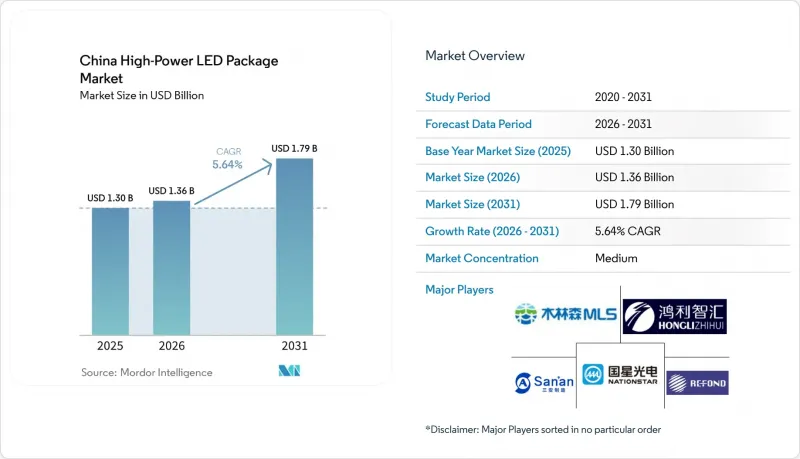
This report is Segmented by Power Range (1W-3W, 3W-10W, and Above 10W), Architecture (Single-Die Packages, Multi-Die Packages, COB, and More), Application (General Lighting, Automotive Lighting, Display and Backlighting, and Specialty/Niche). The Market Forecasts are Provided in Terms of Value (USD).
China High-Power LED Package Market Trends and Insights
Rapid Mini and Micro-LED Adoption Demanding Higher Drive Currents
Mini and Micro-LED backlights now ship in premium televisions, tablets, and automotive instrument clusters, increasing per-unit LED counts ten-fold compared with edge-lit designs. Bonding tens of millions of sub-100-micrometer chips per panel pushes local heat flux above 20 W cm-2, so packagers are redesigning thermal interfaces and spreading layers to handle die currents that exceed 1 A in automotive projection modules. Domestic suppliers have installed automated mass-transfer tools and copper-core boards to cut defect density, yet wafer-to-wafer emission-wavelength uniformity remains a hurdle for seamless tiling in ultra-high-definition displays.
Growth of Adaptive Matrix Headlamps in New Energy Vehicles
China sold 12.87 million New Energy Vehicles in 2024, lifting NEV penetration to 40.9% of passenger-car sales. Each mid-range sedan already carries at least 100 controllable pixels per headlamp, and flagship models integrate more than 25,000, driving demand for chip-on-board or single-chip pixelated LEDs qualified to AEC-Q101. Vertical integration moves, such as the Sanan-Lumileds deal, trimmed chip cost nearly 30% and opened European luxury OEM supply chains to Chinese die.
Price Compression From Over-Capacity in Guangdong and Jiangxi
Large-scale capacity expansions between 2022-2024 created a supply glut that cut average selling prices 30-40%. Although precious-metal cost inflation triggered a brief price rebound in 2025-2026, margin recovery remains fragile as buyers in commodity lighting easily defer purchases or down-spec drive currents. Asset sales and mergers, such as a recent stake purchase in Purui Optoelectronics, illustrate ongoing rationalization.
Other drivers and restraints analyzed in the detailed report include:
- LED Subsidy Roll-Offs Steering Suppliers Toward High-Efficiency Packages
- ERP Standards Tightening for Public-Lighting Installations
- Thermal-Management Limits Above 10 W in Compact Form Factors
For complete list of drivers and restraints, kindly check the Table Of Contents.
Segment Analysis
The China high-power LED package market size for the 1 W-3 W tier remained the largest in 2025, buoyed by retrofit downlights and streetlighting. However, improved chip efficacy lets luminaire makers replace several low-watt packages with a single Above 10 W emitter, cutting driver count and assembly labor. Packages at or above 10 W already command the fastest growth, underpinned by adaptive driving-beam modules and industrial high-bay fixtures that operate above 1 A. Ceramic substrates delivering sub-1 K W-1 thermal resistance and gold-tin die attach are becoming standard, even though they raise unit cost, because they enable long-term lumen maintenance at currents that were once impractical.
Thermal innovations are also disrupting the mid-range. Copper-core metal-core boards lower thermal resistance to roughly 1.3 K W-1 at one-third the cost of aluminum-nitride ceramics, but solder-joint fatigue emerges above 12 W during the -40 °C to 125 °C automotive test cycle. The 1 W-3 W tier therefore faces gradual share erosion as designers opt for fewer high-current nodes once thermal hurdles are cleared. The trend amplifies vertical-integration advantages enjoyed by large Chinese packagers that control substrate pressing, phosphor compounding, and driver electronics in-house.
List of Companies Covered in this Report:
- Sanan Optoelectronics Co., Ltd.
- Nationstar Optoelectronics Co., Ltd.
- MLS Co., Ltd.
- Hongli Zhihui Group Co., Ltd.
- Refond Optoelectronics Co., Ltd.
- Lextar Electronics Corp.
- Everlight Electronics Co., Ltd.
- Cree LED (Smart Global Holdings, Inc.)
- Nichia Corporation
- Seoul Semiconductor Co., Ltd.
- Osram Opto Semiconductors GmbH
- Lumileds Holding B.V.
- Dominant Opto Technologies Sdn. Bhd.
- Shenzhen Jufei Optoelectronics Co., Ltd.
- Kingsun Optoelectronic Co., Ltd.
- Sharp Corporation
- Samsung Electronics Co., Ltd.
- LG Innotek Co., Ltd.
- Lite-On Technology Corporation
- HC SemiTek Corporation
Additional Benefits:
- The market estimate (ME) sheet in Excel format
- 3 months of analyst support
TABLE OF CONTENTS
1 INTRODUCTION
- 1.1 Study Assumptions and Market Definition
- 1.2 Scope of the Study
2 RESEARCH METHODOLOGY
3 EXECUTIVE SUMMARY
4 MARKET LANDSCAPE
- 4.1 Market Overview
- 4.2 Market Drivers
- 4.2.1 LED Subsidy Roll-offs Steering Suppliers Toward High-Efficiency Packages
- 4.2.2 Rapid Mini/Micro-LED Adoption Demanding Higher Drive Currents
- 4.2.3 ERP Standards Tightening for Public Lighting Installations
- 4.2.4 Growth of Adaptive Matrix Headlamps in New Energy Vehicles
- 4.2.5 Smart Factory Retrofits Requiring High-Lux Illumination
- 4.2.6 Surge in UV-C Disinfection Modules in Semiconductor Fabs
- 4.3 Market Restraints
- 4.3.1 Price Compression from Over-capacity in Guangdong and Jiangxi
- 4.3.2 Thermal-Management Limits Above 10 W in Compact Form-Factors
- 4.3.3 High Import Dependence for Flip-Chip Gold-Bump Equipment
- 4.3.4 PFAS Regulation Increasing Encapsulation Costs
- 4.4 Technology Analysis
- 4.5 Regulatory Landscape
- 4.6 Impact of Macroeconomic Factors
- 4.7 Porter's Five Forces Analysis
- 4.7.1 Bargaining Power of Suppliers
- 4.7.2 Bargaining Power of Buyers
- 4.7.3 Threat of New Entrants
- 4.7.4 Threat of Substitutes
- 4.7.5 Intensity of Competitive Rivalry
5 MARKET SIZE AND GROWTH FORECASTS (VALUE)
- 5.1 By Power Range
- 5.1.1 1 W - 3 W
- 5.1.2 3 W - 10 W
- 5.1.3 Above 10 W
- 5.2 By Architecture
- 5.2.1 Single-die Packages (SMD / Discrete)
- 5.2.2 Multi-die Packages (SMD)
- 5.2.3 COB (Chip-on-Board)
- 5.2.4 Others (CSP, Flip-chip, Hybrid Modules)
- 5.3 By Application
- 5.3.1 General Lighting
- 5.3.2 Automotive Lighting
- 5.3.3 Display and Backlighting
- 5.3.4 Specialty / Niche
6 COMPETITIVE LANDSCAPE
- 6.1 Market Concentration
- 6.2 Strategic Moves
- 6.3 Market Share Analysis
- 6.4 Company Profiles (includes Global Level Overview, Market Level Overview, Core Segments, Financials as available, Strategic Information, Market Rank/Share, Products and Services, Recent Developments)
- 6.4.1 Sanan Optoelectronics Co., Ltd.
- 6.4.2 Nationstar Optoelectronics Co., Ltd.
- 6.4.3 MLS Co., Ltd.
- 6.4.4 Hongli Zhihui Group Co., Ltd.
- 6.4.5 Refond Optoelectronics Co., Ltd.
- 6.4.6 Lextar Electronics Corp.
- 6.4.7 Everlight Electronics Co., Ltd.
- 6.4.8 Cree LED (Smart Global Holdings, Inc.)
- 6.4.9 Nichia Corporation
- 6.4.10 Seoul Semiconductor Co., Ltd.
- 6.4.11 Osram Opto Semiconductors GmbH
- 6.4.12 Lumileds Holding B.V.
- 6.4.13 Dominant Opto Technologies Sdn. Bhd.
- 6.4.14 Shenzhen Jufei Optoelectronics Co., Ltd.
- 6.4.15 Kingsun Optoelectronic Co., Ltd.
- 6.4.16 Sharp Corporation
- 6.4.17 Samsung Electronics Co., Ltd.
- 6.4.18 LG Innotek Co., Ltd.
- 6.4.19 Lite-On Technology Corporation
- 6.4.20 HC SemiTek Corporation
7 MARKET OPPORTUNITIES AND FUTURE OUTLOOK
- 7.1 White-Space and Unmet-Need Assessment

