
PUBLISHER: Mordor Intelligence | PRODUCT CODE: 2064370

PUBLISHER: Mordor Intelligence | PRODUCT CODE: 2064370
Karl Fischer Titrators - Market Share Analysis, Industry Trends & Statistics, Growth Forecasts (2026 - 2031)
According to Mordor Intelligence, the karl fischer titrators market size was valued at USD 220.36 million in 2025 and is estimated to grow from USD 226.64 million in 2026 to reach USD 260.83 million by 2031, at a CAGR of 2.85% during the forecast period (2026-2031).
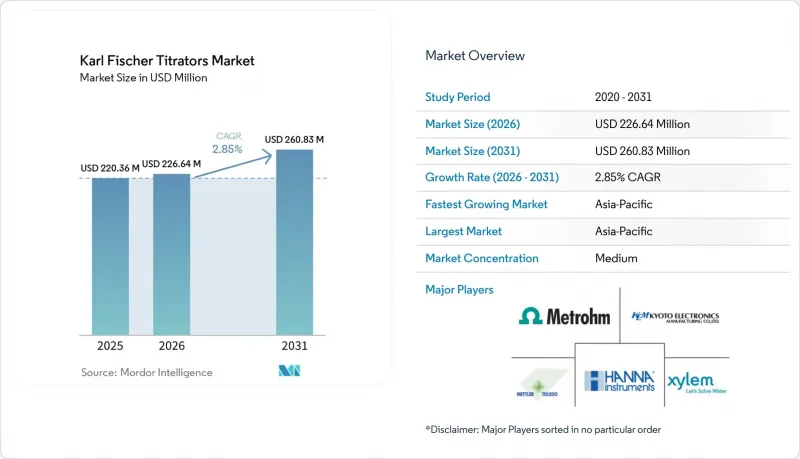
This report is Segmented by Product Type (Volumetric, Coulometric), Technology (Automated, Semi-Automated, Manual), End User (Pharma and Biotech, Chemical and Petrochemical, Food Testing, CROs/CDMOs, Academic, Industrial QA/QC), and Geography (North America, Europe, Asia-Pacific, Middle East and Africa, South America). The Market Forecasts are Provided in Terms of Value (USD).
Global Karl Fischer Titrators Market Trends and Insights
Tightening Pharma And Biotech Moisture-Control Compliance
The market continues to draw its strongest structural support from pharmaceutical and biotechnology quality systems, where moisture limits are not optional and compendial acceptance remains central to routine testing. Mettler-Toledo's pharmaceutical guidance ties volumetric and coulometric Karl Fischer workflows directly to USP 921 and Ph. Eur. requirements, which keeps the method embedded in testing for active ingredients, excipients, and finished products. The compliance burden now extends beyond the chemistry itself because many regulated facilities must also show secure electronic records, audit trails, user permissions, and traceable review workflows during inspection readiness. That shift changes purchase behavior inside the Karl Fischer titrators market, since older analog units can still measure water but cannot support the digital evidence chain that regulated plants increasingly need. As a result, replacement demand is staying active even where sample volumes are stable, and the decision is often framed around data integrity risk rather than pure analytical performance. This is one reason the Karl Fischer titrators market is seeing firm demand for integrated systems instead of a broad return to lower-cost manual setups.
Battery-Electrolyte And Electrode Moisture Control
The market is also being supported by battery manufacturing, where trace moisture control has become a process gate rather than a laboratory preference. Mettler-Toledo's battery application material highlights that water in lithium-ion battery materials can contribute to hydrofluoric acid formation and other reactions that reduce performance and raise safety concerns. Chemistry World makes the same point from an application perspective, noting that moisture testing is now tied closely to batteries, fuels, and other industrial settings where water content has direct quality and safety consequences. This matters for the Karl Fischer titrators market because battery producers cannot rely on broad screening alone when electrolytes and electrodes require trace-level measurement with tight repeatability. The application also favors coulometric systems and specialized reagent choices, which pushes demand toward higher-value configurations instead of basic entry platforms. With global electric vehicle capacity still expanding, each new line creates repeated testing points that support durable instrument demand rather than one-time lab purchases.
Alternative Moisture-Analysis Method Substitution
The market faces its clearest substitution risk from near-infrared spectroscopy in repetitive testing environments where samples are stable and speed matters more than direct water reaction chemistry. Metrohm's application material and recent analytical literature show why NIR is attractive, since it can deliver fast, non-destructive results and fits well with inline process control. Even so, the Karl Fischer titrators market remains protected in regulated and trace-level uses because Karl Fischer titration is still treated as a direct and stoichiometric method for water, while NIR depends on model quality and calibration discipline. In practical terms, substitution pressure is therefore strongest at the lower end of the market, especially in high-throughput food and polymer settings where labs test similar matrices repeatedly. It is far less disruptive in pharmaceuticals, biologics, and battery materials, where reference testing and trace sensitivity still matter more than screening speed. This creates a split pattern in the market, with entry and mid-range units more exposed than premium trace-moisture platforms.
Other drivers and restraints analyzed in the detailed report include:
- Lyophilized Biologics Residual-Moisture Testing
- Automation, Audit Trails, And LIMS Integration
- High Instrument And Reagent Lifecycle Cost
For complete list of drivers and restraints, kindly check the Table Of Contents.
Segment Analysis
Volumetric systems held 62.3% of Karl Fischer titrators market share in 2025, which kept them firmly in the lead across the product mix. Their position reflects a wide operating range for samples that contain moderate to high moisture, which suits routine work across pharmaceuticals, chemicals, and food ingredients. The Karl Fischer titrators market still depends heavily on these systems because many quality control labs handle varied sample types and need one method that can move across solvents, powders, and finished materials with less configuration change. Compendial familiarity also matters, since laboratories in regulated sectors tend to prefer methods that are already embedded in routine procedures and internal validation packages. Volumetric instruments therefore remain the practical default for many multi-product facilities, especially where trace-level sensitivity is not the central requirement.
Coulometric Karl Fischer titrators are forecast to grow at 4.4% CAGR through 2031, which places them well above the overall category pace. Their strength comes from trace-moisture work, where electrochemical iodine generation avoids routine titer standardization and supports stronger control at low water levels. The market is pulling these systems into battery electrolytes, lyophilized biologics, and moisture-sensitive intermediates, all of which punish small measurement errors more severely than conventional samples. Vendors are responding with premium launches and application-specific design choices, which shows where current product investment is concentrating. As a result, the Karl Fischer titrators market is becoming more polarized by use case, with volumetric systems protecting the broad base and coulometric systems capturing the sharper growth edge.
Geography Analysis
Asia-Pacific held 35.2% of Karl Fischer titrators market share in 2025, and the region is projected to expand at 4.8% CAGR through 2031. That combination makes Asia-Pacific both the largest and fastest-growing regional block in the Karl Fischer titrators market. Japan remains an important technology anchor because local instrument makers and long-established laboratory practices support a deep installed base across pharmaceutical and chemical testing. China and India are widening the regional demand base as pharmaceutical manufacturing, outsourced analytical work, and battery-related testing continue to grow in scale. The Karl Fischer titrators market also benefits here from a wide spectrum of buyers, ranging from premium regulated labs to cost-sensitive industrial users who still require routine moisture measurement.
The region's growth profile is stronger than its headline share alone suggests because it combines mature instrumentation demand with new application build-out. Battery materials and cell production give the Karl Fischer titrators market a clear opening in China, South Korea, and Japan, where moisture control is tied closely to product safety and yield. Pharmaceutical outsourcing also supports purchases of automated systems, since CROs and CDMOs need reliable documentation and repeatable testing across international client programs. That favors platforms with audit trails, software control, and stronger workflow standardization rather than only low upfront cost. At the same time, mid-tier price competition remains important in Asia-Pacific, which is why both premium automation and lower-cost alternatives can expand side by side in the Karl Fischer titrators market.
North America and Europe form a mature demand cluster where the Karl Fischer titrators market is driven more by replacement and workflow modernization than by first-time adoption. Regulated pharmaceutical production and advanced laboratory infrastructure support steady demand for connected systems with strong data integrity features. Europe also has an added chemistry dimension because reagent-handling and environmental pressure encourage interest in methanol-free or imidazole-free formulations alongside instrument upgrades. The Middle East and Africa, along with South America, remain smaller but relevant parts of the Karl Fischer titrators market, supported by petrochemical refining, food processing, pharmaceutical quality control, and distributor-led equipment access. These regions are more budget sensitive, which gives cost-competitive systems room to grow even while premium suppliers retain an advantage in highly regulated applications.
- Bioevopeak
- CSC Scientific
- ECH Elektrochemie Halle
- Electronics India
- Hach
- Hanna Instruments
- Hanon Instruments
- HIRANUMA SANGYO
- Hitachi High-Tech
- Infitek
- JM Science
- Koehler Instrument Company
- Kyoto Electronics Manufacturing (KEM)
- Labtron Equipment
- Metrohm
- Mettler-Toledo
- Shanghai INESA Scientific Instrument
- Xylem Analytics / SI Analytics
Additional Benefits:
- The market estimate (ME) sheet in Excel format
- 3 months of analyst support
TABLE OF CONTENTS
1 Introduction
- 1.1 Study Assumptions & Market Definition
- 1.2 Scope of the Study
2 Research Methodology
3 Executive Summary
4 Market Landscape
- 4.1 Market Overview
- 4.2 Market Drivers
- 4.2.1 Tightening Pharma and Biotech Moisture-Control Compliance
- 4.2.2 Broader Moisture-Critical QA Across Chemicals, Fuels, and Food
- 4.2.3 Automation, Audit Trails, and LIMS Integration
- 4.2.4 CRO And Contract Testing Expansion
- 4.2.5 Battery-Electrolyte and Electrode Moisture Control
- 4.2.6 Lyophilized Biologics Residual-Moisture Testing
- 4.3 Market Restraints
- 4.3.1 High Instrument and Reagent Lifecycle Cost
- 4.3.2 Alternative Moisture-Analysis Method Substitution
- 4.3.3 Matrix Interference and Difficult Sample Preparation
- 4.3.4 Methanol And Reagent-Handling EHS Pressure
- 4.4 Supply Chain Analysis
- 4.5 Regulatory Landscape
- 4.6 Technological Outlook
- 4.7 Porter's Five Forces
- 4.7.1 Threat of New Entrants
- 4.7.2 Bargaining Power of Suppliers
- 4.7.3 Bargaining Power of Buyers
- 4.7.4 Threat of Substitutes
- 4.7.5 Intensity of Competitive Rivalry
5 Market Size & Growth Forecasts (Value, USD)
- 5.1 By Product Type
- 5.1.1 Volumetric Karl Fischer Titrators
- 5.1.2 Coulometric Karl Fischer Titrators
- 5.2 By Technology
- 5.2.1 Automated
- 5.2.2 Semi-Automated
- 5.2.3 Manual
- 5.3 By End User
- 5.3.1 Pharmaceutical and Biotechnology Companies
- 5.3.2 Chemical, Petrochemical, and Energy Material Manufacturers
- 5.3.3 Food Testing and Processing Laboratories
- 5.3.4 CROs, CDMOs, and Contract Testing Organizations
- 5.3.5 Academic and Research Institutes
- 5.3.6 Independent and Industrial QA/QC Laboratories
- 5.4 By Geography
- 5.4.1 North America
- 5.4.1.1 United States
- 5.4.1.2 Canada
- 5.4.1.3 Mexico
- 5.4.2 Europe
- 5.4.2.1 Germany
- 5.4.2.2 United Kingdom
- 5.4.2.3 France
- 5.4.2.4 Italy
- 5.4.2.5 Spain
- 5.4.2.6 Rest of Europe
- 5.4.3 Asia-Pacific
- 5.4.3.1 China
- 5.4.3.2 India
- 5.4.3.3 Japan
- 5.4.3.4 South Korea
- 5.4.3.5 Australia
- 5.4.3.6 Rest of Asia-Pacific
- 5.4.4 Middle East and Africa
- 5.4.4.1 GCC
- 5.4.4.2 South Africa
- 5.4.4.3 Rest of Middle East and Africa
- 5.4.5 South America
- 5.4.5.1 Brazil
- 5.4.5.2 Argentina
- 5.4.5.3 Rest of South America
- 5.4.1 North America
6 Competitive Landscape
- 6.1 Market Concentration
- 6.2 Market Share Analysis
- 6.3 Company Profiles {(includes Global level Overview, Market level overview, Core Segments, Financials as available, Strategic Information, Market Rank/Share for key companies, Products & Services, and Recent Developments)}
- 6.3.1 Bioevopeak
- 6.3.2 CSC Scientific
- 6.3.3 ECH Elektrochemie Halle
- 6.3.4 Electronics India
- 6.3.5 Hach
- 6.3.6 Hanna Instruments
- 6.3.7 Hanon Instruments
- 6.3.8 HIRANUMA SANGYO
- 6.3.9 Hitachi High-Tech
- 6.3.10 Infitek
- 6.3.11 JM Science
- 6.3.12 Koehler Instrument Company
- 6.3.13 Kyoto Electronics Manufacturing (KEM)
- 6.3.14 Labtron Equipment
- 6.3.15 Metrohm
- 6.3.16 Mettler-Toledo
- 6.3.17 Shanghai INESA Scientific Instrument
- 6.3.18 Xylem Analytics / SI Analytics
7 Market Opportunities & Future Outlook
- 7.1 White-space & unmet-need assessment

