PUBLISHER: Mordor Intelligence | PRODUCT CODE: 2065752

PUBLISHER: Mordor Intelligence | PRODUCT CODE: 2065752
Biotechnology - Market Share Analysis, Industry Trends & Statistics, Growth Forecasts (2026 - 2031)
According to Mordor Intelligence, the biotechnology market size is projected to expand from USD 2.15 trillion in 2025 and USD 2.42 trillion in 2026 to USD 4.41 trillion by 2031, registering a CAGR of 12.67% between 2026 to 2031.
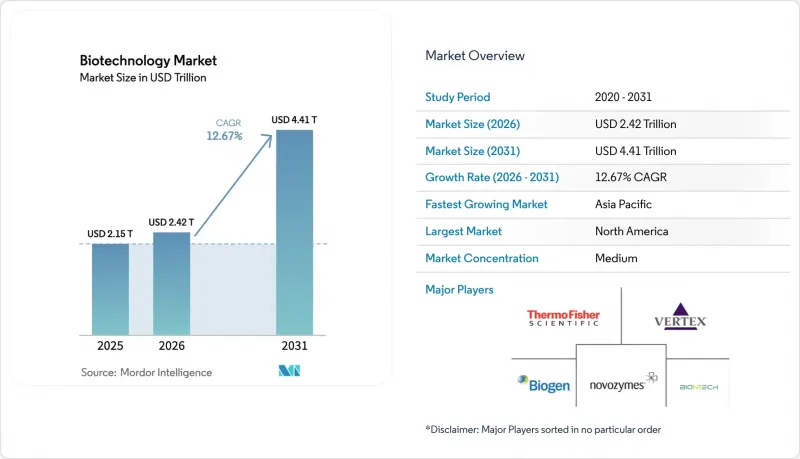
This report Segments the Industry Into by Technology (DNA Sequencing, Nanobiotechnology and More), Application (Health & Red Biotechnology, Food and Agriculture and More), End User (Biopharma & Biotechnology Companies, Cmos & CROs and More), Product Type (Biopharmaceuticals, Bioprocess Equipment & Consumables and More), and Geography.
Global Biotechnology Market Trends and Insights
Accelerated Demand for Novel Biologics and Gene-Based Therapeutics
Recent approvals of first-in-class gene therapies for rare diseases validate genetic medicine's transition into commercial practice, spurring manufacturers to scale continuous bioprocessing capacities and invest in single-use technologies that cut changeover times and reduce contamination risks. Premium pricing for regenerative products Humacyte's SYMVESS vessel sells for USD 29,500 per unit-illustrates the economic potential that attracts new entrants and capital. AI-powered patient stratification tools are boosting trial success, highlighted by Genmab's epcoritamab combination achieving 87% response in refractory lymphomas. Together these factors raise the ceiling on the biotechnology market revenue pool and reinforce demand visibility across pipeline stages.
Rapid Cost Decline in High-Throughput Sequencing
Sequencing-cost freefalls underpin the sector's shift into population-scale diagnostics and real-time pathogen surveillance. Illumina's USD 425 million SomaLogic acquisition signals strategic intent to merge proteomic data streams with genomics for multi-omic analytics. Machine-learning-driven classifiers now surpass 90% accuracy in cancer subtype detection, propelling multi-omic integration into routine clinical workflows. Improved reagent yields and lab automation further cut per-sample cost, widening access for academic labs and smaller firms, thereby democratizing innovation within the biotechnology market.
Shortage of Bioprocessing Single-Use-Systems Specialists
Rapid facility build-outs have outpaced human-capital growth, producing acute shortages in single-use-technology operators despite Novo Nordisk's 1,000-job expansion in North Carolina. The skills gap slows facility validation and jeopardizes on-time product launches, pushing firms to partner with universities for bespoke curricula and ramp up internal training programs. In emerging markets, limited educational pipelines exacerbate the constraint, tempering infrastructure utilization and near-term revenue realization within the biotechnology market.
Other drivers and restraints analyzed in the detailed report include:
- Government Bio-Economy Stimulus and Pandemic-Era R&D Tax Credits
- M&A Race for AI-Driven Drug-Discovery Platforms
- Regulatory Lag on Multi-Omic Companion Diagnostics
For complete list of drivers and restraints, kindly check the Table Of Contents.
Segment Analysis
Tissue Engineering and Regeneration captured 20.55% of biotechnology market revenue in 2025, reflecting the transition of engineered-tissue constructs from laboratory prototypes to clinically reimbursed products. Approvals such as Humacyte's SYMVESS vessel validated commercial pathways and enhanced investor confidence. The segment's expanding therapeutic breadth, spanning vascular trauma and organ repair, is projected to reinforce its leadership position through 2031.
Next-Generation Sequencing is forecast to register a 21.4% CAGR, the fastest across technologies. As cost per genome continues to fall, sequencing platforms increasingly integrate AI modules that accelerate variant interpretation, propelling broad adoption in oncology, infectious-disease surveillance, and agricultural genomics. In parallel, CRISPR and gene-editing toolkits benefit from smoother regulatory reviews and mature manufacturing protocols, elevating their share in the overall biotechnology market.
Health biotechnology accounted for 48.85% of 2025 revenue, anchored by strong biopharmaceutical demand and high reimbursement levels for life-saving therapies. This segment's dominance is expected to persist as gene-edited treatments and cell therapies commercialize at premium price points. Digital health platforms that integrate omics data are boosting patient stratification, improving outcomes, and thereby reinforcing payer support.
Bioinformatics and Omics, projected to climb at 22.1% CAGR, embodies the field's shift toward data-centric value creation. AI-enabled multi-omics platforms streamline target discovery and diagnostic decision-making, catalyzing new service models for precision medicine. As digital tools proliferate, application diversity expands, further enlarging the biotechnology market opportunity landscape.
Geography Analysis
North America retained 44.90% of global revenue in 2025, supported by dense innovation clusters, favorable intellectual-property regimes, and swift regulatory approvals. Flagship investments, such as Eli Lilly's USD 4.5 billion Medicine Foundry, illustrate manufacturers' confidence in domestic supply-chain stability. Federal loan guarantees for bio-based facilities and coordinated agency oversight further lower financing risk and accelerate product launch cycles, cementing regional leadership across the biotechnology market.
Asia-Pacific represents the fastest-growing region with 16.95% CAGR, catalyzed by significant public funding and lower operating costs. Japan's JPY 110 billion regenerative-medicine program demonstrates strategic ambition to become a "land of drug discovery," while China's policy support and India's green-transition agenda underpin manufacturing expansion. Cross-border partnerships accelerate technology transfer, fostering a dynamic environment that enhances the region's share of the biotechnology market.
Europe benefits from robust infrastructure, high ethical standards, and the forthcoming Biotech Act designed to streamline approvals. Germany's 78% jump in biotechnology financing to EUR 1.917 billion underscores investor appetite. Major capacity additions by Boehringer Ingelheim and Sanofi augment the continent's manufacturing base. Europe's focus on sustainable biotechnology reinforces its competitive advantage in green applications, strengthening its position in the global biotechnology market.
- Amgen Inc.
- Biogen Inc.
- Gilead Sciences Inc.
- Illumina Inc.
- Thermo Fisher Scientific Inc.
- Regeneron Pharmaceuticals Inc.
- Moderna Inc.
- BioNTech SE
- Vertex Pharmaceuticals Inc.
- CSL Ltd.
- Lonza Group AG
- Novozymes A/S
- Catalent Inc.
- Charles River Laboratories International Inc.
- Genmab A/S
- CRISPR Therapeutics AG
- Editas Medicine Inc.
- Intellia Therapeutics Inc.
- Sangamo Therapeutics Inc.
- Alnylam Pharmaceuticals Inc.
- Sarepta Therapeutics Inc.
- Bluebird Bio Inc.
- Gingko Bioworks Holdings Inc.
- Zymergen Inc.
- Twist Bioscience Corp.
Additional Benefits:
- The market estimate (ME) sheet in Excel format
- 3 months of analyst support
TABLE OF CONTENTS
1 INTRODUCTION
- 1.1 Study Assumptions and Market Definition
- 1.2 Scope of the Study
2 RESEARCH METHODOLOGY
3 EXECUTIVE SUMMARY
4 MARKET LANDSCAPE
- 4.1 Market Overview
- 4.2 Market Drivers
- 4.2.1 Accelerated demand for novel biologics and gene-based therapeutics
- 4.2.2 Rapid cost decline in high-throughput sequencing
- 4.2.3 Government bio-economy stimulus and pandemic-era R&D tax credits
- 4.2.4 M&A race for AI-driven drug-discovery platforms
- 4.2.5 Emergence of cell-free biomanufacturing micro-plants
- 4.2.6 Synthetic biology-enabled carbon-negative materials
- 4.3 Market Restraints
- 4.3.1 Shortage of bioprocessing single-use-systems specialists
- 4.3.2 Regulatory lag on multi-omic companion diagnostics
- 4.3.3 Rising bio-geopolitical export controls on genetic data
- 4.3.4 Volatility in venture funding for platform-only start-ups
- 4.4 Regulatory Landscape
- 4.5 Technological Outlook
- 4.6 Porter's Five Forces Analysis
- 4.6.1 Threat of New Entrants
- 4.6.2 Bargaining Power of Buyers
- 4.6.3 Bargaining Power of Suppliers
- 4.6.4 Threat of Substitutes
- 4.6.5 Intensity of Competitive Rivalry
5 MARKET SIZE AND GROWTH FORECASTS (VALUE)
- 5.1 By Technology
- 5.1.1 DNA Sequencing
- 5.1.2 Nanobiotechnology
- 5.1.3 Tissue Engineering & Regeneration
- 5.1.4 PCR Technology
- 5.1.5 Fermentation
- 5.1.6 Chromatography
- 5.1.7 Gene Amplification Technologies
- 5.1.8 Synthetic Biology
- 5.1.9 CRISPR & Gene-Editing Tools
- 5.1.10 Biochips & Microarrays
- 5.1.11 Others
- 5.2 By Application
- 5.2.1 Health & Red Biotechnology
- 5.2.1.1 Biopharmaceuticals
- 5.2.1.2 Diagnostics
- 5.2.1.3 Gene Therapy
- 5.2.1.4 Personalised Medicine
- 5.2.2 Food & Agriculture (Green)
- 5.2.3 Industrial Processing (White)
- 5.2.4 Environmental & Natural Resources (Grey)
- 5.2.5 Bioinformatics & Omics
- 5.2.6 Others
- 5.2.1 Health & Red Biotechnology
- 5.3 By End User
- 5.3.1 Biopharma & Biotechnology Companies
- 5.3.2 CMOs & CROs
- 5.3.3 Academic & Research Institutes
- 5.3.4 Hospitals & Diagnostic Centres
- 5.3.5 Agricultural Corporations
- 5.3.6 Environmental Agencies & NGOs
- 5.4 By Product Type
- 5.4.1 Biopharmaceuticals
- 5.4.2 Bioprocess Equipment & Consumables
- 5.4.3 Reagents & Kits
- 5.4.4 Bioservices
- 5.4.5 Bioinformatics Platforms & Software
- 5.4.6 Others
- 5.5 By Geography
- 5.5.1 North America
- 5.5.1.1 United States
- 5.5.1.2 Canada
- 5.5.1.3 Mexico
- 5.5.2 Europe
- 5.5.2.1 Germany
- 5.5.2.2 United Kingdom
- 5.5.2.3 France
- 5.5.2.4 Italy
- 5.5.2.5 Spain
- 5.5.2.6 Rest of Europe
- 5.5.3 Asia-Pacific
- 5.5.3.1 China
- 5.5.3.2 Japan
- 5.5.3.3 India
- 5.5.3.4 Australia
- 5.5.3.5 South Korea
- 5.5.3.6 Rest of Asia-Pacific
- 5.5.4 Middle East
- 5.5.4.1 Israel
- 5.5.4.2 Saudi Arabia
- 5.5.4.3 United Arab Emirates
- 5.5.4.4 Turkey
- 5.5.4.5 Rest of Middle East
- 5.5.5 Africa
- 5.5.5.1 South Africa
- 5.5.5.2 Egypt
- 5.5.5.3 Nigeria
- 5.5.5.4 Rest of Africa
- 5.5.6 South America
- 5.5.6.1 Brazil
- 5.5.6.2 Argentina
- 5.5.6.3 Rest of South America
- 5.5.1 North America
6 COMPETITIVE LANDSCAPE
- 6.1 Market Concentration
- 6.2 Strategic Moves
- 6.3 Market Share Analysis
- 6.4 Company Profiles (includes Global level Overview, Market level overview, Core Segments, Financials, Strategic Info, Rank/Share, Products & Services, Recent Developments)
- 6.4.1 Amgen Inc.
- 6.4.2 Biogen Inc.
- 6.4.3 Gilead Sciences Inc.
- 6.4.4 Illumina Inc.
- 6.4.5 Thermo Fisher Scientific Inc.
- 6.4.6 Regeneron Pharmaceuticals Inc.
- 6.4.7 Moderna Inc.
- 6.4.8 BioNTech SE
- 6.4.9 Vertex Pharmaceuticals Inc.
- 6.4.10 CSL Ltd.
- 6.4.11 Lonza Group AG
- 6.4.12 Novozymes A/S
- 6.4.13 Catalent Inc.
- 6.4.14 Charles River Laboratories International Inc.
- 6.4.15 Genmab A/S
- 6.4.16 CRISPR Therapeutics AG
- 6.4.17 Editas Medicine Inc.
- 6.4.18 Intellia Therapeutics Inc.
- 6.4.19 Sangamo Therapeutics Inc.
- 6.4.20 Alnylam Pharmaceuticals Inc.
- 6.4.21 Sarepta Therapeutics Inc.
- 6.4.22 Bluebird Bio Inc.
- 6.4.23 Gingko Bioworks Holdings Inc.
- 6.4.24 Zymergen Inc.
- 6.4.25 Twist Bioscience Corp.
7 MARKET OPPORTUNITIES AND FUTURE OUTLOOK
- 7.1 White-space and Unmet-Need Assessment

